What if the faces that defined Hollywood’s Golden Age were themselves elaborate performances—not just on screen, but in every interview, every biography, every carefully crafted origin story? Behind the dazzling smiles and perfect portraits lay a machinery of deception so precise that even the stars themselves began to believe the lies. Studios didn’t just create movies; they created people, manufacturing childhoods, erasing ethnicities, and rewriting birth years with the stroke of a publicist’s pen.
From the moment the cameras started rolling, the truth became optional. Some performers willingly embraced their new identities, while others stayed silent because the real story could shatter careers overnight. Tonight, we open the secret files on 40 legendary stars whose pasts were as fictional as the scripts they brought to life.
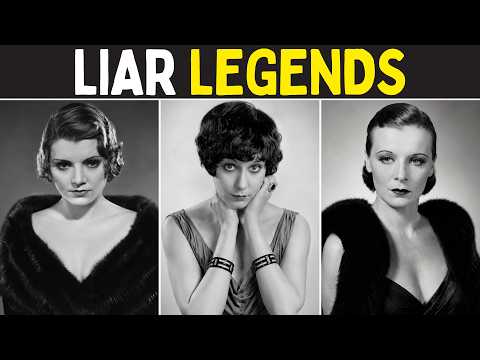
Take Rita La Roy. Born Ena La Roy Stewart in rural Idaho, she was reborn as a sophisticated French beauty from Paris. The studio didn’t just give her a new birthplace—they gave her an entire persona, one that made her mysterious, fashionable, and far more marketable than a struggling American vaudeville performer. Audiences never imagined the real woman behind the accent; they saw only the continental elegance Hollywood sold them.
But La Roy was just the beginning. Peggy Shannon was presented as younger than her records indicated, a fresh replacement for Clara Bow. Three missing years might sound trivial today, but in an industry that measured youth with brutal precision, that small adjustment meant contracts, romantic roles, and the difference between being called a promising discovery or a fading opportunity.
Then there was Fifi D’Orsay, who reportedly invented an entire Parisian past during a single audition. “I came from Paris and performed at the Folies Bergère,” she claimed—neither statement true. Yet the lie worked so well that audiences never questioned it. Her accent, her name, her flirtatious French persona—all of it was a performance that extended far beyond the screen.
Ann Miller added years to her age to circumvent child labor laws, landing a contract at RKO while still a teenager. Jeanette MacDonald’s sister helped her claim to be 13 instead of 17, making her seem like a prodigy. Danny Kaye shaved two years off his birth record and simplified his Jewish surname. Jean Arthur let her birth year drift, creating enough confusion to protect her privacy and her career.
And these were just the first few. From Greer Garson’s romanticized Irish roots to Maria Montez’s adjusted age, the pattern was clear: Hollywood didn’t hire performers—it designed them. Each fabrication served a purpose, whether to seem younger, more exotic, more aristocratic, or simply more sellable.
But the deeper we dig, the more dramatic the deceptions become. Some stars didn’t just change a date or a name—they erased entire families, cultures, and identities. And the consequences of those lies would follow them for the rest of their lives.
Mae West understood that arithmetic could be as important as dialogue. Born in 1893, she allowed publicity to move her birth year toward 1900, a revision that became essential once she entered motion pictures in her late thirties. Paramount needed audiences to marvel at her nerve, not count her years in vaudeville. West also kept an early marriage to Frank Wallace buried for decades, because a husband contradicted the independent woman she had written for herself.
Clara Bow faced a different kind of erasure. Publicity shaved her age and repackaged her as a carefree flapper, carefully separating the It Girl from a Brooklyn childhood marked by poverty and her mother’s severe mental illness. The playful figure on screen was a performance of happiness built on top of genuine hardship. When the same machine later turned on her, it used private details as ammunition.
Lillian Gish preserved a different illusion—permanent innocence. She was born in 1893, yet interviews often encouraged the belief that she had been almost a child when D.W. Griffith placed her in demanding roles. The uncertainty made her fragile heroines seem more miraculous. She had more than seventy years to polish her own legend, blending memory, family story, and studio publicity into one seamless account.
Katharine Hepburn’s false birthday came from grief rather than marketing. After discovering her brother Tom’s body as a teenager, she adopted his November 8th birthday as her own for years. Her real date was May 12th, 1907. Reporters repeated the November date until she finally corrected it in her autobiography. Not every invented past was designed by a publicity department—some were carried privately, out of pain.
Marlene Dietrich controlled mystery with the discipline of a director. She managed photographs, lighting, interviews, and even the recorded age of her daughter to protect her image as a timeless romantic figure. She also kept quiet about her sister Elizabeth, who had remained in Germany during the war. Dietrich’s anti-Nazi work was genuine and courageous, but she believed a legend required strict editing. Silence, she understood, could protect a reputation more effectively than any invented interview.
Joan Crawford’s transformation was total. Lucille LeSueur became Joan Crawford through a magazine contest, and MGM reshaped her voice, posture, clothing, and history until the new woman seemed to have existed from birth. Her birth year drifted across several dates. Crawford could appear vulnerable, aristocratic, or dangerously independent because no fixed biography confined her. The identity demanded constant maintenance, and Lucille had to disappear whenever the public was watching.
Jetta Goudal went further still. Born Julie Henriette Goudeket in Amsterdam in 1891, she presented herself as a Frenchwoman born at Versailles in 1901, complete with a fictional lawyer father. Country, age, ancestry, and parentage were all rewritten. Yet when Cecil B. DeMille ended her contract and called her difficult, Goudal sued him—and won. The woman who invented a father refused to let Hollywood invent the story of her failure.
Dona Drake’s disguise was a matter of survival. Born Eunice Westmoreland, the light-skinned Black performer was marketed as a Mexican woman of Mexican, Irish, and French descent. The fiction opened doors to musicals and adventures opposite major stars. Some stars changed their pasts because ordinary facts seemed boring; Drake changed hers because the truth had been made professionally dangerous.
Acquanetta became the Venezuelan Volcano, an orphan of Arapaho and English ancestry—stories that multiplied with each retelling. Later research connected her to Mildred Davenport of Pennsylvania, possibly a light-skinned Black woman whose background was rewritten for glamorous roles. Universal benefited from the uncertainty, casting her as jungle women and exotic beauties whose origins no audience could locate on a map.
Turhan Bey’s transformation was subtler but no less effective. Born Turhan Gilbert Selahattin Sahultavy in Vienna to a Turkish father and a Czech Jewish mother, he watched publicity reduce his multicultural European childhood to a single exotic word printed beneath his photograph. The respectful Turkish title “Bey” made him seem like a mysterious aristocrat, while fan magazines called him the Turkish delight. He played Arabs, Indians, Egyptians, and Chinese characters—whatever region a script required that week—but rarely anyone resembling his real self.
Pola Negri decorated her past until poverty looked like exile and theatrical training looked like inherited sophistication. Born Apolonia Chałupec in territory controlled by the Russian Empire, she was surrounded by suggestions of noble blood and royal connections. When talking pictures arrived, the accent and European identity that had made her fascinating became obstacles—the same constructed foreignness now treated as a reason to move on.
Rudolph Valentino’s reinvention was perhaps the most consequential. Before he became Hollywood’s greatest romantic fantasy, he was Rodolfo Guglielmi, an Italian immigrant dancing for wealthy clients in New York nightclubs. Publicity polished him into a cultured continental gentleman, then answered accusations of insufficient masculinity with stories about boxing and physical courage. He had to appear foreign enough to seem thrilling while remaining familiar enough to be accepted as a romantic hero.
Yul Brynner treated biography as improvisation. Depending on the interview, he claimed Swiss origins, Mongolian ancestry, Romani connections, and a dramatic childhood on Sakhalin Island. After shaving his head for The King and I, he became visually unforgettable—a man detached from ordinary geography and time. His son later tried to separate family history from the stories Brynner told reporters, but by then the inventions had become part of the attraction.
Carole Lombard learned early that age could be adjusted according to an employer’s needs—older when productions demanded it, younger when romance required it. Her name changed from Jane Peters to the more elegant Carole Lombard, and publicity minimized the automobile accident that scarred her face and nearly ended her career. The industry required a marketable age, name, and face; Lombard supplied all three, then used genuine comic intelligence to become far more memorable than the identity created for her.
Lana Turner’s discovery story was moved from the Top Hat Cafe to Schwab’s Pharmacy because the pharmacy had become a symbol of Hollywood opportunity. The invented pharmacy became more famous than the real place where her future actually changed. Born Julia Jean Turner, she was promoted as the sweater girl—a label she disliked because it reduced her ambitions to her appearance.
Marilyn Monroe’s studio biography described an orphan discovered almost by accident, erasing a mother who experienced serious mental illness and a childhood spent moving through foster homes and an orphanage. Monroe sometimes repeated false statements about her parents because she feared the truth would invite aggressive reporting and public shame. The tragedy was that the fictional orphan eventually overshadowed the thoughtful survivor who built the character.
Loretta Young’s deception was the most elaborate of all. During the filming of The Call of the Wild, she became pregnant with Clark Gable’s child. She disappeared from public view, secretly gave birth to a daughter named Judith, then placed the child briefly in an orphanage so she could publicly adopt her. This was not a changed birthday or invented hometown—Hollywood’s morality system encouraged a woman to reorganize her family so audiences would continue believing the saintly image printed in magazines.
Hedy Lamarr’s escape from her first husband became a legend of hidden jewelry and a maid’s disguise, but biographers questioned the theatrics. MGM renamed Hedwig Kiesler and marketed her as a silent European mystery, concealing both her Jewish background and her inventive mind. Her frequency-hopping concept was real, yet Hollywood found the beautiful fugitive easier to sell than the technically imaginative woman.
Errol Flynn expanded real adventures into lost action films, and W.C. Fields deepened his childhood poverty with each retelling until the cynicism seemed earned. George Raft let audiences believe he had nearly been a gangster, though his strongest early talent was dancing. Raft became trapped by the identity that made him famous—the invented criminal past opened Hollywood’s door, then narrowed the range of futures available after he entered.
John Wayne was born Marion Morrison in Iowa, not on an open frontier. Kirk Douglas became Kirk from Issur Danielovitch, softening the immigrant story. Tony Curtis replaced Bernard Schwartz, and Boris Karloff replaced William Pratt because a monster needed a more frightening birthplace than London.
Laurence Harvey buried Zvi Skikne beneath polished English control. Cary Grant was Archie Leach, a frightened Bristol boy who studied elegance until it looked inherited. “Everyone wanted to be Cary Grant,” he joked, “including myself.” Rock Hudson was Roy Scherer, rebuilt by an agent and protected by a marriage that quieted rumors.
Rita Hayworth’s hairline was raised by electrolysis so Margarita Cansino could become an all-American beauty. “Men became interested in Gilda,” she said, “but discovered they were living with Rita.” Theda Bara was transformed into a woman born in the shadow of the Sphinx. And Merle Oberon, born Estelle Merle Thompson in Bombay, maintained a Tasmanian origin story until after her death.
Forty stars. Forty manufactured pasts. Some changed a single date; others erased families, cultures, and entire identities. Their talent was genuine, but the biographies sold beside their films often were not.
Which transformation surprised you most—and does knowing the truth change how you watch their films today? Tell us in the comments below.
Report this article
Select a reason for reporting:






