September 1939. As Europe hurtled toward war, South Africa stood at a crossroads that would define its place in history. Prime Minister J.B.M. Hertzog demanded neutrality, but his rival Jan Smuts fought fiercely for loyalty to Britain. Parliament sided with Smuts, and on September 6, South Africa declared war on Germany. It was a decision that split the nation—and set the stage for an extraordinary military saga.
Smuts faced an uphill battle. The Union Defence Force was tiny and ill-prepared, with only about 5,000 regular troops and 15,000 reservists. Afrikaner nationalism ran deep, with many hostile to Britain and some sympathetic to Germany. To avoid a political crisis, Smuts made service voluntary rather than compulsory. Yet despite this limitation, over 330,000 South Africans eventually volunteered—a remarkable response for a nation of just 11 million.
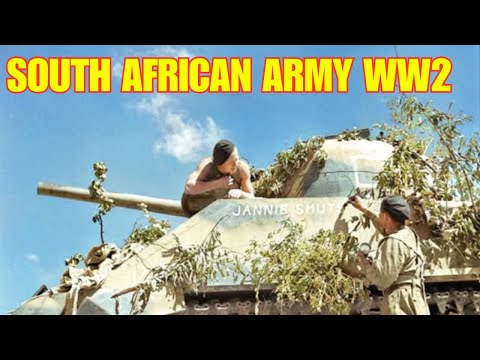
The army that emerged reflected South Africa’s divided society. Most combat troops came from the white population, with English-speaking South Africans forming the majority of volunteers, while many Afrikaners were reluctant to serve. Those who did tended to be younger men from urban areas or families with ties to Britain. Enlistment standards were loose—recruits had to be between 18 and 40, at least 5’2″ tall, and with a minimum chest measurement of 33 inches. But physical fitness was hammered home relentlessly, because these men would fight in some of the harshest climates of the war.
Training was brutal. Long-distance route marches under the blazing sun, weapons drills, bayonet practice, and fieldcraft filled the days. Armored and artillery units emphasized technical skill as much as toughness, with mechanics, drivers, and gunners receiving specialized instruction—often overseen by British instructors. Infantrymen drilled relentlessly in desert warfare, practicing mobile column tactics designed for the sweeping maneuvers of North Africa. British support was crucial, supplying weapons, vehicles, and training infrastructure. Yet South African commanders rose to the challenge. Major General George Brink led the 1st South African Division, while Major General Dan Pienaar would become one of the army’s most respected battlefield leaders.
The army’s first real test came in East Africa, where Italian forces threatened Kenya and Sudan. Smuts dispatched the 1st South African Division under Brink. Operating in harsh terrain, South African troops fought in Ethiopia and Somaliland. At the Battle of El Wak in December 1940, South African soldiers achieved their first victory of the war, capturing the town from Italian forces. In 1941, during the Battle of Mega in Ethiopia, they overcame tough resistance to force a garrison of more than 3,000 Italians to surrender. These early victories demonstrated adaptability and determination. By mid-1941, Italian East Africa had collapsed, and South African units had proven themselves in the field.
But greater challenges awaited. After success in the Horn of Africa, South African forces moved into the Western Desert to face Rommel’s Afrika Korps. Here, the army’s greatest trial—and its deepest humiliation—would unfold.
In late 1941, during Operation Crusader, the 5th South African Brigade was heavily engaged near Sidi Rezegh. Rommel’s panzer divisions outflanked the brigade, overrunning its positions. Nearly half the brigade was destroyed, and South African losses were severe. The desert had drawn first blood—and it would not be the last.
Worse was to come at Tobruk. In June 1942, the 2nd South African Division under Major General Hendrik Klopper was tasked with defending the fortress. Rommel launched a sudden, concentrated assault. Within a single day, Tobruk fell and 33,000 men were captured—the majority of them South Africans. It was the largest capitulation in the country’s history and a humiliating blow to morale. Though the men of the division had fought bravely, the disaster was largely the result of poor planning at higher levels of British command. Still, the stigma lingered. The South African army was seen by some critics as unreliable, and Smuts had to rebuild confidence at home and abroad.
Redemption, however, was not long in coming. At the Second Battle of El Alamein in October 1942, the 1st South African Division under Major General Dan Pienaar held a critical sector of the front. For twelve days, they endured heavy shelling and repeated assaults, refusing to give ground. Their steadfastness allowed Montgomery’s Eighth Army to concentrate its armored thrusts elsewhere. Pienaar, known as “the soldier’s general,” earned a reputation for cautious but effective leadership. His men admired him for his refusal to waste lives needlessly, and his division’s solid performance at El Alamein helped erase the shadow of Tobruk.
By 1944, the South African Army had reorganized and expanded into an armored formation. The 6th South African Armored Division, under Major General Evered Poole, sailed to Italy and joined the US Fifth Army in its advance northward. The division fought at Monte Cassino, supporting Allied attacks in the Liri Valley. They then advanced through Tuscany, capturing Florence in August 1944. The liberation of the city earned the gratitude of the Italian people, who remembered the South Africans as disciplined and humane occupiers.
Later, in the brutal fighting along the Gothic Line, the division distinguished itself once again. Its blend of armor, motorized infantry, and artillery made it a versatile formation respected by both Allied and enemy commanders. By the end of the campaign, the 6th Armored had established itself as one of the Eighth Army’s most reliable units.
South African bravery did not go unnoticed. The highest award for gallantry, the Victoria Cross, was earned by Captain Gerard Ross Norton of the Kaffrarian Rifles, who led a daring assault on enemy positions in Italy in 1944, capturing multiple machine-gun posts. Another recipient was Sergeant Quentin Smythe, who won the Victoria Cross in North Africa in 1942 after taking command of his platoon under heavy fire, silencing enemy weapons and leading his men to success despite severe wounds. Countless others received Distinguished Service Orders, Military Crosses, and Military Medals. Their actions demonstrated that South African soldiers—whether in infantry trenches, armored vehicles, or support roles—could match the best of the Commonwealth.
But the story of South African arms in the Second World War extends beyond the desert and the Italian hills. It reaches into the skies, across the oceans, and deep into the logistics that sustained the Allied war machine. South Africans served in every branch, and their contributions often went unseen but never unfelt.
The South African Air Force (SAAF) was a formidable force in its own right. At its peak, it numbered some 35,000 personnel and operated more than 1,700 aircraft. SAAF squadrons flew with distinction in East Africa, North Africa, and Italy, and even in the skies over Europe. No. 1 Squadron SAAF, flying Hurricanes and later Spitfires, produced aces like Major John Frost, who downed numerous enemy aircraft in the Western Desert. The SAAF also played a crucial role in maritime patrol, hunting German U-boats in the waters around South Africa and beyond.
On the home front, South Africa’s ports and railways became vital arteries for the Allied war effort. The country’s strategic location at the southern tip of Africa made it an indispensable waypoint for convoys rounding the Cape. Durban and Cape Town became bustling hubs, repairing ships, refueling fleets, and providing rest for weary crews. South African dockworkers, engineers, and laborers toiled around the clock, often under the threat of enemy raiders.
Yet the war also deepened the fractures within South African society. While white volunteers fought abroad, black South Africans were largely restricted to non-combatant roles. The Native Military Corps (NMC) was formed in 1940, and thousands of black men served as stretcher-bearers, cooks, drivers, and guards. They endured the same dangers—bombings, disease, harsh conditions—but received lower pay and fewer privileges. Their contribution was essential, yet their sacrifice was often overlooked in the post-war narrative.
One such man was Job Maseko, a member of the NMC who served in North Africa. Captured at Tobruk, he was put to work by the Italians. In a remarkable act of sabotage, he fashioned a homemade bomb from a tin of gunpowder and placed it in the engine room of a German cargo ship. The ship exploded and sank. For his bravery, Maseko was awarded the Military Medal—one of the few black South Africans to receive such recognition.
As the war in Europe drew to a close, South African forces found themselves in the heart of the final battles. The 6th Armored Division pushed into the Po Valley in April 1945, helping to break the last German defensive lines in Italy. On May 2, 1945, German forces in Italy surrendered, and South African troops were among the first to enter the city of Milan. The war in Europe was over, but for South Africa, the reckoning had only begun.
The return home was bittersweet. White veterans were hailed as heroes, but black and coloured servicemen found their sacrifices quickly forgotten. The promises of a more equal society faded as the National Party rose to power and began to implement the policies that would become apartheid. Many veterans, both white and black, felt betrayed by a country that had asked for their blood but refused them their dignity.
Yet the legacy of South Africa’s Second World War service endured. It proved that a small nation, divided by politics and race, could still produce soldiers of world-class caliber. From the dunes of El Alamein to the rubble of Monte Cassino, South Africans had stood their ground. They had suffered, learned, and ultimately triumphed.
The question of how capable the South African Army was in World War II resists a simple answer. It began as a small, under-equipped force riven by political division, and it suffered humiliating losses at Sidi Rezegh and Tobruk. Yet it adapted, learned, and overcame—transforming itself into a professional armored formation respected on both sides of the line.
At El Alamein, Florence, and along the Gothic Line, South African soldiers proved themselves disciplined, courageous, and skilled. For a nation of just 11 million, the contribution was extraordinary: over 300,000 volunteers, thousands who never returned, and two Victoria Crosses earned in the field.
Their service ensured that the Union of South Africa—small in size and divided at home—left a lasting mark on the greatest conflict in human history. The desert and the Italian hills remember them still.
So, what do you think? How capable were the South Africans in World War II—and does their story deserve a larger place in the history books? Let me know in the comments below.
Report this article
Select a reason for reporting:






