In the shadowed ruins of war, where every breath could be your last, an unwritten code governed the deadliest marksmen. On both sides of the front, snipers adhered to a silent honor system—a list of targets forbidden by mutual understanding. They didn’t shoot soldiers while they were performing their natural needs. But this restraint wasn’t born of pity; it was a cold calculation to avoid inviting retaliatory fire.
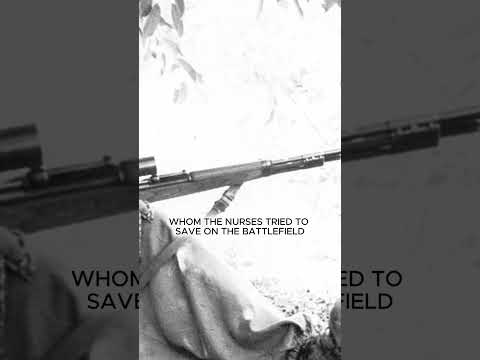
Even more surprising, shooting at nurses was highly discouraged. Even coldblooded snipers are human beings first and foremost, and some could not bring themselves to kill a pretty nurse. Yet this informal rule didn’t extend to the wounded the nurses tried to save—those were still fair game.
Water carriers, too, were often spared. On sections of the front where water was scarce, opposing sides reached tacit agreements not to fire on those fetching water. Both the Red Army and the Germans understood perfectly well: if you shot an enemy water carrier, they would shoot yours in retaliation, and everyone would suffer.
These rules weren’t written in any manual, yet they were enforced by the ever-present threat of escalation. Snipers on both sides knew that breaking the code meant inviting chaos—and no one wanted that. But as the war dragged on, the lines between honor and survival blurred, and the code began to crack.
Winter brought a new commander to the German sector—a young Oberleutnant named Vogel, fresh from Berlin and eager to prove himself. He had studied the reports of sniper activity with growing contempt. “Honor among marksmen?” he sneered to his adjutant. “That is peasant superstition. We are here to kill the enemy, not to play gentleman’s games.”
Vogel ordered his snipers to target water carriers first. The effect was immediate and brutal. Within three days, two Red Army water details were shot down at the well near the collapsed mill. The Soviet side responded in kind, and soon no one could fetch water without crawling through mud under a hail of bullets.
Thirst became a weapon. Men on both sides began to suffer, their lips cracking, their tongues swelling. The tacit truce that had kept the wells safe for months was shattered by a single order from a man who had never spent a night in a forward trench.
It was then that the old hands decided to act. On the Soviet side, a sniper named Zaitsev—no relation to the famous one, but carrying the same stubbornness—studied the German lines through his scope for two days straight. He wasn’t looking for soldiers. He was looking for the man who had broken the code.
On the third morning, he found him. Vogel had made the mistake of inspecting the forward positions himself, standing tall in his crisp greatcoat, binoculars raised. Zaitsev’s crosshairs settled on the man’s chest, but he didn’t fire. Not yet. He waited until the Oberleutnant turned, presenting his profile against the pale sky—and then squeezed the trigger.
The shot echoed across the valley. Vogel crumpled without a sound. For a long moment, the front was silent, as if the war itself had paused to acknowledge what had just happened.
That evening, a strange thing occurred. A German soldier crawled out of his trench waving a white rag, and a Soviet soldier met him halfway across no man’s land. They exchanged no words. The German simply pointed toward the well, then toward the sky, and the Soviet soldier nodded. The code had been restored—not by treaty, but by a bullet aimed at the one man who had forgotten it.
But Vogel’s replacement arrived within the week, and he was not a man who believed in old superstitions either. The wells remained dangerous, the nurses stayed hidden, and the snipers on both sides settled into a colder, more ruthless rhythm. The unwritten rules had survived one test—but the war, it seemed, had many more to offer.
The new man was called Hauptmann Reiner, and he was no eager boy from Berlin. He had spent two years on the Eastern Front, and he understood the front’s silent economy better than Vogel ever had. But where Vogel had been reckless, Reiner was methodical—and far more dangerous.
He didn’t order the water carriers shot. Instead, he had his engineers map every well and spring within a kilometer of the line, then zeroed his mortars on each one. “Let them come for water,” he told his gunners. “We won’t waste bullets. We’ll wait until they gather, and then we’ll drop the whole lot on them at once.”
The first barrage caught eleven men at the mill well. The Soviets, believing the code still held, had come in a loose, trusting cluster. Only three crawled back.
Zaitsev heard the news in the dugout and said nothing for a long while. He cleaned his rifle, oiled the bolt, and stared at the map pinned to the plank wall. The old rules had been broken by a bullet once, and restored by one. But this—this was different. Reiner wasn’t breaking the code out of arrogance. He was breaking it because it worked.
That night, Zaitsev did something no sniper on that front had done before. He crawled across no man’s land alone, carrying no rifle—only a folded note wrapped in oilcloth and a tin of American cigarettes, the kind the Germans prized. He left them at the base of a shattered birch tree, the agreed neutral point where the two sides had once traded tobacco and news.
The note was written in clumsy German, learned from a prisoner years ago: “Your captain kills the thirsty. We know his name. We know his habits. Do you want a war of no rules? We can give you one. Or you can give us the man who made the mortars speak. You have three days.”
For two days, nothing happened. The front was quiet in that heavy, watchful way that always preceded something terrible. Zaitsev watched the German lines through his scope, counting the men who came and went from Reiner’s command post.
On the morning of the third day, a single shot rang out from the German side—not toward the Soviet lines, but deep within them. Then silence.
An hour later, a German soldier crawled out under a white rag and left a bundle at the birch tree. Inside was a pair of officer’s binoculars, still warm from a body, and a scrap of paper with two words scrawled on it: “It is done.”
Zaitsev retrieved the binoculars at dusk and turned them over in his hands. They were good glass, German-made, the kind an officer would never surrender willingly. He buried them at the base of the birch and said nothing to his commander. Some victories were not meant to be reported.
The mortars fell silent. Within a week, water details moved freely again, and the wells, though still watched, were no longer killing grounds. The old rhythm returned—cautious, watchful, but survivable. No one spoke of Reiner. His name simply vanished from the German rosters, as if he had never existed.
But the war had taught Zaitsev a harder lesson than any manual could. The code held only as long as both sides feared the cost of breaking it. It was not honor that kept men alive at the wells. It was the certainty of retaliation, the cold arithmetic of blood for blood.
One evening, a young sniper in his unit asked him about the rules—the ones the veterans whispered about. Zaitsev considered the question for a long moment, watching the light fade over no man’s land.
“There are no rules,” he said at last. “Only men who remember what happens when we forget them.”
He turned back to his scope and resumed his watch, counting the shadows along the German line. Somewhere across the valley, another marksman was doing the same, and for now, that was enough.
But the war would send more men like Vogel and Reiner—men who saw the code as weakness, not wisdom. And each time, the snipers would face the same choice: hold the line, or let it fall.
So tell me—if you were the one behind the scope, would you keep an unwritten code that your enemy might break at any moment?
Report this article
Select a reason for reporting:






