Imagine holding a piece of paper that can buy every barrel of oil on Earth. Not gold, not land, just ink on linen backed by nothing you can touch. That paper is the US dollar, and the system that makes it indispensable was built in secret by a refugee who once worked in a shaving brush factory. His name was Henry Kissinger.
This is the story of how Nixon destroyed the gold standard and Kissinger replaced it with something far more powerful: the petrodollar. A system so elegant and ruthless that it shaped every oil war since.
To understand what Kissinger did, you must first understand what Nixon destroyed. In 1944, the world gathered at Bretton Woods to design a financial order. Every currency pegged to the dollar, and the dollar pegged to gold at $35 an ounce. It was simple, stable, and it worked—for a while.
But running the world’s reserve currency creates a trap. To supply the world with dollars, America had to run deficits. The more dollars abroad, the less gold to back them. By the 1960s, the math was failing. Vietnam and the Great Society drained the Treasury. France demanded gold. De Gaulle called America’s privilege ‘exorbitant.’
On August 15, 1971, Nixon closed the gold window. The dollar was cut loose. Treasury Secretary John Connally told the world: ‘The dollar is our currency, but it’s your problem.’ But it was a problem. Inflation soared. Why hold dollars when they’re backed by nothing?
Enter Henry Kissinger. Born Heinz Alfred Kissinger in Bavaria, 1923, he fled the Nazis at 15. Thirteen relatives died in the Holocaust. He returned as a US soldier, interrogating the men who drove his family out. That experience taught him the fragility of civilization—and the need for stability at any cost.
By 1973, Kissinger was Nixon’s Secretary of State, a master of realpolitik. Then came the Yom Kippur War. Egypt and Syria attacked Israel. Nixon airlifted weapons to Israel. OPEC retaliated with an oil embargo. Oil prices quadrupled. Gas lines stretched for blocks. The American economy reeled.
Kissinger saw an opportunity. The dollar needed a new anchor. What if oil—the lifeblood of every industrial economy—could only be bought with dollars? Then every nation would need dollar reserves. The dollar would be backed by energy itself.
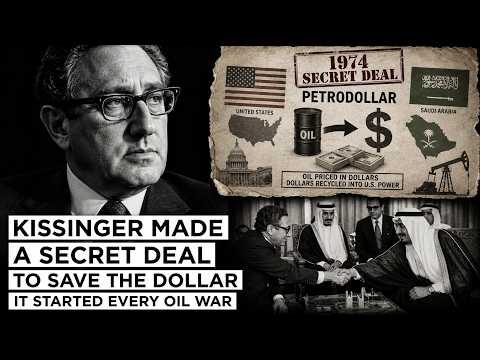
In June 1974, Kissinger flew to Riyadh with Treasury Secretary William Simon. They met King Faisal and Finance Minister Abalkhail. No formal treaty, just a handshake. The US offered Saudi Arabia military protection and access to American markets. In return, Saudi oil would be sold only in dollars, and the surplus would be recycled into US Treasuries.
The deal was secret for 40 years. By 1975, all of OPEC priced oil in dollars. The petrodollar system was born. The dollar was no longer backed by gold—it was backed by the fact that the lights stay on.
This system gave America the power to run deficits, print money, and impose sanctions without firing a shot. But it also created a dark pattern: nations that challenged dollar oil pricing faced American hostility. Iraq switched to euros in 2000; invaded in 2003. Libya planned a gold dinar; Gaddafi killed in 2011.
Kissinger’s petrodollar survived for 50 years, but cracks are appearing. China, Russia, and BRICS are building alternatives. The Saudi-US agreement expired in 2024. The architecture is shifting.
What remains is the audacity: a currency stripped of gold, saved by oil, and the man who saw the world as a fragile order to be managed, not idealized. This is the story of how that order was built—and how it might unravel.
The unraveling, when it comes, will not announce itself with a single dramatic headline. It will look like a series of small technical decisions, each defensible on its own, each quietly eroding the gravitational field Kissinger built.
Consider what has already happened. In 2023, China and Brazil signed an agreement to settle trade in their own currencies. In 2024, the mBridge project—a multi-central-bank digital currency platform linking China, the UAE, Thailand, and Hong Kong—moved from pilot to minimum viable product. These are not symbolic gestures. They are plumbing. And plumbing, once installed, is very hard to remove.
The petrodollar’s deepest vulnerability was never military or even economic. It was psychological. The system worked because everyone believed everyone else would keep using dollars. That belief was self-fulfilling. But beliefs can shift, slowly at first, then all at once.
Watch the Gulf states closely. Saudi Arabia’s Vision 2030 is, in essence, a hedge against the post-oil world. Crown Prince Mohammed bin Salman has said publicly that the kingdom will price oil in whatever currency its customers prefer. That statement would have been unthinkable from King Faisal in 1974. It is now official policy.
What changed? The security guarantee that Kissinger offered is no longer seen as reliable. American retreat from the Middle East, the chaos of the post-Iraq era, the perception that Washington is distracted by great-power competition with China—all of this has convinced Riyadh that it needs options. And options mean alternatives to the dollar.
The Chinese have been patient. They have not demanded that Saudi Arabia abandon the dollar. They have simply built the infrastructure—the yuan-denominated oil futures contract in Shanghai, the bilateral currency swaps, the digital payment rails—that makes the alternative possible. They are not tearing down the old house. They are building a new one next door.
Kissinger understood this game better than anyone. In his final years, he warned repeatedly that the United States could not treat dollar hegemony as a permanent entitlement. He told interviewers that the post-war order was eroding and that American leaders needed to adapt. He was, in effect, warning about the system he himself had built.
There is a final irony here. The petrodollar was designed to solve a crisis of confidence. It worked so well that it bred complacency. For fifty years, American policymakers could run deficits, fight wars, and print money without consequence, because the world had no alternative. That complacency is now the system’s greatest liability.
The question is not whether the dollar will remain dominant. It probably will, for years, perhaps decades. The question is whether the United States will recognize, before it is too late, that the system Kissinger built required constant maintenance—constant attention to the interests of the nations that sustained it. Kissinger never forgot that. His successors largely did.
The petrodollar was never a machine that ran itself. It was a bargain, renewed every day, between America and the world. And bargains, unlike gold, must be tended.
That is the part of the story that rarely gets told. We remember the deal, the handshake, the secret cables declassified four decades later. What we forget is that the system required a second act—a continuous, grinding diplomatic campaign to keep the bargain alive as the world around it changed.
Because the petrodollar was never self-enforcing. It was a set of incentives that had to be renewed, reinforced, and defended against every shock that threatened to break the cycle. And Kissinger, for the rest of his tenure, was its chief mechanic.
Consider the sheer scale of what had to be managed. Between 1974 and 1977, Kissinger shuttled between capitals at a pace that would exhaust a man half his age. He was negotiating disengagement agreements between Israel and its neighbors, managing the fallout from the Lebanese civil war, and keeping the Saudis and the Iranians—then still allies under the Shah—from tearing each other apart. Every one of these crises had a dollar dimension.
Because instability in the oil-producing regions was the single greatest threat to the recycling mechanism. If the Gulf descended into war, if the House of Saud fell, if the Strait of Hormuz closed, the flow of petrodollars back into American Treasuries would stop. The dollar would lose its anchor. The whole architecture would crack.
Here is what most people miss about the petrodollar system. It was not just an agreement about oil pricing. It was a security architecture. The United States essentially became the guarantor of the Persian Gulf, and in exchange, the Gulf guaranteed the dollar’s primacy. American aircraft carriers in the Gulf were not just projecting power—they were protecting the plumbing of global finance.
This is why the Carter Doctrine of 1980 mattered so much. When President Carter declared that any attempt by an outside power to gain control of the Persian Gulf would be met with military force, he was not just responding to the Soviet invasion of Afghanistan. He was codifying the security guarantee that Kissinger had built into the petrodollar deal. The Gulf was now an American protectorate in all but name, and the dollar was the currency of that protectorate.
The costs of this arrangement were enormous, and they came due almost immediately. The Iranian Revolution of 1979 toppled the Shah—America’s other pillar in the Gulf—and brought to power a regime that was openly hostile to both Washington and the dollar system. The hostage crisis, the oil price spike that followed, the Soviet invasion of Afghanistan—all of it threatened to unravel the delicate balance Kissinger had constructed.
But the system held. Why? Because the Saudis, terrified of the revolution spreading across the Gulf, doubled down on their American partnership. Fear, as much as interest, kept the petrodollar alive through the darkest years of the late 1970s.
And then came the 1980s, and with them a new challenge: success. The high oil prices that had made petrodollar recycling so lucrative also triggered a massive global search for new energy sources. Conservation, alternative energy, new oil fields in the North Sea and Alaska—all of it came online. By 1986, oil prices had collapsed.
This was, in its own way, as dangerous as the 1973 spike. If oil prices fell too far, the petrodollar surpluses would shrink, and with them the flow of capital into American Treasuries. The recycling mechanism depended on high volumes of dollar-denominated oil revenue.
Kissinger, by then out of government, watched from the sidelines as the Reagan administration navigated this new terrain. The solution, when it came, was characteristically American: military presence in the Gulf was expanded, the dollar’s role in oil was reinforced through diplomatic pressure, and the Saudis were persuaded to keep pricing in dollars even as their revenues fell.
The system survived, but it was no longer a bargain between equals. It was becoming something closer to a dependency.
And that, perhaps, is the deepest irony of all. Kissinger had built the petrodollar as a mutually beneficial arrangement, a web of reciprocal interests so strong that neither side would want to break it. But over time, the relationship became asymmetrical. The United States needed the dollar’s primacy to sustain its deficits and its global military posture. The Saudis needed American security to survive in a dangerous neighborhood. Each needed the other, but not equally.
The Saudis, over time, came to understand this. And they began, quietly, to hedge.
That hedging has now become visible. In 2025, Saudi Arabia began accepting yuan for a portion of its oil sales to China. Not all. Not even most. But enough to signal that the bargain is being renegotiated.
The Chinese, meanwhile, have built something Kissinger would have recognized: not a rival currency, but a rival plumbing. The Shanghai oil futures contract, the digital yuan, the bilateral swaps—each one a small crack in the foundation.
What remains is the question Kissinger himself posed in his final years. Can a system built on managed power survive when the managers forget that power must be tended? He warned them. They did not listen.
The petrodollar is not dead. It may outlive us all. But the era of unquestioned dollar hegemony—the era Kissinger built in a Riyadh summer—is ending. And what comes next is not yet written.
So here is the question for you: If you were advising the Saudi crown prince today, would you bet on the American security umbrella, or on the Chinese payment rails? Which system would you trust to keep the lights on?
Report this article
Select a reason for reporting: