On the afternoon of August 20, 1942, a man stumbled out of the jungle on the northern coast of Guadalcanal and walked straight into a column of Japanese soldiers. His name was Jacob Vouza. He was nearly fifty, a Solomon Islander who had spent over twenty years in the colonial police before retiring as a sergeant major. When the war reached the islands, his retirement was cut short—he became a scout for the Allies. When the U.S. Marines landed two weeks earlier, he began working for them. The soldiers searched him and found a small American flag hidden in his clothes. That was all they needed. They tied him to a tree and began asking questions. How many Americans were waiting to the west? Where were their weapons? Where was their defense line? Vouza said nothing. They beat him with rifle butts. He said nothing. Then they used bayonets. They stabbed him in the chest and throat, kept questioning him, but he kept his silence. Finally, they left him slumped against the ropes, drenched in blood, and moved on. To them, he was as good as dead.
But he didn’t die. After nightfall, Vouza managed to chew through the ropes. Then, bleeding from wounds that should have killed him, he began crawling west toward the Americans through the same jungle the Japanese were moving in. He was in a race against time, and he knew it. He didn’t know exactly how many men were behind him. He only knew they were many, they were close, and they would arrive that night. When he finally reached the Marine positions along a slow stream near the beach, he could barely speak. He managed to deliver his warning to the officers there. Then, certain of his imminent death, he asked one of them to write a last message to his wife.
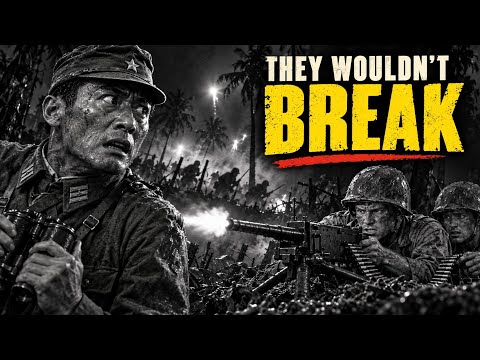
Shortly after, the darkness on the other side of that stream filled with soldiers. What was about to happen at that stream had been repeated again and again over the eight months since Pearl Harbor. A Japanese force encircles in the dead of night. It strikes a defensive line in the late hours, when the defenders are at their most exhausted and fearful, and the line collapses. It happened to British and Indian troops, to Australians and Canadians, to Americans and Filipinos. It happened in concrete forts, in rubber plantations, and on the shore of a strait that was supposed to protect the most important naval base in Asia. But at that stream, it didn’t happen. And throughout the island battles that followed, Japanese night attacks never did to the Marines what they did to others. This is the story of why. The real answer is stranger and simpler than most people expect. And the man tied to that tree turned out to be part of the story more than he seemed.
To understand what the Marines truly faced, we have to go back to the early days of the war, to a hill above Hong Kong. In December 1941, the British defense of Hong Kong relied on a series of trenches, forts, and tunnels known as the Gin Drinkers Line. Near its western end lay Shing Mun Redoubt, a cluster of concrete positions connected by underground passages. The defenders hoped the line would hold for days, maybe weeks. On the night of December 9, the Japanese regimental commander, Colonel Doi Teichi, studied the redoubt and decided its garrison was weak. He sent his men to attack without waiting for orders. They crept through the darkness, tossed grenades into ventilation shafts, and cut their way through the tunnels. By morning, the redoubt was in their hands. Within days, the entire line was abandoned. The defenders retreated across the harbor to Hong Kong Island, and on Christmas Day, the colony surrendered. One night, one hill, and the whole line was lost.
A month later, in Malaya, it happened again. This time, the attack was armored. In the early hours of January 7, 1942, a Japanese tank officer, Major Shimada Toyosaku, led a small column of tanks and infantry straight up the main road toward the Slim River. Two brigades of the 11th Indian Division were positioned deep along that road. Theoretically, any force advancing there should have been stopped several times over. But Shimada sliced right through. His tanks rolled past positions where the defenders didn’t realize what they were hearing until it was on top of them. They destroyed vehicles parked along the sides, scattered troops still in their camps, and kept going. For miles, until they reached the Slim River bridge and captured it intact. Behind them, two divisions had simply dissolved. Thousands of men were killed, captured, or lost in the jungle. Shimada’s casualties were negligible by comparison.
Then came Singapore. On the night of February 8, 1942, Japanese assault troops crossed the Johor Strait in small boats and landed on the northwestern coast of the island. That sector was held by the Australian 22nd Brigade, about 3,000 men spread thinly across miles of mangrove swamp and tidal creeks. Many of the beach searchlights didn’t work. Shelling had cut the telephone lines, so calls for artillery went unanswered or came too late. The Australians fought fiercely, but throughout the night, small groups of Japanese infiltrated between their positions, and by dawn, the northwest had fallen. A week later, Lieutenant General Arthur Percival surrendered Singapore. Some 80,000 British, Indian, and Australian troops went into captivity. It was the largest surrender of British-led forces in history.
If you put those three nights side by side, a pattern emerges. It had little to do with numbers or rifles or even courage. The Imperial Japanese Army had treated darkness as a weapon since its war with Russia in 1904, when night attacks helped it defeat a great European power. Its units trained in silent approach, night marches, and bayonet assaults in pitch darkness until they could do it half-asleep. The logic was cold and practical. Japan couldn’t match Western armies in artillery, trucks, or ammunition, and night erased those advantages. In the dark, artillery can’t see its target, and a gunner who outnumbers you doesn’t know if he’s facing ten men or a thousand.
But the real target of a Japanese night attack was never the trench. It was the mind of the man inside it. Imagine a trench in Malaya at two in the morning. You’ve been retreating for weeks. You haven’t slept well in days. The jungle drips and rustles around you. Somewhere ahead, there’s a sound that might be a man or an animal. The soldier to your left fires. Someone else fires farther off. Then you hear shooting behind you. Shooting behind you means one thing. You’ve been cut off. Here’s what matters more. Nearly every army in 1941 trained its men to face that moment the same way. If the enemy is behind you, your position is surrounded. A surrounded position can’t hold, so you fall back to form a new line. In Europe, with its roads and open flanks and hills to retreat to, that was sound military logic. In Malaya, it was a trap they set for themselves.
The Japanese didn’t need to defeat a British battalion. They only needed to get a few dozen men behind it, on the road it used, and make enough noise to convince it that the position was lost. The defenders did the rest. They withdrew in the dark, lost contact with each other, fired on their own men, left trucks jammed on the road, and reached the next line fewer in number, more tired, and more frightened than before. Then it started all over again. The Japanese weren’t really winning battles. They were winning arguments. That argument every frightened soldier has with himself in the dark about whether it’s time to leave.
Now, return to Guadalcanal. On August 7, 1942, the 1st Marine Division landed on the island’s northern coast and seized a nearly completed Japanese airfield, which they named Henderson Field. Before dawn on August 9, a Japanese cruiser force surprised Allied warships off Savo Island and sank or crippled four heavy cruisers in less than an hour. The transport ships sailed away, and most of the Marines’ food, ammunition, and heavy equipment were still in their holds. The Marines were on their own. About 11,000 men on Guadalcanal, living on captured Japanese rice and holding a tight perimeter around the airfield with the sea at their backs.
At the 17th Army headquarters in Rabaul, the Japanese believed there were no more than 2,000 Americans. If the Americans were that few, a small, fast force could throw them into the sea before they could organize. The man chosen for this mission was Colonel Ichiki Kiyonao. Ichiki was a hard-driving infantry officer with an almost religious faith in the bayonet. Five years earlier, he had led Japanese troops at the Marco Polo Bridge, the clash that ignited Japan’s full-scale war with China. His regiment had been selected to land at Midway, but when the carriers sank, that mission was lost with them. Now, destroyers landed the first echelon of his detachment, about 900 men, on the beach east of the Marine perimeter on the night of August 18. The rest were following on slower ships.
Ichiki had no intention of waiting. Against an enemy he had been told was small and panicked, 900 men attacking at night should have been more than enough. It always had been. But the Marines were already looking for him. On August 19, a patrol led by Captain Charles Brush bumped into a Japanese patrol near the coast and killed most of them. Searching the bodies, the Marines found things that chilled them. The dead were wearing clean, new uniforms. They carried maps with Marine positions marked in detail. They were not survivors of the old island garrison. They were fresh troops, and they were studying the Marine lines.
On the eastern edge of the perimeter, the Marines dug their defenses deeper. That edge ran along a stream the Marines called the Tenaru River. Their maps were wrong. It was actually the Ilu River, but the men who fought there remembered it by a better name: Alligator Creek. It was a slow, green stream inhabited by crocodiles, and near the beach, it didn’t reach the ocean at all. A sandbar dammed the mouth, and that sandbar was the only way across. The 2nd Battalion, 1st Marines held the west bank. They strung barbed wire across the approach, dug machine-gun pits on the bank, and aimed a 37mm gun to sweep the sandbar. It wasn’t loaded with armor-piercing shells, but with canister rounds, which burst on leaving the barrel into a spray of steel balls. And the men in those pits were given a simple order. Don’t shoot at sounds. Wait until you see something worth killing.
In the dark hours of August 21, shortly after Vouza stumbled into their lines, Ichiki’s men surged out of the coconut grove on the far bank and charged across the sandbar. They expected a nervous defense, early shots, then panic, then collapse. But what they met was patience. The Marines let them come until their men were tangled in the wire, then the west bank lit up from end to end. There were three men in one machine-gun pit covering the sandbar. Corporal LeRoy Diamond, Private First Class Johnny Rivers, and Private Al Schmidt. Rivers was on the gun when the attack began, and he kept firing until a bullet killed him where he stood. Schmidt pulled his body aside and took his place. Diamond was hit in the arm, but stayed in the pit, calling out targets. All night, their gun hammered the sandbar and the water around it. Then a grenade burst inside the pit. Schmidt’s face was shredded by fragments, and he was blinded. The gun kept firing anyway. Diamond told him where to aim, and Schmidt, unable to see anything, squeezed the trigger.
Ichiki tried again. With the sandbar littered with his dead, he sent men wading into the surf to flank around the stream’s mouth and land behind the Marines. They were shot in the water. The line didn’t move. Daylight revealed the sand in front of Schmidt’s gun covered with bodies. Then the Marines went over to the attack. The 1st Battalion, 1st Marines crossed the stream upstream and swung behind the survivors, trapping them in the coconut grove between the stream and the sea. That evening, a platoon of light tanks advanced across the sandbar toward the grove, firing and crushing everything in their path. General Alexander Vandegrift later described the state of those tank tracks in words that are still hard to read. By evening, it was over. About 800 of Ichiki’s men lay dead. The Marines had lost fewer than 50. Ichiki died there too. Though how he died is still debated. Some accounts say he fell in the fighting. Others say he burned his regimental colors and took his own life.
But Al Schmidt lived. He returned home almost completely blind, and in 1945, Hollywood made a movie about him. That is a large part of why his name is remembered. Someone happened to point a camera at his story. Most of the men in those pits never had a camera pointed at them. There were thousands of nights like that one in this war, in places no one filmed, and most of what happened in them was never told at all.
The Marines who walked out to that sandbar afterward found the Japanese dead piled up, many of them right at the wire. The attackers had come certain that this line would behave like every other line they had faced. But it didn’t. And it’s worth pausing to understand why, because it’s tempting to say the Marines were simply tougher men. That answer flatters the Marines, insults the others, and misses what actually happened. Let’s start with three rules a Marine on Guadalcanal learned quickly. Usually from a sergeant, and usually in language that can’t be repeated here.
Rule one. Once the sun goes down, you don’t leave your hole. Not to stretch your legs, not to check on a buddy, not to get water, not for anything. Which means anything moving above ground after dark is, by definition, the enemy. It was a hard rule, and it cost the Americans lives now and then. But it left no room for infiltrators to hide. A Japanese soldier slipping through the lines couldn’t impersonate a Marine on an errand, because Marines didn’t run errands at night.
Rule two, don’t shoot at noise. A rifle flash in the dark is a signpost. Fire at a sound, and you’ve just drawn the enemy a map to your hole. So you waited until you saw what you were shooting at. The Japanese understood this perfectly and worked hard to break it. At night they would call out in English, pretending to be wounded men calling for a corpsman, or shouting insults, anything to provoke a reply or a shot. The Marines learned to stay silent and let the sounds fade around them. And when they challenged a figure in the dark, they used passwords full of the letter L. Words like lollapalooza, because Japanese speakers stumbled over them.
Rule three: the planning for the killing was done in daylight. Before dark, machine guns were fixed so their bullets swept the approaches at knee height along fixed lines that interlocked with the guns on either side. Mortars and artillery were registered precisely on the ground an attacker would have to cross. When the attack came, the gunner didn’t need to see his enemy. He only had to fire where he had decided, hours before, that the enemy would be. There was nothing mysterious about any of it. Versions of these three rules exist in the manuals of half the world’s armies. So why did the Marines actually follow them in the dark while men were screaming toward them?
Part of the answer lies in where their leaders had served. Many of the officers and senior NCOs on Guadalcanal had spent the 1920s and 1930s chasing rebels through the jungles of Nicaragua and Haiti. Merritt Edson had led boat patrols deep up the Coco River in Nicaragua. Lewis Puller had spent years there leading Nicaraguan troops through ambush country, and came home with two Navy Crosses. The Marine Corps had even distilled those lessons into a book called the Small Wars Manual. These men had been shot at in the dark before. The jungle didn’t frighten them the way it frightened soldiers trained on the open plains of Europe.
The other part was the sea. In Malaya, there was always a road south and another line to fall back to. The instinct to withdraw when cut off made sense because there was somewhere to go. On Guadalcanal, there was nowhere. The perimeter was a ring a few miles across, with the airfield at its center and the ocean behind it. The Navy had left. A Marine company that withdrew wasn’t falling back to a new line. It was falling back toward the airstrip, the hospital, and the ammunition dumps—the very reason they were there. So on Guadalcanal, the old question—what do you do when the enemy gets behind you?—got a different answer. You stay put. A hostile soldier behind your hole is not a reason to leave it. He’s a target for the men behind you. And when the sun comes up, he’s a target for you, too.
For eight months, the Japanese had perfected a method for making men leave. On Guadalcanal, they met men who had nowhere to go, and who had stopped wanting to. In Rabaul, the destruction of Ichiki’s unit was hard to accept. The conclusion at headquarters was not that the method had failed. It was that Ichiki had been reckless and had brought too few men. The cure, in their view, was more men and a better plan.
The next attempt fell to Major General Kawaguchi Kiyotake and a brigade of about 6,000 men, most of them ferried in at night by destroyer convoys the Americans called the Tokyo Express. Kawaguchi knew what had happened at the stream, and he had no desire to go near the beach. His plan was to disappear his main force into the rainforest, hack a trail inland, and strike the airfield from the south, through jungle the Americans had barely explored.
But the Marines struck first. On September 8, a battalion of Edson’s Raiders landed behind Kawaguchi’s force at Tasimboko, where his supply base lay lightly guarded. The raiders destroyed his stores and artillery and captured documents indicating a large force moving through the jungle toward the airfield. Edson returned convinced he knew where the blow would fall. A few days later, his battalion was moved to a long grassy ridge about a mile south of the airfield, partly to get them away from the daily shelling. The ridge lay directly in Kawaguchi’s path.
Edson’s men dug in, strung the barbed wire they had, and marked their fields of fire, while the 11th Marines’ artillery registered its guns on the jungle below. Meanwhile, Kawaguchi’s march was falling apart. The jungle swallowed his timetable. Units lost contact, got lost, and arrived late and exhausted. On the night of September 12, he attacked piecemeal. The attack pushed the raiders back near the Lunga River but didn’t break them. The next day, Edson pulled his line back to higher, firmer ground and waited.
The real attack came the following night, September 13. Japanese soldiers climbed the slopes in wave after wave, screaming as they came. In places, the Marine line bent backward until it curved around the last hill before the airfield. Edson ran the fight from that hill by field telephone, calling artillery fire in closer and closer to his own men. The 11th Marines’ howitzers fired all night, their shells landing so near the Marine trenches that the attackers were shaken by their own guns. When parts of the line began to give, Edson and his officers re-formed them. One company commander, Major Kenneth Bailey, moved along the line for hours, driving men back into their holes. A handful of Japanese got past the ridge, and a few even reached the edge of the division command post before they were killed. But the line on the ridge held.
By dawn on September 14, Kawaguchi’s brigade was finished as an attacking force, hundreds of dead scattered on the slopes. Both Edson and Bailey received the Medal of Honor. Bailey didn’t live to see it. He was killed less than two weeks later. The remnants of Kawaguchi’s force staggered west through the forest, carrying their wounded with almost no food. Many of them didn’t make it. Before long, Japanese soldiers gave Guadalcanal a bitter nickname, Gato. It was a play on the island’s name and it meant “Starvation Island.”
The third attempt was the largest. In October, the Japanese brought in the 2nd Division, the Sendai, one of the proudest formations in their army, under Lieutenant General Maruyama Masao. Tanks and artillery were to pin the Marines along the coast to the west, while the main force slipped inland and swung south to strike near the ridge where Kawaguchi had failed. Japanese engineers hacked a trail through the rainforest for them, later known as the Maruyama Road. It was a nightmare. Soldiers carried artillery shells on their backs on top of their own loads. Heavy guns were left in the mud. Rain fell without stopping. The attack date slipped again and again. And somewhere along that road, the Japanese Army made a decision that sums up much of this story better than any battle.
Kawaguchi was there, commanding a wing of the attack. He had stood beneath that ridge before. He knew what was waiting on top of it. He asked to turn his wing east, where he believed the American lines were weaker. Maruyama relieved him of command. The Japanese commander who knew the Marine lines best tried to act on what he had learned, and was removed.
On the night of October 24, in heavy rain, the Sendai Division struck the southern edge of the perimeter. The sector they hit was held by the 1st Battalion, 7th Marines, commanded by Lieutenant Colonel Lewis Puller, the same “Chesty” Puller who had learned his trade in the jungles of Nicaragua. His battalion was stretched over 2,000 yards of front by itself because the unit next to it had been pulled west. Among Puller’s men was a machine-gun sergeant named John Basilone. He had served earlier in the Army, most of it in the Philippines, and had come away with a nickname that stuck for life, “Manila John.” In 1940, he enlisted again, this time in the Marines, supposedly because he figured they’d get him back to Manila faster.
That night, he was in charge of two sections of heavy water-cooled machine guns on Puller’s line. The Japanese came out of the rain in wave after wave. In front of Basilone’s guns, men charged the wire and fell, and more came behind them. One of his gun sections was knocked out, its crew killed until only two men were left fighting. Basilone dragged a spare gun into position and kept it firing. He found another gun that had jammed, fixed it, and ran it himself. When ammunition ran low and the supply line was cut, he carried ammo himself, crawling through the dark back and forth, passing Japanese soldiers inside the line, bent under the weight.
Meanwhile, Puller needed men. From the rear came the 3rd Battalion, 164th Infantry, an Army National Guard unit from North Dakota that had been on the island less than two weeks. They made their way through mud and rain in pitch darkness. There was no time to assign them a sector, so Marine guides led them in small groups and fed them into the infantry holes, a few men at a time, alongside men they had never met. Many of them carried the new M1 Garand, which the Marines, still armed with bolt-action Springfields, eyed with open envy. And the soldiers held exactly as the Marines did. They were in Marine holes, under Marine fire plans, and the Japanese attack broke on them just the same.
Consider that for a moment. Fresh troops from another service, dropped into the line at midnight, fought like veterans because the system around them told them what to do. Whatever the Marines had, it wasn’t in their blood. It was in their method. And method can be taught.
The Japanese came back the next night and were repulsed again. By October 26, the offensive was over. One of Maruyama’s generals was dead, along with more than 2,000 of his men. American losses were a fraction of that. John Basilone would be awarded the Medal of Honor.
Then, as after every battle, came the writing and the recording. On the Japanese side, some of what was written was fiction. In the middle of that first night, a signal went out declaring that Henderson Field had been captured. The signal was passed up the chain, prompting ships and aircraft to move on a victory that never happened. The correction came later, and quietly. On the American side, the writing was clearer. Each Marine company kept a roster. And each month, the clerk recorded each name. Beside some of those names, a few words. Wounded in action, killed in action. Those records still exist.
At home, the news arrived as a telegram from a place most families had never heard of until that year. Army records faced a harder fate. In 1973, a fire at the National Personnel Records Center in St. Louis destroyed millions of service files, including about 80% of Army personnel records for men discharged between 1912 and 1960. For many of the North Dakota men who stood in those Marine holes, the official record of their service no longer exists. Which means that somewhere tonight, there is a family with a name, a photograph of a young man in uniform, and a box of things no one can explain. A patch of cloth, a ribbon, a scrap of silk covered in Japanese writing. That young man might be your grandfather. His war can still be reconstructed from those three things alone. And I’ve put together a guide showing you how. It’s called Find Your Grandfather’s War, and there’s a link waiting for you right below this video.
The paperwork of the Marines had another job, too. It taught the next battalion what the last battalion had learned the hard way. By the summer of 1944, the night defenses of the Marines were close to a science. On Guam, on the night of July 25, Marines dug in across the neck of the Orote Peninsula heard a strange noise drifting from the Japanese side. Shouting, singing, laughter, the clinking and smashing of bottles. The garrison was drinking its way toward a mass attack. The Marines had hours to listen and prepare. When the Japanese finally came out of the mangroves, the artillery was already registered on the ground they had to cross, and the attack was shattered almost before it began.
The Marines weren’t the only ones learning. In Burma, the British and Indian Army, driven out of the country in 1942, rebuilt itself around the same hard idea. In February 1944, when the Japanese got behind the 7th Indian Division and surrounded its rear areas, the men inside didn’t withdraw. They stayed in place, were supplied by parachute, and beat off attacks night after night. The “Admin Box” held. It had taken the British two years and a thousand miles of retreat to reach the lesson the Marines learned at a stream two weeks after landing on Guadalcanal.
The Japanese changed in the end. After Saipan in July 1944, where thousands of their soldiers died in a final mass attack, Tokyo began telling island commanders to stop sacrificing men that way. At Peleliu that fall and Iwo Jima the following February, the defenders dug deep into the rock, largely abandoned the old mass attacks, and made the Americans come to them. It was the hardest compliment the Marines ever received. As long as the Japanese kept charging the wire at night, they were fighting a battle the Marines had learned how to win. When they stopped, the killing got worse. Nearly 7,000 Americans died taking Iwo Jima. One of them was John Basilone.
After Guadalcanal, the Corps made him famous. His hometown of Raritan, New Jersey, threw him a parade, and he toured the country selling war bonds. He could have sat out the rest of the war. He didn’t want to. He went back to the Pacific with a new division, and on February 19, 1945, the first day on Iwo Jima, he was killed near the first airfield on the island. He was twenty-eight years old, and had been married less than eight months. The man who helped break the Japanese night attack at its height died on the island where the Japanese finally learned to stop charging.
As for Jacob Vouza, the man who crawled into the Marine lines with bayonet wounds in his throat and chest and asked one of them to write down his last words to his wife, he didn’t die. Surgeons treated his wounds, and within weeks he was back in the jungle scouting for the Americans again. He later led a battalion of Marine raiders on a month-long patrol behind Japanese lines. He was awarded the Silver Star, and decades later he was knighted. Sir Jacob Vouza died in the Solomon Islands in 1984.
Think about what the Japanese needed from him on that tree. They needed a reply. It’s the same thing their night attacks had always needed. A bullet fired at a noise. A voice shouting back in the dark. A step backward out of the hole. Every army they had faced had given them a reply. Vouza gave them nothing. A few hours later on the other side of that stream, the Marines didn’t either. Take away the wire and the rifles and the maps, and this is what’s left. The dark only works on men who answer it. And the Marines had learned not to.
That was the lesson of the stream, and it did not stay there. It traveled—into manuals, into the training of the battalions that came after, into the way a young lieutenant would one day tell his men to hold their fire and let the sounds die.
Vouza never knew what his silence set in motion. He only knew that on a certain night, he had refused to answer, and that refusal had been enough.
The Japanese needed a reply. They always had. And at the stream, they received none.
So here is the question that remains, the one that outlasted the war itself: when the darkness comes for you—when the sounds close in and every instinct screams to answer—will you give it the reply it is waiting for? Tell us in the comments below.
Report this article
Select a reason for reporting:






