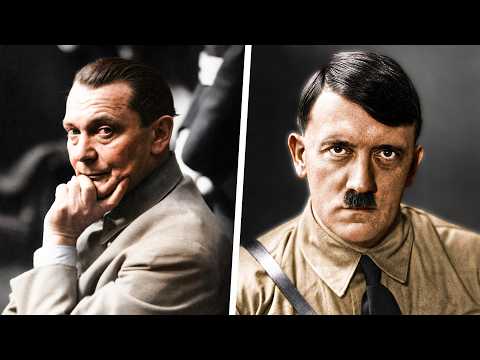
He swore an oath to follow Adolf Hitler unto death. He was named Hitler’s official successor, the second most powerful man in the Reich. And yet, in a prison cell at Nuremberg, Hermann Göring pulled out a private notebook full of jokes he had collected over the years—jokes that mocked his own vanity and jokes that mocked the Führer himself.
This was a man who told his American captors that there were, in truth, two different Hitlers. So what did Göring, the loyal paladin, actually think about the man he had followed into ruin? The answer is stranger and colder than the propaganda ever let on.
In November 1922, a decorated war hero walked into a Munich beer hall and had his entire life redirected in the space of one speech. Hermann Göring was already famous. He had been a fighter ace in the First World War, the final commander of the legendary squadron once led by the Red Baron—a man with medals, aristocratic connections, and a certain reckless glamour.
Then he heard Hitler speak, and something in him clicked into place. He later described the experience as something close to falling in love at first sight. Politically speaking, a total surrender.
To understand why that speech hit so hard, you have to understand where Göring was in 1922. The war had ended four years earlier, and with it the only life he had ever been good at: in the air. He had been somebody—a celebrated ace decorated with Germany’s highest honors, a man who lived at the edge of death and loved it. On the ground in the humiliated, broke, directionless Germany of the early Weimar years, he was nobody.
He drifted. He had no cause and no stage. And then a failed painter with a hypnotic voice stood up in a beer hall and offered him both.
Hitler saw the value immediately. Here was a genuine war hero with money, social standing, and a name that opened doors. To a fringe party desperate for respectability, Göring was a gift. And Hitler said as much to those around him: “A wealthy man, a war hero—exactly the kind of propaganda the movement needed.”
From the very first, the relationship was built on usefulness. Each man had something the other wanted. Hitler needed Göring’s shine. Göring needed Hitler’s fire. Neither of them at that point was thinking about the other as a friend.
But it would be a mistake to imagine Göring as a wide-eyed true believer. The psychiatrist Douglas Kelley, who spent roughly eighty hours interviewing him after the war, came away convinced that Göring embraced Nazism to feed his own ambition. According to Kelley, his loyalty was never really about Hitler—and least of all about ideology or race. It was about power and what proximity to Hitler could deliver to Hermann Göring.
Keep that in mind, because it shadows everything that follows. And what it delivered was catastrophe.
Göring would go on to found the Gestapo, build and command the Luftwaffe, run the German war economy, and in July 1941 signed the order authorizing Reinhard Heydrich to prepare a plan for what the Nazis called the Final Solution—the administrative starting gun for the murder of Europe’s Jews. Whatever Göring privately felt about Hitler, that feeling helped power a machine that killed millions. The human cost is the whole reason his opinion is worth examining at all.
Their partnership was cemented not with a handshake but with a bullet. On the 9th of November 1923, Göring marched beside Hitler through Munich in the failed coup known as the Beer Hall Putsch. When police opened fire, Göring took a round to the groin. He was smuggled across the border and treated in Austria. And during that treatment, he was given morphine for the pain.
The addiction that followed would haunt him for the rest of his life—a dependency that swelled his body, clouded his judgment, and eventually helped destroy his standing in the regime. But in the short term, the wound bonded the two men in a way words never could. Göring had bled for Hitler. He had risked everything and gone into exile for the cause.
When the Nazis finally took power in 1933, that debt was repaid with staggering authority. Göring became the second most powerful figure in Germany, collecting titles and offices the way other men collect stamps. At the height of it all, he made his devotion explicit. Over the years, as he came to understand Hitler’s personality more fully, Göring told him that he was binding his own fate to the Führer’s, for better or worse, in good times and bad, even unto death.
And at Nuremberg, years later, facing a hangman, he insisted he had meant every word of it—and still did.
That is the puzzle at the center of this story. A man who mocked Hitler in private, who believed there were two Hitlers, who followed him mainly for personal gain—and who still, at the very end, refused to renounce the oath.
The trouble began the moment Göring’s power stopped delivering results. For years he had been the man who promised miracles and somehow produced them. Then the miracles stopped.
The Luftwaffe he had built and boasted about failed to defeat Britain in the skies in 1940. It failed again, disastrously, when Göring personally guaranteed he could supply the trapped German army at Stalingrad by air—a promise that helped doom an entire army. And as Allied bombers began to flatten German cities, the air force that was supposed to protect the Reich proved unable to stop them.
Stalingrad was the wound that never healed. When more than a quarter of a million German soldiers were encircled in the frozen ruins of that city, Göring assured Hitler the Luftwaffe could keep them alive from the air, flying in the food, fuel, and ammunition they needed to hold out. It was a fantasy. The planes could not carry a fraction of what was required. The weather was murderous, and Soviet guns tore the transports out of the sky. Men starved and froze while the promised supplies never came.
When the army finally surrendered, Hitler had someone to blame, and the name was Göring. Hitler’s trust curdled into contempt. Göring found himself pushed out of the military planning meetings that had once been his natural home.
Excluded and humiliated, he retreated into a fantasy of luxury. At Carinhall, his vast estate north of Berlin, he surrounded himself with plundered paintings, tapestries, and treasures pulled in from across occupied Europe—the stolen wealth of families being murdered, even as he arranged it on his walls. He hosted lavish hunts, changed uniforms several times a day, and paraded through his private galleries like a Renaissance prince while the country he had helped set on fire burned around him.
The morphine, the swelling weight, the rouged cheeks, the jeweled fingers, the theatrical costumes—it all became a mask for a man who had lost the one thing that defined him. He was still the designated successor on paper. In reality, he was a relic, and everyone in the bunker knew it.
Here is the cruel irony. The very power that had made Göring cling to Hitler was now evaporating. And with it went the entire basis of the relationship. Strip away the offices, the influence, the access—and what was actually left between these two men?
That question would get its answer in a Berlin bunker in the final week of the war.
Long before the end, Göring had quietly concluded that the man he served had changed into someone else. After the war, in captivity, he laid out a theory to his interrogators that has fascinated historians ever since. There were, he said, two Hitlers.
Before we take that theory seriously, we have to be honest about where it comes from. This was a man on trial for his life, with every reason to distance himself from the crimes of the later war years. So his account is not neutral testimony. It is at least partly a defense.
With that firmly in mind, here is what he claimed. The first Hitler, in Göring’s telling, existed up until the fall of France in 1940—genial, charming, and frank, a man of extraordinary willpower who could bend a room to his will and who treated those around him with a kind of warmth. The second Hitler emerged with the invasion of the Soviet Union in 1941—suspicious, tense, quick to anger, and distrustful to an extreme degree. A man who no longer listened and who saw betrayal everywhere.
What makes this more than self-serving spin is that other insiders described something similar. Albert Speer, among others, also spoke of a Hitler who hardened and withdrew as the war turned against him. Historians still argue about what this means. Was it genuine psychological deterioration under the pressure of losing? Was it always there, simply revealed by defeat? Or was it a story the surviving Nazis told one another and the world to separate the leader they had loved from the crimes they had served?
There is no clean answer. But whether the change was real or convenient, it tells us something crucial about Göring. By the end, he no longer believed the man he had sworn himself to still existed.
By late April 1945, Hitler was trapped in his bunker beneath Berlin as Soviet troops closed in, and Göring was hundreds of miles south in Bavaria, watching the Reich collapse. On the 23rd of April, he did something that would end their twenty-three-year partnership in a single stroke. He sent Hitler a telegram.
The message was cautious, even deferential. Göring pointed out that under a decree Hitler himself had signed in 1941, he was the legal successor, and he asked whether he should now assume leadership of the Reich since Hitler was cut off in Berlin and unable to act. He gave Hitler a deadline to respond, promising to act on his own only if he heard nothing.
And crucially, he did not do this recklessly. Historians note that Göring first consulted the officials around him, including senior figures in the Reich Chancellery, and they agreed the request fell within the legal terms of that succession decree. By the letter of Hitler’s own law, Göring may well have been entirely within his rights.
It didn’t matter. Martin Bormann, Göring’s bitter rival, was in the bunker beside Hitler, and he saw his chance. Bormann presented the telegram not as a legal question but as treason—a naked grab for power. And in the paranoid, poisoned air of the bunker, Hitler believed him. He flew into a rage, stripped Göring of every office and title, expelled him from the party, and ordered his arrest.
The man who had bled for Hitler in 1923, who had been his chosen heir, was now branded a traitor in the regime’s final hours. The telegram closed with a line of almost unbearable irony: Göring telling Hitler he was at a loss for words, that he felt for him in this most serious hour, and signing off as “your loyal Hermann.” Loyalty was exactly what it had cost him.
So we return to the question we started with. In a cell at Nuremberg, stripped of everything, what did Hermann Göring really think about Adolf Hitler? The answer came out in fragments, in conversations with the American psychiatrist assigned to keep him sane enough to hang.
Douglas Kelley found something that unsettled him deeply. Göring was not a raving fanatic or an obvious madman. He was intelligent, charming, and by the tests available, entirely sane. His measured intelligence was among the highest recorded of any defendant at the trials. There was no convenient psychiatric label to explain him away. No madness to quarantine.
Here was a rational, capable man who had helped organize mass murder and could still crack jokes about it. And that ordinariness terrified Kelley more than any monster could have. He had come to Nuremberg half expecting to find something inhuman, some flaw he could name and file away. Instead, he found a witty, self-possessed man who would have been at home at any dinner table—and who happened to have signed off on genocide.
The lesson Kelley took from that cell was the one nobody wanted to hear. This kind of evil was not rare, and it was not alien. It could wear an ordinary face. Years later, Kelley himself died by swallowing cyanide—the very method Göring had used. And some who knew him believed he never fully escaped what he had seen in those long hours of conversation.
What Göring revealed was a mind full of contradictions. He mocked Hitler in private and collected jokes at his expense. He claimed to have been one of the few men brave enough to warn Hitler when the Führer was making mistakes. When his American interrogators pointed out that the world saw all the top Nazis as mere yes-men, Göring shot back that anyone in Germany who had ever told Hitler no was by now six feet underground.
He wanted history to remember him as the clear-eyed realist who saw the disasters coming. And yet in the same breath he refused to disown the oath, insisting he had bound his fate to Hitler’s and meant it to the last.
So what did he really think? The most honest answer is that Göring’s feeling for Hitler was never one thing. It was genuine devotion braided together with cold ambition. Real admiration for the early Hitler tangled up with contempt for the paranoid wreck he became. He loved what Hitler gave him—the power, the glory, the escape from being an ordinary, washed-up war hero. Perhaps more than he ever loved the man. And when the power vanished, the loyalty that remained was mostly a performance for the history books he was already writing in his head.
In the end, Hermann Göring told the truth without meaning to. There really were two Hitlers in his story. There were also, all along, two Görings—and only one of them ever truly believed.
So here’s the question that lingers: if loyalty is mostly self-interest dressed in uniform, can it ever be called loyalty at all—or is it just the most dangerous kind of lie?
Report this article
Select a reason for reporting:






