On the morning of November 21, 1916, a hospital ship steaming through the Aegean Sea was shaken by an explosion. Within minutes the order came: get to the lifeboats.
One young woman in uniform did something that seems almost absurd. Before she ran for the boats, she went back to her cabin. Among the things she grabbed was a toothbrush.
It was not panic. It was experience. Her name was Violet Jessop, and this was not the first time a great ship had gone down beneath her.
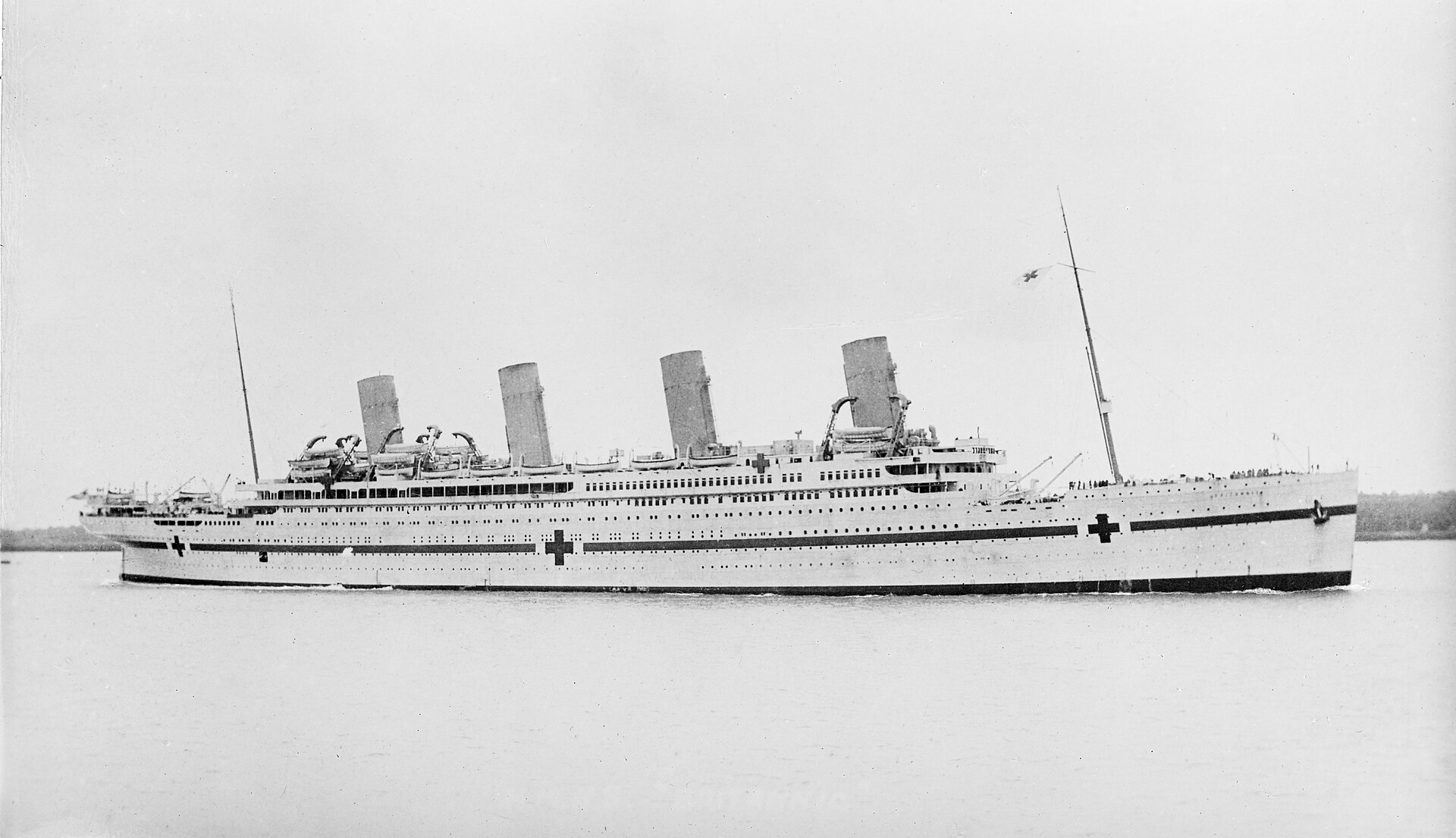
Four years earlier, she had been a stewardess on the Titanic. A year before that, she had been working aboard the Titanic’s older sister, the Olympic, when a Royal Navy warship rammed into its side.
Three ships. Three sisters. And one woman who was there for the worst day of each of them.
A short viral video from The Vintage News sums up her story in one line: Violet Jessop survived the Titanic, the Britannic sinking and the Olympic’s collision with HMS Hawke. It sounds like a legend invented to sell a film.
It is not. The three events really happened, and Violet really was there. But the full story is stranger, and in places sadder, than the one-line version.
To understand how one person ended up on all three ships, you have to start with a sick little girl on the other side of the world.
Violet Jessop was born on October 2, 1887, near Bahía Blanca, in Argentina. Her parents, William and Katherine, were Irish immigrants who had gone there to farm sheep.
As a child she fell seriously ill with what is believed to have been tuberculosis. The doctors expected it to kill her.
It did not. Years later, the editor of her memoir, John Maxtone-Graham, put it simply: “Violet’s stubborn, almost fierce will to live healed her.”
That will would be tested again and again.
After her father died, the family moved to England. Her mother went to work at sea as a stewardess, looking after passengers on ocean liners.
Then her mother fell ill. Violet, then 21, became the family’s main breadwinner, and she followed her mother into the only trade she knew.
It was not easy. Shipping lines thought she was too young, and too pretty, for the job.
So she dressed down, wore old clothes and skipped makeup to look plainer. It helped that she spoke English, Spanish and French.
Her first post at sea, in 1908, was aboard the Orinoco, a Royal Mail Line steamer. By 1911, she was working for the White Star Line aboard the largest passenger liner in the world: the RMS Olympic.
Olympic was the first of three enormous sister ships. The second was not yet in service. Its name was Titanic.
On September 20, 1911, Olympic left Southampton under the command of Captain Edward Smith. A harbor pilot named George Bowyer was guiding her through the Solent, the busy strait off the Isle of Wight.
Nearby was HMS Hawke, a Royal Navy cruiser. As the giant liner made a wide turn, the warship could not get out of the way.
Hawke’s ram-shaped bow smashed into Olympic’s starboard side near the stern. Two watertight compartments flooded, and one of the propeller shafts was twisted.
And yet Olympic did not sink. Nobody was killed or seriously injured. The liner limped back to Southampton under her own power.
A legal fight followed. The Navy argued that suction from the liner’s huge bulk had pulled the cruiser into her, and the Navy won. Repairing Olympic even delayed work on her younger sister: Titanic.
Here is one detail the viral version leaves out. Violet Jessop wrote a memoir about her life at sea, and she never mentioned the Hawke collision in it.
The accounts that place her aboard Olympic that day come from later writers, not from her own pen. Perhaps, after what came next, a collision that killed no one did not seem worth a page.
Because a few months later, Violet was offered a place on the brand-new sister ship. She was reluctant to leave Olympic, but a friend persuaded her to go.
On April 10, 1912, Violet Jessop joined the crew of the Titanic. She was 24 years old.
Four days into the maiden voyage, on the night of April 14, she had just finished her prayers. At 11:40 p.m. she heard what she later described as a “low, rending, crunching, ripping sound.”
At first she thought it might be a drill. It was not. The ship had struck an iceberg.
Her memoir records what happened next with an odd calm: “I was ordered up on deck. Calmly, passengers strolled about.”
The crew had a job for her. Many passengers did not speak English, and the stewardesses were to show them, by example, that there was nothing to fear.
Then came a harder order. “Sometime after, a ship’s officer ordered us into the boat first to show some women it was safe.”
She climbed in. Researchers believe her boat was very likely lifeboat No. 16, on the port side, though even careful studies stop short of calling it proven.
As the boat was lowered, an officer leaned over and placed something in her arms. It was a baby.
Who the child was, nobody can say for sure. Another stewardess in the same boat, Elizabeth Leather, told the Daily Mirror a few weeks later: “Miss Jessop and myself nursed two little babies.”
From the lifeboat, Violet watched the grandest ship she had ever served on slip beneath the black water. Her thought, she wrote, was: “Surely it is all a dream.”
It was no dream. More than 1,500 people died that night.
Hours later, the survivors were picked up by the liner Carpathia. Violet was still holding the baby when she came aboard.
Then, according to her memoir, a woman rushed up, snatched the child from her arms and ran off crying, without a single word. Violet assumed she was the mother. She never learned more.
The Carpathia reached New York on April 18. Violet made her way home to Southampton.
Afterward, one small loss kept bothering her more than she expected. She kept complaining that she could not get hold of a toothbrush.
Her friends never let her forget it. “There had always been much fun at my expense after the Titanic,” she wrote, “when I complained of my inability to get a toothbrush.”
It was a joke. Four years later, it would turn into a rule she lived by.
After all that, she could have stayed on dry land for good. Violet Jessop did not.
When the First World War broke out, she volunteered as a nurse with the Voluntary Aid Detachment, working with the British Red Cross.
The youngest of the three White Star sisters had been turned into a floating hospital. Its name was HMHS Britannic.
The ship carried wounded soldiers from the Gallipoli campaign back toward England. Violet went with it.
On the morning of November 21, 1916, she had just come back from morning Mass and sat down to breakfast. The Britannic was steaming through the Aegean, near the Greek island of Kea.
At 8:12 a.m., an explosion tore into the ship. Most accounts say she had struck a German mine.
And there was a fatal detail. Nurses had opened the portholes to air out the wards, and the sea poured in through them.
The order came to go to the lifeboats. And Violet Jessop, survivor of the Titanic, did what no one else seemed to think of. She ran back to her cabin for her valuables, her prayer book and her toothbrush.
A friend’s advice from years earlier had stuck: “Never undertake another disaster without first making sure of your toothbrush.”
By the time she reached the boats, things were going badly wrong. Some boats had been lowered without orders while the ship was still moving forward under power.
The Britannic’s huge propellers were still turning. The lifeboats in the water near the stern were being dragged toward them.
Violet’s boat was one of them.
She watched the blades come closer, and she made a choice in seconds. She jumped.
In her own words: “I leapt into the water but was sucked under the ship’s keel which struck my head.”
The boats that stayed close to the propellers were torn apart. Most of the 30 people who died in the sinking were in those prematurely launched boats.
Somehow, Violet came back up. She was rescued from the water and later taken aboard a British destroyer.
Behind her, the Britannic was going down. She remembered how it “dipped her head a little, then a little lower and still lower.”
“All the deck machinery fell into the sea like a child’s toys,” she recalled.
At 9:07 a.m., only 55 minutes after the explosion, the Britannic was gone. Of the 1,066 people aboard, 30 had died. Violet Jessop was not one of them.
On the destroyer, she saw two familiar faces: doctors she had knelt beside at Mass that very morning.
One of them looked at the battered young woman in front of him and said: “I know what saved you today, young lady.”
Her injuries were worse than anyone knew at first. She had a deep gash in her leg and, as it turned out, a fractured skull. Recovery took about three years.
She only learned the full extent of it long afterward, when a doctor examined her. She wrote, almost amused: “he discovered I had once sustained a fracture of the skull!”
She was not quite alone in her bad luck. A stoker named Arthur Priest had also been aboard Olympic, Titanic and Britannic, and a lookout named Archie Jewell survived both the Titanic and the Britannic.
But for Violet, the strangest part of the story is what she did next. In 1920 she went back to sea, and back to the White Star Line, aboard the repaired Olympic, the same ship that had been rammed nine years earlier.
She would work at sea for another thirty years. But one of the strangest moments of her life would come after she left it.
Later she joined the Red Star Line and made two round-the-world cruises on its flagship, the Belgenland, before moving back to the Royal Mail Line, where her career had begun.
She married a fellow steward, John James Lewis, but the marriage was brief. She had no children.
In 1950, at the age of 63, she finally retired to a cottage in Great Ashfield, a village in Suffolk.
There is one more story she told, and it is the hardest to explain. One stormy night, years after she retired, her telephone rang.
A woman on the line asked whether she was the stewardess who had saved a baby on the night the Titanic sank. Violet said yes. The caller answered, “I was that baby,” laughed and hung up.
Her editor suspected it was village children playing a joke. Violet replied that she had never told the story to anyone.
No one has ever identified the caller, and records of the babies in lifeboat No. 16 do not settle the mystery. It remains, like the baby’s name, one of the loose threads of her life.
So is the viral version true? Yes, with two footnotes.
The Olympic collision was not a shipwreck, and Violet’s own memoir never mentions it. The Titanic and the Britannic, though, are exactly as terrible as the legend says.
Violet Jessop died in Great Ashfield on May 5, 1971, of congestive heart failure. She was 83.
Late in life, a friend asked her what had given her the strength to keep going. Her answer was short: “Just the will to live.” Then she added: “And a huge chunk of faith in divine intervention.”
The girl the doctors gave up on had gone on to survive a collision, an iceberg and a mine. And the next time disaster came, she made sure to bring her toothbrush.
If you had survived the Titanic at 24, would you have gone back to sea like Violet Jessop did, or would you never have set foot on a ship again?
Report this article
Select a reason for reporting:






