In the spring of 1842, a prosperous village on the outskirts of London became the stage for a crime so gruesome it would echo through the corridors of power and reshape the very institution sworn to protect the innocent. The name Jane Jones is barely a whisper in the annals of history, yet her brutal murder—and the spectacular failure to catch her killer—would force Scotland Yard to evolve from a toothless patrol force into the detective powerhouse we know today.
But who was Jane Jones? And why did her death, buried under a pile of straw in a stable, become the catalyst for the creation of the world’s first professional detective unit?
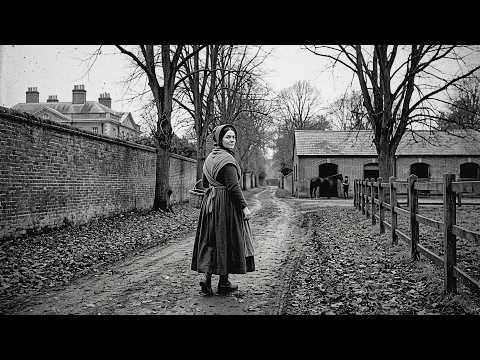
The story begins in Roampton, a semi-rural enclave of grand estates and wealthy merchants, where the fields still stretched open between London and the countryside. It was here, at a property called Coombe Shiel, that a wealthy plantation owner from Montserrat kept a household of servants, gardeners, and coachmen. Among them was Daniel Good, an Irish coachman with a dark complexion, long features, and a distinctive bald crown. Good had worked at the estate for just over two years, managing the carriage and the stable yard—a domain where he ruled with little oversight from the main house.
By early 1842, Good’s domestic arrangement with Jane Jones—a woman who had taken his name without the benefit of legal marriage—had soured. Jane had lived as his wife for nearly three years, but Good’s attention had wandered to another woman: Lydia Susanna Butcher, a thirty-year-old spinster from Woolwich. The tension in the household was palpable, and Jane’s fate was sealed.
On Easter Sunday, April 3, 1842, Jane Jones was murdered. The exact sequence of events inside the stable that night remains uncertain, but what followed was beyond doubt: her body was dismembered. The head, arms, and legs were severed from the torso, the stomach was opened, and an attempt was made to burn the remains. When that failed, Good hid the butchered trunk under a heap of straw and went about his business as if nothing had happened.
For three days, he waited. And then, on the evening of April 6, a petty theft—a stolen pair of black trousers from a pawnbroker’s shop—led a police constable named William Gardner to the stable at Coombe Shiel. Gardner was searching for the trousers. What he found instead was a headless, limbless torso. In that moment, Daniel Good slammed the stable door shut, locking Gardner and two pawnbroker’s assistants inside with the remains of Jane Jones, and fled into the night.
The discovery triggered a manhunt that exposed every flaw in London’s policing system. The Metropolitan Police, founded just thirteen years earlier by Sir Robert Peel, had no plainclothes detectives, no centralized intelligence, and no authority to pursue a suspect across the boundaries of its administrative divisions. Good crossed from Roampton into Spitalfields, then to Deptford, Bromley, and finally into Kent—and once he left the Metropolitan Police District, the trail went cold. Nine divisions of police had failed to catch a single man who simply kept walking.
The press had a field day. The Times chronicled every misstep, and the public demanded answers. How could a force of 3,800 officers, spread over a fifteen-mile radius, be outwitted by one fugitive with nothing more than a head start and a cool demeanor? The reputation of the Metropolitan Police, already viewed with suspicion by many, suffered a grievous blow.
The break came not from diligent detective work but from sheer coincidence. Good, using the alias James Connor, found work at a construction site near Tunbridge railway station. A former police officer from Wandsworth recognized him and alerted the railway police supervisor, Humphrey. On the pretense of offering refreshments, Humphrey lured Good to the Angel Inn, where the fugitive removed his hat—revealing the unmistakable bald crown—and was arrested. The manhunt was over, but the damage to Scotland Yard’s credibility was done.
As Daniel Good stood trial at the Old Bailey in May 1842, the courtroom buzzed with the details of his crime and his flight. The evidence was damning: the discovery of the body, the medical testimony of surgeon Benjamin Rieu, the history of Good’s relationship with Jane Jones, and his behavior after the murder. Good’s defense—that Jane had taken her own life and that Lydia Butcher’s interference had driven her to suicide—was dismissed by the jury in just half an hour. He was found guilty and sentenced to hang.
On May 23, 1842, Daniel Good was executed at Newgate Prison before a hostile crowd. But the story of Jane Jones did not end with his death. The case had laid bare a fundamental flaw in the policing of the capital: the inability to investigate crime across divisional boundaries. The public outcry forced the hand of the Metropolitan Police Commissioners, Richard Mayne and Sir Charles Rowan.
On June 14, 1842, they submitted a memorandum to the Home Secretary proposing the creation of a small, plainclothes detective force—two inspectors and eight sergeants—who would operate across the entire district. By August 15, 1842, the Detective Branch was officially established at Scotland Yard. Inspector Nicholas Pearce, who had led the investigation into Jane’s murder, became its first head. The eight men of the Detective Branch were the first professional detectives in British history.
Jane Jones herself, however, remained a ghost. Her origins, her age, her family—all lost to time. She is remembered not as a person but as a case, the victim whose death inadvertently gave birth to modern criminal investigation. The trunk that Benjamin Rieu examined, the stable where William Gardner made his gruesome discovery, the courtroom where Daniel Good proclaimed his innocence—these are the fragments that survive. But Jane, the woman, is barely a shadow in the archive.
The story of how a single murder forced the world’s most famous police force to reinvent itself is a story of failure, coincidence, and institutional change. And it all began with a woman named Jane Jones, whose life was taken in a stable in Roampton, and whose death would echo for centuries.
Yet the memorandum of June 14 and the orders of August 15 tell only half the story. The other half belongs to the men who suddenly found themselves transformed from uniformed patrolmen into something the British public had been taught to distrust: plainclothes investigators with the power to cross boundaries and pry into private lives. Nicholas Pearce, the first head of the Detective Branch, understood the danger better than anyone. He had led the pursuit of Good through nine divisions and watched it collapse at the Kent border. He knew that the new unit would be judged not by its founding document but by its first successes—and its first scandals.
The eight men who reported for duty at Scotland Yard in the late summer of 1842 were an odd assortment. Pearce himself was a career policeman of fourteen years’ standing, a man of methodical habits and few words. His second-in-command, Inspector John Haynes, had spent a decade in the force after training as a chemist—a background that made him invaluable in a unit that would soon be handling poisons, forgeries, and the earliest forensic evidence. The six sergeants were drawn from the ranks of those who had distinguished themselves during the Good investigation, men who had knocked on doors in Spitalfields and Bromley and Woolwich, asking the questions that had ultimately led nowhere.
Their first months were quiet, almost suspiciously so. The public, accustomed to the reassuring sight of a blue-coated constable on his beat, was not sure what to make of men in plain coats who appeared at crime scenes and asked pointed questions. The newspapers, which had excoriated the force for its failure to catch Good, now turned their scrutiny on the new detectives. Were these not the very ‘French-style’ spies that Parliament had been assured would never take root in English soil? The comparison to the Sûreté of Paris, with its reputation for infiltration and political surveillance, was made repeatedly and with evident alarm.
Pearce responded by keeping his men on a short leash. They were forbidden from entering public houses in search of information unless authorized. They were required to file daily reports of their movements. And they were instructed, above all, to remember that their authority rested on the consent of the public, not on the fear they inspired. It was a delicate balance, and Pearce knew that a single overstep could undo everything the memorandum had achieved.
The test came sooner than expected. In the autumn of 1842, a series of warehouse robberies in the City and the East End prompted the Detective Branch to undertake its first coordinated investigation. Haynes, working with a sergeant named Thornton, traced the stolen goods through a network of receivers and identified the gang responsible. The arrests were made without violence and without the kind of publicity that had attended the Good case. For the first time, the Metropolitan Police had solved a cross-boundary crime through patient, unglamorous detective work.
The press noticed—and, more importantly, so did the Home Office. The Detective Branch, which had been created as an emergency measure, began to be spoken of as a permanent feature of the police landscape. Its numbers would grow slowly over the following decades, and its methods would be refined through trial and error, but the principle established in the summer of 1842 would never again be seriously challenged. England had accepted, however grudgingly, that the prevention of crime required not only the visible presence of the constable but the invisible work of the detective.
And what of Jane Jones? The woman whose dismembered trunk had set all of this in motion remained as she had always been: a name in a ledger, a description in a surgeon’s report, a victim in a case file. No portrait of her survives. No letter in her hand has been found. The room in Manchester Square where she lived as Jane Good, the stable at Coombe Shiel where she died, the straw under which her body was hidden—these places have long since been built over or erased by time. Yet the institution that her death helped to create endures, its origins traceable to a spring night in 1842 when a coachman with a bald crown closed a stable door on a constable and ran.
The story of Jane Jones is, in the end, a story about the price of progress. It is a story about how the failures of institutions are often paid for by those who have the least power to demand justice. And it is a story that reminds us, even now, that the machinery of investigation—the detectives, the forensics, the cross-boundary cooperation—was not handed down from on high but built, piece by painful piece, out of the wreckage of individual lives.
Pearce’s men learned quickly that the public’s tolerance was fragile. When Sergeant Thornton arrested a respectable shopkeeper on suspicion of receiving stolen silks, the man’s friends raised a cry of “French espionage.” Pearce personally reviewed the evidence, found it sound, and let the case proceed—but he also ordered that future arrests be made with the local constable present, a small concession that bought the Branch time.
By 1845, the Detective Branch had become indispensable. It had solved murders, foiled a plot to rob the Bank of England, and even assisted in a case of forgery that reached the Queen’s Bench. The eight men had grown to a dozen, and their plain coats were no longer a novelty but a reassurance.
Jane Jones never received a grave, but her case received something else: permanence. In the archives of Scotland Yard, the file marked “Good, Daniel—murder of Jane Jones” became required reading for every new detective. It taught them that a single failure could topple a force, and that justice for the powerless demanded institutions willing to change.
Today, the Metropolitan Police’s Homicide and Major Crime Command traces its lineage directly to that memorandum of June 1842. And in the quiet corners of police museums, a single line is often displayed: “The Detective Branch was born of the failure to catch one man—and the determination never to fail again.”
What do you think—was Jane Jones’s death a necessary sacrifice for modern policing, or a tragedy that should have been prevented? Share your thoughts below.
Report this article
Select a reason for reporting:






