Step through the revolving brass doors and the year is 1958. A pianist plays in the tea room, white-gloved elevator operators call out floors, and families have driven three hours just to see the Christmas windows. This is not a mall. This is the American department store at its peak—a nine-story palace of marble, perfume, and possibility. For nearly a century, it was the beating heart of American commercial life.
Now fast-forward to today. Macy’s is closing 150 stores by the end of 2026. JCPenney, once an 800-store titan, is a shadow of itself. Sears, which operated over 3,500 locations, is down to a handful. Entire malls sit abandoned, their fountains dry and skylights cracked. How did an institution so dominant simply vanish?
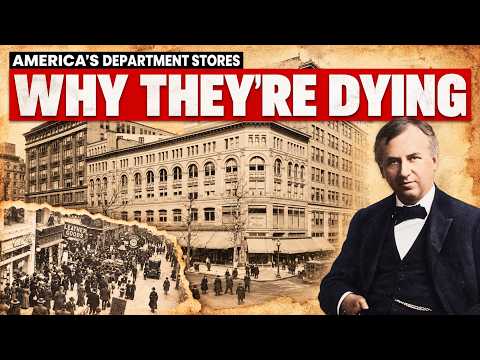
The easy answer is Amazon. But that’s not even half the truth. The department store was being hollowed out from the inside for decades before Jeff Bezos shipped his first book. It was gutted by Wall Street, overbuilt by its own ambition, outflanked by discounters, and strangled by debt.
To understand what died, you first have to understand what it was. Before the department store, shopping in America was fragmented and often humiliating. You went to a dry goods merchant for cloth, a milliner for hats, a cobbler for shoes—and at each one, you haggled. Prices were not posted. A shopkeeper sized you up and named a number. If you were a woman, you often could not even enter certain stores unaccompanied.
Then came Alexander Turney Stewart. In 1846, this Irish immigrant opened a dry goods store on Broadway and did something radical: he put price tags on everything. He let customers browse without buying. He accepted returns. His marble palace treated shopping itself as a destination. Historians credit Stewart as the father of the American department store.
But Stewart was only the opening act. In 1858, Rowland Hussey Macy—a man who had failed at four previous retail ventures—opened a small dry goods store on Sixth Avenue. He stuck to a cash-only, fixed-price model and watched it grow into a 13-building complex within two decades.
In Philadelphia, John Wanamaker, who had been refused the return of a purchase as a boy, swore he would run a store on different principles. He guaranteed quality in print, allowed cash refunds, and installed the first in-store restaurant, the first electrical lighting in a department store in 1878, the first store telephone in 1879, and the first pneumatic tubes to shoot cash and receipts around the building in 1880.
When the Titanic sank in April 1912, the news was transmitted to Wanamaker’s own wireless station and shouted out to the crowds gathered outside. Think about that for a second. A department store had its own radio relay. That is how central these buildings had become to civic life.
Chicago gave the country Marshall Field, who by 1881 had built a store comprising 73 acres of floor space with the largest book, china, shoe, and toy departments on Earth. By 1910, Marshall Field employed more than 8,000 people and sprawled across a million square feet. Field is credited with coining the phrase, “Give the lady what she wants,” and popularizing, “The customer is always right.”
From roughly 1890 to 1940, the entire industry pivoted toward service. One price, no haggling. Goods out on display. Browsing welcomed. Returns easy. These stores wanted middle-class and upper-class women with discretionary money, and they bent their entire operation around keeping those women happy and inside the building for as long as possible.
The Walnut Room restaurant opened inside Marshall Field in 1907—the first restaurant located inside a department store in America. Dayton’s in Minneapolis designed whimsical Christmas windows that drew crowds from across the Midwest. Lord and Taylor hired Dorothy Shaver, who would later become one of the first women to run a major American corporation. Geraldine Stutz, hired by Henri Bendel in 1964, invented the modern boutique concept of dividing the floor into little brand-specific worlds—a layout every department store still uses today.
These were not just stores. They were cultural institutions run by people who understood they were in the experience business as much as the merchandise business.
And then there was Sears, which deserves to be told on its own terms. Richard Warren Sears started selling watches by mail in 1886. By the mid-1890s, his catalog had grown to 532 pages of everything a rural American family could possibly want. For most of the country, especially the enormous population still living on farms, catalog shopping was the only shopping.
Sears opened its first retail store in 1925. By 1931, more than half of its revenue came from retail stores rather than mail order. By 1941, there were 600 Sears locations across the country. In 1973, Sears moved into the Sears Tower in Chicago, which upon completion was the tallest building in the world. For most of the 20th century, Sears was the single most powerful retailer in America and probably the world.
By roughly 1950, if you lived in or near any American city, your relationship with a specific downtown department store was almost like a family loyalty. New Yorkers were Macy’s people or Gimbels people. Chicagoans worshiped Marshall Field’s. Philadelphians had Wanamaker’s. Detroiters had Hudson’s, which in the 1960s was the second-largest department store in the country by sales volume behind only Macy’s.
These stores were social institutions. You met your friends there. You had tea in the restaurant. Your kids visited Santa there. You bought your first interview suit there. Your wedding dress there. Your baby’s first outfit there. One author described it as a “sentient, sensual experience.” That is a very specific word for what shopping used to be—and a word almost nobody would use to describe shopping today.
But right at this peak, the seeds of destruction were already in the ground. And the first of them was something that looked at the time like the greatest opportunity in American retail history.
It was called the suburb.
After World War II, the United States went through one of the fastest geographic realignments in history. Returning soldiers, cheap mortgages backed by the GI Bill, the interstate highway system, and a boom in automobile ownership emptied downtowns and filled an endless ring of new subdivisions around every American city.
The middle class—the lifeblood of the downtown department store—simply stopped going downtown. They were twenty miles away, surrounded by lawns, driving everywhere. If you were the CEO of Macy’s or Hudson’s or Dayton’s, you had a problem. Your flagship sat in a part of the city your customers no longer visited.
The solution came in 1956 in Edina, Minnesota. An Austrian-born architect named Victor Gruen designed the Southdale Center, widely credited as the first fully enclosed, climate-controlled suburban shopping mall in America. Gruen’s idea was almost utopian: he imagined these malls as a substitute town square, a place where suburbanites could gather and socialize in a public space the suburbs otherwise lacked.
The department stores understood immediately what Southdale meant. They were going to be the anchors. Each new mall would have one or two or three or even four of them, one at each end of a long corridor of smaller specialty shops that leased space in between. The department stores would drive the foot traffic. The small stores would pay the rent. Everybody wins.
For about thirty years, that bargain really did work. Over 1,200 enclosed malls were built across the United States between the late 1950s and the early 1990s, each one bigger than the last. Developers made fortunes. Department store chains expanded aggressively, opening dozens or even hundreds of new suburban locations.
Meanwhile, the downtown flagships started to wither, and the small independently owned stores on Main Streets across America died by the thousands. The country was reshaping itself around the mall, and the department store was the engine making it possible.
But there was a catch nobody wanted to talk about. The country was overbuilt. By the 1980s and 1990s, there were vastly more department stores than the American middle class could actually sustain. Many communities had three or four competing mall anchors chasing the same shoppers.
And at the same time, something quieter and more dangerous was happening. A new kind of competitor was starting to appear on the edge of town. Not another department store. Something different.
In 1962, three separate stores opened their doors for the first time. One was Walmart in Rogers, Arkansas, founded by Sam Walton. Another was Kmart, launched by the S.S. Kresge Company. The third was Target, launched by the Dayton Company—the same Minneapolis department store chain that had built Southdale.
These were called discount stores. The model was simple. They operated out of plain, cheap boxes. They skipped the marble floors, the pianists, the tea rooms, the gift wrapping, the elevator operators. They stocked a somewhat narrower selection, but they stocked it at prices roughly 15 to 30 percent below what you would pay at the mall. They won customers one trip at a time by being faster, cheaper, and easier.
For a while, the department store industry barely noticed. Discount stores served working-class shoppers. The department stores served the middle class, and the two seemed to coexist.
Except the middle class started crossing over. By the 1980s, as inflation and wage stagnation squeezed household budgets, more and more families discovered that the quality gap between a $40 towel at the department store and a $12 towel at Target was much smaller than the price gap. Walmart, in particular, grew into a monster. By the mid-1990s, it was the largest retailer on Earth.
Then came the specialty chains. The Gap took the department store’s apparel business. The Limited and Victoria’s Secret peeled off women’s clothing and intimates. Toys R Us ate the toy departments. Circuit City and Best Buy ate the electronics. Home Depot and Lowe’s ate the hardware and appliances. One by one, the specialty retailers took the most profitable departments inside the department store and built entire chains around just that one thing—almost always with better selection, better prices, and more knowledgeable staff.
The department store was being eaten alive, department by department. Many analysts pinpoint this as the real moment of structural decline, not the arrival of the internet. By the early 1990s, the most exciting stores in most American cities were no longer the big downtown department stores. They were the Gap, the Limited, and Target. The department store was already becoming boring—already losing its sense of being special.
And the industry’s response was mostly to merge, to cut costs, and to buy each other.
Enter the consolidation wave. Starting in the 1980s and accelerating through the 1990s and 2000s, the department store industry collapsed into a smaller and smaller number of corporate parents. Federated Department Stores merged with Macy’s in 1994. Then in 2005, Federated acquired the May Department Stores Company for roughly $11 billion in stock—a deal some analyses valued at $17 billion when the full stock package is counted. That single acquisition folded in Marshall Field’s, Filene’s, Foley’s, Kaufmann’s, Robinson’s-May, and others.
In 2006, in a decision that still provokes anger in Chicago nearly two decades later, Federated took down the Marshall Field’s name and painted Macy’s on the State Street flagship. Protesters marched with signs reading “Field’s is Chicago.” It didn’t matter.
The regional stores with their deep local loyalties and distinct identities were being homogenized into one national brand so Federated’s marketing could be more efficient. And here is the quiet tragedy of that consolidation. Each of those regional names—Marshall Field’s, Hudson’s, Kaufmann’s, Dayton’s, Jordan Marsh—had been built over generations and carried the loyalty of entire cities. When corporate accountants painted Macy’s over all of them, they also painted over whatever emotional connection those customers had.
And once that was gone, there was nothing stopping those shoppers from drifting to Amazon or Target or T.J. Maxx.
One retail analyst put it bluntly: “The holding company spent its resources buying brands rather than investing in the stores it held.” The stores got worse while the balance sheet got bigger.
Then came the financial engineers. Eddie Lampert merged Kmart and Sears in 2004 and treated the empire as a real estate portfolio, not a retailer. Private equity firms loaded Toys R Us, Payless, and Neiman Marcus with debt, then sold off their buildings. Of the major retailers bankrupt by 2019, roughly 80 percent had private equity ownership.
The 2008 recession turned slow decline into freefall, and e-commerce delivered the final blow. But studies showed most lost department store spending flowed to off-price and specialty shops, not online. The real killers were uninspiring stores and unpleasant experiences—self-inflicted wounds.
The middle class hollowed out, and so did the stores built to serve it. What remains are luxury flagships and dollar stores, with nothing in between.
So here’s the question: when the last anchor store goes dark, what will we have lost that no warehouse can ever replace?
Report this article
Select a reason for reporting: