June 28, 1778. The sun blazed over New Jersey, the air thick and suffocating. General George Washington rode toward the sound of gunfire near Monmouth Court House, expecting to hear his advance guard mauling the British rear. Instead, he found his soldiers streaming toward him in retreat—whole regiments colliding, fleeing without orders, without direction.
Washington had spent six months rebuilding this army from nothing. Now, in one afternoon, it seemed all that work would vanish. But to understand how he ended up on that road, watching his plans collapse under the June sun, you have to go back six months—to a frozen camp in Pennsylvania where the Continental Army nearly ceased to exist.
December 1777. Nearly 12,000 soldiers marched into Valley Forge. The word “soldiers” was generous. They were exhausted, malnourished, barely armed. About a third had no shoes. They had just come off a brutal campaign—beaten at Brandywine, beaten again at Germantown, and Philadelphia, the capital of the new nation, had fallen. Congress had fled. Morale had evaporated.
Now Washington was ordering these men to build a winter camp in the frozen countryside, 18 miles from a city where British officers slept in warm beds and ate hot meals. Conditions at Valley Forge were horrific. Soldiers built crude log huts, 12 men to a hut, chinking gaps with mud to keep out the wind. Food was scarce for days on end. Some units had nothing but “firecake”—a miserable paste of flour and water cooked on hot stones. When supplies did arrive, they were often rotten. The supply system had collapsed under corruption and mismanagement, with provisions rotting in forgotten storehouses while men starved just 20 miles away.
Some soldiers had no trousers. Washington himself wrote that you could track his army by the bloody footprints left by barefoot men in the snow. Disease ravaged the camp worse than any enemy attack. Typhoid, dysentery, and smallpox killed over 2,000 soldiers that winter—far more than British bullets had in the previous campaign. The camp hospitals, if they could be called that, were overwhelmed. Men died in their bunks, sometimes left for days.
And as Washington’s men froze and died, his political enemies circled. A faction of officers and congressmen—sometimes called the Conway Cabal—sought to replace Washington as commander-in-chief. Major General Horatio Gates, the victor of Saratoga, was the favored candidate. Washington was supposed to be a failure. His army was supposed to be finished.
Which is what makes what happened next so hard to believe.
On February 23, 1778, a man arrived at Valley Forge who would change the course of the war. His name was Friedrich Wilhelm von Steuben. He claimed to be a lieutenant general in the Prussian army. That was an exaggeration. In reality, he had been a captain. But Benjamin Franklin, who had met Steuben in Paris, knew that a captain’s rank wouldn’t impress the Continental Congress. So Franklin inflated his credentials—and frankly, it didn’t matter what rank Steuben held, because the man knew exactly what he was doing.
The Prussian army in the 1770s was considered one of the finest military forces in Europe, and Steuben had spent years learning how it worked from the inside. He arrived at Valley Forge wearing a silver star on his chest engraved with the word “Fidelity,” and he spoke almost no English. He communicated with American officers in broken French, which was then translated into English. Yet within days of his arrival, Washington appointed him acting inspector general and gave him one job. Fix this army.
Steuben began with a model company of about 100 men. He drilled them personally—unheard of for a general officer. In European armies, generals issued orders from afar and left training to junior officers. Steuben marched right onto the frozen parade ground and faced the soldiers eye to eye. He adjusted their musket grips with his own hands. He taught them the soldier’s stance, how to stand at attention properly for the first time. He taught them to march at 75 steps per minute, then increased the pace to 120. And when discipline broke down, he exploded. He cursed them in German. He cursed them in French. Then, when he ran out of languages, he unleashed the only English curse word he had learned since arriving in America. His translator, a young captain named Benjamin Walker, often had to step in and finish the scolding in English while Steuben stood there red-faced and sputtering. The soldiers loved it.
He taught them to load and fire their muskets in coordinated volleys instead of the chaotic, disorganized fire that had prevailed before. He taught them to change formations under fire without falling apart. And most importantly, he taught them how to use the bayonet. This was critical. Before Steuben, most Continental soldiers used the bayonet as a cooking tool. They’d skewer meat on it and hold it over a fire. The British, by contrast, were terrifyingly proficient with the bayonet, using it to devastating effect in battle after battle. Steuben changed that. He drilled them in bayonet charges until the American soldiers could execute them in their sleep.
By late March, the entire army was drilling under Steuben and his assistants. The goal was to make every unit in the Continental Army capable of maneuvering and fighting as a single, coordinated force. By the time spring arrived, something remarkable had happened. That ragged, hungry, demoralized collection of men who had stumbled into Valley Forge in December had transformed into something that resembled a professional army. They could march in step. They could hold formation under pressure. They could fight with bayonets. And for the first time, they were trained to face the British on equal terms.
The question was whether that training would hold when real bullets started flying. That answer was coming sooner than anyone expected.
While Steuben rebuilt the Continental Army, the strategic picture of the entire war was shifting. In February 1778, France signed a treaty of alliance with the United States and entered the war officially against Britain. That changed everything. Britain could no longer focus its full military resources on crushing the American rebellion. French warships now posed a threat in the Atlantic and the Caribbean. Panic struck London.
The new orders from the British government were clear. Stop trying to win the war outright. Shift to the defensive. Consolidate forces. General Sir Henry Clinton, who had just replaced William Howe as commander of British forces in North America, was instructed to evacuate Philadelphia and pull his army back to New York City. Clinton didn’t have enough ships to transport everyone by sea. So he planned an overland march through New Jersey to Sandy Hook, where the Royal Navy would ferry his troops to Manhattan.
On June 18, 1778, the British began leaving Philadelphia. Clinton’s force was massive. Between 11,000 and 15,000 soldiers, plus thousands of Loyalist civilians, women, children, and camp followers who refused to stay behind when the army withdrew. All told, the caravan numbered over 20,000 people. The baggage train alone stretched for more than 12 miles. Wagons loaded with supplies, artillery pieces, ammunition, and the plunder of nine months of occupation crawled through the New Jersey countryside at a painfully slow pace.
Clinton organized the march into two divisions. General von Knyphausen led the advance with the baggage. Lord Cornwallis commanded the rear guard. The column moved slowly, sometimes covering only six or seven miles a day in the brutal summer heat. Temperatures regularly exceeded 90 degrees Fahrenheit. British and Hessian soldiers, wearing thick wool uniforms buttoned to the neck and carrying packs weighing nearly 100 pounds, collapsed in their tracks on the dusty New Jersey roads. Desertion was constant, especially among the Hessian mercenaries. American agents had been working on them for months, offering land in Pennsylvania and a fresh start. Whole groups slipped away at night and disappeared into the countryside.
Washington saw his opportunity. He broke camp at Valley Forge the same day and sent his newly trained army in pursuit of Clinton. Militia units under General Philemon Dickinson and others began harassing the British column, destroying bridges, felling trees across roads, even poisoning wells. The British crawl turned into a miserable slog.
Washington wanted to strike a hard blow against the British before they reached the safety of New York, but his senior officers were deeply divided over how aggressive to be. A council of war on June 24 produced a cautious recommendation. Most of the generals, led by Charles Lee, argued that the Continental Army should avoid a major engagement. Lee was a complicated figure. He had been a British officer before the Revolution, served across Europe, and gained real combat experience. He considered himself the most qualified general in the American army. And he didn’t hide this opinion.
Lee openly questioned whether American soldiers, even with Steuben’s training, could stand up to British regulars in an open battle. He argued for harassment and guerrilla tactics. Let the militia wear down the British column. Let the French, with their professional navy and seasoned army, do the real fighting. Don’t risk everything on a battle you might lose in one bad hour.
Washington listened to the advice and then ignored most of it. He decided to send a strong advance guard to attack the British rear guard while it was separated from the main column. He offered command to the Marquis de Lafayette, a young French officer eager for action. Lee initially refused the assignment, saying it was beneath a general of his rank and experience. But when the advance guard grew to over 5,000 men, Lee changed his mind and demanded the command back. Washington gave it to him despite serious doubts about Lee’s enthusiasm for the mission. That decision would come back to haunt him within 48 hours.
By the evening of June 27, Lee’s advance guard was positioned at Englishtown, four miles behind the British rear guard at Monmouth Court House. Washington’s main force was another five miles back. The plan was straightforward. Lee would hit the British rear at dawn. Washington would advance with the rest of the army to support him. If things went as planned, they could trap the British rear guard and inflict serious damage before Clinton could bring up his main force.
June 28 dawned hot and humid, temperatures already above 90 before the sun was fully up. The air was thick and still, the kind of heat that seeps into your clothes and drains your energy before you take a single step. Lee advanced toward Monmouth Court House, but his approach was disorganized from the start. He didn’t scout the ground ahead. He didn’t issue a clear battle plan to his subordinate commanders, no coordinated sequence of attacks, no withdrawal positions.
When his troops made contact with the British rear guard around 10 a.m., the initial skirmishing went well enough. American units advanced across the fields east of the courthouse and engaged elements of the British rear. Then Clinton responded. The British commander quickly realized the size of the American force attacking his rear and made a bold decision. He reversed part of his march and sent Lord Cornwallis with some of his best troops, including the elite Foot Guards and grenadier battalions, back toward Monmouth Court House to crush the American attack.
These were not ordinary soldiers. The Guards and grenadiers were the finest troops in the British Army. Veteran warriors carefully selected and battle-tested across the world for years. Lee’s advance guard suddenly faced far more resistance than expected. Then things got worse. Two of Lee’s subordinate commanders, Charles Scott and William Maxwell, pulled more than half his troops off the field without orders and without informing Lee what they were doing. Whole regiments withdrew from the battle.
Lee ordered a general retreat after facing the prospect of his remaining force being destroyed. The withdrawal was chaotic. Units intermingled. Orders conflicted. Thousands of Continental soldiers began streaming west away from Monmouth Court House as the British Guards and grenadiers pursued them.
This is the moment Washington arrived. He had been waiting five miles back, listening for the sound of Lee’s attack, expecting to hear his advance guard pressing the British rear. Instead, one of his aides rode up with news of the American retreat. Washington couldn’t believe it. He spurred his horse forward and reached Lee’s retreating columns around midday.
What he saw was pandemonium. Regiments tangled together, soldiers with no clear leadership, dust and heat and chaos everywhere. Washington spotted Lee on horseback and rode straight for him. What happened next has been debated by historians for over 200 years. Eyewitness accounts at the court-martial vary on the exact words, but the substance is consistent across multiple witnesses. Washington was furious. He demanded to know why Lee was retreating. Lee looked confused, even stunned. He mumbled something about the impossibility of the position, about conflicting intelligence, about the unexpected strength of the British counterattack. He pointed out that his subordinates had pulled their troops without telling him.
Washington wasn’t interested in explanations. Several officers present later testified that Washington berated Lee with language some described as the harshest they had ever heard from the normally composed commander-in-chief. One aide, James McHenry, said Washington called Lee a name that was difficult to repeat in polite company. Whether Washington actually swore at Lee or spoke with cold fury, the effect was immediate.
Washington took personal command of the situation. He rode among the retreating troops, shouting orders, and soldiers who had been fleeing suddenly stopped and turned around. The sight of Washington on his white horse in the middle of the field under fire steadied men who minutes before had been ready to run. He ordered General Anthony Wayne to take what remained of Lee’s regiments and form a line to delay the British advance. Wayne gathered a force near a grove of trees called the Point of Woods and dug in.
Meanwhile, Washington used the time Wayne bought to form the main Continental Army into a defensive line on high ground called Perrine Ridge north of the road. He placed General Nathanael Greene’s division on the right flank and Lord Stirling’s division on the left. The Continental artillery, ten guns, was positioned on the hill with clear fields of fire.
By the time the British pushed past Wayne’s delaying action and reached the main American line, they were looking at a disciplined force with cannons aimed directly at them. Here the training at Valley Forge was put to its first real test.
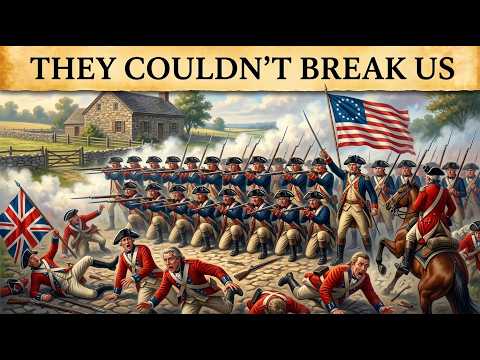
The British Guards and the 1st and 2nd Grenadier battalions advanced in force. They marched across the open ground toward the American positions. Bayonets fixed, with reports that General Clinton himself was running at the front, shouting at the grenadiers to charge. These were soldiers who had never been stopped by an American force in open battle. They expected the Americans to break and run as they had at Brandywine, as they always had before.
Wayne’s troops at the edge of the woods opened fire and inflicted heavy casualties on the Guards as they passed, but the Guards and grenadiers responded exactly as they had been trained. They lowered their bayonets and charged hard into the American position. Wayne’s three regiments were forced back to a bridge over a marshy stream. While Wayne fought south of the stream, the rest of the grenadiers pushed toward a hedgerow where Lee had placed two infantry battalions and some artillery in a last-ditch attempt to delay. A short, violent fight erupted along the fence line, and when Lee saw both his flanks being turned, he pulled his men back across the bridge toward Washington’s main position.
The British followed, and when they crossed the stream and looked up at Perrine Hill, they ran straight into the Continental line. Ten cannons opened fire with grapeshot at close range. The grenadiers, exhausted from a forced march in 100-degree heat and now being torn apart by artillery fire, staggered. The attack collapsed.
What followed was one of the fiercest artillery duels of the entire Revolutionary War. British cannons traded fire with American guns across the fence and open fields for nearly an hour. Continental artillerists on Combs Hill, south of the road, poured fire into the flanks of the British troops. Greene’s division fired into the British from the front while his artillery tore into their sides. British guns tried to reply, but their fuses were cut too long, so their shells overshot the American line and exploded on the ground behind the positions instead of bursting overhead.
Clinton threw everything he had at the American line. The Guards attacked. The grenadiers charged again. British infantry and cavalry swept against Washington’s left flank. Cornwallis shifted Hessian grenadiers and British light infantry into new formations and struck the Americans from different angles. Every attack was repulsed. The Continentals stood their ground on Perrine Ridge, pouring disciplined fire into the advancing British ranks, then reloading with the speed and precision Steuben had drilled into them over four months of daily training.
And then something happened that would have been unimaginable six months earlier. The Continentals launched a bayonet counterattack. Two New England regiments advanced along the stream to push back the retreating Royal Highland regiment. Wayne led three Pennsylvania regiments across the bridge to attack the withdrawing grenadiers head-on. These were the same Americans who had spent a bitter winter learning how to use the bayonet. And now they were charging British elite soldiers with the very weapon that had terrified them for years. Wayne’s men fought the grenadiers to a standstill before being forced back to cover by the parsonage house and orchard, but the fact that they attacked at all was the point. This was a different army.
The fighting continued through the afternoon. By 3:30 p.m., after hours of direct combat in heat that exhausted soldiers on both sides, Clinton ordered his troops to withdraw. Washington wanted to pursue, but his men were utterly spent.
The heat had done what bullets could not. Men collapsed beside their guns, dead without a wound. Washington reported fifty-six Americans killed by heat alone; Clinton counted fifty-nine of his own. “The day was so excessively hot,” one officer wrote, “that soldiers died in their ranks.”
As evening fell, Washington positioned fresh troops to turn the British flank, but darkness ended the fight. At midnight, Clinton slipped away toward Sandy Hook. By morning, the British works stood empty.
Monmouth was officially a draw. But the draw was the victory.
Six months earlier, this army could barely march in a straight line. Now it had stood in the open against the finest troops Britain could send—and held. “They were men of a different kind,” Washington wrote afterward, his pride barely concealed.
Valley Forge had built this. Steuben had forged it. Monmouth proved it.
So here is my question for you: if a starving, barefoot army could become this in six months, what does that say about what determination can build today?
Report this article
Select a reason for reporting:






