The jungle was silent. Too silent. Private First Class Jameson wiped sweat from his brow, his eyes scanning the dense foliage for any sign of movement. He had heard the stories—whispers among the ranks about the Viet Cong’s brutal traps, designed not just to kill but to maim and terrorize. Every step could be his last.
Then, a faint click. Jameson froze. His heart pounded as he looked down. A thin wire, nearly invisible, was taut against his boot. He had triggered something. Somewhere in the shadows, a primitive but deadly mechanism was about to unleash its fury.
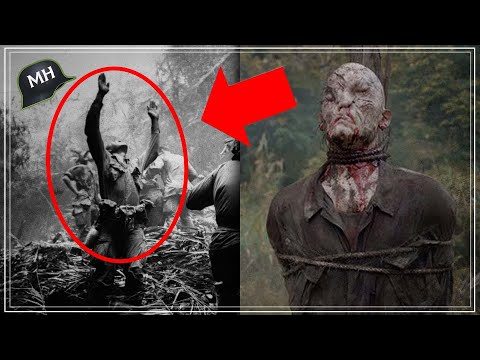
The Vietnam War was a conflict of contrasts. On one side, the United States, with its overwhelming firepower and advanced technology. On the other, the North Vietnamese and Viet Cong, armed with little more than determination and ingenuity. They knew they couldn’t match American strength in open combat, so they turned the jungle itself into a weapon.
Guerrilla warfare became their art, and their canvas was the dense, unforgiving terrain of Vietnam. Every trail, every clearing, every seemingly safe path was a potential death trap. The traps they devised were simple yet diabolical, aimed at causing maximum suffering and psychological damage.
The mace, or hanging spike trap, was a favorite. A heavy wooden or metal ball, studded with sharp bamboo spikes, hung concealed in the trees. A tripwire connected to the ground would release it, sending it swinging into the skull or chest of an unsuspecting soldier. The spikes were often coated with excrement or poison, ensuring that even a minor wound could lead to a painful, lingering death.
Then there was the bamboo whip. Long wooden stakes were attached to a bent bamboo pole, held back by a tripwire. When triggered, the pole would snap forward with terrifying speed, driving the stakes deep into the victim’s chest. The wounds were rarely instantly fatal; instead, the screams of the impaled soldier would echo through the jungle, spreading fear among his comrades.
But the horrors didn’t end there. The explosive can trap combined a metal spike with a hidden grenade. A soldier stepping on it would have his foot impaled, and any attempt to remove it would trigger an explosion, often costing him his legs—or his life.
Perhaps the most infamous were the punji stakes. Pits filled with sharpened bamboo or metal spikes, often smeared with feces, were hidden along patrol routes. The goal wasn’t to kill but to maim, to slow down the enemy and stretch their resources. A wounded soldier required evacuation, tying up helicopters and medics, and his cries demoralized those around him.
The Viet Cong also exploited American bravado. They booby-trapped their own flags with grenades, knowing that soldiers would try to seize them as trophies. When the flag was pulled down, the grenade pin would release, causing an explosion that left victims maimed or dead.
Cartridge traps were another clever invention. A bullet was placed in a bamboo tube with a nail connected to a detonator. Stepping on it would fire the bullet into the foot. The real danger came afterward, as the Viet Cong would ambush the comrades who came to help the wounded soldier.
Even the simplest structures became deadly. Trap bridges over streams appeared sturdy but would collapse under the weight of a soldier, dropping him into water filled with sharpened stakes. As the Americans struggled to rescue their friends, Viet Cong fighters would open fire from the trees, then vanish into the jungle.
And beneath it all lay the tunnel systems—a vast underground network that allowed the Viet Cong to move unseen, launch surprise attacks, and disappear without a trace. The Americans were so unaware of these tunnels that they even built a base directly above one.
Each trap was a testament to the Viet Cong’s resourcefulness and their willingness to do whatever it took to level the playing field. The psychological impact was immense. Every step in the jungle was taken with fear, every shadow a potential threat. The traps didn’t just wound bodies; they wounded minds.
As Jameson stood frozen, the wire still pressed against his boot, he knew that the next few seconds would determine his fate. Would he become another statistic in this brutal war of attrition?
He didn’t move. He didn’t even breathe. The wire was thin, almost delicate, and it ran from his boot toward a cluster of bamboo that seemed to lean at an unnatural angle. Somewhere behind that bamboo, something was waiting.
Jameson had heard the veterans talk about this exact moment. They said the trick was to hold still and let your eyes do the work. So he did. He traced the wire with his gaze, past the bamboo, toward a dark shape half-buried in the leaves. A bent pole. A row of stakes. The bamboo whip.
Slowly, he lifted his boot. The wire went slack. Nothing happened. He let out a breath he hadn’t realized he’d been holding, then stepped back the way he had come, his movements deliberate, almost mechanical.
“Sarge,” he whispered into his radio. “I’ve got one. Bamboo whip. Ten meters ahead of my position.”
The reply came back crackling with static. “Mark it and move. Don’t try to disarm it. We’ve lost three men this week doing that.”
Jameson pulled a strip of white cloth from his pocket and tied it to a branch, the universal signal for danger. Then he moved on, his eyes now fixed on the ground, every leaf and twig a potential trigger.
Two hours later, the platoon reached a narrow stream. A wooden bridge spanned it, simple but sturdy-looking, the kind of structure the locals might have built. It looked safe. That was the problem.
Sergeant Hollis held up his hand, halting the column. He studied the bridge for a long moment, then shook his head. “Nobody crosses. We ford it downstream. I’m not losing anyone to a trap bridge.”
One of the newer soldiers, a kid named Ramirez, frowned. “But Sarge, the water could be deeper than it looks. And the banks are steep.”
Hollis turned to him, his face hard. “You see that bridge? The Viet Cong built it. Not the villagers. They want us to use it. So we don’t.”
They forded the stream a hundred meters down, the water rising to their chests, their boots slipping on the slick stones. It was slow, miserable work, but they made it across without incident.
As Jameson climbed the far bank, he glanced back at the bridge. In the fading light, he noticed something he hadn’t seen before—a thin line, almost invisible, running from the bridge’s support beams into the water. Stakes. Rows of them, just beneath the surface.
He didn’t say anything. He didn’t have to. The men around him had seen it too, and their faces were pale.
That night, as they set up their perimeter, Jameson thought about what the Viet Cong must have been thinking when they built that bridge. They weren’t just trying to kill Americans. They were trying to make every single step a decision, every decision a gamble.
And in that jungle, with the darkness pressing in and the distant sound of movement in the trees, Jameson understood something else. The traps weren’t just physical. They were a message, written in bamboo and wire and blood: You are never safe here.
The next morning, the platoon moved out before dawn, the jungle still wrapped in a gray mist that clung to their skin. Hollis kept them off the trails, cutting through the undergrowth in a wide arc that would take them toward the abandoned village of Ap Binh. Intelligence said the Viet Cong had been using it as a supply cache. The men walked in silence, spaced five meters apart, each one watching the ground more than the horizon.
It was Ramirez who found the first tunnel. He was crouched behind a fallen log, adjusting his pack, when his hand brushed against something that wasn’t dirt. A wooden hatch, no bigger than a dinner plate, half-hidden under a layer of leaves and twigs. He froze, then slowly lifted it. A dark shaft dropped into the earth, the air rising from it cool and damp, carrying a faint smell of rice and sweat.
“Sarge,” he called out, his voice barely above a whisper. “I think we found a way in.”
Hollis came over, his eyes narrowing as he studied the opening. He pulled a flashlight from his belt and shone it down the shaft. The beam caught the edges of a narrow tunnel, braced with bamboo and timber, that curved away into darkness. It was wide enough for a man, but only just.
“Nobody goes down there,” Hollis said flatly. “We’re not tunnel rats. We mark it, we call it in, and we let the engineers deal with it.”
But even as he spoke, Jameson noticed something odd. A thin wire, almost invisible in the mist, ran from the edge of the hatch toward a nearby tree. He followed it with his eyes and felt his stomach drop. The wire was connected to a small wooden box, and inside that box, he could see the dull gleam of metal.
“Sarge,” Jameson said, his voice tight. “The hatch is rigged. Someone opens it the wrong way, and that box goes up.”
Hollis turned slowly, his jaw tightening. He looked at the box, then at the tunnel, then back at the men gathered around him. “So the tunnel’s a trap, too. They’re not just hiding down there. They’re waiting for us to come looking.”
Ramirez swallowed hard. “What do we do?”
Hollis was quiet for a moment, his eyes scanning the treeline. Then he made a decision. “We don’t open it. We don’t touch it. We back away, nice and slow, and we leave it exactly as we found it.”
They retreated in silence, each man careful to step in the footprints of the one ahead. When they were fifty meters clear, Hollis keyed his radio and called in the coordinates. The reply came back calm and professional: engineers would handle it. But Jameson noticed the way Hollis’s hand shook as he lowered the handset.
They moved on, deeper into the jungle, and the mist began to lift. The sun broke through the canopy in thin, golden shafts, and for a moment, the jungle almost looked peaceful. Almost.
Then they heard it. A single gunshot, sharp and distant, followed by a burst of static on the radio. Hollis grabbed the handset. “Say again, say again. What’s your status?”
There was no reply. Only silence, and the slow, patient rustle of the jungle closing in around them.
Hollis’s jaw tightened. “Nobody panic. We hold the perimeter and wait for orders.” The men crouched low, rifles raised, eyes fixed on the green wall of foliage. Jameson felt his pulse hammering in his ears.
Then the radio crackled again. A voice, calm and steady: “Engineers are five mikes out. Hold your position. Do not engage.” Hollis exhaled slowly, his shoulders dropping just a fraction.
Five minutes felt like five hours. When the engineers finally arrived, they moved with quiet precision, disarming the hatch rig and marking the tunnel for demolition. No shots fired. No casualties. Just another day in the jungle.
As they regrouped and pushed on toward Ap Binh, Jameson realized the truth of it. The Viet Cong didn’t need to win every fight. They only needed to make the Americans doubt every step. And in that, they had succeeded.
But the platoon kept moving. One foot in front of the other. Watching the ground, watching the trees, watching each other.
What would you have done if you were Jameson—freeze, disarm it, or run? Let us know in the comments below.
Report this article
Select a reason for reporting:






