The morning of December 6, 1942, dawned cold and gray over the English countryside. At RAF airfields across Norfolk, 93 bombers roared to life, their engines shattering the silence. These were not night raiders, but daylight bombers—a rare and perilous breed. Their target: the Philips factories in Eindhoven, the beating heart of Nazi Germany’s electronics war machine. The stakes could not have been higher. If the raid failed, the Luftwaffe’s radar and communications would remain unchallenged, and Allied air superiority would be gravely threatened. If it succeeded, the Nazi war effort would be dealt a crippling blow. Every crew member knew the odds. They were flying into the teeth of heavily fortified defenses, with no fighter cover over the target. Yet they went anyway.
“This is a mission unlike any we’ve flown before,” one squadron leader briefed his men. “Low-level, daylight, precision. We hit them hard and fast, and we get out. Ten minutes—that’s all we have.” The plan was audacious: a coordinated strike by three aircraft types—the sturdy Lockheed Ventura, the agile Douglas Boston, and the legendary de Havilland Mosquito—each with a specific role. The Bostons would lead, blasting the main factory complex with high explosives. The Mosquitos would follow, their pinpoint accuracy targeting power systems and radar research labs. Finally, the Venturas would blanket the site with incendiaries, ensuring total destruction. It was a symphony of destruction, timed to perfection.
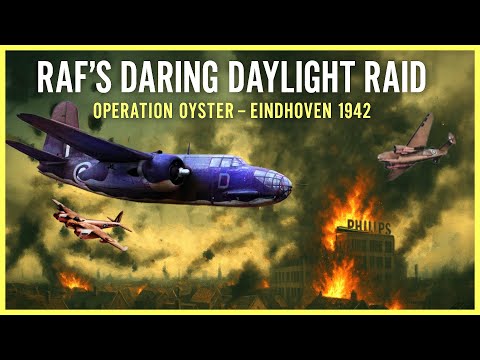
Training had been intense. For weeks, crews practiced low-level flying, skimming treetops and simulating evasive maneuvers. They drilled bombing runs on mock targets laid out to mimic the Philips complex. But no amount of preparation could fully ready them for the reality of flak, fighters, and the chaos of battle. As the bombers crossed the North Sea at treetop height, tension hung thick in the cockpits. Navigators watched the coastline of the Netherlands draw nearer, their hearts pounding. “Enemy coast ahead,” came the call. “Stay low and stay tight.” The formation tightened, each aircraft a mere wingspan from the next. One mistake could mean collision or detection. But they pressed on, the roar of their engines masked by the drone of the sea below.
Then, the Dutch coast appeared. The bombers climbed slightly to clear the shoreline, then dropped back down, racing toward Eindhoven. The first wave, the Bostons, approached the target. For a moment, the defenses seemed asleep. Then all hell broke loose. Flak batteries erupted, filling the sky with black puffs of smoke and shrapnel. “Steady, steady,” the pilots urged, their eyes fixed on the factory complex ahead. The Bostons pressed home their attack, bombs releasing in a deadly cascade. Explosions tore through the Philips works, sending debris soaring. “Direct hits! We got them!” a gunner shouted, but there was no time to celebrate. The Mosquitos were already diving in, their wooden frames slicing through the smoke. Their targets were the research labs and power stations. With surgical precision, they dropped their bombs, then strafed gun emplacements, their machine guns chattering. The Venturas followed, slower and more vulnerable, but determined. They flew through a curtain of fire, releasing incendiaries that ignited infernos across the factory roofs.
In the midst of the chaos, the cost became clear. Aircraft fell from the sky, trailing smoke. “Mayday! Mayday! I’m hit!” came the desperate calls over the radio. Some crews managed to bail out; others were not so lucky. The return journey was a nightmare of evasive maneuvers and narrow escapes. German fighters, alerted to the raid, swarmed like angry hornets. “Fighters! Twelve o’clock high!” The bombers’ gunners fought back valiantly, but the odds were overwhelming. Yet, many crews made it back, their aircraft riddled with holes, their nerves shattered, but their mission accomplished. The Philips factories were left in ruins, a smoking testament to the bravery and sacrifice of the RAF.
As the surviving bombers limped back across the North Sea, the full extent of the damage was still unknown. But one thing was certain: Operation Oyster had struck a blow that would echo through the corridors of Nazi high command. The electronics hub that had fueled the German war machine was now a burning wreck. But the victory had come at a terrible price. The skies over Eindhoven had claimed 62 airmen, and the city below had lost 150 civilians. The raid was over, but its consequences—both strategic and human—were only beginning to unfold.
The intelligence officers at RAF Number 2 Group headquarters pored over the first reconnaissance photographs with grim satisfaction. Where the Stripe Works had once stood, there was now only a skeleton of twisted girders and collapsed roofs. The Emma single workshops, struck first by the Bostons, were a cratered wasteland of shattered machinery and scorched assembly lines.
Yet the photographs revealed something else—something that would spark fierce debate in the weeks to come. Entire residential streets adjacent to the Philips complex had been flattened. The precision bombing that had been the raid’s hallmark had not been precise enough to spare the Dutch workers who lived in the shadow of the factories they toiled in. “The cost is bitter,” one intelligence officer noted in his report, “but the blow to German electronics is beyond anything we dared hope.”
In Berlin, the reaction was swift and furious. Albert Speer, the Reich Minister of Armaments, received the first damage assessments within hours. The Philips plants had produced roughly one-third of all vacuum tubes for the Wehrmacht—a figure that now seemed like a cruel joke. Production reports from Eindhoven simply stopped arriving. When couriers finally reached the site, they found a scene of total devastation: furnaces cold, assembly lines silent, and the specialized glass-blowing equipment that had taken years to install reduced to molten slag.
Speer summoned his industrial planners to an emergency meeting. The numbers were catastrophic. Radio production for the Wehrmacht would have to be cut by nearly forty percent. Radar installations along the Atlantic Wall—already stretched thin—would face months of delays. “We have been struck a blow from which we cannot quickly recover,” Speer reportedly told the assembled officials. “The British have shown us that no target is beyond their reach.”
The Luftwaffe, already reeling from the raid’s implications, scrambled to reinforce air defenses across the occupied Netherlands. Additional flak batteries were rushed to industrial sites in Amsterdam, Rotterdam, and Utrecht. Fighter squadrons were redeployed from the Eastern Front, a decision that would have consequences far beyond the Dutch border.
But the most immediate impact was felt in the corridors of RAF Bomber Command. Air Chief Marshal Arthur Harris, never one to shy from controversy, faced pointed questions about the raid’s civilian toll. The Dutch government-in-exile in London issued a formal protest, and newspapers in neutral countries decried the loss of innocent life. Harris’s response was characteristically blunt: “War is not a gentleman’s game. The Nazis built their war machine in the heart of a city. We struck that machine. If the Dutch people wish to blame someone for their dead, they need look no further than the German occupiers who put those factories there.”
Among the surviving aircrews, the mood was more somber. At RAF Marham, the men of 105 Squadron gathered in the mess to count their losses. Three Mosquitos had failed to return—six men gone. The Bostons of 88 Squadron had fared worse, losing four aircraft and twenty-two airmen. The Ventura squadrons, flying the most vulnerable aircraft in the formation, had borne the heaviest losses of all.
At RAF Feltwell, the men of 487 New Zealand Squadron stood in stunned silence as the roll call was read. Nine Venturas had failed to return. “Nine aircraft, thirty-six men,” the adjutant’s voice cracked as he spoke. “Gone.” The New Zealanders had flown into the teeth of the flak with the oldest, slowest aircraft in the formation, and they had paid the price.
For days afterward, the mess halls were quiet. Veterans who had survived dozens of missions sat staring at their cups, unable to speak of what they had seen. The smoke over Eindhoven, the desperate calls over the radio, the sight of Venturas falling in flames—these images would haunt them for years.
Yet the mission’s success could not be denied. Within a week, intelligence reports confirmed that the Philips factories were utterly destroyed. German attempts to salvage machinery from the ruins met with failure; the specialized equipment had been too badly damaged. The vacuum tube shortage that followed rippled through every branch of the Wehrmacht. Radio communications grew unreliable. Radar stations reported equipment failures. Tank crews in North Africa complained of faulty electronics in their wireless sets.
But the most significant impact was on the Luftwaffe’s defensive capabilities. The radar systems that guided German night fighters to RAF bomber streams had relied heavily on Philips components. With those supplies cut off, the night defenses weakened noticeably. RAF bomber losses over Germany dropped by nearly fifteen percent in the months following Operation Oyster—a fact that Bomber Command quietly noted but never publicly attributed to the raid.
In London, the Air Ministry convened a special committee to study the raid’s lessons. The low-level daylight precision attack had worked, but the casualties had been severe. Could the same results be achieved with fewer losses? The answer, the committee concluded, lay in better fighter escort, improved formation tactics, and more advanced aircraft. Operation Oyster became a case study in what was possible—and what was sustainable.
The Dutch people, meanwhile, endured the aftermath. The destruction of the Philips factories had been a blow to the German war machine, but it had also cost Dutch lives and livelihoods. Workers who had labored in those factories—some willingly, many under duress—now faced unemployment and destitution. The German occupiers, furious at the raid, tightened their grip on Eindhoven. Reprisals were swift and brutal. Hundreds of Dutch men were rounded up and sent to labor camps in Germany as punishment for the city’s role in the raid.
Yet in the years that followed, the story of Operation Oyster took on a different meaning for the Dutch. It became a symbol of resistance, a reminder that the Allies had not forgotten them. The factories that had been forced to serve the Nazi war machine had been destroyed, and with them, the tools of their own oppression.
In the quiet airfields of Norfolk, the men who flew the raid slowly rebuilt their squadrons. New crews arrived, fresh-faced and eager, unaware of what their predecessors had endured. The veterans taught them what they could—the low-level techniques, the formation discipline, the split-second timing—but some things could not be taught. Courage, they knew, was not a skill. It was a choice made in the moment, when the flak was flying and the fighters were diving and the only way out was through.
Operation Oyster was not the largest raid of the war, nor the most famous. But for the men who flew it, and for the city that bore its scars, it remained something else entirely: a moment when the impossible was made real, when a handful of bombers struck a blow that changed the course of the war.
The war moved on, as wars do. By 1944, the Philips works in Eindhoven had been partially rebuilt, this time under Dutch management as the tide turned. But the men who flew Operation Oyster never forgot. At reunions in Norfolk pubs, they raised glasses to absent friends and spoke in hushed tones of that ten-minute storm of fire.
“We were young, we were scared, and we did it anyway,” one veteran recalled decades later. “That’s all there is to say.”
The raid’s legacy endured—a blueprint for precision strikes, a warning about civilian cost, and a testament to ordinary men who flew into hell at treetop height. In Eindhoven today, a quiet memorial honors both the airmen and the civilians who fell. The factories rose again, but the memory of that December morning never faded.
Was Operation Oyster a triumph of precision or a tragedy of collateral damage—and can the two ever be separated in war?
Report this article
Select a reason for reporting:






