On March 23, 1918, the citizens of Paris woke to the thunder of explosions. The front lines were over 100 kilometers away, yet shells were raining down on the city. Eyes scanned the clear skies for German bombers, but found nothing. It was only after the fires were extinguished and shell fragments examined that the terrifying truth emerged: Germany had built a gun capable of striking Paris from beyond the horizon.
This was not an isolated marvel. The First World War transformed warfare beyond recognition, turning science fiction into slaughter. From the Paris Gun to the U-boat, from the R6 bomber to the Maxim machine gun, the Great War introduced weapons that would shape the century to come. This is the story of five deadly inventions that turned the front lines into death factories—and changed the world forever.
The Paris Gun was a marvel of engineering and terror. Built by repurposing naval guns from the abandoned Bayern-class battleships, it was 37 meters long—longer than any artillery piece before it. Its shells flew for over three minutes, so long that gunners had to account for the Earth’s rotation using a formula devised by French mathematician Gustave-Gaspard Coriolis—ironically, a Parisian himself. Each of its 65 rounds had to be slightly larger than the last to seal the worn barrel. In total, around 350 shells were fired, killing 250 Parisians and wounding many more. The psychological impact was immense, but the gun’s true legacy was as a harbinger of long-range terror.
While the Paris Gun struck from afar, the skies above Europe saw their own revolution. In 1914, aircraft were little more than powered gliders. Just four years later, both sides fielded multi-engine bombers capable of raining destruction on cities hundreds of miles away. Germany’s Zeppelin-Staaken R.VI was a Goliath: a biplane with a wingspan of 138 feet, a crew of 7 to 9, and a bomb load of nearly 4,500 pounds. It was larger than some World War II bombers, yet it flew on night missions because it was slow and vulnerable. Only 56 were built, but they carried out raids as far as London, laying the groundwork for the strategic bombing campaigns of the next war.
At sea, a different kind of weapon emerged. The German U-boat was not new, but the Type U-31 class perfected it. These submarines were small and inexpensive, yet they could cripple the Royal Navy’s supply lines. Four of the top five U-boat aces of the war commanded Type U-31s, with U-35 alone sinking 220 ships totaling over 500,000 tons. Their success came at a price: seven of the eleven boats were lost. But their impact was decisive, nearly starving Britain into submission and cementing the submarine’s place in modern warfare.
On land, the Maxim machine gun redefined infantry combat. Invented by Hiram Maxim, who was told that to make his fortune he should invent something to help Europeans kill each other more efficiently, the gun was adopted by the British in 1883 and later licensed to Germany as the MG08. Weighing over 140 pounds, it fired 500 rounds per minute and was responsible for repelling mass infantry assaults. On the first day of the Somme, the MG08 cut down tens of thousands of British soldiers. Its lighter variant, the MG08/15, became the standard German machine gun, with over 130,000 produced. The weapon’s design influenced generations of machine guns, including the infamous MG42 of World War II.
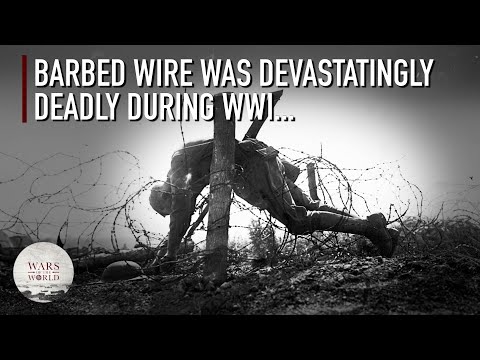
Finally, there was barbed wire—a simple invention by an Illinois farmer to keep cattle contained. Joseph Glidden could never have imagined that his wire would entangle millions of soldiers. By 1918, enough barbed wire had been laid to circle the Earth 40 times. It was cheap, effective, and brutally simple: it blocked infantry, caused festering wounds, and made no man’s land a deadly obstacle. Even artillery struggled to destroy it. Only the tank could reliably break through. Yet barbed wire remains a staple of modern warfare, a testament to the deadly ingenuity of the Great War.
These five weapons—the Paris Gun, the R.VI bomber, the U-31 submarine, the Maxim gun, and barbed wire—each played a part in the industrial-scale slaughter of 1914–1918. But their stories are only the beginning. The war would see countless other innovations, each pushing the boundaries of what was possible—and what was permissible. The Great War was a laboratory of death, and its experiments would echo for decades to come.
The Paris Gun’s reign of terror ended not with a dramatic duel but with quiet obsolescence. As German lines collapsed in the summer of 1918, the weapon was hauled back east and eventually dismantled. No surviving example remains today—every barrel was scrapped, every carriage destroyed. Yet its ghost lingered: the Allies’ Versailles Treaty explicitly banned Germany from possessing long-range guns, a clause that betrayed how deeply the weapon had shaken them.
But if the Paris Gun was a terror weapon, its true successor was already taking shape in the minds of military planners. The idea of striking an enemy’s heartland from the air—bypassing the trenches entirely—had taken root. The R.VI bomber had proven it was possible, even if just barely. Its raids on London killed fewer than 300 people, but they tied up dozens of fighter squadrons and hundreds of anti-aircraft guns that were desperately needed at the front. The math of strategic bombing was born: a cheap attacker could force an expensive defense.
The men who flew the R.VI knew they were pioneers, but they also knew they were guinea pigs. Pilots reported that the giant biplane handled like a drunken elephant, and more than one crew died not from enemy fire but from structural failure during landing. Still, the lessons learned—formation flying, night navigation, radio direction-finding—were written into the manuals of every air force that followed. When the next war came, the bombers would be all-metal, monoplanes, and capable of carrying ten times the load. But the blueprint was drawn over the trenches of France.
At sea, the U-31 class had proven something even more unsettling: that a handful of men in a steel tube could bring a global empire to its knees. By 1917, Britain was down to six weeks’ worth of grain. The Admiralty privately admitted that if the sinkings continued at their current rate, starvation would force a surrender by summer. It was a close-run thing—so close that the German High Command gambled on unrestricted submarine warfare, a decision that dragged America into the war and doomed Germany in the end.
The U-boat crews themselves were a different breed. They lived in cramped, oily darkness, breathing diesel fumes and praying that the hull would hold when depth charges rattled the plates. Of the roughly 375 U-boats Germany sent to sea, nearly half never returned. It was the most dangerous service of the war, with a casualty rate of over 60 percent. Yet volunteers kept coming, drawn by the promise of glory and the knowledge that they were striking at the enemy’s lifeline.
And the weapons they used were evolving fast. The early torpedoes were unreliable—often running too deep or failing to explode—but by 1917, German engineers had developed magnetic pistols that detonated on contact with a ship’s hull. The British responded with degaussing coils and disguised Q-ships, turning the Atlantic into a deadly cat-and-mouse game that would repeat itself in the next war.
On land, the Maxim gun had already rewritten the rules of engagement, but its true heir was yet to appear. The MG08/15 had made machine guns portable, but they were still heavy and required a crew. What the infantry needed was a weapon that could be carried and fired by one man—a personal automatic weapon. The Germans experimented with the world’s first submachine gun, the MP18, which fired pistol ammunition and could clear a trench in seconds. It arrived too late to change the outcome, but its design echoed in every subsequent generation of close-quarters weaponry.
Barbed wire, too, had a successor. The tank had proven it could crush a path through the wire, but the wire itself was adapting. German engineers developed concertina wire—coils that sprang open when disturbed—and razor wire with blades sharp enough to slice through leather gloves. These improvements would be used in the next war, in prison camps, and along borders from Korea to Berlin.
The Great War had ended, but its weapons had not. They had been tested, refined, and stockpiled. The men who had built them had learned a terrible truth: that the fastest way to advance technology is to find a more efficient way to kill. And as the world entered an uneasy peace, the next generation of weapons was already being sketched on drafting tables from Tokyo to Washington.
When the guns finally fell silent on November 11, 1918, the world surveyed the wreckage and counted the cost. Nearly ten million soldiers were dead, twenty million more wounded, and four empires had collapsed into dust. The weapons that had done this—the Paris Gun, the R.VI, the U-31, the Maxim, the barbed wire—were not merely tools of destruction. They were prophets of a new age.
The men who survived came home changed. Many had learned to hate the machines more than the enemy. A British officer wrote that he could no longer look at a Maxim gun without hearing the screams of the Somme. A German U-boat captain confessed that he dreamed of drowning men clawing at the hull. The weapons had done their work too well—they had broken not just bodies, but souls.
Yet the world did not stop. The treaties that ended the war placed limits on battleships and guns, but they said nothing about airplanes or submarines or machine guns. The loopholes were deliberate. Every nation wanted an edge, and the lessons of 1914–1918 were clear: he who innovates fastest wins. The race that had begun in the trenches of France would continue in the laboratories of the 1920s and 1930s.
By the time the next war came, the weapons had grown monstrous. The Paris Gun’s descendants could hit London from the French coast. The R.VI’s children carried five tons of bombs and flew at 300 miles per hour. The U-31’s heirs prowled the Atlantic in wolf packs, and the Maxim’s grandchildren fired 1,200 rounds per minute. Barbed wire still lined the beaches of Normandy, and it still tore flesh from bone.
The Great War was supposed to be the war to end all wars. Instead, it was the first draft of a century of slaughter. The five weapons we have examined were not just inventions—they were the opening chapters of a story that would repeat itself with terrifying precision. And the men who built them, from Hiram Maxim to the engineers of the Paris Gun, had shown the world a terrible truth: that in the modern age, the fastest path to progress runs through the battlefield.
So the question remains—and it is not a comfortable one. If the weapons of 1914–1918 could change the world forever, what will the weapons of tomorrow do? And more importantly, will we ever learn to stop building them?
What do you think—are we doomed to repeat the arms race of the Great War, or can humanity break the cycle? Share your thoughts in the comments below.
Report this article
Select a reason for reporting:






