April 1945. The Arizona desert burned white beneath a merciless sun. Traudl Ketner stood in the dust, her uniform torn, her hands raw, her heart slamming against her ribs like a trapped bird. She had been warned her entire life: the Americans would cut off her fingers for sport, starve her, beat her, break her bones one by one. She had prepared herself to die.
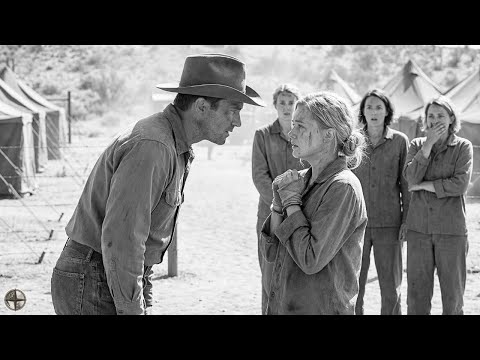
But the man walking toward her wore no anger. Dusty boots. A cowboy hat. He stopped three feet away, looked her straight in the eyes, and spoke three words. The guards behind him went silent. The women around her froze. Even the wind stopped moving. Those three words hit harder than any bullet ever could.
Two years earlier, in a chalk-dusted classroom outside Munich, Traudl sat with her spine pressed flat against the wall. She was 22, a trained nurse with steady hands and a heart taught to beat quietly. The instructor paced like a predator. “If you are captured by the Americans, you will not survive,” he said. “They will use you. They will break you. And when they are finished, they will discard you like refuse.” She did not blink. She had heard it all before.
By 1943, over 750,000 German women had been deployed in auxiliary roles. Traudl was sent to a medical station near the Belgian border, where she sewed flesh back together and learned to sleep standing up. Then the Allies came—not with gunfire first, but with engines, a low grinding roar that seemed to come from everywhere at once.
The retreat was chaos. Her unit scattered like seeds in a storm. She ran through a forest she did not recognize, her lungs burning, until she fell and could not get up. The Americans found her at dawn, curled beneath a fallen oak. She waited for the shot, the blade, the cruelty she had been promised.
Instead, a young soldier with a boy’s face knelt beside her, offered his canteen, and said something she did not understand. His voice was not hard. His hands did not strike. She drank, and in that single, impossible moment, everything she had ever believed began to crack.
But the worst was yet to come. A ship. An ocean. A country she had only known through nightmares. The USAT General Meigs was not built for comfort. Below deck, over 300 women were packed into a dark, hot hold, the air thick with salt, sweat, and despair. For 11 days, Traudl counted the rivets in the ceiling—143—to keep her mind from breaking.
On the 11th day, the engines changed pitch. The hatch opened. Sunlight poured in like a slap. “Up,” a voice said in broken German. “Everyone up. We’ve arrived.”
Traudl stepped off the transport truck and into the Arizona sun. The heat hit her like a wall. She saw barbed wire first, but it sagged lazily between wooden posts. Beyond the fence, the desert opened wide and empty—red dirt, low scrub, distant mountains painted on the horizon. It didn’t look like a prison. It looked like the end of the world.
Then she saw the guards. They wore wide-brimmed hats and scuffed boots. One leaned against a post, chewing a piece of straw. They looked like cowboys. One of them nodded as the women walked past. Another tipped his hat. It made no sense.
Inside barrack four, Traudl found a cot with a folded blanket and a pillow. An older woman with gray streaks in her hair looked up. “It’s not what they told us, is it?” Traudl said nothing. She sat slowly, hands in her lap, and stared straight ahead. She didn’t trust this—any of it.
That evening a bell rang—not a siren, just a low, dull clang like a dinner bell on a farm. In the mess hall, a guard handed her a metal tray: warm bread, stew with beef and potatoes, a cup of water, and an apple. An apple. She hadn’t seen fresh fruit in over a year. Her hand shook as she lifted the spoon.
On the third day she saw the name stitched above his pocket: Emmett. He moved through the camp like water, steady, unhurried. When he passed the women, he tipped his hat, just slightly, the way a man might greet a neighbor. It unnerved her more than cruelty ever could.
Then came the blanket, folded at the foot of her cot. The soap that smelled of lavender. The pencil. She wrote her name—Waltraud Kettner—and the letters came out shaky, but something loosened in her chest.
On a Tuesday morning, a young woman named Annie collapsed in the dust. Traudl dropped to her knees, checking pulse, airway, temperature. Then boots crunched across the gravel. Emmett stopped a few feet away, looked down at the girl, then at Traudl. The world went quiet. And he spoke three words, soft, steady, certain.
“Ma’am, you’re safe.”
Not prisoner. Not enemy. Ma’am. Kindness, she realized, was more powerful than cruelty. Cruelty confirmed what you already believed. Kindness shattered everything.
That night she wrote to her mother: “He said I was safe, Mama, and I believed him.” The letter never left the camp—it sat in a Virginia storage facility for forty years before being destroyed. But for months, believing it was on its way gave her something to hold.
In August 1945, the war ended. By November the camps emptied. Traudl stood at the gate of Camp Florence, the wool blanket folded inside her bag. She looked for Emmett, but his shift had ended the night before. She would never see him again.
Germany was rubble. Her mother was alive, thin and gray. “You came home,” she whispered. “I came home.”
Decades later, at a kitchen table, Traudl finally told her daughter Matilda about the cowboy who never raised his voice. “He really said that? You’re safe?” Matilda asked. “And you believed him?” Traudl smiled—soft, weighted. “Yes. I believed him.”
She kept the blanket until she died in 1996, still carrying the faint smell of desert dust. Emmett returned to his ranch in New Mexico, raised cattle, fixed fences, played his harmonica on quiet nights. They never met again, but they carried each other forward—because sometimes the greatest weapon is not a bomb. It’s mercy.
What small act of kindness has ever shattered something hard inside of you?
Report this article
Select a reason for reporting:






