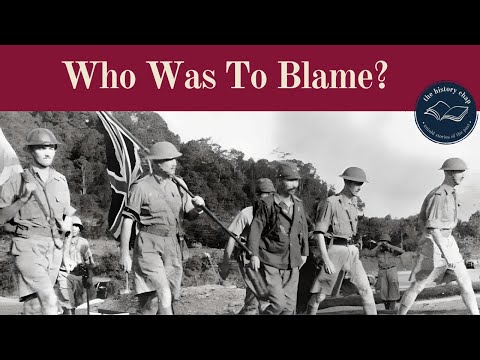
On February 15, 1942, the British flag was lowered over Singapore, and 85,000 troops—British, Australian, Indian, and local volunteers—marched into captivity. It was the largest surrender in British military history, a catastrophic blow that shattered the myth of British invincibility in Asia and condemned thousands to years of brutal imprisonment. The question that has haunted historians ever since: how did an army that outnumbered the Japanese two to one suffer such a humiliating defeat? And was Lieutenant General Arthur Percival, the man in command, truly to blame?
The seeds of disaster were sown long before the first shot was fired. In the 1920s and 1930s, Britain pinned its hopes on the “Main Fleet to Singapore” strategy—a plan that assumed the Royal Navy could rush to the colony’s defense within 70 days. But as financial pressures mounted and war loomed in Europe, the fleet was never stationed in the Far East, and the island’s defenses were left critically underfunded. The RAF, meant to provide air cover, was equipped with obsolete Brewster Buffaloes, while the Army lacked tanks, modern aircraft, and even basic fortifications. As one officer bleakly noted, Singapore was a “fortress” in name only.
Yet even as the storm clouds gathered, complacency reigned. Many British commanders dismissed the Japanese as inferior fighters, racially prejudiced and overconfident. Major General William Dobbie had warned as early as 1937 that the Malayan jungle was not impenetrable and that an attack from the north was inevitable, but his report was ignored. When Percival arrived in April 1941, he inherited this hollow shell of a command. A decorated World War I veteran and a brilliant staff officer, Percival was meticulous and rule-abiding—but he lacked the aggressive drive needed to shake up the complacent establishment. As one contemporary observed, “he was excellent in any role that didn’t involve contact with troops.”
Percival’s tenure was marked by missed opportunities. His chief engineer, Brigadier Ivan Simpson, repeatedly pressed for defensive works—both on the mainland and on Singapore’s northern shore—but Percival refused, fearing it would alarm civilians and troops. Even when the Japanese invaded Malaya on December 8, 1941, Percival hesitated to launch Operation Matador, the pre-emptive move into Thailand that could have disrupted the landings. Instead, he waited for confirmation, and by then it was too late. The Japanese, battle-hardened from years in China and commanded by the audacious General Tomoyuki Yamashita, advanced with terrifying speed, using bicycles and jungle infiltration to outflank British positions. “The Japanese were not built to be natural flyers,” Air Chief Marshal Robert Brooke-Popham had scoffed—a sentiment that epitomized the racial hubris blinding the British high command.
As the Japanese swept down the Malay Peninsula, Percival’s forces—poorly trained, ill-equipped, and outnumbered in the air—fell back in disarray. The sinking of HMS Prince of Wales and HMS Repulse on December 10 shattered naval hopes, and by the end of January 1942, the British had retreated to Singapore Island. Still, Percival refused to fortify the island’s northwest coast, convinced the main attack would come from the northeast. It was a fatal miscalculation.
But was Percival solely responsible? His superiors—Brooke-Popham, General Archibald Wavell, and even Winston Churchill—had all contributed to the debacle. Churchill had diverted tanks to the Soviet Union rather than Malaya, and Wavell had interfered with Percival’s battle plans, only to step back when it mattered most. The Japanese, meanwhile, displayed superior tactics, motivation, and a willingness to take risks that the British lacked. As Yamashita later remarked, his soldiers won because they had “more desire to win.”
In the end, Percival surrendered on February 15, 1942, with the fate of 85,000 men in his hands. He went into captivity with them, and after the war, he lived quietly, never fully escaping the shadow of Singapore. The debate over his culpability continues—was he a scapegoat for a systemic failure, or a commander out of his depth? The answer, perhaps, lies somewhere in between.
To understand how that surrender unfolded, it helps to step back and examine the men and decisions that shaped the campaign. Percival’s path to Singapore was paved less by battlefield brilliance than by the quiet competence of a staff officer. Wounded at the Somme and decorated with the Military Cross, he had spent the interwar years in appointments where his meticulous nature thrived—far from the chaos of frontline command. His mentor, Colonel John Dill, later Chief of the Imperial General Staff, had opened doors for him at every turn. When Dill recommended him for the Malaya command in April 1941, Percival arrived with a reputation for order and procedure, not for fire.
That temperament would prove disastrous. Duff Cooper, the resident minister in the region, captured the problem with a memorable image: “It was all a field day at Eton to him. He knows the rules and he follows them closely, and is waiting for the umpire’s whistle to blow for the ceasefire.” In a war that demanded improvisation and ruthlessness, Percival played by the book—a book the Japanese had never read.
His subordinates were not blind to this. Brigadier Ivan Simpson, the chief engineer, had watched with mounting alarm as Percival refused to authorize defensive works. When Simpson presented a five-point plan to bolster Singapore’s defenses, Percival rejected it without explanation. A few months later, in August 1941, Simpson tried again, requesting permission to build fortifications in Johor, the state directly across the strait. Percival refused once more, arguing it would damage morale. The irony was bitter: the south and east coasts were already bristling with guns, yet the north—the direction from which any land attack must come—lay open.
The Royal Navy’s contribution was equally hollow. In late 1941, Churchill dispatched the battleship HMS Prince of Wales and the battlecruiser HMS Repulse to Singapore as a deterrent. The carrier HMS Indomitable was meant to accompany them, but she ran aground and was under repair in Virginia. When the two capital ships arrived on December 2, they represented a pale shadow of the mighty fleet the strategy had promised. Their sinking eight days later by Japanese aircraft—covered in detail in a previous episode—left Singapore without any naval shield at all.
On the ground, the Japanese advance was relentless. At the Battle of Jitra in northern Malaya, two brigades of the 11th Indian Division held a defensive line under Major General Murray-Lyon. Percival believed he faced an entire Japanese division; in reality, just two battalions broke through. Over three days, the position collapsed into a rout. Through the rest of December, the Japanese drove south using bicycles along jungle tracks, repeatedly outflanking British and Indian positions. At the Slim River in early January, two Indian brigades were practically annihilated in a night attack spearheaded by tanks—over 500 killed and 3,000 captured.
Kuala Lumpur fell on January 10. Churchill, alarmed, began to contemplate abandoning Malaya altogether and withdrawing onto the island fortress. Yet Percival still had not ordered a single defensive line on Singapore’s northern shore. Instead, he planned a decisive battle at Johor on the mainland—a plan endorsed in principle by the new commander, General Archibald Wavell, who nonetheless harbored doubts. “He has the knowledge but not the personality to carry through a tough fight,” Wavell observed privately. By contrast, the Australian general Gordon Bennett, with his bombastic claim that one Australian was worth ten Japanese, struck Wavell as exactly the fighting spirit needed.
That admiration would have consequences. Wavell overrode Percival’s troop dispositions, moving the Australians west for the coming battle and placing Bennett in command on the ground rather than the more experienced General Lewis Heath. On January 14, the Australians fought well, inflicting 600 casualties in an ambush at a bridge crossing. But the next day, a Japanese amphibious landing outflanked the 45th Indian Brigade, and Bennett’s force was encircled. Only 500 of 3,000 men escaped.
Wavell accepted the inevitable: Malaya was lost. Percival must pull every man back onto Singapore Island. Yet even as the retreat began, no serious defenses were being built. On January 19, Churchill cabled Wavell insisting that Singapore be held—British honor was at stake, and the Americans, making their last stand at Bataan, were watching. Reinforcements began to arrive: 7,000 raw Indian recruits on January 22, then 1,900 untrained Australians, and finally the British 18th Division on January 29—troops originally bound for North Africa, diverted after three months at sea and still wearing desert uniforms. With them came a single squadron of light tanks, the only armor Percival would possess in the entire campaign.
These arrivals were met by the sight of the retreating army streaming across the causeway. The withdrawal nearly ended in catastrophe when a sapper sergeant, ordered to blow the bridge at midnight on January 30, prepared to detonate it while thousands were still on the mainland side. An Australian officer, John Wyatt, drew his pistol and forced a delay. In the early hours of January 31, the Argyll and Sutherland Highlanders marched across, led by their two remaining pipers playing Highland Lament. Then the engineers blew a seventy-foot section of the causeway. The Battle of Malaya was over. The Battle of Singapore was about to begin.
Percival now commanded 85,000 men on the island—38 infantry battalions, three machine-gun battalions, nine artillery regiments, and 152 anti-aircraft guns. He had food for three months and mountains of ammunition. But 15,000 of those men were non-combatants, thousands more were wounded, and over 10,000 were raw recruits who had never fired a shot in anger. Opposing him was an army of just 30,000.
Yet Percival misread the Japanese once more. He assumed he had weeks to prepare, but within seven days Yamashita’s men had hauled 150 landing craft down the peninsula. Percival placed his strongest forces in the northeast, around the causeway and naval docks. Wavell, remembering his earlier interference had gone badly, stayed silent—though his gut told him the attack would come from the northwest. Just three Australian battalions stood guard there.
On February 8, the Japanese unleashed 880,000 shells on that thin Australian line. Percival, still convinced it was a decoy, held his troops in the east. At 8:45 p.m., 13,000 Japanese stormed ashore. By dawn, another 10,000 followed. The Australians fought desperately, but reinforcements were pitiful—460 Highlanders, 200 Royal Marines, and 400 Hyderabad soldiers. By February 9, the Japanese had captured Tengah airfield.
Churchill’s cable was blunt: “The battle must be fought to the bitter end at all costs.” But the end came fast. The Durong line collapsed; Bukit Timah fell on February 11, along with Percival’s main food and fuel depots. The reservoir was seized. Brigadier Simpson warned the city’s water would run out in 48 hours. Japanese troops bayoneted 250 medical staff and patients at the Alexandra hospital—some still on operating tables.
On February 15, with one million civilians and troops crammed into a shrinking enclave, Percival met his commanders. He proposed a counterattack to retake the reservoirs and supply dumps. Not a single one of the twelve senior commanders backed him. All voted to surrender. At 5:15 p.m., Percival formally capitulated. Yamashita, bluffing about his own dwindling supplies, banged the table and demanded immediate terms. Percival fell for it.
So was Percival to blame? He made fatal errors—misjudging the northwest attack, refusing to reinforce the Australians, blocking Simpson’s defenses. But Churchill had diverted tanks to Russia; Brooke-Popham had dismissed the Japanese as poor flyers; Wavell had interfered, then stepped back. The Main Fleet strategy was never funded. As Napoleon said, “I would rather have a general who is lucky than one who is good.” Percival was neither.
He spent the war in captivity, then lived quietly until 1966, serving as president of the Far East POW Association. The fall of Singapore remains a lesson in complacency, underinvestment, and racial hubris. But the question lingers: was Percival a scapegoat for a systemic failure, or a commander who simply should never have been there? What do you think—does the blame lie with one man, or with an entire empire that refused to see the truth?
Report this article
Select a reason for reporting:






