June 1940. Franz Wesper stood at the edge of the Canadian prisoner camp and stared at nothing. There was no barbed wire. No guard towers. Just open fields stretching to the horizon. He turned to the Canadian guard nearby. “Where is the fence?” he asked in broken English. The guard shrugged. “You can go for a walk if you want. Just be back by dinner.” Franz’s blood ran cold. It had to be a trap. They wanted him to run so they could shoot him in the back. That’s what guards did—or so he’d been told.
Just weeks before, Franz had been a soldier in the German army. He believed in the cause. He believed the lies: that enemies were cruel, that prisoners would starve, that Germany was superior. But then his unit was captured, and everything he knew began to unravel.
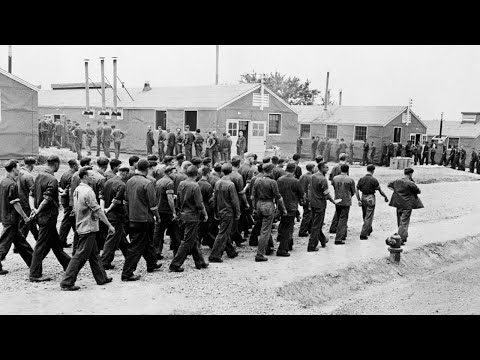
The journey to Canada felt like a dream. They were loaded onto a ship, crossed the Atlantic, then boarded real passenger trains—not cattle cars. Franz pressed his face against the glass and watched Canada roll by. Forests that seemed to go on forever. Rivers as wide as roads. Towns with clean streets and cars parked outside houses. This didn’t look like a weak country. It looked rich. Organized. It looked like it worked.
The train stopped in Lethbridge, Alberta. Guards marched the prisoners down a dirt road. Franz expected walls, towers, searchlights. Instead, he saw wooden buildings in neat rows, a Canadian flag flapping in the wind, and guards standing around talking. And he saw that impossible thing: no fence. No wall. Nothing to keep them in.
An officer spoke in German. They would follow rules, work if asked, but be treated fairly under international law. The camp had no fence, he explained, because there was nowhere to run. They were a thousand miles from Germany. Escape meant death in the wilderness. It was safer to stay.
Franz looked at the other prisoners. Confusion. Whispering. One older soldier laughed—a hollow, terrible laugh. The guards led them to their barracks. Franz expected straw on the floor. Instead: clean wooden structures, real beds with two blankets each, windows with glass, a stove for heat. It looked better than some German army barracks he’d slept in.
That first night, Franz lay in bed staring at the ceiling. Outside, he heard the wind across the prairie, guards talking and laughing. Nothing sounded like a prison. And that scared him more than barbed wire ever could.
The next morning, a bell rang at 6:00. Franz shuffled to the dining hall with the others. The smell hit him before he walked through the door: bacon. Real bacon frying. His mouth watered. His stomach growled. Inside, long tables filled the room. Canadian cooks stood behind a counter with huge pots. A cook waved him forward and piled his plate with scrambled eggs, three strips of bacon, two pieces of toast, real butter, and a cup of coffee. Sugar on the table—actual white sugar.
Franz sat down and stared. This was more food than he’d eaten in a single meal in months. Maybe years. He took a bite. The eggs were hot and fresh. The bacon crispy. The toast had real butter that melted into the bread. Around him, other prisoners ate the same way. Some had tears in their eyes. Nobody spoke. They just ate.
Later, Franz learned they’d get three meals like this every day. Lunch might be soup and sandwiches with meat and cheese. Dinner could be chicken or beef with potatoes and vegetables. Sometimes pie. On Sundays, extra portions. A guard said each prisoner received about 3,000 calories per day. Franz didn’t know exactly what that meant, but he knew it was a lot. Back in Germany, his mother’s letters talked about food shortages, ration cards that didn’t stretch far enough, bread made with sawdust. She was probably eating half what he ate now. Maybe less.
The second shock came that afternoon. A guard told Franz he could walk around the camp. Franz asked how far he could go. The guard pointed to a line of white stones about 200 feet past the last building. “Don’t cross that line,” he said. “Everything on this side is fine.” Then he walked away. He didn’t watch Franz. He didn’t follow him. He just left.
Franz walked slowly toward the edge of camp. His heart beat fast. This had to be a test. But when he reached the white stones, nothing happened. No alarm. No guards came running. He looked out at the prairie—miles and miles of grass and sky. He could just walk into that. He could try to run, but where would he go? The guard was right. There was nothing out there but empty land. And even if he walked for days, he would still be in Canada, still thousands of miles from home.
Over the next few weeks, Franz discovered even stranger things. Some prisoners got to work on local farms. Canadian farmers came to the camp and asked for workers. Guards picked men who seemed trustworthy and drove them out to the fields. The prisoners picked potatoes or gathered hay or fixed fences. The farmers gave them water and sometimes snacks. They treated the German prisoners like regular farmhands. At the end of each day, the farmers paid them 50 cents. The money went into special accounts in Switzerland that they could access after the war.
One prisoner named Klaus came back from a farm and told an impossible story. The farmer had handed him a shotgun—a real gun with real shells. The farmer wanted Klaus to shoot gophers that were eating the crops. Klaus held that gun and realized he could have shot the farmer. He could have run, but he didn’t. Where would he go? And besides, the farmer had given him cold lemonade and a ham sandwich for lunch. The farmer’s wife had waved at him. Their kids played in the yard nearby. Klaus shot the gophers and gave the gun back at the end of the day. The farmer thanked him and said he could come back next week.
Inside the camp, life got even more confusing. The Canadians set up a recreation hall with books and games. Someone donated a piano. Prisoners who knew how to play gave concerts. Other men formed a theater group. They practiced German plays and put on shows. The guards came to watch. Everyone clapped at the end. Franz went to one show and sat there in the dark listening to actors speak his language and perform a comedy. He laughed. Then he felt guilty for laughing. Then he felt confused about feeling guilty.
There were sports, too. The prisoners organized soccer teams. Different barracks played against each other. They made a league with standings and scores. Guards helped them mark out a proper field. Someone found real soccer balls. On Saturday afternoons, prisoners played matches while other prisoners cheered. It felt like being back in school. It felt normal. And that was the problem. How could prison feel normal?
The medical care shocked Franz most of all. A prisoner named Josef got a bad toothache. The pain got so bad he couldn’t eat. Guards took him to the camp hospital. A real Canadian dentist looked at the tooth. The dentist said it needed to come out. They gave Josef medicine so it wouldn’t hurt. They pulled the tooth. They gave him more medicine for after. They didn’t charge him anything. Josef came back and told everyone the dental chair was newer than anything he had seen in Berlin. The tools were clean and shiny. The dentist was kind.
Another prisoner broke his arm during a soccer game. They took him to the same hospital. A Canadian doctor set the bone and put on a cast. The doctor checked on him every few days. The arm healed perfectly. The prisoner said the hospital had x-ray machines and proper operating rooms. He said it was better equipped than military hospitals he had seen in Germany.
At night, Franz lay in his warm bed under his two blankets and tried to make sense of it all. He was a prisoner of war. He was supposed to be suffering. He was supposed to be punished. Instead, he was gaining weight. His skin looked healthier. His teeth were getting fixed. He played soccer on Saturdays. He ate three hot meals a day. He could walk almost wherever he wanted. He went to plays and concerts. Meanwhile, his letters from home got worse each week. His mother wrote about air raids. His brother wrote about food shortages. His sister wrote about factories being bombed. Germany was supposed to be winning. Germany was supposed to be strong. So why did the losers have so much? Why did the enemy treat him better than his own country treated its people?
Franz stared at the dark ceiling and felt something crack inside his mind. A small crack, just the beginning, but it was there.
Snow came to Lethbridge in December 1943. Franz had been a prisoner for three and a half years. The war still raged, but inside the camp he lived in a different world. His barracks stayed warm. He had three blankets now, a coat, wool socks. His mother’s letters spoke of rationed coal, of wearing her coat indoors, of going to bed early because it was too cold to stay up. Franz read those letters in his warm room and felt something heavy in his chest.
On Christmas Eve, the guards seemed excited. They hung paper chains and set up a small tree. At lunch the commander announced a special dinner, with guests from town. Franz didn’t know what that meant. He tried not to think about home.
That evening, warm air rushed over him as he entered the hall. Roasted meat, baked bread, something sweet, pine, candles. White cloths covered the tables. Real plates and glasses. The food came out on huge platters—turkey, glazed ham, mashed potatoes, fresh rolls, cranberry sauce. Franz ate until his stomach hurt, then ate more. It felt wrong to stop.
After dinner, townspeople walked in carrying boxes. A gray-haired woman stopped at Franz’s place and handed him a package. “Merry Christmas,” she said. Inside was a dark blue wool scarf, handmade. She smiled, patted his shoulder, and moved on. Franz held it with shaking hands. She had knitted it for him—the enemy—with care.
Someone began singing “Stille Nacht.” More voices joined. Then the Canadian guards sang in English. Two languages mixed together, singing the same song about the same hope. Franz looked around through wet eyes—full stomachs, gentle faces, the candlelit tree—and understood something that flipped his world upside down. These people didn’t hate him. They pitied him. They knew he had been lied to.
He thought of his mother eating bread with sawdust, his brother in a bombed factory, his sister hiding in basements. And here he sat, the enemy prisoner, full of turkey and ham, warm and safe, holding a scarf from a woman who had no reason to be kind. The lie became clear. How could Germany be superior when it couldn’t feed its own people? How could any of it be true when the evidence was in front of him every single day?
That night Franz lay holding his new scarf. He had gained thirty pounds while his country starved. The crack in his mind split wide open. There was no going back. He stopped being a soldier who believed in the cause. He became just a man who saw the truth.
May 1946. The war was over. Franz stood on the dock in Halifax, carrying a small bag: English textbooks, a farming manual, photographs of the camp, and the blue scarf, worn soft from use. The ship pulled away and Canada grew smaller. Nobody talked much. They all knew what waited—rubble, hunger, a divided country.
Hamburg was a graveyard. Buildings stood like broken teeth. People walked like ghosts. It took Franz three days to reach his hometown. When his mother opened the door, she barely recognized him—then she screamed, then cried, then touched his face. “You’re so healthy,” she kept saying. She made tea from dried leaves and put a small piece of bread on a plate. “This is half my ration for today. But you need to eat.” He pushed it back. They argued. Finally they split it. Neither piece was enough.
Rations were 1,200 calories a day—less than half what he got as a prisoner. His brother was dead in Russia. His sister’s husband was gone. A neighbor spat, “You got fat while we starved.” Franz understood the anger. None of it was fair. At night he lay on a thin mattress in his childhood room, cold and damp, and had a thought that made him feel like a traitor: he missed Canada. He missed being a prisoner of war. There he had food, friends, hope. Here he had ruins.
He used his farming skills, paid in potatoes, sometimes an egg, giving most to his mother. In 1948 he heard former prisoners were returning to Canada—over six thousand made that choice. Franz thought about it every day. But his mother, his sister, the duty to rebuild—he stayed. He kept his English books, his photographs, the blue scarf. On hard days he took them out and remembered.
Years later, he told his grandchildren about the camp with no fences, the guard who said, “You can go for a walk if you want,” the Christmas dinner that changed everything. “Canada won the war before they ever fought us,” he said. “They defeated us, not by breaking our bodies, but by proving we had been lied to all along. The strongest prison isn’t made of wire and walls. It’s made of lies you believe about yourself and others. And the only way to escape is for someone to be kind enough to show you the truth.”
Franz lived until 1984. He never returned to Canada, but he never forgot it. In his mind he could still taste that turkey, feel that stove’s warmth, hear “Silent Night” in two languages, see the face of a woman who gave him a scarf for no reason except that it was Christmas and he was human. Sometimes the greatest weapon isn’t violence—it’s showing your enemy they were wrong about you. And maybe, just maybe, wrong about everything.
What would you have done in Franz’s place—stayed to rebuild, or returned to the country that showed you kindness? Share your thoughts below.
Report this article
Select a reason for reporting:






