The desert sun beat down like a hammer, and the sandstorm clawed at their eyes, but the men of the 18th Brigade knew there was no turning back. Before them lay the fortress of Giarabub, a stronghold the Italians had spent 15 years fortifying into an impregnable bastion. Behind them, nothing but the vast, unforgiving Sahara. They were 400 Australians, outnumbered nearly five to one, with no tanks, no air support, and machine guns that jammed with every gust of wind. Yet Brigadier George Wootten had a plan—a daring, audacious plan that would either become a legendary victory or a catastrophic failure.
The Italians, commanded by the ruthless Colonel Salvatore Castagna, were confident. They had 2,500 troops, artillery, and layers of barbed wire and trenches. But they had never faced an enemy quite like this. As the Australians moved into position under the cover of a fierce sandstorm, the stage was set for one of the most improbable battles of World War II.
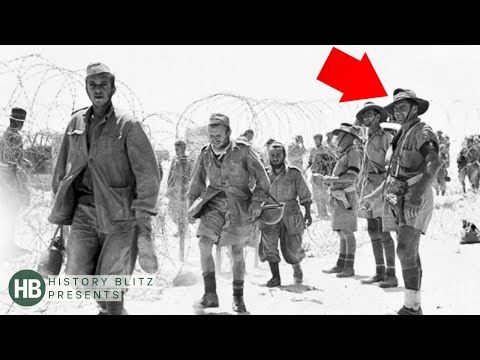
The odds were stacked against them, but the Australians were not ordinary soldiers. They were tough, resourceful, and driven by a fierce determination to overcome. In the days leading up to the assault, they had probed the Italian defenses, disrupted supply lines, and even captured key outposts. Each small victory chipped away at the Italians’ confidence, and each raid brought the Australians closer to the heart of the fortress.
But the final push would require more than just bravery. It would demand ingenuity, coordination, and a willingness to sacrifice everything. As the men of the 2/9th Battalion prepared to charge into the teeth of the Italian defenses, they knew that the world was watching—and that the fate of the North African campaign hung in the balance.
The sandstorm howled, the artillery roared, and the Australians surged forward. What happened next would echo through history—a testament to courage, resilience, and the indomitable spirit of a force that refused to be beaten.
At 5:15 a.m. on March 21st, the earth shook as twelve 25-pounder guns of the Royal Horse Artillery opened fire. For ten minutes, shells rained down on the Italian forward positions, tearing through wire and trench alike, before the barrage shifted to the second objective. Under the deafening roar, A and C Companies rose from their start lines and surged toward the enemy wire, their Bren guns chattering through the swirling dust.
But the desert had other plans. The same sandstorm that provided cover also played havoc with the artillery. Wind-whipped shells fell short, and one salvo crashed directly into A Company, killing twelve men in an instant—including Captain R.F. Riedel, who had led his men to within fifty meters of the Italian wire. Twenty more were wounded, their screams swallowed by the gale as soldiers scrambled for whatever cover the barren ground offered.
Chaos threatened to unravel the assault. Yet in the midst of the carnage, Corporal A. Calvert gathered a handful of survivors and plunged through the gap in the Italian wire, his small team vanishing into the smoke. Lieutenant W.H. Noise’s platoon, relatively untouched by the friendly fire, pushed forward and linked up with C Company under the wounded Captain Barry, who despite his injuries waved his men toward the first line of defenses.
The Italians, stunned by the bombardment and the ferocity of the assault, offered only scattered resistance. By 7:26 a.m., word reached Brigade headquarters: the 2/9th Battalion had taken the four northern posts. But the cost had been steep, and A Company was disorganized, its survivors scattered across the wire.
On the northern front, the Cavalry thundered down Pipsqueak Valley, raising dust and firing into the Italian flank. Their diversion worked—Italian commanders, uncertain where the main blow would fall, hesitated to commit their reserves. By 9:00 a.m., the Cavalry had secured a line running through a position the Australians had nicknamed Eggbert, completing their objectives with barely a fight.
Back at the southern redoubt, D Company pushed through the cultivated area northeast of the town, only to be halted by a minefield spotted days earlier by an RAF Lysander. Sappers cleared a narrow path under fire, and at 11:25 a.m., the 2/9th Battalion began its general advance into the town itself. They entered the mosque—left undamaged, per orders—and pressed on toward the fort.
By midday, the black and blue standard of the 2/9th Battalion fluttered above the Italian fort. The siege of Giarabub was over. Brigadier Wootten had achieved his objective within the designated time frame, with minimal losses, and among the captured officers was Colonel Castagna himself, wounded and supported by his loyal attendant.
But as the Australians secured the oasis, a strange quiet settled over the desert. The victory was total—yet the men who had fought it knew the campaign was far from finished. Beyond the horizon, greater challenges awaited, and the lessons of Giarabub would soon be tested in battles yet to come.
The prisoners were led away in long, weary columns, their shadows stretching across the sand as the sun began its slow descent. Some of the Australians sat on the captured Italian guns, too exhausted to speak, staring at the fort they had taken against every reasonable expectation. The black and blue standard snapped in the wind, a small flag over a small oasis, but to the men who had fought there, it meant everything.
Brigadier Wootten walked the battlefield that evening, his stomach still churning from the illness that had nearly kept him from the fight. He looked at the wire, the trenches, the abandoned artillery—all of it now silent. “We did it,” he murmured, more to himself than to anyone. “We actually did it.”
Colonel Castagna, wounded and captured, was said to have asked how such a small force had achieved what a garrison of thousands could not. The answer was simple, though it would take historians decades to fully unpack: audacity, planning, and men who refused to accept the odds.
Within weeks, the 18th Brigade would be withdrawn from the desert, their thoughts turning toward Greece and the next fight. Giarabub would fade into the vastness of the Sahara, its importance measured not in territory gained, but in the spirit it forged.
The Australians had proven that courage and ingenuity could overcome even the most formidable defenses. And as the last trucks rolled out of the oasis, the desert swallowed the echoes of battle, leaving only the wind and the sand—and the memory of what a few determined men could do.
What would you have done, standing at the wire with the sandstorm in your eyes and the odds stacked against you? Let us know in the comments below.
Report this article
Select a reason for reporting:






