The German sergeant had counted to five. For three years on the Eastern Front, that count had meant survival—the enemy’s rifle would click empty, and in that pause, his K98k would speak. But on June 11, 1944, south of Carentan, the sixth shot rang out. Then the seventh. Then the eighth. There was no pause. There was no window. There was only the relentless, distributed fire of American rifles that never seemed to reload.
That moment—a single German NCO behind a red-hot MG 42, waiting for a silence that never came—was the collision of two military philosophies, one already a decade out of date. It was the instant when three extra bullets in an American clip became the difference between living and dying.
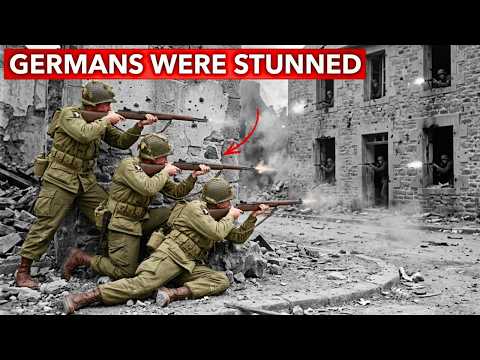
Lieutenant Colonel Robert Cole stood up in the artillery-blasted field and ordered a bayonet charge. More than 250 American paratroopers ran directly at the German position, each one pulling the trigger of a rifle that still had bullets in it. The German sergeant did not live to see them arrive. He died because he counted the way he had been taught—and the way he had been taught was already obsolete.
This is not a story about a miracle weapon. It is a story about a system—a distributed system of firepower that the Wehrmacht refused to acknowledge for ten years. The Germans believed the machine gun was the heart of the battle. The Americans did something no one expected: they killed the very idea of a heart.
To understand why that German sergeant died counting, we must return to 1934, when Germany decided how it would fight the next war. Both Germany and America drew the same conclusion from World War I: the infantry of the future would need vastly more firepower. The question was how. The two nations chose paths that ran in opposite directions—and that choice would determine the fate of millions.
Germany bet everything on the general-purpose machine gun: first the MG 34, then the MG 42, capable of firing up to 1,800 rounds per minute. American GIs later called it Hitler’s buzzsaw. Soviet soldiers called it the linoleum ripper. The Germans called it Knochensäge—bone saw. A doctrine built around the machine gun was economically rational. One MG 42 replaced the firepower of roughly ten riflemen, and producing it took about 80 man-hours of labor. Equipping ten infantrymen with semi-automatic rifles required five times the production time and material.
America, in 1936, did the exact opposite. They issued every infantryman a semi-automatic rifle—the M1 Garand, the first self-loading rifle ever adopted as the standard service weapon of a major army on Earth. No other nation managed this during the entire Second World War. The British kept the bolt-action Lee-Enfield. The Soviets relied overwhelmingly on the Mosin-Nagant. The Japanese carried the bolt-action Arisaka Type 99. The Germans never produced their Gewehr 41 or Gewehr 43 at any meaningful scale. Only America made it work—and only because of one man, John Cantius Garand.
Garand never saw combat. He never received a single dollar in royalties. Under federal employee regulations, every patent he produced belonged to the United States government. General George S. Patton, a man not given to easy compliments, later called Garand’s rifle “the greatest battle implement ever devised.”
To understand why Patton said this, compare two typical infantry squads. The German Gruppe consisted of ten men: one MG 42 gunner, one assistant gunner, one ammunition carrier, and seven riflemen carrying the K98k Mauser. Each rifleman carried 45 rounds in nine five-round stripper clips. His role was not to kill. His role was to keep the machine gun from being killed. He protected the gun’s position, carried more ammunition forward, and filled the gap when the barrel had to be changed every 250 rounds. The real firepower lived in the machine gun.
The American squad consisted of twelve men: one Browning automatic rifle and eleven M1 Garands. Each American rifleman carried between 80 and 96 rounds in ten to twelve eight-round en bloc clips. His role was to kill. All twelve men were killers. Not one was merely support.
On paper, the MG 42 still produced more raw volume of fire. A single MG 42 fired around 1,500 rounds per minute. An American squad produced perhaps 300 rounds per minute. So why did the Germans lose? Because what looks decisive on paper is not what kills men in the field. The answer lies in a concept military historians call vulnerability to disruption. The MG 42 is a point—a target, a single object that can be shot, suppressed, silenced, destroyed. When it stops firing, even for ten seconds to change a barrel, the entire German group’s firepower collapses. The seven remaining K98k riflemen could produce only 50 to 70 rounds per minute between them. They were support, not primary.
The American squad, by contrast, distributed its firepower across eleven independent points. Each M1 Garand was, in effect, a small private machine gun. Shoot one rifleman and ten others continued without interruption. There was no heart to cut out. There was no central weakness to exploit.
This was a clash between two military philosophies: concentrate firepower in one extremely powerful point, or distribute firepower across many moderately powerful points. For the first three years of the war, the Germans believed they had chosen correctly—and they had every reason to believe it. Because for those first three years, they had won almost everywhere.
The summer of 1941. The Wehrmacht crossed the Soviet border in Operation Barbarossa. Within six months, more than three million Red Army soldiers were dead, wounded, or captured. The German MG-centric doctrine performed brilliantly. Why? Because the Red Army carried the bolt-action Mosin-Nagant—five rounds, manual operation, almost identical in cyclic rate to the German K98k. Both armies relied on machine guns for volume, with riflemen acting as marksmen and support. When two doctrines mirror each other, the side with the better machine gun wins. The MG 42 fired roughly twice as fast as the standard Soviet machine gun. The Germans won.
Across 1,500 kilometers of advance and retreat, every surviving German infantryman was retrained by blood—his own blood, the blood of his comrades, the blood of three million Soviet soldiers his army had killed. The lesson they learned was simple: the machine gun is the heart of the fight. Our doctrine is correct. This was combat experience confirmed under the most extreme conditions imaginable.
And here is the first true twist of this story. The Germans were not stupid. The Germans were not weak. They were right. For three years on that front, against that enemy, their mistake was not ignorance. Their mistake was something far more subtle and far more dangerous. They trusted the experience that had kept them alive. A Wehrmacht soldier in 1943, having survived two Russian winters, had no rational reason to question his doctrine. That doctrine had saved his life. That doctrine had killed his enemies. That doctrine worked—until it stopped working.
The first crack appeared on the 19th of August, 1942, at a small French coastal town called Dieppe. This was the first major Allied raid on continental Europe after Dunkirk. Five thousand troops, mostly Canadian infantry and British commandos, landed on the most heavily fortified stretch of German coastline. Among them were 50 American Rangers under Captain Roy Murray. They belonged to the first Ranger Battalion, the pioneering American unit formed only one month earlier. They were the first Americans to carry the M1 Garand into combat in the European theater.
The raid was a catastrophe. 3,400 of the 5,000 Allied troops became casualties—dead, wounded, or captured. One of the bloodiest single-day Allied failures of the entire war. But amid that catastrophe, one moment occurred. Corporal Franklin Koons, a young American Ranger from Iowa, climbed into the loft of a stable near a German coastal battery. He aimed. He squeezed the trigger. He killed a German artilleryman. Franklin Koons became the first American soldier to kill a German on the ground during the entire Second World War. He was later awarded the Military Medal by the British, presented in recognition of his marksmanship.
But what mattered more than the medal was what happened in the minds of the British commandos who witnessed it. According to historian Jim DeFelice in his book Rangers at Dieppe, Major Mills-Roberts of Number Four Commando was, and I quote, “impressed by the marksmanship of the Americans and very fond of their rifle.” The M1 spread through British units so quickly that one American Ranger captain later complained he had to lock up the unit armory.
That was the Allied reaction. What about the German reaction? The Wehrmacht immediately studied the captured weapons from Dieppe. They had known about the M1 Garand for years. Late-1930s German firearms magazines had published detailed photographs of the rifle. According to historian W. H. B. Smith in his 1948 reference work Small Arms of the World, Germany was so familiar with the M1 that their own Gewehr 41 partially copied the early Garand’s gas trap system. But the Gewehr 41 failed. Gas system fouling meant that of approximately 6,700 rifles produced, more than 1,600 were returned to the factory as unusable.
So what did Germany do after Dieppe? They filed reports. They placed those reports in folders. They concluded that this was a special case involving an elite unit and that the existing MG-centric doctrine would remain unchanged. This was perhaps the most consequential German decision of the entire war that almost no textbook mentions. They had eleven months—eleven months between Dieppe and the Sicily landings, when an entire American division equipped with the M1 would come ashore. Eleven months to warn the battalions, eleven months to adjust training doctrine, eleven months to ramp up Gewehr 43 production. They did none of it. Because doing so would mean admitting they had been wrong. Admitting they had been wrong would mean writing a report to Hitler. Writing such a report meant a strong probability of dismissal, reassignment to the Eastern Front, or worse.
When the 1st and 4th Ranger Battalions landed at Gela in July of 1943, the German soldiers waiting for them had been trained exactly the same way as the German soldiers of 1941. This was the price of confirmed belief. This was the moment an entire army chose comfort over truth.
The 10th of July, 1943. The beach at Gela on the southern coast of Sicily. Before dawn, two American Ranger Battalions crossed a mined beach under the command of Colonel William Darby and Major Roy Murray—the same Roy Murray who had been at Dieppe eleven months earlier. Their opponents were the Hermann Göring Panzer Division, one of the elite formations of the entire Wehrmacht.
Over the following two days, the Germans launched two armored counterattacks with Panzer III and Panzer IV tanks. The Rangers held Gela in narrow, dust-choked streets with thermite anti-tank grenades and a single 37-mm cannon. Colonel Darby fought personally in the street fighting. According to the US Army Center of Military History, he himself operated that 37-mm cannon and destroyed a German tank at close range.
But the real story at Gela was what happened at the squad level. When German infantry accompanying the Panzers entered the streets, they applied their familiar doctrine: MG 42 in a suppressing position, K98k riflemen flanking outward to envelop. The problem was that the American Rangers did not defend in the way Germans were trained to counter. They dispersed across multiple floors of buildings. Each M1 rifleman became an independent point of fire. When the MG 42 suppressed one window, three other windows returned fire instantly. The German infantry was suppressed from three directions simultaneously. They had no window in which to maneuver.
The Hermann Göring division withdrew from Gela. This was the first battalion-scale American victory on Axis soil in the entire war. After Sicily, the German High Command began to acknowledge a problem. Gewehr 43 production was accelerated. A new project called the Maschinenkarabiner 42 was approved—what would later become the Sturmgewehr 44, the first true assault rifle in history. But it was already too late. German industry in 1943 had no slack to spare. A Gewehr 43 cost three times as much as a K98k. An StG 44 cost four to five times as much. Germany lacked the steel, the machine tools, and the time. They had to choose: keep the old doctrine and hope, or rebuild the army from scratch in the middle of a war. They kept it. This was the decision that sealed the fate of the Wehrmacht.
The consequences became undeniable at Carentan, ten months after Sicily, June of 1944. Four days after D-Day, the US 101st Airborne Division, under Major General Maxwell Taylor, was tasked with capturing Carentan—the small town linking Utah and Omaha beaches. If Carentan was lost, the Allied beachheads could not be joined. Their opponent was the 6th Parachute Regiment, the elite of what remained of Germany’s airborne troops. Under Colonel Friedrich von der Heydte, Fallschirmjäger 6 was equipped as well as Germany could equip a unit by mid-1944. A handful of FG 42s, many MG 42s, a few G43s, but the vast majority of riflemen still carried the K98k. They had prepared perfectly for a defensive battle in the German style: MG 42s commanding the bridges and approaches, K98k riflemen positioned to pick off anyone crossing the open ground. On paper, the position was nearly impregnable.
On the 11th of June, Lieutenant Colonel Robert G. Cole led his battalion across an 800-yard causeway under direct MG 42 fire from the German strongpoint. His paratroopers fell across the open field. Cole watched his men being torn apart. He understood that if they continued trading fire at this range, all of them would die. He also understood that retreating was suicide. He stood up in the middle of the artillery-shattered field. He ordered a bayonet charge. It became one of the very few successful bayonet charges executed by the United States Army during the entire Second World War.
Cole survived that day. He was awarded the Medal of Honor, but he never knew. He was killed in Holland three months later during Operation Market Garden. His mother received the medal on his behalf.
The tactical analysis of Carentan is the crucial point of this entire investigation. The German defenders at Carentan had prepared for the German style of battle—MG 42 suppression, K98k flanking, picking off men in the gaps. But when American paratroopers ran forward across open ground firing M1 Garands while moving, the German doctrine had no answer. One paratrooper ran 30 meters, fired three aimed shots, dropped. Another ran 10 meters, fired two shots, dropped. A third fired five. A fourth fired four. A fifth fired three. There was never a silent moment. There was never a window for a German Fallschirmjäger to raise his head safely. They lost Carentan in four days. The 6th Parachute Regiment lost approximately 3,000 of its 4,500 men during June of 1944. Colonel von der Heydte later wrote in memoirs published after the war about being overwhelmed by sustained American infantry firepower at a level he had never encountered in his earlier career. This is one of the rare admissions in German post-war writing that something fundamental had broken.
But I must pause here and tell you a different story. A story that proves the M1 Garand was not a magic weapon. Because if I only tell you the American victories, I am lying to you. Cisterna, Italy. The 30th of January, 1944. The 1st and 3rd Ranger Battalions under Colonel Darby attempted to infiltrate the town of Cisterna through a system of irrigation ditches. Their goal was to break the German defensive ring around the Anzio beachhead. They walked directly into the Hermann Göring Panzer Division, which was preparing a counterattack—the same division they had defeated at Gela eight months earlier. This time everything was reversed. The Germans had two divisions. The Americans had two battalions. The terrain was open. There were no houses in which to disperse American firepower. The Rangers were surrounded almost completely. Of 767 men who went forward, only six made it back. The rest were killed or captured. Two Ranger battalions were effectively annihilated. America lost two of its most elite units in a single morning.
What is the lesson of Cisterna? The M1 Garand cannot overcome a two-division-to-two-battalion mismatch. No rifle, however excellent, can compensate for failures of intelligence, planning, and higher tactics. Doctrine is not the weapon. Doctrine is how you use the weapon. Cisterna proved this in the most painful way possible.
And this leads us to the next critical pivot. The Americans did not win because of their rifle. They won because of their doctrine. But how can we know that from the outside? There is one battle, one forest, that proves it more clearly than any other engagement of the war. A battle the Germans not only won, but won decisively. Despite everything we have just said about the M1 Garand. That story is called the Hürtgen Forest.
September of 1944. The US First Army, under Lieutenant General Courtney Hodges, made one of the worst tactical decisions of the American war. They would take the Hürtgen Forest. Hürtgen Forest was a 140-square-kilometer expanse of pine on the German-Belgian border. Trees 40 meters tall, visibility limited to 50 meters, ground sodden year-round. Hodges’ decision was driven by fear. He did not want his right flank exposed as American forces advanced into central Germany. He wanted to anchor that flank first. He chose the worst possible way to do it.
The opposing force was the German 275th Infantry Division under Lieutenant General Hans Schmidt. The overall commander was Field Marshal Walther Model, known as Hitler’s fireman—53 years old, twice gravely wounded in the First World War. Model understood defense, and he understood that Hürtgen was a natural fortress only fools would attack.
Here is the largest twist of this entire investigation. Over the next 88 days, America committed six infantry divisions, two armored divisions, and a Ranger battalion to the Hürtgen Forest. America suffered 33,000 casualties. The Germans suffered substantial losses as well, but held their ground. This was the longest single battle the United States Army has ever fought on German soil during the Second World War, and America lost tactically, operationally, by every measure that matters. Why?
First reason: the dense forest eliminated the M1 Garand’s range advantage. Visibility was 30 to 50 meters. The K98k’s accuracy advantage at long range no longer mattered. But the German positional defensive advantage did. Second reason: German artillery used airburst rounds designed to detonate above the treetops, raining shrapnel and wooden splinters onto American soldiers below. Ernest Hemingway, reporting for Collier’s magazine, called Hürtgen “Passchendaele with tree bursts”—a reference to one of the worst battles of the First World War. Third reason: the concrete bunkers of the West Wall, the minefields, the barbed wire, the booby traps. Hürtgen had been prepared since 1938—six years of construction. Fourth reason, and the most important: the Wehrmacht executed thousands of its own soldiers for cowardice or desertion during the war. The Germans at Hürtgen knew retreat meant death. Fighting at least offered a chance to live. They fought like men with nothing to lose.
Dwight Eisenhower, after the war, admitted, and I quote, “The enemy had all the advantages of strong defensive country.” And the attacking Americans had to depend almost exclusively upon infantry weapons because of the thickness of the forest. The US 22nd Infantry Regiment, the same regiment that had landed at Utah Beach on D-Day, lost 300% of its company-grade officers in 18 days. Every officer position was filled, killed, refilled, killed, and filled a third time. Major General James Gavin of the 82nd Airborne Division wrote after the war that Hürtgen was, and I quote, “one of the most costly, most unproductive, and most ill-advised battles that our army has ever fought.”
Why do you need to know this? Because this is the moment you have to accept an uncomfortable truth. The M1 Garand is not a magic weapon. American soldiers are not Superman. The Allied system has its limits. When conditions favored German doctrine—dense forest, fixed fortifications, indirect fire, soldiers more afraid of their own officers than of the enemy—the Germans won. They won decisively. The rifle does not matter as much as how the rifle is used. This is the lesson of Hürtgen. And it leads directly into the next battle where every condition reversed.
The 16th of December, 1944. Hitler launched his final offensive in the West—the Battle of the Bulge. More than 400,000 German troops eventually committed, over 1,400 tanks and armored vehicles. The objective was to split the Allied armies, seize the port of Antwerp, and force a negotiated peace. At the center of that offensive, a small town named Bastogne became the pivot of the entire campaign. Bastogne sat at the junction of seven roads. Whoever held Bastogne controlled the logistics of the region.
The 101st Airborne Division, under Brigadier General Anthony McAuliffe, was rushed into Bastogne with attached units. They were completely surrounded by multiple German divisions within five days. On the 22nd of December, the Germans sent an ultimatum demanding surrender. McAuliffe read it. He paused for a moment. He wrote a single word on the page—a single English word. “Nuts.” Roughly translated, it meant go to hell. But the cultural connotation was something more savage than any direct translation captures. Colonel Joseph Harper delivered the response to the German officer. The German officer did not understand. Harper explained in plain English that it meant go to hell. The German officer returned to his command. This became the legendary reply of American military history.
The next several days were hell. German soldiers charged the Bastogne perimeter according to familiar doctrine: MG 42s in suppressing positions from the forest, Volksgrenadier infantry—newly raised conscripts—advancing during the supposed pauses between American volleys. They counted eins, zwei, drei, vier, fünf. They raised their heads on the sixth beat. They never counted to seven. Because American paratroopers at Bastogne were dispersed across the perimeter. Every M1 Garand fired in alternating rhythm. When one rifleman emptied his eight rounds, two others were in the middle of their clips. There was never a silent moment. There was never a window to exploit.
For the first three days, fog had concealed the German MG 42 positions. These were nearly ideal conditions for German doctrine. But on the 23rd of December, the sky cleared. American P-47 Thunderbolts began flying sorties. The Thunderbolts dropped bombs and rockets on every MG 42 position they could locate. The heart of the German system was being systematically excised. When the MG 42s went silent, the German riflemen were alone against the dispersed M1 firepower of American paratroopers. They died in the snow in great numbers. The Germans suffered thousands of casualties around Bastogne during the siege. The 101st Airborne suffered approximately 2,000 casualties—remarkably few given the scale and the encirclement they had faced.
This is the biggest twist of this entire investigation. At Hürtgen, the Germans won because their doctrine matched the context: dense forest, fortifications, indirect fire, troops compelled to fight. At Bastogne, that same doctrine did not match the new context: open snow, dispersed defenders, no fixed fortifications, and Allied air power able to silence the central machine guns. And the Americans did not win because the M1 Garand was a better rifle. They won because their doctrine was more flexible. Distributed firepower worked in the hedgerows of Normandy, in the streets of Aachen, in the snow of the Ardennes, on the trails outside Carentan. Every kind of terrain, every kind of condition, the German MG-centric doctrine required specific conditions: dense terrain, fixed fortifications, prepared positions, the absence of enemy air power. When those conditions were missing, the Germans had no second plan.
And this is the bitter lesson few textbooks dare to write plainly. The Germans did not lose because their rifles were inferior. They lost because they needed perfect conditions for their rifles to perform. The Americans needed no special conditions. Their system worked everywhere.
This story might be only the speculation of historians looking back. Unless the men who were there said it themselves. They did. The year is 2017. Andrew Biggio, a former American Marine who had served in Iraq and Afghanistan, purchased an M1 Garand manufactured in 1945. He bought it to honor his great-uncle, an American soldier who died on a hillside in Italy in 1944. When he showed the rifle to his neighbor, a Second World War veteran in his 90s, something unexpected happened. The old man had not spoken about the war for 50 years. His wife and children had never heard a single combat story from his mouth. When his hands touched the M1, the silence broke. The first story came out, then another, then an entire evening’s worth.
Biggio began bringing the rifle to other Second World War veterans across the country. Each time a veteran held it, a new memory surfaced. Over two years, Biggio interviewed more than 200 veterans. Each one signed his name on the rifle. His book, The Rifle, published in 2021, told 96 of those stories. A pattern emerged in almost every interview. Young American soldiers had not understood the advantage they held. They thought their rifle was simply a rifle. Until they met German troops trying to reload. Until they watched a German officer raise his head during a lull that to them did not exist. Until they discovered that experienced German veterans were dying because they applied old reflexes to a new enemy.
What did the German side say? Robert Bell, the M1 Garand armorer at the Civilian Marksmanship Program at Camp Perry, has interviewed many German veterans and former Panzer commanders over decades. The most important question he asked them was this: “Did you really wait for the ping of the empty M1 clip before attacking?” The answer, repeated by German veteran after German veteran, was essentially the same. In combat, hearing is poor. The small ping of an ejecting clip is lost in the noise of MG 42 fire, artillery, and screaming.
This is the moment you have to understand something important. The ping legend was spread after the war, mostly by American veterans telling stories at reunions. It is largely false. German soldiers in actual combat could not hear the small metal sound of an ejecting clip. But the ping legend hides something larger, something that German veterans themselves confirm. They counted. They raised their heads. They died. Not because the rifle made a chime when empty, but because there was no pause to exploit. They counted to five. Three rounds still waited in the chamber. They counted to six. Another rifleman was already firing.
To extend this story beyond Europe, Eugene Sledge, a former United States Marine who fought with the First Marine Division in the Pacific, describes in his memoir With the Old Breed an almost identical pattern at Okinawa. Japanese soldiers carried the Arisaka Type 99, a five-round bolt-action rifle nearly identical to the K98k in cyclic rate. Sledge describes banzai charges being broken by Marines firing M1 Garands in exactly the same way. Japanese soldiers ran. They believed there was a lull between American volleys. The lull did not exist. This was not a German-American phenomenon. This was a global pattern of one doctrine confronting many other doctrines. The Americans chose correctly. Every other major nation chose differently.
Why only America chose this path? This is the question for the third part of our investigation. So what have we learned in these 48 minutes?
The first lesson: distribution defeats concentration. When an opponent is intelligent enough to cut out the heart of your system, a concentrated system collapses. A distributed system continues to function. The German MG-centric doctrine was extraordinarily powerful until the enemy understood exactly what needed to be silenced. American P-47s at Bastogne understood. American artillery at Normandy understood. A simple tactical truth killed many tens of thousands of young men.
The second lesson: the experience of success is a double-edged blade. Three years of Wehrmacht victories on the Eastern Front did more than train German soldiers in how to win. It trained them to believe with absolute conviction that the way they were fighting was correct. That belief was confirmed by blood. That same belief killed them in the West. Every veteran Wehrmacht soldier was a kind of ticking time bomb. He carried reflexes refined across hundreds of battles fought and won. When the context changed, those reflexes did not adapt. He died in familiar ways in unfamiliar situations. This is the most uncomfortable truth in military history. Correct experience can kill you when the context changes.
The third lesson: weapons do not win wars. The systems around weapons win wars. The M1 Garand was not a magic weapon. It lost at Cisterna. It could not save the Rangers from annihilation. It lost at Hürtgen. 33,000 American casualties proved that. A rifle is only as effective as the doctrine in which it is used. Distributed, flexible, capable of adapting to any terrain and any condition. The Americans won the war, not because they had John Garand. They won because they had a military doctrine that placed every infantryman in the role of an independent killer, rather than a cog in service of a central weapon.
How does this lesson extend beyond the battlefield? In business, a company dependent on one major client is the Wehrmacht of the 21st century. Lose that client and the company collapses. A company with thousands of small clients can lose 10 or 100 and still stand. In technology, concentrated systems are vulnerable to attack. Single points of failure. Distributed systems are more resilient. This is why blockchain, mesh networking, and microservices exist. In personal life, one extraordinary skill is not as safe as several good skills that combine well. When context changes, a single skill may suddenly become worthless. Multiple flexible skills still have utility. In organizations, a team dependent on one central star collapses when that person leaves. A team with distributed capability remains resilient. This is a deeper lesson than any weapon. It is a lesson about designing systems that survive change.
I want to return now to a character I built to illustrate this story. A 19-year-old German Volksgrenadier we can call Hans. He is not a real historical person. He is a composite drawn from the records of thousands of teenage German soldiers who died in the snow at Bastogne. In his foxhole in the Ardennes on his last night, Hans counted eins, zwei, drei, vier, fünf. He raised his head. He never counted to six. Hans’s sergeant had taught him how to count. That sergeant had survived years on the Eastern Front. He had watched the doctrine save his own life through countless battles. He passed the lesson on with absolute sincerity. That sergeant also died in the Ardennes counting in the same rhythm as Hans.
They did not die because the American rifle was superior. They died because an army had decided ten years before either of them was born that the machine gun was the heart of the battle. When the Americans cut out that heart, Hans was left alone with five bullets and a false belief. A false belief, regardless of the uniform it wears, the language it speaks, or the century it is born into, is always more expensive than any weapon on Earth.
That is why this story still matters. You are counting in the way you were taught. You are believing what you were taught. But who taught you? And did they teach you for their world or for yours? Hans never had the chance to answer that question. You still do. The story of the M1 Garand does not end at Bastogne. It continues every day in every organization, every company, every human life. The question is not which weapon is better. The question is whether the system you are building can survive when its heart is cut out. Think about that. Before the next Ardennes winter arrives in your own life.
So here is the question I leave with you: What is the central weakness in your own system—the single point of failure you have been taught to trust—and what will you do to distribute it before the next winter comes?
Report this article
Select a reason for reporting:






