On March 12, 1947, President Harry Truman stood before a joint session of Congress and delivered a warning that would echo through the decades: “The gravity situation which confronts the world today necessitates my appearance before a joint session of the Congress… the menace is communism.” The world was still reeling from the devastation of World War II, but a new conflict was already taking shape—one that would divide Europe and redefine the global order.
Just two years after the fighting stopped, Europe lay in ruins. From the Atlantic to the Urals, cities were shattered, economies crippled, and millions struggled to survive. In this vacuum of despair, communism found fertile ground. Truman saw it spreading like an epidemic, and he was determined to contain it at any cost.
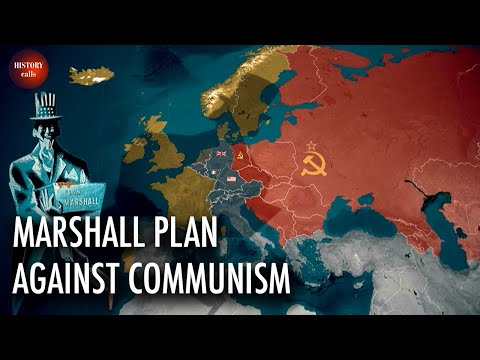
Across the Atlantic, another drama was unfolding. In Moscow, the Council of Foreign Ministers convened to discuss Germany’s future. The former allies—Britain, France, the Soviet Union, and the United States—sat around the table, but the spirit of collaboration was a façade. “The cracks are showing,” and the conference ended in stalemate. Germany’s fate was postponed, but the divisions were deepening.
George Marshall, the U.S. Secretary of State and a hero of the Second World War, left Moscow preoccupied. He knew that Germany was not the only country in ruins. “The whole of Europe is still on its knees,” and the misery was a breeding ground for communism. But Marshall also understood something else: America’s own economy was at stake. Its factories were running at full throttle, producing a surplus that needed foreign markets. Rebuilding Europe was not just a humanitarian gesture—it was an economic imperative.
Back in Washington, Marshall assembled a team of advisers: George Kennan, the architect of containment; Dean Acheson, a fervent anti-Soviet; and William Clayton, an expert on economic affairs. Their mission: to devise a plan that would help Europe recover and secure America’s future. “Their aim: to help Europe get out of the slump and guarantee the future of the United States.”
On June 5, 1947, Marshall traveled to Harvard University to deliver a speech that would change history. Among the audience were luminaries like J. Robert Oppenheimer and T.S. Eliot. Marshall outlined a plan for massive American aid to rebuild Europe—“several million dollars of Aid to rebuild Europe, including the countries of the East.” It was a wake-up call, a bold offer that promised an end to a continent’s suffering.
But the offer came with strings attached. The Americans laid out conditions: European nations had to cooperate, open their markets, and align with American interests. “If the French want to benefit from U.S. largesse, they have to free the 750,000 German prisoners of war they’ve been holding since the end of the war.” Paris was cornered and had to comply.
Meanwhile, in the East, the Soviet Union was watching closely. Molotov, the Soviet Foreign Minister, arrived at a meeting in Paris not in the best of moods. “It’s categorical niet,” he declared. “American Aid is a poisoned chalice any country that accepts it risks losing both economic independence and National sovereignty.” The Kremlin’s message was clear: accept the Marshall Plan, and you submit to American domination.
Despite the Soviet pressure, sixteen countries eagerly accepted the offer. In Spain, Franco’s regime was excluded—“Washington won’t help a dictator who supported Nazi Germany.” But in Britain and France, the aid was a lifeline. Yet, as the plan took shape, it became clear that American generosity was not entirely selfless. “20% of the aid is in the form of loans to be paid back, 80% is in subsidies. The money is there almost exclusively for buying goods and materials made in the USA.” The dollars allocated to Europe found their way straight back to the United States, propping up the American economy.
As the Marshall Plan was implemented, a new organization, the Economic Cooperation Administration (ECA), was created to oversee the distribution of funds. “A whole colony of conscientious and zealous American administrators, officials, and agents now descends on Europe.” Their task: to facilitate communications, stimulate production, and stabilize currencies. But their presence also signaled a new era of American influence.
In Berlin, the stakes were even higher. The city, still divided among the four Allied powers, became the focal point of the Cold War. When the Americans introduced a new currency, the Deutsche Mark, Stalin retaliated by cutting off all road access to West Berlin. “The Berlin blockade has begun.” The city was isolated, on the brink of famine. But America responded with a massive airlift, Operation Vittles, flying in over 2 million tons of supplies. “West Berlin becomes a symbol of freedom for the Western world.”
After 11 months, Stalin relented. The blockade was lifted, and the Federal Republic of Germany was proclaimed. “The United States have succeeded in making Germany the center of Europe.” The Eastern Bloc and the Western were now truly divided.
But the Marshall Plan was never just about food and machinery. As the dollars flowed, so did the politics. George Marshall himself declared before Congress: “We’re engaged in a parlous struggle… an investment in saving all those precious articles of faith and ways of life we call democracy.” From that moment, the aid came with new obligations. Trade with the Soviet Bloc was forbidden under pain of exclusion, and one ECA ruling even barred Communist Party members from distributing the plan’s supplies.
The Americans would go further still. Under cover of the Marshall Plan administration, a new bureau in Washington sent its agents across Europe: the Central Intelligence Agency. “A top-secret memo lays out their mission: part of the funds destined for the ECA must be made available to the CIA, with the aim of advancing the Marshall Plan by opposing communist elements in the beneficiary countries.”
The trade unions were their first target. In France, the CGT split in two, giving birth to Force Ouvrière, a new union that received both money and logistical support from the United States through Irving Brown, a high-ranking CIA operative. “We told them to help themselves from the crates and we looked the other way,” one ECA representative later admitted.
Italy was next. With general elections approaching, the CIA threw its full weight behind the Christian Democrats, funding most of their campaign and even supplying communication consultants. In New York, a campaign targeted Italian Americans, urging them to pressure their families back home with explicitly worded sample letters. “If the forces of democracy were to lose the Italian election,” the letters warned, “the American government would send no more money to Italy—and neither would we.” The U.S. candidate won hands down.
Fighting communism was one thing; glorifying America was another. The Marshall Plan became a vast public relations machine. Aided countries were obliged, at their own expense, to trumpet its virtues—exhibitions, films, posters, comic books for children in which American superheroes were cast as saviors and the Soviet foe as the devil. Even the weekly La Vie Catholique flagged up its evangelism: “The Mormons came over from America to redeem us; from America too came the Jehovah’s Witnesses to go from door to door.”
Then came the real work: thousands of Europeans crossed the Atlantic for training programs, immersing themselves in American methods and the American way of life—barbecues, tidy gardens, Tupperware, home appliances. Britain alone organized 267 productivity missions. “It’s a way of exporting to the old world the methods and ideas of the new.”
But on September 3, 1949, the sky over America darkened. A B-29 patrol over the North Pacific picked up higher-than-normal radioactivity. The USSR had just successfully tested its first atomic bomb. Fear of a third world war gripped the United States. From the stock exchange to the air raid shelters, New York rehearsed its civil defense.
Faced with this new threat, in early 1950 the Marshall Plan became a martial plan. American aid was no longer simply a way to rebuild Europe—it was a way to rearm it. Marshall, now Secretary of Defense, affirmed his position before the House Foreign Affairs Committee: “The only solution that I see is to establish a firm front, and the more resilient the front, the more effective it will be.”
The men in charge of American aid were replaced. The ECA gave way to the Mutual Security Agency, and the lion’s share of the funds was earmarked for the military. The German Federal Republic’s punishment was at an end—it could now form an army. Fifty million dollars were invested in its rearmament. In Paris, former combatants, deportees, and resistance members took to the streets in protest. “Some wounds take a while to heal.” But in the New World Order, France had little influence.
Initially intended to last four years, the Marshall Plan was interrupted after two years and eight months. Its founder headed off for a well-earned retirement, but although he had left the stage, many Europeans would keep striving to reproduce the American Miracle they had heard so much about. Everywhere they were incited to get into personal debt—fridges, washing machines, and cars, all bought on credit, pushed Europe into the age of consumerism. There were a few mistakes along the way, but America’s gamble had paid off. It was a done deal.
On December 17, 1953, with Europe rising from the ashes, George Marshall was awarded the Nobel Peace Prize. There was a bit of protest at the ceremony, but it was quickly silenced. For the moment, there was no question that the plan that bears the laureate’s name had saved a continent from the devastation of war. It had revived its industries and its economic growth and restored their faith in the future to the countries it helped.
It’s true that those countries’ recovery was faster than expected—but only by a year or two, according to the experts. In the end, the Marshall Plan gave things a boost; at best, it established a more positive cycle. But ever since, and to this day, the myth persists. The so-called philosophy of the Marshall Plan continues to resonate: generosity, reconciliation, hope. It remains the reference, the miracle solution to all problems.
The truth is that above all it satisfied the US’s ambitions for economic globalization and legitimized the promotion of the American dream. Less a selfless act than a supremely intelligent political action. And as the dollars flowed and the propaganda machine whirred, one question lingered: was the Marshall Plan truly a gift to Europe, or was it America’s most brilliant investment in itself?
Report this article
Select a reason for reporting:






