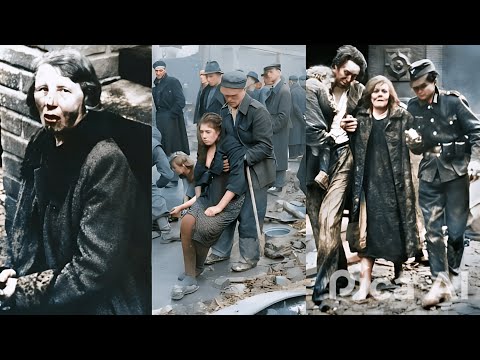
May 1945. The guns fell silent, but the screams had only just begun.
While the world celebrated victory over Nazi Germany, a nightmare of unimaginable proportions was unfolding across the shattered remnants of the Third Reich. From the burning streets of Berlin to the frozen wastes of Siberia, millions of German civilians—women, children, the elderly—found themselves trapped in a maelstrom of vengeance, starvation, and terror.
The Red Army’s advance had been brutal, fueled by years of Nazi atrocities on Soviet soil. Now, that fury was unleashed on an unprotected population. “One in three women in Berlin suffered sexual assault,” historians estimate—a horror repeated across every town and village in the Soviet zone.
Entire communities were uprooted, forced into cattle cars and driven westward. In Poland and Czechoslovakia, Germans who had lived there for generations were expelled, their property seized, their lives threatened. Between 12 and 14 million Germans were displaced—the largest forced migration in human history. Many died of cold, hunger, or simply from the brutality of their neighbors.
And then there were the soldiers. Of the 90,000 Germans captured at Stalingrad, only 5,000 would ever see home again. Those who survived the frozen marches to Siberian camps faced years of slave labor, starvation, and disease. “They were not committing war crimes,” one Soviet officer later admitted, “they were erasing the fascist pig from the land.”
In the town of Demmin, the horror reached its peak. As Soviet troops entered on April 30, 1945, hundreds of civilians—whole families—chose death over surrender. They drowned themselves in the river, their hands tied together, their children clutched to their chests. Estimates put the death toll between 700 and 1,000 suicides in a single town.
But this was just the beginning. The Allies had plans for Germany—plans that included dismantling its industry, dividing its territory, and leaving millions to starve. “No help should be given to the Germans,” American policy stated, “except the minimum required so they don’t die of starvation immediately.”
What followed was a period of suffering that would shape generations. Families torn apart. Cities reduced to rubble. A people forced to confront the crimes of their leaders while facing the wrath of the world.
This is the story of the German people in 1945—the year their world ended, and the long, brutal road to survival began.
The first winter of peace was worse than the war. In the ruins of Berlin, families huddled in cellars and bombed-out apartments, burning furniture to stay alive. “We had survived the bombs,” one woman later wrote, “only to face the cold and the hunger.” Rations were barely enough to keep a child alive, and black markets flourished in the shadow of the Brandenburg Gate.
In the Soviet zone, the occupation authorities began the systematic dismantling of German industry. Whole factories—machines, rails, even the nails from the walls—were shipped east as reparations. “They took everything but the rubble,” a worker in Dresden recalled. What remained was a land stripped of its capacity to feed itself.
Across the border, the expulsions continued. In Czechoslovakia, the Beneš decrees stripped Sudeten Germans of citizenship and property overnight. “We were given an hour to pack,” remembered a farmer from the Sudetenland. “One hour for a lifetime.” They were marched to the border, their homes and farms handed to Czech settlers.
In Poland, the situation was even more brutal. The new communist government declared that all Germans must leave—no exceptions. Those who resisted were beaten, arrested, or worse. “The Poles had not forgotten,” one historian noted, “and they were not about to forgive.” Trains of refugees crossed the Oder-Neisse line, often in open freight cars with no protection from the winter.
By the end of 1946, more than two million Germans had arrived in the Western zones—homeless, penniless, and unwanted. The cities were already overflowing with refugees from the East. “We were treated like animals,” one woman recalled. “Even by our own people.”
And then there were the prisoners of war. Those who had surrendered to the Western Allies fared relatively well—most were released by 1948. But those in Soviet hands faced a different fate. “We worked from dawn until dark,” one survivor of a Siberian camp remembered. “Food was a piece of bread and a bowl of watery soup. Many of us did not survive the first year.”
By 1947, the Western Allies began to realize that a starving, broken Germany would only strengthen Soviet influence in Europe. The Marshall Plan was extended to West Germany, and the currency reform of 1948 brought the first glimmer of hope. But in the East, the Soviet zone was being transformed into a communist state—and the divide between the two Germanies was already being drawn.
The suffering of the German people in 1945 was real, but it was also a consequence of the crimes committed in their name. “We were guilty,” one German pastor wrote, “and we paid the price.” The road to recovery would be long, and the scars would never fully heal.
Yet even as the rubble was being cleared, a new and sinister chapter was opening—one that would define the next half-century. The Allied decision to divide Germany into occupation zones had seemed a temporary necessity in 1945. By 1947, it had hardened into a permanent fracture. “An iron curtain is drawn down upon their front,” Churchill declared in Fulton, Missouri, and the Germans on either side of that curtain would soon find themselves citizens of two hostile worlds.
In the East, the Soviet Military Administration moved swiftly to remake society in its own image. Land reform broke up the great estates of the Junker class, handing plots to peasant farmers—a popular measure that masked the coming collectivization. The Social Democratic Party was forcibly merged with the Communists to form the Socialist Unity Party, and by 1948, the SED was already tightening its grip on every aspect of life.
Former Nazi Party members were purged from schools, courts, and factories—but the criteria were often arbitrary, and the process became a tool for settling old scores. “They denounced their neighbors for a better apartment,” one East Berliner recalled. “The Gestapo had taught us well.”
In the West, the story took a different turn. The currency reform of June 1948—replacing the worthless Reichsmark with the new Deutsche Mark—was an economic shock that worked almost overnight. Shop windows that had been empty for years suddenly filled with goods. “One day there was nothing,” a Munich shopkeeper remembered, “and the next, there was everything—if you had the money.”
But the reform also deepened the divide. Stalin, furious at being excluded from the decision, ordered a blockade of West Berlin. For nearly a year, from June 1948 to May 1949, the western sectors of the city were cut off from all land routes. Electricity was shut off. Food and coal could only arrive by air.
The Berlin Airlift became the first great confrontation of the Cold War. American and British pilots flew more than 200,000 sorties, delivering nearly 2.5 million tons of supplies—everything from flour to medicine to candy for the city’s children. “When the first plane landed at Tempelhof,” a Berliner wrote, “we knew we were not alone.” The blockade failed, and Stalin lifted it in May 1949.
But the scars of the war were not only physical. In the years that followed, the German people would be forced to confront the full magnitude of what had been done in their name. The Nuremberg Trials had exposed the horrors of the regime, but they had also allowed ordinary Germans to tell themselves a comfortable lie: that the crimes had been the work of a few fanatics, and that the nation as a whole had been deceived.
This “clean hands” myth would persist for decades. It was only in the 1960s, when a new generation began to ask uncomfortable questions of their parents, that the silence finally cracked. “What did you do during the war, Papa?” became a question that tore families apart.
And yet, amid the guilt and the grief, there was also the raw human instinct to survive—and to rebuild. By the early 1950s, the streets of West German cities were lined with new buildings, the factories were humming, and the Wirtschaftswunder—the economic miracle—was underway. “We had nothing to lose,” a Ruhr coal miner said. “So we worked, and we worked, and we did not look back.”
In the East, a different kind of rebuilding took place—one measured in five-year plans and socialist slogans. The Stasi, the secret police, was founded in 1950, and its network of informers would soon reach into every apartment block and workplace. “In the West, you could speak your mind and lose your job,” one East German dissident observed. “In the East, you could speak your mind and lose your freedom.”
The division of Germany was now complete. Two states, two systems, two histories. And in the middle of it all, the city of Berlin remained a divided island—a symbol of the world’s new fault line. The Wall would not come until 1961, but the foundations of that concrete barrier were already being laid in the minds of men.
For the millions of Germans who had survived the war, the journey from the ruins of 1945 to the uncertain peace of the 1950s had been a passage through hell. They had lost their homes, their loved ones, their country, and—for many—their sense of who they were. “We were born in one Germany,” a woman from Königsberg wrote in her memoirs, “and we died in another.”
Yet the story of 1945 was not only one of suffering. It was also a story of resilience—of people who, having witnessed the worst that humanity could do, somehow found the strength to start again. In the cellars of Berlin, in the refugee camps of Schleswig-Holstein, in the bombed-out churches of the Rhineland, a new Germany was being born—one that would have to carry the weight of the old one’s crimes for generations to come.
By the time the 1950s dawned, the two Germanies had settled into an uneasy rhythm. In the West, the Wirtschaftswunder lifted millions from poverty; in the East, the SED celebrated its first five-year plan while the Stasi quietly filed away reports on every citizen. “We built a new country on top of the old one’s grave,” a West Berlin architect reflected. “But the grave was still there, underneath.”
The past, however, refused to stay buried. When the Frankfurt Auschwitz Trials opened in 1963, ordinary Germans were forced to confront something the Nuremberg Trials had allowed them to avoid: that the killers had not been monsters, but neighbors, clerks, and family men. “I saw my father’s name in the newspaper,” one woman recalled. “I never spoke to him again.”
And in the East, a different silence reigned. There, the state declared itself the heir of the anti-fascist resistance—as if the GDR had never shared in the guilt. “They told us the Nazis were all in the West,” an East German teacher remembered. “We believed it, because we wanted to.”
Then came the Wall. On August 13, 1961, Berliners woke to find barbed wire and concrete slicing their city in two. Families were separated overnight. “My mother stood on the other side,” a man from Bernauer Strasse said. “I could see her face, but I could not touch her.” For twenty-eight years, the Wall stood as the final, brutal monument to the divisions that 1945 had created.
When it finally fell in November 1989, the images of Germans dancing on the Wall seemed to promise that history had come full circle. But reunification in 1990 brought its own reckonings. The Stasi files were opened, and millions discovered that someone they trusted had been reporting on them. “I found out my best friend had denounced me for a trip to the West,” one Leipzig pastor said. “I never forgave him. I never forgave myself for not knowing.”
And so the question that had haunted Germany since 1945 returned once more: how does a people live with what it has done—and what was done to it? The answer, if there is one, lies somewhere between the memorials and the museums, the history books and the family silences. “We cannot choose our past,” a German president once said. “But we can choose what we make of it.”
For the generation of 1945, the road ended long ago. For those who came after, the road continues—paved with guilt, grief, and the stubborn hope that memory can do what bombs could not: build something that lasts.
What do you think—can a nation ever truly reckon with its darkest chapter, or does the past always find a way to return?
Report this article
Select a reason for reporting:






