August 21st, 1942. The Coconut Grove at the mouth of Alligator Creek on Guadalcanal. A column of Japanese soldiers from the Ichiki Detachment massed for another charge across the sandbar. They never saw the mortar team. 60 yards behind the firing line, three Marines from G Company of the First Marines knelt around a 42-pound tube. The corporal did not need to call battalion. He did not need to request divisional fires or wait for a battery 5 miles in the rear to register the target. He sighted the position himself. The gunner fed a 3-pound shell down the barrel. A Marine on the line described what happened in plain words: “Bodies and parts of bodies flew into the air along with great splashes of mud and bits of palm tree.” That was the M2 60-mm mortar. American infantrymen called it pocket artillery. To the Axis defenders on the receiving end, it was the sky coming down on their heads.
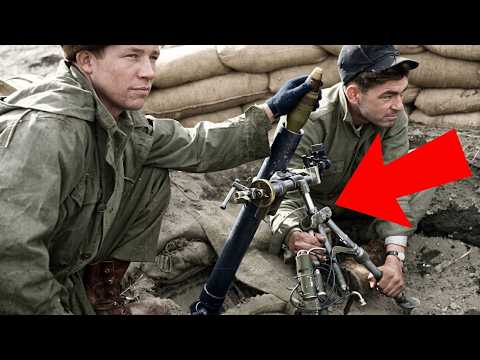
Every American rifle platoon in World War II faced the same arithmetic problem. A hand grenade reached 30 yards. The battalion 81-mm mortar reached 3,000. Between those two numbers was the killing zone where the rifleman lived and where the enemy machine guns hid. In Normandy, that killing zone had walls. The bocage country was a labyrinth of hedgerows up to 15 ft tall, ancient earthen embankments crowned with brush, every field a kill box. 21st Army Group’s post-war assessment concluded that mortars caused roughly 70% of Allied infantry casualties in Normandy through July of 1944. American crews learned within days that calling divisional artillery on a hedgerow was a way to kill your own platoon. The shells clipped tree branches and detonated 30 ft above the foxholes.
November 1944, the Hurtgen Forest, 3 months after the Normandy breakout. First Lieutenant George Wilson of Company F, 2nd Battalion, 22nd Infantry Regiment, 4th Infantry Division, watched the same tree bursts shred his rifle squads. The howitzer rounds came in at a shallow angle and exploded in the canopy overhead. The only weapons that could put steel on the forest floor without killing the men in the holes were the high-angle mortars, the big 81s 2 miles back, and the 60-mm tubes the riflemen carried themselves.
The Americans needed a weapon that could be carried by infantry, set up in seconds, and dropped on a target the platoon commander could point to with his finger. That weapon already existed. The Americans had bought it from the French in 1938, the Brandt MLE 1935. Designed by the French ordnance engineer Edgar Brandt as a battalion-level light mortar, the weapon was a smoothbore, drop-fired tube that broke down into three loads a single squad could carry. The War Department purchased eight Brandt mortars in 1938, redesigned the drawings to American threads and materials at Watervliet Arsenal, and standardized the result as the mortar, 60-mm M2. The first contract went to Read Machinery in York, Pennsylvania, in January of 1940. By the end of the war, the United States had built roughly 60,000 tubes and fired more than 51 million 60-mm shells. In the first 8 months of 1945 alone, American factories produced over 30,000 mortars, almost matching the entire output of the previous 3 years combined.
The weapon weighed 42 lb broken into three loads. A 12.8 lb barrel for one man, a 16.4 lb bipod for another, and a base plate that matched the barrel at 12.8. Three men carried the gun. Two more carried the shells. What it did was simple. The gunner dropped an M49 AT shell down the barrel. A fixed firing pin at the base of the tube struck a small ignition cartridge in the shell’s tail. The propellant burned, the shell flew. Maximum range, 2,017 yd at 45° elevation. A bursting radius of 17 yd on impact. Sustained rate of fire, 18 rounds a minute. A trained crew could put a shell on a target within seconds of the platoon leader pointing.
August 7th, 1942. The 1st Marine Raider Battalion went ashore on Tulagi as the M2 went to war. By the second day, Major Justice Chambers of Company D was hitting Hill 281 with a heavy mortar concentration. M2s from the weapons company, 81s from 2nd Battalion, 5th Marines. The Japanese position broke and the riflemen pushed through. The pocket artillery had passed its first test. It would not be the last.
D-Day, June 6th, 1944. Brécourt Manor in Normandy. First Lieutenant Richard Winters of Easy Company, 2nd Battalion, 506th Parachute Infantry Regiment had a problem. Four German 105-mm howitzers in a hedgerow gun pit were ranging in on Utah Beach, where the 4th Infantry Division was coming ashore. Winters had 13 men and a plan. The plan worked. Easy Company took the guns one by one. But Winters could not hold the position without covering fire to withdraw. Sergeant Donald Malarkey ran the 60-mm mortar section for Easy Company. He had jumped out of a C-47 the night before, and the base plate of his M2 had gone into a Norman field somewhere over Sainte-Mère-Église, along with most of the other heavy gear on the drop. He had a tube. He had a bipod. He had shells. He bore-sighted the gun with his eye, set the bipod into the dirt, and started dropping rounds. He fired so many shells that the recoil drove the tube into the soft French earth. The blasts shattered every window in the manor house. The German MG 42 teams along the hedgerow stopped firing. Easy Company withdrew. Four heavy howitzers had been silenced. A paratrooper with no base plate had used a 42-lb tube to suppress a German strongpoint on D-Day. The same tube used the same way was about to do worse things in the Pacific.
September 15th, 1944, Peleliu. The 1st Marine Division stepped into a coral meat grinder that Major General William Rupertus had predicted would last 4 days. It lasted 73. Corporal Eugene Sledge of K Company, 3rd Battalion, 5th Marines, was a 60-mm mortarman on Peleliu. Then he was a 60-mm mortarman on Okinawa. Late May 1945. Of the Shuri Line. The 6th Marine Division had taken Sugar Loaf in 10 days at a cost of 2,662 killed and wounded. That single 10-day toll equaled the entire 2nd Marine Division’s casualties at Tarawa. K Company of 3/5 was now finishing the job on the reverse slope. A radio message came down. A large number of Japanese were massing behind the crescent of Halfmoon’s western arm. Hidden in cave positions, the Americans could not see and could not reach with direct fire. Sledge’s three-tube section was ordered into a mass fire mission. Squared away to box in the target and prevent escape. Searching and traversing. Rapid fire. In Sledge’s own words from his memoir With the Old Breed, the tube became so hot the mortarmen wrapped a dungaree jacket around it and an ammo bearer poured helmets full of water from a shell crater over the cloth to cool the steaming barrel while they continued to fire. The crew burned through hundreds of shells before the cease-fire order came. A K Company NCO walked the reverse slope of Halfmoon Hill afterward. He counted more than 200 Japanese dead. They had been trapped and killed by the fire from three 42-lb tubes operated by five Marines. That was what the 60-mm mortar could do when it was used as designed.
But the M2 also had a darker side, one the manuals never printed. For every mass fire mission that broke a banzai charge, there were mornings when the tube was the only thing between a rifle squad and annihilation, and the men who fed it paid a price the infantry never saw. The mortar pit was a magnet for counter-battery fire. Every stack of empty shell cases beside the position was a visual signature, a smoking arrow pointing straight down at the crew. Japanese spotters on Okinawa learned to watch for the soft white puff of a 60-mm propellant charge and answer it with their own tubes within a minute.
The men firing the weapon were never as safe as the men they were killing believed. On top of Sugar Loaf, Major Henry Courtney, executive officer of 2nd Battalion, 22nd Marines, was killed by accurate counter-mortar fire while directing the assault. He was not a mortarman, but he died because the Japanese had learned exactly how to answer the pocket artillery. The crews knew the arithmetic. A 60-mm tube in action drew fire, and the foxholes around it were shallow.
The weapon itself fought back in other ways. At Bastogne in December 1944, the cold froze the M5A1 ignition cartridges and produced hang fires, the awful seconds when a shell sat in the tube and the crew waited to learn whether it would fire or simply cook off in their faces. The recoil drove base plates into the frozen mud and locked them there, so the gun could not be shifted without a pickaxe and a prayer. The minimum range was 200 yards. A pinned squad 20 yards from a German pillbox could not call its own mortar fire, because the round would not arc that short. The men in the holes learned to curse the tube as often as they blessed it.
And yet the requests kept coming. After Guadalcanal, Lieutenant Colonel Merritt Edson of the 1st Raider Battalion wrote a report to the Marine Corps that read like a complaint. “We need the knee mortar badly,” Edson said. “I believe the Japs have three of these mortars in a mortar squad in each rifle platoon. A man can carry 10 rounds on his person besides his weapon.” The Japanese had been using something similar to the M2 for years, the Type 89 grenade discharger, which American troops mistranslated as the knee mortar. One Marine on Guadalcanal tried bracing the curved base plate against his thigh and shattered his own femur. A Japanese rifle platoon fielded three of those weapons organically. An American rifle platoon fielded none. The M2 belonged to the weapons platoon at company level, and the riflemen in the line wanted one of their own.
Edson’s report drove the M19 variant program at Watervliet Arsenal, a lighter tube meant to live with the rifle squad the way the Type 89 lived with the Japanese. The Army rejected it. The Marines adopted it after the war and carried it into Korea and into the early years of Vietnam. But the M2, the 42-pound French design bought in 1938, stayed in the line through the end of the war and beyond. It was still in the inventory when the infantry rifle company finally replaced it with the M224 lightweight mortar in 1978.
Three M224s still ride in every American infantry weapons company. The barrel is shorter, the range is longer, the doctrine has not changed. A platoon leader points, a corporal drops to one knee, a shell is in the air in seconds. The arithmetic of the killing zone, the 30 yards of the grenade and the 3,000 of the battalion mortar, has never gone away. Somewhere in that gap a rifleman still needs the sky to come down on the men trying to kill him.
April 13th, 1945. Kakazu Ridge. Technical Sergeant Buford Anderson, 22 years old, 5’7″ and 130 lbs, had already earned a Bronze Star on Leyte. Before dawn, a reinforced Japanese battalion came through the saddle aiming for his flank. He ordered his squad into an Okinawan burial tomb. Then he walked out alone with his carbine.
He emptied a magazine at point-blank range. He picked up a Japanese mortar dud, threw it back, and watched it kill several soldiers when the fuse finally functioned. Then he reached for his squad’s box of M49 60-mm shells. He pulled the safety wire, banged the tail cap against a rock to ignite the primer, and threw the shell like an oversized hand grenade. The M52 fuse armed in flight. He kept doing it, bleeding from a severe shrapnel wound, until the Japanese broke off.
The count in front of his position: 25 enemy dead, several machine guns and knee mortars destroyed. Truman pinned the Medal of Honor on him in 1946. Sledge survived the war and became the most read American voice of the Pacific ground war. He had been a 60-mm mortarman.
August 21st, 1942. The men of the Ichiki Detachment never saw the mortar team that killed them. They only heard the soft thunk of the round leaving the tube. By the time they heard it, the sky was already coming down on their heads. What would you have done if you were in Anderson’s boots that morning?
Report this article
Select a reason for reporting:






