You’ve seen the battles, the brotherhood, the sacrifice. But have you ever wondered why Darrell Powers was called ‘Shifty’? Or why Bill Guarnere earned the nickname ‘Wild Bill’—and the far less flattering ‘Gonorrhea’? These weren’t just random labels. They were badges of identity, forged in the crucible of war, and each one carries a story you’ve never heard.
In the chaos of World War II, nicknames were more than convenience—they were survival. With dozens of men named Joe, Bill, and John in a single company, a nickname cut through the confusion. Last names, often similar and hard to shout over roaring engines and artillery fire, became secondary. But there was a deeper reason, one that will be revealed later. First, let’s uncover the real stories behind the nicknames of Easy Company.
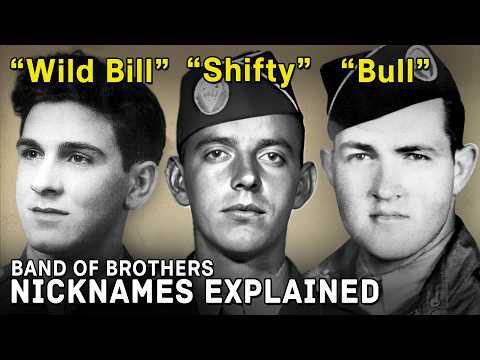
Take ‘Wild Bill’ Guarnere. Just before D-Day, Bill learned his older brother Henry had been killed in Italy. Consumed by vengeance, he vowed to kill as many enemy soldiers as possible before falling himself. ‘I poured my anger and revenge into those bastards,’ he later wrote. ‘I shot at everything I saw that day. People ask if the first kill is hard. It was as easy as squashing a bug.’ That ferocity earned him the name ‘Wild Bill.’
But his comrades also teased him with another nickname: ‘Gonorrhea.’ John Martin coined it because ‘Guarnere’ sounded similar. The miniseries ran with it, showing Bill complaining to Doc Roe about painful urination—a hint at a venereal disease. In reality, Bill never contracted one; the nickname was likely just a crude joke among young soldiers. The show invented the ailment, perhaps to avoid delving into the truth.
Then there’s Darrell ‘Shifty’ Powers. His uncanny shooting skills might make you think the nickname came from his ability to shift targets. But no—it was basketball. ‘I played a lot of basketball in high school, and that’s where I got my nickname,’ he recalled. ‘They thought I was shifty in my moves, you know, quick. So they called me Shifty, and it stuck.’ Every kid on the team had a nickname: Slick, Red, Pete, Flattery. ‘You’d forget the boy’s real name, but that was part of the fun.’
Buck Compton—even fans don’t realize his first name was Lynn. He hated it. ‘Lynn was a girl’s name and always will be,’ he wrote. As a boy, he idolized baseball catcher Truck Hannah and decided he needed a nickname too. ‘Truck Compton’ sounded like a copycat. ‘Buck’ felt right. ‘I told all my friends that Buck was the only name I’d answer to. No one wanted a friend with a sissy name.’ His mother, though, always called him Lynn.
And Bull Randleman—his size and gravelly voice inspired the name, but he wasn’t the giant some imagine. His draft card listed him at 5’11” and 200 pounds, far from the actor’s towering frame. Yet his presence was immense. During training at Camp Toccoa in 1942, his fellow soldiers collectively dubbed him ‘Bull.’ No single person claimed credit; it was a group effort, a tribute to the man who pushed men out of planes and could be counted on for anything.
These are just a few of the men whose nicknames became legend. But why did these labels matter so much? The answer lies in the unspoken rules of war—and the emotional walls soldiers built to survive. Stay tuned as we uncover more stories, including the real reason behind ‘Babe,’ ‘Popeye,’ and the nickname that saved a man’s sanity.
Warren ‘Skip’ Muck was the company clown, always quick with a joke. But his nickname came from his childhood—he never walked anywhere; he skipped. ‘As a little kid, Warren Muck never walked anywhere,’ his niece recalled. ‘He was a happy boy who found joy in the simplest activities, like moving from point A to point B. Whenever he moved, he skipped. And so he got his nickname.’ It stuck with him through adulthood.
Edward ‘Babe’ Heffron’s nickname was a family affair. His older brother Jimmy, trying to say ‘baby,’ blurted out ‘Babe,’ and it stuck. In the series, the moment Doc Roe finally calls him ‘Babe’ is a small but powerful victory—a sign of acceptance. ‘Hey, Gene, you called me Babe,’ he says, beaming. ‘I guess I did,’ Roe replies. It was a nickname he carried long before the war.
Robert ‘Popeye’ Wynn’s nickname is obvious—his narrow eyes and prominent jaw reminded the men of the cartoon sailor. No record says exactly when or who coined it, but it was in use by 1942 at Camp Toccoa. After being shot in the rear at Brecourt Manor, Wynn apologized to his lieutenant for letting the squad down. ‘I’m sorry, Lieutenant. I made a mistake. I’m sorry,’ he said. ‘My God, it’s remarkable to think of a man who was so dedicated to his company that he apologized for being wounded,’ Winters wrote. Here was a soldier hit by enemy fire behind German lines, more worried about failing his comrades than his own injury.
Floyd ‘Tab’ Talbert’s nickname was a family one, likely derived from his last name. He grew up in Indiana, and ‘Tab’ was a childhood moniker that stuck. Winters considered him the best soldier in the unit. ‘If I had to pick one man to go with me on a mission, it would be Talbert,’ he said. Even decades after his death in 1982, his family and veterans still called him ‘Tab.’
Frederick ‘Moose’ Heyliger’s nickname didn’t come from his size—he was about six feet and 210 pounds—but from a childhood mishap. One winter day, he accidentally grabbed his older brother’s boot, which was far too big. As he trudged through the snow, one of his siblings noticed the large footprint and said, ‘Hey, look at the moose tracks.’ The name stuck. He eventually grew into it, which is probably why it stayed.
Terrence ‘Salty’ Harris earned his nickname from his time at the Naval Academy. After resigning under pressure, he made several trips to Australia as a merchant sailor before joining the Army. Veterans remembered that he ran his squad with naval terminology—ordering men to go starboard instead of right, or to swab the deck instead of clean the floor. On the train to training camp, he annoyed everyone by singing the same sea shanties over and over. Tragically, he was killed by a German sniper near Carentan, only 23 years old.
Myron ‘Mike’ Ranney’s nickname was simply a common shortening of his first name. He survived the war and died of a heart attack in 1988 at 65.
Burton ‘Pat’ Christenson’s nickname was self-chosen. Growing up in Oakland, friends called him Pat or Chris, but he picked ‘Pat’ himself, possibly derived from his middle name, Paul. In the series, he’s remembered for the canteen incident during a night march, but in reality, he was one of the fittest men in the company. He was also the company artist, and his sketches and diaries were later published in a book called ‘Screaming Eagle.’ Winters wrote to his family after his death, ‘I was always proud to have my most handsome man in front carrying the company guidon in parades, and that man was always Pat.’
Wayne ‘Skinny’ Sisk was small and wiry, hence the nickname. He grew up in West Virginia with two older brothers who teased him, so he had to make himself tough. Despite his size, he was fierce. On the plane to Normandy, he broke the tension by shouting, ‘Anyone want to buy a good watch?’ The men laughed. After the war, he struggled with his memories, but found faith and became a minister. He died in 1999 at 77.
Walter ‘Smokey’ Gordon got his nickname not from smoking cigarettes but from chewing tobacco. He was shot by a sniper in Bastogne, the bullet severing his spinal cord. He was paralyzed from the neck down, but eventually regained some feeling. After a long recovery, he was discharged with a 90% disability. He became an oil broker and lived with pain for the rest of his life. His comrades still called him Smokey.
Earl ‘One Lung’ McClung was a Native American from the Colville reservation, an expert tracker and marksman. His nickname came from a poem by Paul Rogers, who called him ‘One Lung’ just for the rhyme. It stuck. McClung was one of the best snipers in the company, and Darrell ‘Shifty’ Powers called him the best. ‘He could smell Germans,’ his comrades said.
Ronald ‘Sparky’ Spears’ nickname was rarely heard in the series, but it was used by a select few officers. Lieutenant Dorowood Kane, an intelligence officer, gave it to him. Spears would smile when called ‘Sparky,’ a surprisingly innocent nickname for a man many feared. To the enlisted men, he was ‘The Killer’ or ‘Bloody.’
Other nicknames needed little explanation: Charles ‘Chuck’ Grant, Lewis ‘Nix’ Nixon. And if you dig deeper into Easy Company’s roster, you’ll find dozens more.
But why did these nicknames matter so much? There was a deeper reason, one that went beyond convenience. Nicknames created a barrier between the soldier and his civilian self. They allowed a man to do things his civilian self might not be able to live with. They made others treat him as part of the unit rather than a whole person whose safety they were responsible for. In units with heavy casualties, men learned not to get too attached to replacements. A full name invited questions: What was his family like? What was his mother’s name? Did he have a child? A nickname let you avoid all that. You didn’t have to imagine a funeral for a stranger you’d only known six weeks. It wasn’t cruelty; it was emotional rationing. There was a limit to how much loss a man could bear, and you couldn’t afford full civilian grief for every empty bunk. The nickname kept the grief within the unit.
The name on the dog tag was for the telegram sent home. After the war, many veterans shed their nicknames and returned to civilian life. The nickname stayed overseas, its purpose served. Only the comrades who fought beside them kept using it, a reminder of the bond they shared and still share as a band of brothers.
That bond never faded. At Easy Company reunions decades later, men in their seventies still called each other Shifty, Babe, and Smokey. Their real names were for gravestones; their nicknames were for brothers. The war took their youth, but it gave them something the telegram home never could—a family forged in fire.
So the next time you watch Band of Brothers, listen closely. Every nickname is a doorway into a life. ‘Wild Bill’ wasn’t just a tough soldier—he was a grieving brother. ‘Babe’ wasn’t just a replacement—he was a kid who never outgrew his family’s love. ‘Shifty’ wasn’t just a marksman—he was a boy who dribbled a basketball and earned a name that outlived him.
These names survived the men who carried them. They live in memoirs, in interviews, in the memories of families who still say ‘Tab’ or ‘Moose’ with a smile. The war ended, but the brotherhood didn’t. The nicknames stayed—not as relics, but as proof that these men belonged to something bigger than themselves.
So here’s the question: if you’d fought alongside Easy Company, what nickname would you have earned—and what story would it tell?
Report this article
Select a reason for reporting:






