The war in Europe had hours left, but in a mist-shrouded forest outside Berchtesgaden, Sergeant Michael O’Brien’s heart pounded as he aimed his Thompson at the tree line. Then a white cloth waved—and twelve children stumbled out, hands raised, trembling in oversized Wehrmacht uniforms.
“We surrender. Please, the young ones. They are only children.” The words came from a hollow-cheeked teenager, his voice steady despite the terror in his eyes.
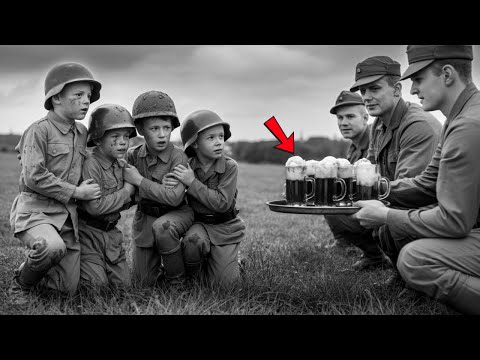
O’Brien’s stomach tightened. These weren’t hardened SS fanatics—they were boys, the youngest barely twelve, his face still round with childhood. Several shook visibly; one cried silently, tears cutting tracks through the dirt.
Private Tommy Chen lowered his rifle. “Sarge, they’re just kids.” His voice cracked.
Nazi propaganda had promised them execution, not mercy. The oldest boy, Klaus, positioned himself between O’Brien and the younger ones, his stance protective despite his own fear. His uniform bore corporal stripes hastily sewn on—a rank absurd on someone so young.
Behind O’Brien, his squad emerged, forming a loose semicircle. Private Martinez, the medic, spotted the youngest swaying with fever, a dark stain on his trouser leg. He approached slowly, Red Cross armband visible, and knelt. The boy tried to back away, but Martinez caught him gently, feeling the heat radiating through the thin jacket.
The wound was infected, red streaks spreading. Martinez cleaned and bandaged it with sulfa powder, ignoring the politics. The boy whimpered, expecting cruelty—but received only care.
O’Brien watched, something shifting in the morning air. His men lowered their weapons completely. These weren’t enemies—they were terrified, wounded, starving children failed by every adult who should have protected them.
He turned to Corporal Washington. “James, go back to the supply truck and bring up whatever rations we’ve got. The good stuff, not just K-rations.”
Washington returned with root beer extract and condensed milk—a strange obsession of the supply sergeant. O’Brien grinned. He’d worked in his uncle’s ice cream parlor every summer. “Tommy, find me clean canteen cups and ice. We’re going to make these kids something they’ve never tasted.”
For twenty minutes, American soldiers became impromptu soda jerks, mixing root beer floats. The German boys watched in bewilderment, unable to reconcile their expected execution with this surreal kindness.
Klaus asked in halting English what was happening. O’Brien replied, “You boys ever had an American root beer float? Well, you’re about to find out what you’ve been missing.”
The youngest boy took the first tentative sip, his eyes widening. Then he drank deeply, and his expression transformed—fear competing with wonder and pure pleasure. The oldest boy drank next, foam on his lip, a small sound escaping him—relief.
What happened next was like a dam breaking. The other ten crowded forward, eager. Some gulped desperately; others sipped slowly, savoring each mouthful. The red-haired boy drank his in three swallows, then stared at the empty cup with grief.
O’Brien felt a tightness in his chest. These were the enemies he’d fought for months—but they were also children, experiencing joy for the first time in months. This was why he’d joined the war: to defeat the ideology that sent children to die, and to prove that American dignity was worth fighting for.
As the boys relaxed, Klaus sat beside O’Brien. Through broken English and gestures, his story emerged. Conscripted four months earlier from his family’s farm, his father dead at Stalingrad. Each boy had a similar tragedy—orphans, separated families, desperate survival.
O’Brien called his men together. “We keep them with us for now. Treat them as wards, not prisoners. We’ll worry about paperwork later.”
Over the next three days, as Germany surrendered, something remarkable happened. The American soldiers established a temporary camp, giving the boys proper bedrolls, clean uniforms, and three meals a day. The youngest, Joseph, recovered under Martinez’s care, attaching himself to the medic like a shadow.
Klaus began keeping a journal, writing down everything as if he needed proof this kindness was real. The soldiers fell into family roles—Chen organized games, Washington mentored the older boys about college and peace, Martinez became a mother hen.
On the fifth day, Red Cross worker Eleanor Hartley arrived. She interviewed each boy, tracing families. Klaus’s mother and sisters were alive near Stuttgart. Friedrich was an orphan. Joseph’s family was missing. The news was bittersweet.
But Hartley also brought photographs from the concentration camps. The boys needed to understand the full truth. The reaction was visceral—crying, denial, vomiting. Hans, a former Hitler Youth member, aged ten years in an afternoon as his indoctrination crumbled.
In response to their guilt, the boys threw themselves into helping around camp. They cleaned equipment, repaired jeeps, organized supplies, built furniture. Their hands, which had held weapons, now created and healed.
As summer approached, the question of their future loomed. Hartley advocated for a program allowing qualified German minors to be sponsored for immigration to America. The story of the root beer floats captured public imagination, and applications poured in.
Seven boys accepted sponsorship; five chose repatriation. Klaus agonized but ultimately couldn’t abandon his mother and sisters. Friedrich, the orphan, was sponsored by O’Brien’s own family. Martinez sponsored Joseph. The farewell was heartbreaking.
Twenty-five years later, a reunion in Milwaukee brought them together—engineers, doctors, professors—all shaped by that single act of mercy. They raised glasses of root beer in memory of those who had passed, celebrating the simple gesture that proved humanity could triumph over hatred.
But the reunion’s quiet joy was pierced by a single, unexpected absence. Wilhelm, the blond boy with anxious gray eyes who had chosen repatriation to search for his grandmother in Munich, had not been found. Letters mailed to his last known address had returned unopened, and Klaus’s inquiries through government channels had hit walls of silence.
It was Joseph, now a pediatrician, who finally broke the mystery. “I found him,” he said quietly on the second evening, and the room fell silent. “He’s in a veterans’ hospital in Bad Tölz. He’s been there for years.”
The men exchanged glances. Wilhelm had been the quiet one, the boy who kept his grief locked behind a stoic mask. He had never written of his search for his grandmother, not once in twenty-five years, and the others had assumed the silence meant pain too deep to share.
Klaus’s jaw tightened. “Why did no one tell us?” he asked, his voice carrying the weight of old guilt. He had been the leader, the protector, and he had let one of his boys slip away into the shadows.
Joseph shook his head. “He forbade it. The doctors said he insisted. He didn’t want to be remembered as he is now.”
The reunion’s final day was spent not in celebration, but in planning. They would go to Bad Tölz together, all of them, the seven Americans and the five Germans, as one family. O’Brien, now white-haired and leaning on a cane, insisted on leading the way.
They found Wilhelm in a sunlit ward, a thin man of forty-one, his gray eyes still anxious but now clouded with something else—a distant, searching look. He recognized them slowly, one by one, and when Klaus knelt beside his bed, Wilhelm’s trembling hand rose to touch his old friend’s face.
“I never found her,” Wilhelm whispered. “The house was gone. The records were gone. I searched for years, and then I stopped searching, and I have been ashamed ever since.”
Martinez, ever the medic, took Wilhelm’s pulse and frowned. “What happened to you, son?” he asked gently.
Wilhelm’s story emerged in fragments. After the war, he had drifted through the ruins of Munich, working odd jobs, sleeping in bombed-out buildings. The search for his grandmother consumed him until it became an obsession, then a madness. He had been institutionalized in 1953, and the years had blurred together ever since.
O’Brien sat on the edge of the bed, his hand on Wilhelm’s shoulder. “You’re not alone anymore. You never were.”
Back in Milwaukee, the men made a decision that would extend the story of the root beer floats into a new generation. They established a foundation in Wilhelm’s name—the Wilhelm Trust—dedicated to tracing and reuniting families separated by war, and to providing care for veterans suffering from the invisible wounds of conflict.
The first donation came from Friedrich, who had built his engineering firm into a modest empire. “For the boy who never stopped searching,” he wrote on the check.
And on a cold morning in December, the phone rang at the Trust’s small office. A woman’s voice, elderly and hesitant, asked if they were still looking for the family of a Wilhelm Hartmann. She had seen the foundation’s notice in a German newspaper. She was his grandmother’s neighbor, and she had a box of letters that had been entrusted to her in 1945, letters Wilhelm’s grandmother had written to him before she died in the bombing, letters that had never reached him.
The box arrived in Milwaukee two weeks later. Klaus opened it with trembling hands, and inside were forty-three letters, each one addressed to Wilhelm, each one filled with love and hope and the simple news of a small Bavarian village.
Klaus read the first letter aloud, his voice breaking on the grandmother’s words: “Liebling, the war will end. Come home. I will keep the stove warm.” Wilhelm wept openly, the way he had not allowed himself to weep since he was a boy in a Wehrmacht uniform.
The men took the box to Bad Tölz together. Wilhelm read all forty-three letters over three days, and when he finished, he looked up at O’Brien with something the sergeant had not seen in his eyes for twenty-five years: peace.
“She never stopped waiting,” Wilhelm said softly. “All those years I searched, and she was already waiting for me the whole time.”
The Wilhelm Trust grew from a small office into a network of volunteers across two continents. They reunited over four hundred families in the first decade alone. And every year, on the seventh of May, the twelve men gathered—by phone, by letter, or in person—to remember the morning a white cloth waved in a Bavarian forest.
O’Brien passed away in 1982, and at his funeral, twelve men stood in a row, some in American suits, some in German, all of them family. Klaus spoke the eulogy, ending with the words the sergeant had said to a terrified boy on a cold spring morning: “Nobody’s going to hurt you.”
The root beer floats were served at the reception, and no one laughed at the strange tradition. They understood. Some gestures are too sacred for laughter.
Years later, a young journalist asked Joseph what he remembered most about that day in 1945. He thought for a long moment, then smiled. “That the enemy turned out to be human,” he said. “And that a root beer float can be a weapon against hatred.”
What small act of kindness might you offer today, to someone you’ve been taught to fear?
Report this article
Select a reason for reporting:






