He was the general who conquered Singapore and was hailed as the “Tiger of Malaya.” But when the war ended, he stood in a Manila courtroom, not for what he did, but for what he was. Tomoyuki Yamashita—a man who had once ordered his troops to not loot, not rape, not burn—was about to be hanged for the atrocities of others.
Was he a war criminal who escaped justice, or the victim of a legal experiment that changed history? The answer lies in the smoke of a burning city and the silence of a commander who lost control.
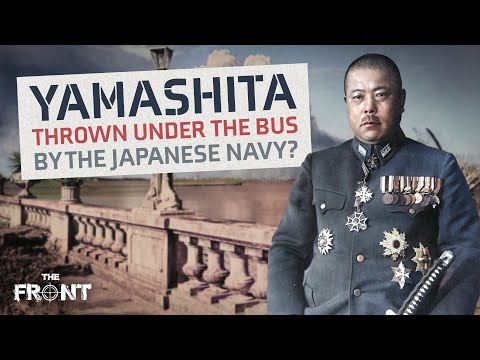
Yamashita’s rise was anything but inevitable. He graduated 18th in his class, married into the military elite, and became an expert on Germany. But he also made powerful enemies—including Hideki Tojo, the future Prime Minister who would eventually send him to a quiet post in Manchuria.
Then came December 1941. Yamashita took command of the 25th Army and launched a lightning campaign down the Malay Peninsula. Against 138,000 British and Commonwealth troops, he had only 70,000 men. But he attacked with ferocity, speed, and audacity.
Singapore fell in February 1942. It was the largest surrender in British military history. Winston Churchill called it “the worst disaster” in British arms. Yamashita became a legend overnight.
But the occupation that followed was soaked in blood. The Alexandra Hospital massacre. The Sook Ching purge, where tens of thousands of Chinese civilians were systematically executed. The orders came from his staff—not from Yamashita himself.
According to historian Akashi Yoji, Yamashita was horrified when he learned of his soldiers’ behavior. He ordered immediate executions of anyone caught looting or raping. He personally apologized to 650 survivors of Japanese atrocities while still in Singapore. He did this voluntarily—before any threat of trial.
Even British POWs under his direct watch were generally treated decently, which often put him at odds with other Japanese commanders. This was not a man who delighted in cruelty.
By 1944, Japan was desperate. Yamashita was sent to the Philippines with 262,000 men and ordered to hold the islands. When the Allies closed in on Manila, he made a fateful choice: he evacuated the city, declaring it open to avoid civilian slaughter.
But one naval commander refused to obey. Rear Admiral Sanji Iwabuchi retook Manila with 16,000 troops and turned it into a killing field. At least 100,000 Filipino civilians were massacred. Women were raped, children bayoneted, pregnant women disemboweled. It was one of the most horrific atrocities of the Pacific War.
And Yamashita? He was miles away, his communications shattered, his orders ignored.
When Japan surrendered, Yamashita was arrested and put on trial in Manila. The charge: command responsibility. He was accused of failing to prevent war crimes committed by troops under his command—crimes he didn’t order, didn’t know about, and couldn’t stop.
His defense was simple: “The accused is not charged with doing something or failing to do something, but only with being something.” No American law recognized such a principle. But the military commission didn’t care.
He was convicted. Sentenced to death. And on February 23, 1946, Tomoyuki Yamashita was hanged.
His execution created a legal precedent—the Yamashita Standard—that holds commanders responsible for the crimes of their subordinates, even without direct knowledge or control. It was a revolutionary concept. And it began with a man who may have been more remorseful than anyone wanted to admit.
But was justice served? Or did America execute a general for the sins of a navy admiral who defied him?
To understand why the tribunal refused to hear him, you have to understand what was happening outside the courtroom. The war had ended less than two months earlier. Manila was still a ruin. Bodies were still being pulled from the rubble of Intramuros. The American public, weary from years of brutal island fighting, wanted someone to answer for the horror.
And Yamashita was the highest-ranking Japanese commander in the Philippines. He was available. He was defeated. He was the face they could put on the atrocity.
But there was a problem the prosecution never fully solved. The Manila massacre was carried out by Iwabuchi’s naval troops—men who had explicitly defied Yamashita’s orders to evacuate the city. Iwabuchi himself committed suicide before he could be tried. The man actually responsible for the slaughter was beyond reach.
So the tribunal reached for the next man up the chain. And to do that, they had to invent a new kind of guilt.
The defense argued that Yamashita’s communications had collapsed. He was commanding 262,000 troops scattered across an archipelago of thousands of islands. He couldn’t even contact Iwabuchi’s forces, let alone control them.
One defense attorney put it bluntly: “You cannot command what you cannot reach.” The tribunal’s response was, in effect, that ignorance was no excuse—that a commander must know, and if he does not know, that failure to know is itself a crime.
It was a stunning legal leap. No precedent existed for it. The American military commission essentially created a new crime: being a commander whose subordinates commit atrocities.
The verdict stunned even some Allied observers. Justice Rutledge’s dissent before the Supreme Court was scathing. He warned that the commission had violated due process, that Yamashita had been rushed to trial with inadequate time to prepare, and that the standard being applied was dangerously vague.
But the Court upheld the conviction. The execution proceeded.
After the hanging, the story refused to die. Legal scholars debated the Yamashita Standard for decades. It was invoked at Nuremberg, at Tokyo, and later in cases involving commanders in Vietnam, the Balkans, and beyond. Every modern war crimes tribunal that holds a leader responsible for the acts of his soldiers traces a line back to that Manila courtroom.
Some argue this was justice—that commanders must be held to a higher standard, that the rank comes with responsibility. Others argue it was victor’s justice dressed in legal robes, a rushed verdict that sacrificed one man to satisfy a nation’s grief.
And Yamashita himself? He never broke. He never confessed to crimes he did not order. But those who saw him in his final weeks described a man at peace—a Zen student who accepted his fate with a calm that unsettled his captors.
Whether that calm was guilt, resignation, or something deeper, no one ever knew.
Yet the deeper question lingers: if the Manila massacre was Iwabuchi’s rebellion, why did the tribunal refuse to separate the two? The answer may lie in a single, damning detail that prosecutors never emphasized—and the defense never fully understood.
When Yamashita evacuated Manila, he did not formally declare it an open city. He ordered his troops out, but he never broadcast the declaration through the proper channels. To the Americans, that silence looked like complicity. A commander who truly wanted to spare the city, they argued, would have announced it to the world.
But Yamashita’s defenders countered with a grim reality: by the time he made the decision, Japanese naval units were already moving back in. A public declaration would have been a death sentence for his own withdrawing soldiers—trapped between Iwabuchi’s defiance and the advancing Allies.
There was another factor the tribunal weighed heavily, one that rarely appears in the history books. Yamashita had refused to commit seppuku. In the final weeks of the war, many Japanese commanders chose ritual suicide rather than face surrender. Yamashita did not. He walked out of the mountains and gave himself up.
To some American officers, that was proof he had something to hide. A man without guilt, they reasoned, would have died with honor. The fact that he chose to live—to face trial—was twisted into an admission.
It was a cruel irony. The very act of submitting to justice became evidence against him.
Meanwhile, the Filipino survivors of the Manila massacre packed the courtroom day after day. Their testimony was devastating—mothers describing children bayoneted before their eyes, priests recounting mass executions in church courtyards. No jury on earth could have listened to that and remained impartial.
The defense tried to redirect blame to Iwabuchi, but the admiral was dead. There was no one else to punish. The gallery wanted a hanging, and Yamashita was the only Japanese general in the room.
What makes the case truly tragic is what happened after the verdict. Documents surfaced decades later—captured Japanese communications, postwar interviews—that painted a more complex picture.
One intercepted message from Yamashita’s headquarters, dated weeks before the massacre, ordered all units to avoid urban combat and protect civilians. Another showed Yamashita attempting to contact Iwabuchi directly, only to receive no reply. He had tried to stop it. He had failed.
But by then, the rope had already done its work.
Historians still argue about whether these documents would have changed the outcome. Some say the tribunal would have convicted him anyway—that the political pressure was too great, that Washington wanted a symbolic execution to close the Pacific War.
Others insist the evidence would have at least spared his life, commuting the sentence to imprisonment. We will never know.
The final irony is that Yamashita’s own words at trial became his legacy. “I was not informed of the atrocities,” he testified, “and if I had been, I would have punished those responsible.” The tribunal called it a lie. History calls it something far more complicated.
In the decades since, the Yamashita Standard has been both praised and condemned. It was cited at Nuremberg, at Tokyo, and in modern tribunals from the Balkans to West Africa. Every commander now bears a legal burden that did not exist before that Manila courtroom. Some call it progress. Others call it a warning about the dangers of victor’s justice.
Yamashita himself met his end with a calm that unnerved his captors. He thanked his guards, prayed with a Buddhist priest, and walked to the gallows without resistance. He never admitted guilt. He never blamed Iwabuchi. He simply accepted.
Was that the peace of an innocent man, or the silence of one who knew he had failed? We may never know. But the question he left behind is one every generation must answer: When a commander loses control of his soldiers, does he lose his right to live?
What do you think—was Yamashita a war criminal, a scapegoat, or something in between? Share your thoughts below.
Report this article
Select a reason for reporting:






