The winter of 1942–1943 was the darkest hour for the German army on the Eastern Front. The catastrophe at Stalingrad had encircled nearly 300,000 Axis soldiers, and the Soviet juggernaut seemed unstoppable. As the Red Army poured through the shattered lines of Germany’s allies, the entire southern flank threatened to collapse. The Wehrmacht stood on the brink of annihilation, and one man—Field Marshal Erich von Manstein—was about to demonstrate why he was considered Hitler’s most brilliant strategist.
But before the legend could unfold, the situation had to get worse. Much worse.
In late November 1942, the Soviets launched Operation Uranus, a massive pincer movement that trapped the Sixth Army in Stalingrad. The shockwaves rippled across the front. Hungarian, Italian, and Romanian armies crumbled under the Soviet onslaught, and the Don River line disintegrated. Manstein, commanding Army Group Don, watched in horror as the Red Army advanced toward Rostov-on-Don. If the city fell, the entire Army Group A in the Caucasus would be cut off—nearly a million men doomed.
Manstein’s rescue attempt to relieve Stalingrad, Operation Winter Storm, had barely begun on December 12th when the Soviets struck further north. The Hungarian Second Army was obliterated, and a massive gap opened south of Voronezh. Soviet vanguards raced toward Rostov, threatening to trap Manstein’s own forces against the Sea of Azov. This was the nightmare scenario he had feared: not just losing Stalingrad, but the entire southern front.
Hitler, however, was fixated on holding ground. He phoned Mussolini, begging the Italians to stand firm, while Manstein pleaded for permission to withdraw Army Group A from the Caucasus. The Führer refused, clinging to the delusion that the Soviets were exhausted. But the Red Army was far from spent—it was just getting started.
By early January 1943, the German line along the Donets River formed a dangerous, indefensible curve. Manstein warned Hitler that without a withdrawal to the Mius River, the entire southern flank would be annihilated. Hitler balked, citing the region’s valuable coal deposits essential for German industry. Only after Albert Speer himself confirmed that the ore west of the Mius was sufficient did Hitler reluctantly authorize the retreat. The withdrawal, however, came too late to prevent the Soviets from pressing their advantage.
The Waffen-SS Panzer Corps—Leibstandarte, Das Reich, and Totenkopf—was thrown into the fray, but even these elite divisions could not stem the tide. Manstein had little faith in them, believing their commanders were reckless. By mid-February, Kharkov had fallen, and the Soviets were only 60 kilometers from the vital Dnieper crossings. The situation was so dire that Hitler considered dismissing Manstein altogether.
Yet, in the chaos, Manstein saw an opportunity. The Soviet offensive had overextended itself, its flanks exposed. When everything seemed lost, he prepared to strike back.
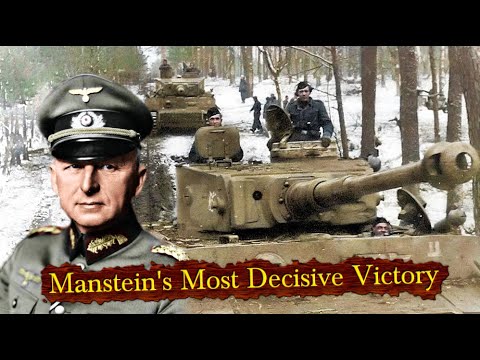
The counterattack began on February 21st, and it caught the Soviets completely off guard. Manstein concentrated the 7th, 11th, and 17th Panzer Divisions north of Stalino, striking the exposed flank of the Soviet penetration driving toward the Sea of Azov. Simultaneously, the SS Panzer Corps—Leibstandarte, Das Reich, and Totenkopf—smashed in from the west. Within days, the gap that had threatened to swallow the entire southern front was sealed shut.
The Red Army units that had been racing south with nothing between them and Mariupol suddenly found themselves cut off from their supply lines and under attack from three directions. The Wehrmacht, so recently on the verge of collapse, was now slicing through the overextended Soviet spearheads like a knife through butter. By February 28th, the Germans had restored the Donets line, and the threat to Rostov was eliminated.
But Manstein wasn’t finished. He saw a chance to do far more than just stabilize the front—he could cut off the Soviet offensive entirely. The Red Army’s left flank was hanging in the air west of Belgorod, and a thrust north could trap an entire Soviet front. Hitler, of course, wanted the counterattack to go as far north as possible, dreaming of a grand encirclement.
Manstein, ever the pragmatist, urged caution. The spring thaw was approaching, and the roads were already turning to rivers of mud. In a message to Hitler’s headquarters on March 1st, he warned: “As seductive as it is to drive north across the Donets into the enemy’s rear, there are numerous road condition complications. Right now there is a danger that the operation will get stuck in the mud.” But the opportunity was too great to ignore. By March 5th, German units south of the Donets hurled themselves north with everything they had.
The immediate objective was Kharkov—the city that had become a powerful political symbol for both sides. The SS Panzer Corps spearheaded the drive, with Leibstandarte and Das Reich advancing side by side. The fighting was brutal, house-to-house, street-by-street. Soviet rearguards fought desperately to hold the city, but the Waffen-SS divisions were relentless. By mid-March, Kharkov was back in German hands.
And still they pushed. The Leibstandarte and Das Reich drove north toward Belgorod, reaching its outskirts on March 22nd. Further north, Army Group Center had also managed to halt the Soviet offensive in its sector, driving the Red Army back eastward. The entire front was stabilizing, and the initiative had shifted back to the Germans.
The results were staggering. In just four weeks of fighting, Manstein’s counterstroke inflicted some 200,000 casualties on the Red Army—killed, wounded, and captured—and destroyed over 1,200 tanks. The Soviet offensive that had aimed to trap the Germans against the Sea of Azov was utterly shattered. The southern and central sectors of the Eastern Front were once again secure.
For the first time in months, the mood at Hitler’s headquarters shifted from despair to cautious optimism. Permits were reinstated, allowing soldiers to return home on leave. The German population, battered by a winter of grim news from the East, began to hear something other than defeat. Even Germany’s wavering allies took note: the Wehrmacht was not finished yet.
But the cost had been enormous, and the respite would be brief. The spring mud—the rasputitsa—brought operations to a halt, granting both sides three months of relative quiet to rebuild and reinforce. And as the ground hardened in the summer of 1943, all eyes would turn to a bulge in the German line around Kursk. The victory at Kharkov had bought the Third Reich time, but time was a currency it could not afford to spend freely.
Yet even as the congratulations poured in, a quieter reckoning was underway in the headquarters of Army Group South. Manstein’s staff pored over the casualty returns and fuel ledgers, and the numbers told a story that the triumphant communiqués carefully omitted. The divisions that had executed the counterstroke were shadows of their former selves—battalions reduced to companies, panzer regiments fielding a handful of operational tanks. The victory at Kharkov had been won by scraping together every serviceable vehicle and every last reserve of fuel.
The SS Panzer Corps, which Manstein had once regarded with such skepticism, emerged from the fighting with its reputation transformed. The Leibstandarte and Das Reich had fought with a ferocity that even the field marshal could not ignore, though he privately grumbled that they had taken appalling losses in costly street fighting that a more patient envelopment might have avoided. Totenkopf, meanwhile, had bled itself white holding the line west of the Donets, and its commander would spend the coming weeks begging for replacements that did not exist.
Reinforcements, when they arrived, were a trickle rather than a flood. The replacement battalions came filled with young recruits, many of them barely trained, and the tank parks were replenished with vehicles that had been patched together in the Reich’s strained factories. Speer’s ministry promised a great surge in production for the summer, but the promises came with timelines measured in months, not weeks.
Across the line, the Red Army was doing its own accounting—and drawing very different conclusions. The defeat had been bitter, but the Stavka did not read it as a verdict on Soviet strength. Instead, the generals around Stalin concluded that they had simply outrun their supply lines and attacked before they were ready. The lesson they took was not caution but preparation.
Throughout April and May, Soviet industry worked around the clock, and the rail networks east of the Volga groaned under the weight of men and materiel moving westward. New tank corps were formed, equipped with the improved T-34s rolling off the lines in the Urals. For the first time, the Red Army began to assemble reserves on a scale that dwarfed anything the Germans could match.
And at the very center of the front, around the city of Kursk, the line that Manstein had stabilized now bulged westward into Soviet territory—a salient nearly two hundred kilometers deep. It was, to any staff officer with a map, an obvious target. The question was not whether the Germans would attack it, but when.
Manstein himself was uneasy. In a series of memoranda that spring, he argued that the Wehrmacht should remain on the defensive in the east for the coming year, husbanding its strength and letting the Soviets exhaust themselves against prepared positions. Offensive action, he warned, would squander the very reserves that had made the Kharkov victory possible. But his voice was one among many, and others at the Führer’s headquarters were already sketching arrows on the map.
By early April, Hitler had made up his mind. The salient at Kursk would be pinched off by twin pincers striking from the north and south—a grand encirclement to rival, and avenge, the disaster at Stalingrad. The operation was given a name that would echo through history: Citadel. The date, however, kept slipping as new tanks were awaited and the mud refused to dry.
Those delays, as Manstein had feared, were a gift to the enemy. Every week that passed saw the Soviets dig deeper, lay more minefields, and mass more reserves behind the salient. What had once been a promising opportunity was hardening into a trap—and the men who would have to walk into it were the very divisions that had just saved the southern front.
By the time Citadel finally began in early July, the panzer divisions that had stormed Kharkov were a memory. The SS corps, refitted and reinforced, now fielded tanks and crews that had never fought together. Manstein watched the opening bombardment from his command post and knew, with the cold clarity of a professional soldier, that the enemy had been waiting for them.
The first days brought gains, then grinding attrition. Soviet minefields swallowed whole companies, and the deep defensive belts bled the panzers white. When Hitler ordered the offensive halted to divert forces to Italy after the fall of Mussolini, Manstein’s counterstroke of the winter was finally undone by the summer.
He had won the last great German victory of the war in the East. He had also spent the reserves that might have prolonged it. Kharkov had bought time, but time, as ever, was a currency the Reich could not afford to spend freely.
Was Manstein’s counterstroke a strategic masterpiece—or a brilliant save that merely postponed the inevitable? Share your thoughts in the comments below.
Report this article
Select a reason for reporting:






