September 1939. The German war machine is rolling toward Warsaw, and only 720 Polish soldiers stand in its path. They have six old artillery pieces, 24 heavy machine guns, and two anti-tank rifles with just 20 bullets between them. On the other side of the river, General Guderian is massing over 42,000 troops, 350 tanks, and more than a thousand machine guns. The math says this is not a fight—it’s an execution.
But nobody told the Poles. For three days, they hold. Three days against odds of more than 50 to one. And their captain keeps a promise that costs him everything.
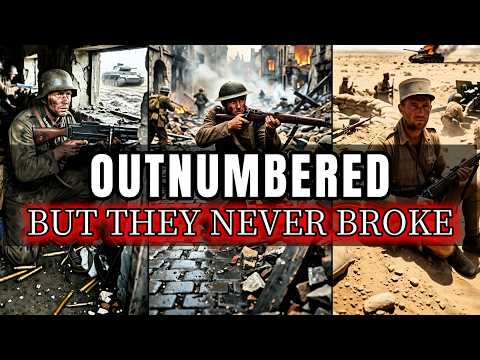
This is the story of Captain Władysław Raginis and the Battle of Wizna—the Polish Thermopylae. It’s the first of ten last stands where outnumbered soldiers looked at the math and decided the math was wrong.
From the deserts of North Africa to the mountains of Austria, from the frozen forests of Belgium to the burning ruins of Belarus, these are the moments when men were told to die, not to win—and they fought anyway.
“I will not leave this bunker alive,” Raginis swore to his officers. He held his position until the end, keeping his word to the very last.
These stories are not fiction. Every name is real. Every number is documented. And when you finish reading them, the Second World War will never look the same to you again.
Raginis was 29 years old, the son of a landowning family, a career officer in the border protection corps—elite troops trained in equal parts police work, military tactics, and frontier patrol. By September 1939, he was stationed near the old Osowiec fortress close to the East Prussian border, tasked with defending the fortified area around Wizna.
This small position controlled two vital river crossings and sat on the main road between Łomża and Białystok. If the Germans broke through here, they would have a straight path to Warsaw from the north.
The defenses at Wizna were not ready. Polish planners had designed a network of 60 bunkers to protect the area, but construction only started in April 1939. By the time war broke out in September, only 16 bunkers had been built—six heavy concrete structures with reinforced steel domes weighing eight tons each, two lighter concrete bunkers armed with machine guns, and eight sandbag pillboxes and earthworks. Four more heavy bunkers were still under construction when the first German shells started falling.
There were also trenches, barbed wire, anti-tank obstacles, and landmines. Plans existed to flood the area by breaking the dams on the rivers, but the summer of 1939 had been one of the driest in Polish history. The water level was too low for that to work.
Raginis had 720 men under his command—20 officers and 700 enlisted soldiers and non-commissioned officers. Most were not professionals. They were conscripts called up in August 1939, barely weeks before the invasion began. Their equipment included six pieces of 75 mm artillery, 24 heavy machine guns, 18 light machine guns, and two anti-tank rifles with a total of 20 rounds between them.
That was it. That was everything Poland had placed between the German 19th Panzer Corps and the road to its capital.
On September 7, scouts from General Nicolaus von Falkenhorst’s 10th Panzer Division captured the village of Wizna itself. Polish scouts fought back but were forced to retreat across the Narew River to the southern bank. Polish engineers blew up the only bridge over the river, temporarily stopping the German advance.
That night, German infantry patrols tried to cross the river in the darkness. As they approached the first bunkers, the Poles opened fire. Machine gun tracers ripped through the air. The Germans took heavy casualties and pulled back. Raginis and his men had drawn first blood.
The next morning, German aircraft appeared over the Polish positions, but they did not drop bombs. They dropped leaflets. The papers told the defenders that they were hopelessly outnumbered and should surrender immediately to save lives. Raginis read the leaflets and reportedly threw them in the dirt. He then called his officers together and made a promise.
He swore an oath that he would not leave his bunker alive. He would hold this position until he was dead.
On September 8, General Heinz Guderian received orders to advance through Wizna toward Brześć. By the morning of September 9, his forces had reached the Wizna area and combined with units already present. The numbers are almost impossible to believe.
Guderian’s combined force included approximately 42,200 soldiers, over 350 tanks, 108 howitzers, 58 field artillery pieces, 195 anti-tank guns, 108 mortars, 188 grenade launchers, 28 heavy machine guns, and 689 light machine guns—against Raginis and his 720 men with their 16 incomplete bunkers and 42 machine guns. The ratio was roughly 60 to 1.
The German assault began on September 9 with a massive bombardment. Artillery and Nebelwerfer rocket launchers hammered the Polish positions. The noise was beyond anything the young conscripts had ever experienced. The ground shook, concrete cracked, dust and smoke blotted out the sky.
Then the infantry attacked. The Poles fought from their bunkers and trenches with everything they had. Machine guns cut down wave after wave of German soldiers trying to cross the open ground. Anti-tank guns fired at the tanks trying to push through. The Polish soldiers were exhausted, outnumbered, and running out of ammunition. But they did not stop fighting.
For three days, this tiny force held up one of the most powerful armored corps in the German army. Three days—not three hours, not three minutes. Three full days.
The Germans could not believe it. After the war, Guderian had trouble explaining to his superiors how his corps had been stopped by what he awkwardly described as a well-defended position manned by a local officer school. He was embarrassed. His diary recorded approximately 900 German soldiers killed at Wizna, along with at least 10 tanks destroyed and even one aircraft shot down.
By September 10, the situation was hopeless. The Polish bunkers were being destroyed one by one by German engineers using explosives. Ammunition was nearly gone. Most of the defenders were dead or wounded. Raginis, true to his oath, ordered his surviving men to surrender so they would not be slaughtered for nothing. But he was not going to break his promise.
He was not going to leave his bunker alive.
Captain Władysław Raginis pulled the pin on a hand grenade and held it to himself. He died at the age of 29, keeping his word to the very end. Out of 720 defenders, only about 40 to 70 survived. The rest fell in battle or were killed in the aftermath. Many civilians in the village of Wizna were also murdered during and after the fighting.
The heroic stand at Wizna delayed Guderian’s advance and bought precious time for other Polish forces in the area. It did not save Poland. Nothing could have saved Poland in September 1939. But it showed something that the Germans would learn over and over again throughout the next six years: outnumbered soldiers who refused to quit can change the math of war in ways that no general staff can predict.
On the ruins of one of the destroyed bunkers at Wizna, now preserved as a memorial, there is an inscription. It reads in Polish, loosely translated: “Passerby, tell the fatherland that we fought to the end, fulfilling our duty.”
The Swedish metal band Sabaton wrote a song about Wizna called “40 to 1.” The title refers to the ratio of German troops to Polish defenders. Today, Wizna is remembered across Poland as the Polish Thermopylae.
Captain Raginis and his men stood in the path of a force designed to crush nations. They held for three days with almost nothing, and their captain died keeping a promise that nobody forced him to make.
That was number one. But Wizna was not the only place where the math was defied.
Number two takes us to the French coast, May 1940. The German Blitzkrieg has shattered the Allied armies. Hundreds of thousands of British and French soldiers are being pushed into an ever-shrinking pocket around Dunkirk. The evacuation that will save over 338,000 men has not yet begun. And between the German panzers and the trapped British army, there are only three Channel ports still in Allied hands: Boulogne, Calais, and Dunkirk.
Boulogne falls quickly. Dunkirk is where the evacuation will happen. Calais is the sacrificial lamb.
On May 22, the British War Office rushed the 30th Infantry Brigade to Calais—elite troops including the 1st Battalion Rifle Brigade, the 2nd Battalion King’s Royal Rifle Corps, the 1st Battalion Queen Victoria’s Rifles, and the 3rd Royal Tank Regiment with 48 tanks. Their commander, Brigadier Claude Nicholson, was not told he was being sent to die. The original plan was confused: establish a supply line to the BEF, maybe help with evacuation. The orders kept changing.
By May 23, two columns of tanks sent out from Calais were stopped cold by German Panzer divisions. Calais was surrounded. The position was already hopeless.
What happened next is one of the most painful decisions of the entire war. On the night of May 23, the British began preparing to evacuate the Calais garrison. An evacuation order was actually drafted. But then Winston Churchill and the War Cabinet changed their minds. A decision was made to deliberately sacrifice the men at Calais to buy more time for the Dunkirk evacuation.
Churchill sent a message to Brigadier Nicholson: “Every hour you continue to exist is of the greatest help to the BEF. The government has decided you must continue to fight. Evacuation will not take place.” Churchill later wrote that he could not help feeling physically sick as they sat silently at the table after sending that message. He knew what it meant. He had just signed the death warrants of 3,000 British soldiers.
Nicholson obeyed. For four days, the British garrison at Calais fought with everything it had. German tanks and infantry attacked from every direction. The Luftwaffe bombed the port and the town. The old medieval walls and fortifications became battlegrounds. The Rifle Brigade made a last stand around Bastion No. 1 near the harbor. The King’s Royal Rifle Corps fought house by house through the streets. The Queen Victoria’s Rifles held positions until they were overwhelmed.
Naval destroyers fired from offshore trying to support the garrison, but HMS Wessex was sunk and other ships were damaged. Ammunition ran low. Food ran out. Water became scarce. By the end, some soldiers were reportedly throwing empty wine bottles at the attacking Germans because they had nothing else left to throw.
On May 26, the Germans finally broke through the last defenses. The Citadel of Calais fell in the mid-afternoon. Brigadier Nicholson surrendered personally at around 4:00 PM. More than 3,000 British troops were taken prisoner along with about 700 French soldiers who had fought alongside them. A few men managed to escape through German lines and eventually reached Dunkirk. Most did not.
Nicholson himself was taken prisoner and would die in captivity on June 26, 1943, at the age of 44. He never got to tell his version of what happened at Calais.
Three hours after Calais fell, the British Admiralty announced that Operation Dynamo, the Dunkirk evacuation, was about to begin. The timing was not a coincidence. The defense of Calais had tied down the German 10th Panzer Division for critical days—days when it could have been attacking Dunkirk instead.
Whether the sacrifice of Calais was the single decisive factor in saving the BEF is debated by historians. The German halt order issued by Hitler also played a role. But the defenders of Calais made a contribution that can be measured in blood. 3,000 highly trained soldiers were sacrificed so that over 300,000 others might live.
They were told there would be no rescue. They were told to fight to the last. And they did.
That was number two. But Calais was not the only place where men were told to die so that others might live.
Number three takes us to the Libyan desert, May 1942. Erwin Rommel’s Afrika Korps is pushing hard toward Egypt and the Suez Canal. The British 8th Army has set up the Gazala Line, stretching south from the Mediterranean coast into the desert. At the very bottom of this line, at its most remote and desolate point, sits a dusty ruin called Bir Hakeim—an old Turkish fort next to a dried-up well in the middle of absolutely nothing.
This is where the British put the Free French.
Brigadier General Marie-Pierre Kœnig commanded the 1st Free French Brigade—about 3,700 soldiers. They were not a normal military unit by any stretch of the imagination. They were a collection of Foreign Legionnaires, many of whom were refugees from Nazi-occupied Eastern Europe, desperate to fight back against the people who had destroyed their countries. French Marines, soldiers from Senegal, Madagascar, Central Africa, and other French colonies. The unit was led by a Georgian aristocrat named Colonel Dimitri Amilakhvari, whose family had fled Georgia when the Soviet Union took over in 1921.
These were men with nothing to lose and everything to prove. France had fallen in six weeks in 1940. The British did not expect much from the Free French. Rommel expected even less. They were both wrong.
Kœnig arrived at Bir Hakeim in February 1942 and had three months to prepare his defenses. He used the time well. His engineers built concentric rings of trenches, underground bunkers, and camouflaged artillery positions. They laid extensive minefields. They dug in their guns and stockpiled what ammunition they could get. The position looked like nothing from the air—just empty desert. But underground, it was a fortress.
On May 26, Rommel launched his attack on the Gazala Line. He sent Italian forces in a frontal attack against the northern section as a distraction while he personally led his 15th and 21st Panzer Divisions in a massive flanking move around the southern end of the line. This meant going past Bir Hakeim. Rommel assumed the French would be easy to overrun. He left the Italian Ariete Armored Division to deal with them while he continued north with his main force.
The Italians attacked on the morning of May 27. Sixty tanks from the 9th Tank Battalion charged straight at the French positions. They hit the minefield and the wire. The French guns opened up. In a matter of hours, 31 Italian tanks were burning in the sand. Ten more got through the minefield but were knocked out by French 75mm anti-tank guns. The Italians suffered 124 casualties and retreated in confusion.
Kœnig sent a defiant refusal when the Italians demanded his surrender. What followed was 16 days of siege warfare in the blazing desert.
Rommel was furious that these ragged French soldiers were holding up his plans. He sent wave after wave of attacks. German and Italian artillery pounded the position day after day. The Luftwaffe launched massive bombing raids. On one single day, 100 Stuka dive bombers dropped over 130 tons of bombs on the French positions. German infantry attacked from the north. Italian tanks attacked from the east. The French held.
They fought with rifles and bayonets when the enemy got close. Some of the fighting was hand-to-hand. They survived on thimblefuls of water in temperatures that would kill a man in hours without shade. They searched the bodies of the dead for ammunition. They fired their last mortar rounds and then counted their remaining rifle bullets.
By June 10, Kœnig reported that his garrison was exhausted and nearly out of ammunition. He had only 200 rounds left for his 75mm guns and 700 mortar rounds. He asked permission to break out. That night, French engineers cleared a narrow path through their own minefields while rear guard units provided covering fire. An English nurse named Susan Travers drove Kœnig’s sandbagged command vehicle through the enemy lines in the darkness at full speed. Bullets punched through the vehicle. Behind them, the garrison streamed out through the gap.
Remarkably, about 2,700 men escaped from the original garrison of 3,700. The rest were killed, wounded, or captured. The French suffered around 141 killed, 229 wounded, and 814 captured over 16 days of fighting. The Axis forces lost approximately 3,300 killed or wounded, 227 captured, 164 vehicles destroyed, and 49 aircraft shot down.
After the war, German General Friedrich von Mellenthin wrote that in the whole course of the desert war, they never encountered a more heroic and well-sustained defense. A Paris Metro station is named after Bir Hakeim today. So is a bridge over the River Seine. But beyond France, almost nobody knows this story. They should.
That was number three. But Bir Hakeim was not the only place where exiles and colonial soldiers held the line against impossible odds.
Number four takes us to the mountains of Austria, May 1945. The war in Europe is essentially over. Hitler is dead. The German army is collapsing everywhere. But in the mountains of northern Tyrol, pockets of fanatical Waffen-SS troops are still fighting and killing anyone they consider a traitor—including any German soldier who tries to surrender to the Allies.
In this chaotic landscape sits Castle Itter, a medieval fortress perched on a hill above a small Austrian village. Since 1943, the SS had used it as a special prison for high-value French political prisoners. The castle was part of the Dachau concentration camp system, but the conditions were comparatively better than most camps. The prisoners included former French prime ministers Édouard Daladier and Paul Reynaud, French generals Maxime Weygand and Maurice Gamelin, the sister of Charles de Gaulle, and a famous French tennis champion named Jean Borotra.
These were people the Nazis had kept as hostages and bargaining chips. As the end of the war approached, the SS guards at Castle Itter began to desert their posts. By May 4, the prisoners found themselves free but trapped. They were unarmed. Waffen-SS troops were still operating in the surrounding forests. The 17th SS Panzergrenadier Division had been ordered to execute all prisoners who remained at the castle. Time was running out.
The prisoners sent two messengers for help. One was Zvonimir Čučković, a Yugoslav handyman who slipped out of the castle and walked through enemy territory to reach American troops near Innsbruck. The second was the castle cook, a Czech man named Andreas Krobot, who made his way to the nearby town of Wörgl. There he found Major Josef Gangl, a German Wehrmacht officer who had turned against the Nazi regime and was working with the Austrian resistance.
Gangl was a decorated veteran of the Eastern Front. He had seen enough of Nazi ideology. He had about 10 to 20 loyal soldiers with him. But he knew that was not enough to hold off the SS. So Gangl grabbed a white flag and drove to the nearest American unit. He found Captain Jack Lee of the 23rd Tank Battalion, 12th Armored Division. Lee was described as a cigar-chewing, hard-drinking, rough-talking tank commander. He did not hesitate.
Lee assembled a small force. His Sherman tank, nicknamed Besotten Jenny, took the lead. He had about 14 American soldiers, Gangl’s German troops, and a truck carrying 10 former German artillerymen. They drove toward Castle Itter, fighting through an SS roadblock on the way. Bridges gave out under the weight of the tanks. Lee was forced to leave most of his armor behind.
By the time the rescue force arrived at the castle on the evening of May 4, it consisted of one Sherman tank, a handful of American GIs, a handful of German soldiers, and a former Waffen-SS officer named Kurt-Siegfried Schrader, who had become disillusioned with Nazism and had befriended the French prisoners during his recovery from wounds at the castle.
Inside, the French prisoners had armed themselves with whatever weapons the guards had left behind. Lee set up defensive positions around the castle. His tank guarded the main entrance. American soldiers, German soldiers, and French politicians took up firing positions along the walls. The scene was almost impossible to believe. Former enemies were now fighting side by side, sharing ammunition and checking each other’s firing sectors.
On the morning of May 5, the SS attacked. Between 100 and 200 Waffen-SS soldiers opened fire on the castle with machine guns and an 88mm anti-aircraft gun. The defenders fired back. Lee’s Sherman tank provided machine gun support until the SS knocked it out with the 88. The fighting was intense. Walls crumbled under the shelling. Ammunition started running low.
Major Josef Gangl was killed by an SS sniper bullet while trying to move former French Prime Minister Paul Reynaud out of the line of fire. A German soldier who had changed sides, killed while protecting a Frenchman from the Nazis. The irony is almost too much to bear.
As the situation grew desperate, Jean Borotra, the tennis champion, volunteered for an insane mission. He would vault the castle wall and run through the SS lines to reach American reinforcements. Lee agreed. Borotra, who was in his 50s, climbed over the wall and sprinted through enemy fire. He made it. He reached the American 142nd Infantry Regiment and guided a relief force back to the castle.
The American tanks arrived just in time. The SS troops scattered into the forest. The battle was over. All of the French VIP prisoners survived. The only defender killed was Major Josef Gangl. A street in Wörgl is named after him today. He is honored as an Austrian national hero. Captain Lee received the Distinguished Service Cross.
Two days after the battle, on May 7, 1945, Germany officially surrendered.
That was number four. But Castle Itter was not the only place where former enemies became brothers in arms.
Number five takes us to Belgium, December 1944. The German army has launched its last major offensive on the Western Front—Operation Wacht am Rhein, the Battle of the Bulge. Hitler believes that if his forces can punch through the thinly held Ardennes sector, cross the Meuse River, and capture the vital port of Antwerp, they can split the American and British armies in two and force a negotiated peace.
The attack began on December 16 with a massive assault through the forests of Belgium and Luxembourg. The Allies were caught completely off-guard. The crossroads town of Bastogne was critical to both sides. Seven major roads converged there. Whoever held Bastogne controlled the road network that the German armor needed to advance west.
The 101st Airborne Division was rushed to Bastogne to hold it. The division traveled over 100 miles in open-air trucks in freezing December weather to get there. They arrived just four hours ahead of the leading German forces. The division’s regular commander, Major General Maxwell Taylor, was in the United States at the time. Command fell to Brigadier General Anthony McAuliffe, the division’s artillery commander.
By December 20, Bastogne was surrounded. German forces encircled the town and cut off all supply routes. Inside the perimeter, McAuliffe had approximately 14,000 American soldiers from the 101st Airborne, elements of the 10th Armored Division, the 705th Tank Destroyer Battalion, and other attached units. They were outnumbered roughly 5 to 1. They were running low on ammunition, food, and medical supplies. They did not have enough cold weather gear. The temperature was well below freezing. Snow covered everything. Wounded men were dying because the division had almost no surgical capability left.
The Germans attacked from every direction. Panzer divisions, infantry divisions, a parachute division. Day after day, they hammered the American perimeter. The Americans bent but did not break. Artillery fire was coordinated so that the limited shells the Americans had were concentrated at the point of each German attack. Fog and low clouds prevented aerial resupply and kept Allied fighter-bombers grounded. The defenders of Bastogne were alone.
On December 22, at about 11:30 AM, four German soldiers appeared at the American lines south of Bastogne. Two officers and two enlisted men carrying white flags. They said they had a message for the American commander. The senior German officer was a major from the 47th Panzer Corps. The message was a formal ultimatum demanding the surrender of Bastogne. It warned that if the Americans did not surrender within two hours, a German artillery corps and six heavy anti-aircraft battalions would annihilate them. The message ended by saying that the serious civilian losses caused by the resulting artillery fire would not correspond with the well-known American humanity.
The message was passed through the chain of command until it reached McAuliffe. The acting chief of staff, Lieutenant Colonel Ned Moore, woke McAuliffe from a nap and told him the Germans had sent people forward to take their surrender. McAuliffe, still half asleep, muttered a single word: “Nuts.” Then he started climbing out of his sleeping bag. When the written ultimatum was formally presented to him, McAuliffe read it, crumpled it into a ball, threw it in a waste paper basket, and said, “Aw, nuts.”
His officers tried to come up with suitable language for a formal reply. Lieutenant Colonel Harry Kinnard suggested that McAuliffe’s first response summed up the situation perfectly. Everyone agreed. The official reply was typed on a single sheet of paper. It read in its entirety: “To the German Commander: Nuts! — The American Commander.”
Colonel Joseph Harper of the 327th Glider Infantry personally delivered the reply to the waiting German officers. When the confused German lieutenant asked if the reply was favorable, Harper said in plain English: “Go to hell.”
The artillery fire the Germans had threatened did not materialize in the way they had promised. Attacks continued, including nighttime bombing raids by the Luftwaffe, but the 101st held. On December 23, the weather cleared. Allied aircraft were finally able to fly. Supply drops came in by parachute. Fighter-bombers began pounding the German positions. On December 26, leading elements of Patton’s Third Army, specifically the 37th Tank Battalion of the 4th Armored Division, broke through the German lines and reached Bastogne. The siege was over.
The Battle of the Bulge continued until January 25, 1945. American casualties in the entire battle exceeded 75,000. But the German offensive had failed. The 101st Airborne suffered 482 killed, 2,449 wounded, and 527 missing or captured during the Bastogne campaign. No member of the division ever admitted to needing rescue. They had held when everything said they should have fallen.
That was number five. But Bastogne was not the only place where a single word changed the course of the war.
Number six takes us to the Soviet Union, June 1941. Operation Barbarossa has just begun—the largest military invasion in human history. More than 3 million German and Axis soldiers attack along a front stretching from the Baltic to the Black Sea. The Brest Fortress, a 19th-century star-shaped fortification on the Soviet Union’s western border, is among the very first targets.
The fortress sat at the meeting point of the Bug and Mukhavets rivers, controlling vital river crossings, the Warsaw–Moscow railway, and the main highway east. It was directly in the path of Army Group Center’s advance. Inside the fortress that morning were approximately 9,000 Soviet soldiers, regular army troops from the 6th and 42nd Rifle Divisions, border guards, NKVD operatives, and about 300 military families—wives and children who lived inside the fortress complex. Most of the senior officers had gone home for the weekend. The fortress was staffed mainly by young junior lieutenants and their men.
The Germans had planned to take Brest Fortress in the first 12 hours of the invasion. The Austrian 45th Infantry Division, about 17,000 soldiers strong, was given the job. They had artillery support from additional divisions and Guderian’s Panzer Group. At 4:15 AM the bombardment began. Heavy artillery, Nebelwerfer rocket launchers, and massive 600mm mortar shells smashed into the fortress. Residential buildings, barracks, and supply depots were hit first. The casualties in those first minutes were terrible. Sleeping soldiers were buried in rubble. Ammunition dumps exploded. Supply stores were destroyed. Communications were cut. Water mains were shattered. Fires broke out everywhere.
The Germans expected the survivors to be stunned and disorganized. They sent assault groups across the Bug River within minutes of the bombardment starting. What they found shocked them. Soviet soldiers, many half-dressed and still bleeding from the bombardment, were fighting back with everything they had.
The defenders could not form a solid front line. Instead, they fought from isolated pockets—bunkers, basements, and rubble piles. Each pocket became its own little fortress. Each group of survivors fought independently, with no communication with any other group, no orders from higher command, and no idea what was happening outside their immediate area. They fought because fighting was the only thing left to do.
On the first day of the assault, 281 German soldiers were killed trying to take the fortress. That number was supposed to be zero. The Germans had expected a walkover. Instead, they got a bloodbath.
The fighting continued day after day. German infantry could not advance through the corridors and rooms of the old fortress because organized rifle and machine gun fire from deep gun positions cut down anyone who approached. The fortress commander, a German general named Fritz Schlieper, wrote to his superiors that it was impossible to advance with infantry alone and that the only solution was to starve the Soviets out through hunger and thirst. Offers of surrender were rejected. The Germans called in the Luftwaffe. On June 29, bombers dropped massive bombs on the East Fort, one of the last major holdout areas. By this point, about 360 defenders were still fighting.
After the bombardment, the organized resistance ended, but scattered holdouts continued fighting from basements, tunnels, and hidden rooms throughout July. The last confirmed engagement occurred on July 23 when a Soviet officer named Pyotr Gavrilov was finally captured. He had held out for 31 days. He was starving. His uniform was in rags, and he was barely alive. He was sent to a concentration camp but survived the war. In 1957, he was awarded the title Hero of the Soviet Union.
German records show 429 killed and 668 wounded in the assault on Brest Fortress. Those are remarkable numbers for what was supposed to be a single day’s operation against a surprised garrison. The Soviets lost approximately 2,000 killed and over 7,000 captured.
On the walls of the fortress, Soviet soldiers scratched messages into the stone and brick. One of those messages, discovered after the war, has become one of the most famous lines of the entire Eastern Front. It reads: “I am dying, but I will not surrender. Farewell, Motherland. July 20, 1941.”
The Brest Fortress was given the title Hero Fortress in 1965. A massive memorial complex was built there in 1971. The main monument is a 32-meter-high concrete sculpture of a defender’s face—one of the most recognizable war memorials in Eastern Europe.
That was number six. But Brest was not the only place where men refused to die on schedule.
Number seven takes us back to the desert, October 1942. The Second Battle of El Alamein is the turning point of the war in North Africa. British General Bernard Montgomery has launched Operation Lightfoot, a massive offensive aimed at finally driving Rommel’s Panzer Army Africa out of Egypt for good. The plan calls for British infantry to punch corridors through the enormous Axis minefields, then send armored divisions through to destroy the German and Italian tank forces in the open desert beyond.
On the night of October 26, Lieutenant Colonel Victor Buller Turner led his 2nd Battalion of the Rifle Brigade forward into the darkness. His objective was a small depression in the featureless desert called Outpost Snipe, about a mile and a half southwest of a map feature known as Kidney Ridge. The position was meant to serve as a forward outpost and jumping-off point for a further armored advance.
Turner had about 300 men. His force included an anti-tank company with 19 six-pounder anti-tank guns, a handful of scout carriers, some machine guns, mortars, and a small group of Royal Artillery gunners with six more six-pounders. That was it. 300 men and about 25 guns in a shallow dip in the sand with nothing but open desert in every direction.
Navigation in the desert at night was nearly impossible. Turner’s battalion followed a creeping artillery barrage on a different compass bearing than his own navigator had calculated, which meant the force ended up about 900 yards south of where it was supposed to be. They did not discover this error until it was too late to move. Turner ordered his men to dig in where they were. The gun crews scraped out shallow positions in the soft sand and set their six-pounders to cover every direction. By dawn, they were as ready as they would ever be—which was not very ready at all.
At first light, the scouts went out and found about 160 enemy soldiers ready to surrender. But before they could collect the prisoners, the patrol ran into a force of 35 German and Italian tanks and self-propelled guns that was forming up nearby. The Germans began to move.
What followed was one of the most ferocious small-unit actions of the entire war. For over 13 hours, 300 British soldiers in a hole in the desert fought off wave after wave of German and Italian armor. Tanks came at them from the east. Tanks came at them from the west. Tanks came from the north. The six-pounder crews waited until the tanks were within range and then opened fire. The effect was devastating. The new six-pounder anti-tank gun, being used in combat for the first time, proved deadly against Axis armor at ranges up to 2,000 yards.
Tank after tank was hit. Some burst into flames. Some ground to a halt and sat smoking. Crews bailed out and were cut down by machine gun fire from the British infantry in their foxholes. One gunner, Sergeant Charles Calistan, personally knocked out nine tanks during the battle. He fired at ranges as close as 150 yards. You could not miss at that range.
Every gun seemed to be firing at once. Burning tanks lit up the desert. But the British were taking punishment, too. German artillery hammered the position all day. Machine gun fire swept across the open ground. One by one, the six-pounders were knocked out. Crews were killed or wounded. Guns were damaged or destroyed. Turner himself was wounded but kept commanding. When ammunition started running out, some guns had only 10 rounds left. Turner ordered maps and codes burned, fearing the position might be overrun.
By late afternoon, only a handful of guns were still operational. The Axis forces made one final push. Fifteen tanks advanced carefully toward the position, using every piece of cover they could find. The remaining British gunners held their fire until the last possible moment, then opened up. More tanks burned. The attack faltered.
As darkness fell, the surviving defenders received orders to withdraw. They had to leave their remaining guns behind. Only one anti-tank gun was brought back. The rest were spiked or abandoned. The final count was staggering. 300 men with their small guns had destroyed or disabled between 52 and 57 Axis armored vehicles, including tanks and self-propelled guns. British casualties were 72.
Turner was awarded the Victoria Cross for his leadership. Sergeant Calistan, who had knocked out nine tanks by himself, received only the Distinguished Conduct Medal. Many who served with him believed he deserved the Victoria Cross as well. He was killed later in the campaign in Italy.
The defense of Outpost Snipe was described by newspapers at the time as the finest action of the war. Rommel himself drew the lesson that armored attacks against well-positioned anti-tank guns were unlikely to succeed. For 300 men in a hole in the sand, that was quite a legacy.
That was number seven. But Snipe was not the only place where a handful of men broke the back of an army.
Number eight takes us to the outskirts of Berlin, April 1945. The war in Europe is in its final weeks. The Soviet Red Army stands on the eastern bank of the Oder River, less than 60 miles from Berlin. The last natural barrier between Marshal Georgy Zhukov’s armies and the German capital is a line of high ground called the Seelow Heights.
These elevated bluffs overlooked the river floodplain and commanded the direct approach to Berlin from the east. The Germans knew the attack was coming. They had nowhere left to retreat. Nearly 100,000 German soldiers were dug into the heights, including regular Wehrmacht infantry, Waffen-SS units, Volksgrenadier divisions made up of older men and teenagers, and Volkssturm militia consisting of old men and boys as young as 15. They had been fortifying the heights for months. Three defensive lines were carved into the terrain. Anti-tank ditches, minefields, concrete bunkers, machine gun nests, artillery positions registered on every likely avenue of approach. The Germans were fighting for their homes, their families, and the simple knowledge that what lay behind them was the end of everything they knew.
Facing them was the largest concentration of military force in human history assembled for a single assault. Marshal Zhukov’s 1st Belorussian Front included over 1 million soldiers supported by thousands of tanks, self-propelled guns, and aircraft. The artillery alone was staggering. Over 20,000 guns were lined up wheel-to-wheel along the river.
The bombardment that opened the assault on April 16 was one of the heaviest in the history of warfare. At 3:00 AM, the guns opened fire. The earth shook for miles in every direction. The barrage lasted over 30 minutes and was intended to obliterate the German defenders. Then Zhukov ordered 143 searchlights switched on. The plan was to blind the defenders as the Soviet infantry crossed the floodplain. It backfired. The lights created a wall of glare that actually silhouetted the advancing Soviet soldiers against the muddy ground, making them perfect targets. The smoke and dust from the bombardment reflected the light back into the eyes of the attackers. Instead of blinding the Germans, the searchlights blinded the Soviets.
The German defenders, though battered by the bombardment, were still alive in their deep bunkers and trenches. When the Soviet infantry advanced across the waterlogged floodplain below the heights, the Germans opened fire from above. The killing was terrible. Soviet soldiers died in enormous numbers trying to climb the muddy slopes. German machine guns cut whole companies to pieces. Anti-tank guns knocked out Soviet armor bogged down in the soft ground. Counterattacks by German tanks pushed back Soviet penetrations.
Zhukov had expected to take the heights in a single day. It took three. For three days, the battle raged across the heights. Soviet losses were enormous. Some estimates put the figure at over 30,000 killed in just those three days. German losses were also severe, probably around 12,000 killed. But the outcome was never in doubt. The Soviets simply had too many men, too many tanks, and too many guns.
By April 19, the German defenses had been broken through. The road to Berlin was open. The defenders of the Seelow Heights had been overwhelmed, but they had imposed a cost on the Soviet advance that shocked even the Soviet high command. The delay was measured in days, not weeks. But every day was another day that civilians in Berlin could flee westward away from the advancing Red Army. Whether that changes the moral calculation of the battle depends on who you ask.
The Seelow Heights today are the site of a memorial and museum. The German cemetery there holds the remains of thousands of soldiers, many of them teenagers, who were handed a rifle and told to hold a position they could not hold. On the Soviet side, Marshal Zhukov was criticized by Stalin for the high casualties his forces suffered. He had been expected to reach Berlin faster. The battle remains one of the most controversial engagements of the entire war.
That was number eight. But Seelow was not the only place where the last stand before the capital cost both sides more blood than anyone expected.
Number nine takes us back to the desert, April 1941. Rommel’s Afrika Korps is pushing the British back across Libya with stunning speed. The British 8th Army is in retreat. Position after position is abandoned. But at the small Libyan port of Tobruk, the retreat stops. The garrison, predominantly Australian soldiers of the 9th Division, digs in and refuses to move.
What followed was one of the longest and most famous sieges of the entire war. Tobruk was important because it was a deep-water port. Whoever held it had a supply base. If Rommel captured Tobruk, his supply lines would be shortened enormously and his advance into Egypt would become far easier. If the Allies held it, Rommel would have to bypass the port and stretch his supply lines across hundreds of miles of desert. The Australians made sure he could not take it.
The garrison was surrounded by April 1941. Rommel’s forces encircled the town and began probing the defenses. What they found was unlike anything they had experienced in the desert. The Australians did not sit passively behind their defenses and wait to be attacked. They came out at night. Aggressive night patrols became the signature tactic of the Tobruk garrison. Small groups of Australians would slip through the wire after dark, crawl across no man’s land, and attack German and Italian positions with bayonets, grenades, and knives. They killed sentries. They destroyed supply dumps. They brought back prisoners for interrogation.
The Germans called them the Rats of Tobruk. The Australians took the insult and made it their badge of honor. They wore the name proudly.
Rommel launched multiple major assaults on the Tobruk perimeter. Every one was repulsed. The Australian infantry, supported by British and Indian troops who rotated through the garrison, held every attack at the wire. The defense was organized around a system of strong points and bunkers linked by trenches. When the Germans broke through at one point, the defenders would counterattack from the flanks and seal the breach. When German tanks penetrated the outer defenses, they were engaged by anti-tank guns positioned in depth. The garrison’s artillery was expertly coordinated and devastated every attacking formation.
For 241 days, the garrison held out. Supplies came in by sea, running a gauntlet of German bombers and submarines. Warships of the Royal Navy made regular runs into the harbor, unloading ammunition, food, and fresh troops while evacuating the wounded. Losses among the supply ships were heavy, but the lifeline was never cut.
The siege was finally lifted in December 1941 when the British launched Operation Crusader. The 8th Army advanced across the desert and linked up with the Tobruk garrison, ending one of the most remarkable defensive actions of the entire war. The Australians and their comrades had denied Rommel a critical port for eight months. They had forced him to extend his supply lines to the breaking point. They had tied down German and Italian divisions that could have been used elsewhere. And they had proven that Rommel’s Afrika Korps was not invincible.
The cost was high: over 3,400 casualties during the siege, including killed, wounded, and captured. But the damage they inflicted on Rommel’s forces was far greater, and the psychological effect was incalculable. The Rats of Tobruk had shown the world that the Germans could be stopped. It would take another year and a half to drive the Axis out of North Africa entirely. But the seed of that victory was planted in the trenches and bunkers of Tobruk by Australian soldiers who refused to give up an inch of sand they had been told to hold.
That was number nine. But Tobruk was not the only place where men held out for months against impossible odds.
Number ten takes us to the Netherlands, September 1944. Operation Market Garden is Field Marshal Bernard Montgomery’s plan to end the war in Europe by Christmas. Three airborne divisions will drop behind German lines and seize a series of bridges over major rivers. Ground forces of the British 30th Corps will then race up a single narrow road, cross the captured bridges, and break through into Germany across the Rhine River. If it works, the war might be over in months. If it fails, thousands of men will be trapped behind enemy lines with no way out.
It failed. And the worst failure happened at the very last bridge, the furthest one, at the Dutch town of Arnhem on the Lower Rhine. This was the bridge that mattered most. It was assigned to the British 1st Airborne Division, the Red Devils. Their job was to land near Arnhem, capture the bridge, and hold it for 48 hours until 30th Corps arrived.
The problems started before the first parachute opened. Intelligence failures were catastrophic. Dutch resistance fighters had reported that two SS Panzer divisions, the 9th and 10th, were resting and refitting in the Arnhem area. Major Brian Urquhart, the intelligence officer for the Airborne Corps, brought aerial reconnaissance photographs to his commander, Lieutenant General Frederick Browning, clearly showing German armor near the drop zones. Browning dismissed the intelligence. He reportedly had Urquhart sent on sick leave.
The drop zones themselves were seven to eight miles from the bridge—far too distant. This meant the paratroopers would have to march for hours through enemy-held territory before even reaching their objective. And the plan required 30th Corps to advance 60 miles along a single road in just two days.
On September 17, the 1st Airborne Division jumped into the Netherlands, but only one battalion, the 2nd Battalion of the Parachute Regiment under Lieutenant Colonel John Frost, managed to reach the Arnhem Bridge. The rest of the division was scattered, disorganized, and immediately engaged by German forces that were far stronger than anyone had expected. The SS Panzer divisions that intelligence had warned about were exactly where the Dutch resistance said they would be.
Frost and approximately 740 men took control of the northern end of the Arnhem bridge. They occupied buildings around the bridge approach and set up defensive positions. They were supposed to hold for 48 hours. They held for four days.
For four days, Frost’s paratroopers fought against two SS Panzer divisions. The fighting was house to house, room to room. German tanks drove up to buildings occupied by the British and fired point-blank through the walls. The paratroopers replied with anti-tank weapons, grenades, and small arms fire. Buildings burned. Rubble filled the streets. Ammunition ran out. Water ran out. Medical supplies ran out. The wounded lay in basements without treatment. The dead were left where they fell because there was no time to move them.
The paratroopers knocked out German armored vehicles attempting to cross the bridge. They held their positions as buildings collapsed around them. They fought from rubble piles and cellars and rooftops. They waited for the sound of 30th Corps’ tanks coming up from the south. Those tanks never came. 30th Corps was stuck on the single narrow road, fighting through one German blocking position after another, falling further and further behind schedule.
By September 21, it was over at the bridge. Frost himself was badly wounded. The survivors, out of ammunition and surrounded, were overrun. Of the roughly 740 men who had reached the bridge, most were killed or captured. Frost was taken prisoner and spent the rest of the war in German hands.
The rest of the 1st Airborne Division fared little better. Of approximately 10,000 men who landed near Arnhem, only about 2,000 managed to escape back across the Rhine in a desperate evacuation on the night of September 25. The division suffered 1,984 killed and 6,854 captured. It effectively ceased to exist as a fighting formation.
Operation Market Garden had failed. The Rhine crossing that was supposed to end the war never happened. The war in Europe continued for another eight months. Browning’s reported comment before the operation—that they might be going “a bridge too far”—became one of the most bitter and famous phrases of the entire war.
The bridge at Arnhem was later renamed the John Frost Bridge in honor of the commander who held it for four days against impossible odds. Today, bullet holes can still be found in some of the buildings near the bridge. Every September, veterans and their descendants gather at Arnhem to remember what happened there.
The men of the 2nd Battalion held a bridge they were told to hold for two days. They held it for four. They waited for help that never came. They fought until they had nothing left to fight with. And then they were overwhelmed. Not because they failed, but because the plan they were given was broken before they ever left the ground.
Those are the ten. From Wizna to Arnhem. From 1939 to 1945. From Poland to the Netherlands. From the deserts of Libya to the mountains of Austria. From the frozen fields of Belgium to the burning ruins of Belarus.
Ten moments when outnumbered soldiers were told to hold—and they held. Some held for hours. Some held for days. Some held for months. Most of them knew they were not going to survive. They held anyway.
720 Poles against 42,000 Germans. 3,000 British soldiers sacrificed so that 300,000 could escape. 3,700 Free French exiles holding off Rommel in the desert. American tankers and German defectors defending French politicians in a medieval castle. 14,000 American paratroopers telling the German army to go to hell. 9,000 Soviet soldiers refusing to surrender even as their fortress collapsed around them. 300 British riflemen destroying 57 tanks from a hole in the sand. 100,000 Germans making a last stand before their capital. Australian soldiers raiding German trenches in the dark for eight months. 740 British paratroopers holding a bridge for four days against two Panzer divisions.
The Second World War was decided by industry, logistics, strategy, and the sheer weight of numbers. But inside those enormous forces, inside those millions of soldiers and billions of bullets, there were moments where everything came down to a handful of men in a single position who decided they were not going to move.
These are those moments. And every one of them really happened.
Which of these last stands hit you the hardest—and why? Share your thoughts in the comments below.
Report this article
Select a reason for reporting:






