The sun hung low over Pearl Harbor, casting a golden sheen on the calm waters of Hawaii. It was 5:00 a.m. on Sunday, December 7, 1941. The mighty warships of America’s Pacific Fleet lay anchored in Battleship Row, their steel hulls gleaming like sleeping giants. “At that time, the Navy personnel thought the battleships were the greatest thing going. Nothing could defeat them,” recalled one veteran. But beneath the serene surface, a storm was brewing—one that would shatter the peace and plunge the world into chaos.
Unbeknownst to the sailors and civilians on Oahu, 230 miles to the north, Japanese forces aboard the carrier Akagi were preparing for a devastating strike. As dawn approached, the first wave of 180 aircraft took flight, their engines humming with deadly purpose. The fate of Pearl Harbor was sealed.
At 6:30 a.m., Navy sailors began their routine, waking to what seemed like an ordinary Sunday. “I was up in the compartment reading a comic book. That’s when I realized we were under attack,” one man remembered. But the signs were already there. Fifteen minutes earlier, the USS Ward had spotted a Japanese submarine periscope and attacked, sending a warning to headquarters. “Sunk enemy submarine one mile south of Pearl Harbor,” the message read. But the warning was dismissed—communications officers believed it was a mistake.
By 7:00 a.m., the first wave of Japanese aircraft was only 130 miles away, homing in on Hawaiian radio music. On the ground, an Army radar post picked up blips but was told not to worry—“Don’t worry about it. It’s a flight of B17s coming in from California,” a lieutenant said. It was a fatal error. The planes were coming from the north, not the east.
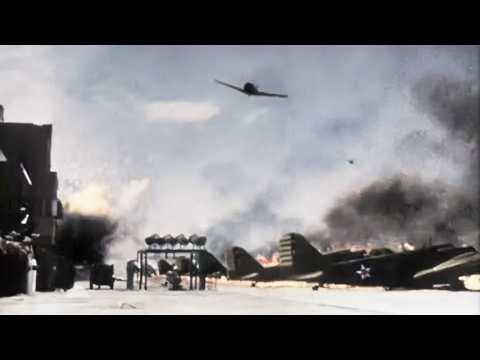
At 7:40 a.m., the first wave reached Oahu. “Out of the misty Pacific skies, like tiny locusts, they swarmed in from the sea,” described a witness. The quiet morning was shattered by the roar of planes and the staccato of gunfire. “I could see the pilot and the co-pilot, and they were laughing for all they were worth. It was horrifying,” a sailor recalled. The Americans were caught completely off guard.
The Japanese had engineered a torpedo specifically for Pearl Harbor’s shallow waters, and it wreaked havoc. Within minutes, the USS West Virginia was torn apart by six torpedoes and two bombs. The USS Oklahoma capsized after three torpedo hits, trapping over 30 men inside. “We took these clothes and blankets and stuffed them in the vent system to try to stop the water from coming in. Well, we’d plug it up in one place, then it’d start coming in somewhere else,” one survivor recounted.
Then came the USS Arizona. A bomb pierced its gunpowder stores, igniting a cataclysmic explosion. “Can you envision a million pounds of TNT blowing up?” asked a veteran. The ship sank in minutes, taking 1,177 lives with it. “It was horrifying because as the bomb hit the starboard side of the fo’c’sle deck, it was just a gigantic explosion,” another recalled. Burning oil slicked the water, and black smoke choked the sky as young sailors jumped into the inferno, some making it, many not.
By 8:10 a.m., Battleship Row was a scene of utter devastation. The Oklahoma had capsized, and the Arizona was in bits. “I felt like somebody kicked me in the stomach with a boot or something because that’s the worst I ever felt the whole war—to see the Oklahoma. You just don’t kill a battleship. They’re impregnable,” a sailor said, his voice heavy with shock.
Meanwhile, at Kaneohe Naval Air Station, sailors fought back with fury. “I was angry, so damn mad that I didn’t have a sense enough to be afraid,” one man said. But the devastation was widespread—charred wreckage, shattered propellers, and lifeless bodies strewn across the landscape. “I know some of them cried, some of them were angry, some of them just couldn’t understand. And none of us really understood why we were hit at that time,” a survivor reflected.
At 8:54 a.m., the second wave of 170 aircraft arrived, but by then, the base was on high alert. Resistance was fierce. “The sky was very full of planes plus exploding shells. At times it was just like a flock of birds,” described a defender. The USS Nevada, despite being hit by five to seven bombs, made a desperate break for open water, eventually beaching itself to keep the channel clear.
By 10:00 a.m., the Japanese strike force withdrew, leaving behind a devastated Pearl Harbor. In just two hours, 21 American warships were sunk or damaged, 188 aircraft destroyed, and 2,403 servicemen and women killed. “Pearl Harbor was the worst defeat the United States had ever had. And that dug right deep into every one of them. This cannot happen. Why did it happen?” a historian pondered. But even in the face of tragedy, a defiant spirit emerged. “We may lose the battle, but we’re going to win the war,” vowed a survivor.
As smoke billowed over the wreckage, the nation transformed overnight. Factories roared to life, soldiers rallied, and the country united under a singular purpose: to strike back with relentless force. President Roosevelt’s voice crackled over the radio: “Yesterday, December 7th, 1941—a date which will live in infamy—the United States of America was suddenly and deliberately attacked by naval and air forces of the Empire of Japan.” The United States was now at war.
But the attack on Pearl Harbor was only the beginning. The Pacific War would become a brutal, drawn-out conflict, spanning thousands of miles of treacherous terrain. From the ferocious island-hopping campaigns to the devastating air assaults, both sides fought fiercely for dominance. And as the war raged on, the world would witness horrors beyond imagination—and a resolve that would ultimately lead to victory.
The news of Pearl Harbor spread across the American mainland like wildfire. In living rooms and diners, on street corners and factory floors, people huddled around radios, their faces pale with disbelief. “Hello NBC. This is KU in Honolulu, Hawaii. I am speaking from the roof of the Advertiser Publishing Company building,” a reporter’s voice crackled through the static. “We have witnessed this morning the distant view, a great battle of Pearl Harbor and a severe bombing of Pearl Harbor by enemy planes, undoubtedly Japanese. This battle has been going on for nearly three hours. It is no joke. It is the real war.”
Across the country, recruitment offices were overwhelmed. Young men lined up around the block, their jaws set, their eyes burning with a mixture of anger and determination. “I guess I really did know that we would win because when you attack a bunch of Marines and sailors, you’re in trouble,” one recruit later said with a grim smile. The nation, once divided over whether to enter the war, was now united in a way it had never been before.
But the road ahead was anything but easy. The United States faced a two-front war—against Japan in the Pacific and against Nazi Germany in Europe. “It’s one thing just to say we’re declaring war, but logistically this is a really tricky ask for the Americans,” a historian explained. “They’ve got to fight a war in Europe, and they’ve also got to fight a war around the other side of the planet, all over the Pacific. This is going to require all of America’s industrial might and know-how.”
The first major test of American resolve came in June 1942 at the Battle of Midway. The Japanese hoped to lure the remaining American carriers into a trap and destroy them once and for all. But the Americans, having cracked Japanese codes, were ready. Within the first five minutes of the battle, American dive bombers struck three Japanese carriers, turning the tide of the Pacific War. By the end, a fourth Japanese carrier lay at the bottom of the sea.
“Midway marked the beginning of a more aggressive American military presence in the region,” a naval historian noted. The victory was a much-needed boost to American morale, but it was only the first step in a long and bloody campaign. The Japanese, far from surrendering, dug in deeper, determined to fight to the last man.
The island-hopping campaign that followed was brutal beyond imagination. On islands like Peleliu and Iwo Jima, American Marines faced a fanatical enemy who fought from hidden caves and fortified ridges. “The temperature was around 115 degrees. Now, 115 degrees with high humidity is insufferable to even sit and rest, but to be running around out there in the scorching sun carrying your load of ammunition and your weapon or trying to help carry wounded out was just absolutely exhausting,” one Marine recalled.
At Peleliu, the Marines expected a swift victory. Instead, they found themselves locked in a hellish battle that would last for months. “You can see Bloody Nose Ridge on the other side. That’s where we were going. Places as many as 200 feet high that had complete clear vision of everything we did,” a veteran described. “The concussion from the artillery shells was so loud and so constant that it was like as though the ground was swaying back and forth. And here you are running through this. You could see guys just falling all around us.”
The carnage was unlike anything the Marines had ever seen. “Some of them just sagged down to the ground. It was almost pitiful, like they were just real tired and they were dead. And other guys threw their arms out and fell over backwards. And some guys pitched forward and some let out god-awful screams. To me, that was the worst part of all—seeing guys get hit,” the veteran said, his voice breaking. “Every one of those guys was a damn good Marine and a buddy and some other son.”
As the war dragged on, Japan grew increasingly desperate. They unleashed a terrifying new weapon: the kamikaze. Young pilots, often barely trained, climbed into planes loaded with explosives and deliberately crashed them into American ships. “By 1944, the Japanese were using kamikaze pilots regularly in an attempt to turn the tide of the war,” a historian explained. The attacks were terrifying and caused significant damage, but they also drained Japan’s already dwindling resources and cost them some of their most skilled aviators.
In Europe, the war ended in May 1945 with Germany’s surrender. But in the Pacific, Japan fought on. The Battle of Okinawa, fought from April to June 1945, was the bloodiest campaign of the Pacific War. Over 12,000 Americans were killed, along with an estimated 100,000 Japanese soldiers and thousands of Okinawan civilians. “The combat at Okinawa was in a sense worse than Peleliu because it went on for three months. And when it was over, we was just so utterly exhausted. It’s indescribable,” one soldier remembered. “I was convinced that if I had had to invade Japan, I would never survive because my luck had run out.”
The catastrophic losses at Okinawa convinced American leaders that an invasion of Japan’s mainland would be devastating. President Truman, who had taken office after Roosevelt’s death, faced an impossible decision. The atomic bomb, a weapon of unimaginable power, had been successfully tested. Using it could end the war quickly—but at a terrible cost.
On August 6, 1945, the Enola Gay released the Little Boy bomb over Hiroshima. “You would have genuinely imagined if you’d seen it that this was the end of days,” a witness said. 80,000 died instantly. Three days later, Nagasaki suffered the same fate.
Emperor Hirohito broke the deadlock, announcing Japan’s surrender on August 15. “I deem this reply a full acceptance of the Potsdam Declaration which specifies the unconditional surrender of Japan,” President Truman declared. The deadliest conflict in history was over.
Four years after Pearl Harbor, the world was transformed. “We may lose the battle, but we’re going to win the war,” a survivor had vowed—and he was right. What began with a devastating surprise attack ended with a hard-fought peace and a new global order.
Looking back, one question still haunts us: could the warning signs have been heeded, and could history have taken a different path?
Report this article
Select a reason for reporting:






