The deadline had passed. At 11:00 a.m. on September 3, 1939, Britain and France demanded Hitler withdraw his forces from Poland. No answer came. World War II had begun.
Less than twelve hours later, under clear skies over RAF Linton-on-Ouse, ten Armstrong Whitworth Whitley bombers roared to life. Their payload? Not bombs—but 1,800 pounds of paper each. Leaflets. Five and a half million of them, bound for Hamburg.
This was Operation Order No. 3—the RAF’s first wartime raid over Germany.
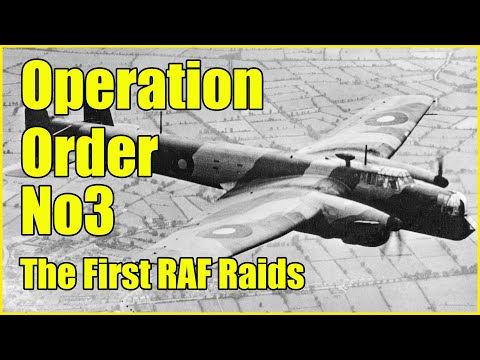
The Whitley crews knew the stakes. The aircraft, reliable but slow, carried no armor and no escort. They would fly across the North Sea, skirt Denmark, and enter German airspace from the north. Any fighter or flak battery could tear them apart.
At 9:50 p.m., the first Whitley lifted off, piloted by Squadron Leader Sittin of 58 Squadron. Nine more followed, the last airborne by 10:45 p.m.
The journey was eerily quiet. Thick cloud at 10,000 feet and slight ice accretion greeted them over the target area. Searchlights swept the sky, but no fighters rose. No anti-aircraft guns fired. The leaflets fluttered down through the flare chutes, strings untying in the airstream, scattering over Hamburg like snow.
Mission accomplished, all ten aircraft turned for home. Seven landed safely at RAF Linton-on-Ouse. But three never made it back to England.
Aircraft K8975 diverted to France, fuel-starved. K8969 force-landed near Amiens with engine trouble. And K8990—missing.
The next day, word arrived: K8990 had crash-landed near Saint-Quentin. The crew—Flight Sergeant Ford, Pilot Officer Walker, Sergeant Jones, Roberts, Burke, and Bunting—were safe.
But the raid was only the beginning. Leaflet drops would continue for seven consecutive nights, then extend to Berlin. Some called it a success—propaganda delivered from the sky. Others were less kind.
As one Air Marshal famously sneered, “The raids did nothing but provide the continent with toilet paper for the duration of the war.”
Yet for the crews who flew that first night, it was no joke. It was war—and they had just fired the first shot.
The men of 51 and 58 Squadrons did not have long to savor their safe return. Within days, the dispersal points at RAF Linton-on-Ouse and RAF Leconfield were alive again with the sound of Merlin engines being run up and bomb trolleys rattling across the grass. The orders came down swiftly: the leaflet raids would continue.
For seven consecutive nights following September 3rd, Whitleys lifted off into the dark, their crews hunched over navigational charts, tracing the same treacherous route across the North Sea and around the Danish coast. The targets shifted—the Ruhr, northern Germany, the industrial heartland—but the payload remained the same. Paper, not steel.
Weather proved a relentless adversary. Ice formed on the wings at altitude. Cloud banks swallowed the aircraft whole. More than once, a Whitley limped home on one engine, its crew pale and silent, counting the miles to the English coast.
Then, on the night of October 1st, the orders changed again. Berlin.
The German capital lay far to the east—over six hundred miles from their bases. It would be the longest run yet, and the most dangerous. The crews gathered in the briefing hut, the map on the wall marked with a red line that seemed to stretch on forever.
“Gentlemen,” the intelligence officer began, tapping the map with his pointer, “you will be over the heart of the Reich. Every searchlight, every night fighter, every anti-aircraft battery between here and Berlin will be looking for you.”
The room fell silent. The Whitley crews exchanged glances. They had no armor, no escort, and no guns worth mentioning. Their only defense was altitude, darkness, and luck.
That night, the first aircraft lifted off into a moonless sky. The crews flew in near-total silence, the roar of the engines filling the cockpit. Over the Netherlands, searchlights probed the darkness. Over the German border, the first flak bursts blossomed like deadly flowers.
But the Whitleys pressed on. They reached Berlin just after midnight, the city’s lights glittering below them like a vast, sprawling net. One by one, the flare chutes opened, and the leaflets spilled out into the cold night air—millions of pages drifting down over the capital of the Third Reich.
No bombs fell. No buildings burned. But the message was unmistakable: Britain was not afraid. Britain would fight.
As the Whitleys turned for home, their crews exhausted and frostbitten, one pilot muttered over the intercom: “Well, lads—we’ve just told Hitler to his face what we think of him.”
The raids over Berlin continued for two more nights, each mission pushing deeper into enemy territory. The crews returned shaken but resolute, their aircraft patched and refueled for the next run.
But the Luftwaffe was watching now. The easy nights were over. And somewhere in the corridors of the Air Ministry, plans were already being drawn for a very different kind of raid—one that would not carry paper.
The winter of 1939 settled over Europe like a shroud. On the ground, Poland had fallen, carved between Germany and the Soviet Union. In the west, the armies of Britain and France sat behind concrete and barbed wire, waiting. The newspapers called it the Bore War; the men in the dispersal huts called it something far less polite.
At RAF Linton-on-Ouse, the Whitley crews flew on. Leaflets over the Ruhr, leaflets over Bremen, leaflets over Kiel. The flare chutes grew worn from use, and the navigators could trace the route to the German coast blindfolded. But the payloads were changing—slowly, quietly, one crate at a time.
It began with the bomb racks. Fitters arrived in the dead of night and worked by torchlight, bolting new shackles into the Whitley’s bays. The crews noticed. Nobody asked questions. In the RAF, questions were a luxury best left to officers.
Then came the new orders. Not leaflets. Bombs.
The target was the German fleet at Wilhelmshaven, the great naval base on the North Sea coast. The Admiralty had been agitating for months; the German warships were a dagger pointed at Britain’s throat. If the RAF could catch them at anchor, the war at sea might be transformed overnight.
On the night of December 3rd, 1939, twenty-four Wellingtons lifted off from bases across England. Their crews had been told to expect a moonlit night, ideal for spotting the ships below. What they found instead was a sky of pitch black, broken only by the flash of their own engines.
The formation broke apart in the darkness. Some aircraft never found the target at all, circling blindly over the sea until fuel ran low. Others pressed on, guided by the faint glow of the coast below.
Among them was a Wellington of 38 Squadron, piloted by Flying Officer Andrew MacPherson, a quiet Scot who had flown leaflet raids over Berlin only weeks before. His crew—Sergeant Ellis on the wireless, Sergeant Doyle and Sergeant Kincaid as gunners—had never dropped a live bomb in anger. Tonight, that would change.
“Target ahead,” MacPherson said quietly over the intercom. “I can see the harbor lights. Stand by, lads.”
The Wellington dropped to eight thousand feet, engines throttled back. Below, the shapes of German warships loomed in the darkness—the cruiser Emden, the pocket battleship Admiral Scheer, a forest of masts and funnels. Searchlights snapped on, sweeping the sky. Flak began to burst around them, orange and lethal.
MacPherson held the aircraft steady. “Bombs gone.”
The Wellington shuddered as the payload fell away. Seconds later, a flash lit the harbor, followed by another. Then the aircraft heaved upward, lightened, and MacPherson threw it into a banking turn, diving for the sea.
Behind them, the harbor erupted. But the cost was terrible. Of the twenty-four Wellingtons that had taken off, twelve would not return. Some were shot down by flak, others by the Messerschmitts that rose to meet them. One aircraft, riddled with holes and trailing smoke, crashed into the sea within sight of the English coast.
MacPherson’s Wellington made it home, its fuselage punctured by shrapnel, its rear gunner silent and pale. Doyle had been hit in the leg; he would survive, but he would never fly again.
As the crew climbed out onto the frost-covered tarmac, MacPherson looked at the holes in his aircraft and said nothing. There was nothing to say.
The raid on Wilhelmshaven was a shock. The newspapers called it a triumph, but the men who flew knew better. The Whitleys and Wellingtons had struck a blow, but the Luftwaffe had struck back harder. The easy war of leaflets was over. From now on, every mission would carry the same price.
And somewhere in Berlin, a man named Hitler read the reports and gave an order of his own. The bombers would not go unanswered.
The winter nights grew longer, and the raids grew heavier. By early 1940, the Whitleys of 51 and 58 Squadrons had traded their leaflet racks for bomb bays, their crews hardened by months of flak and frostbite. The men who had once scattered paper over Hamburg now carried high explosive into the heart of the Reich.
MacPherson flew on, mission after mission, his face thinner, his eyes older. Doyle never returned to flying, but he wrote letters—short, careful letters—to the men he had served beside. “You keep going,” he wrote to MacPherson. “Someone has to.”
Then came the spring, and with it the Blitzkrieg in the west. Denmark fell. Norway fell. The Low Countries were overrun, and the panzers rolled toward the Channel. The airfields of France, so recently the launchpads for leaflet raids, were abandoned in a blur of burning fuel dumps and shattered hangars.
At Linton-on-Ouse, the crews listened to the wireless in silence as France signed the armistice. “Well,” someone said at last, “it’s just us now.”
The Battle of Britain followed—the Spitfires and Hurricanes clawing at the sky over London, the Whitleys flying by night to hit the invasion barges massing in the French ports. The crews who had once dropped paper now dropped bombs on the very coastlines they had flown over in peace.
And through it all, the memory of that first raid lingered. The quiet North Sea crossing. The searchlights that found nothing. The leaflets drifting down like snow over Hamburg.
“We thought we were fighting a gentleman’s war,” MacPherson said years later, an old man with a quiet voice. “We learned soon enough that there are no gentlemen in war. Only survivors.”
The Whitleys flew until the last of them was retired, replaced by four-engine heavies that darkened the skies over Germany. The leaflet raids became a footnote—a curious, almost quaint chapter in the long and terrible story of the bomber war.
But for the men who flew that first night, it was never a footnote. It was the beginning. The first shot fired in a war that would consume the world.
And somewhere in the archives, a yellowed operations order still bears the words: Operation Order No. 3. Target: Hamburg. Payload: Leaflets.
What would you have done, standing on that frost-covered tarmac in September 1939—climbing into an unarmed bomber to drop paper on the enemy, not knowing if you’d see the morning?
Report this article
Select a reason for reporting:






