For over half a century, Dinko Šakić lived a quiet life in Argentina, a respected member of his community, a family man, and a successful businessman. But beneath that ordinary facade lurked one of the most notorious Nazi collaborators of World War II—a man who had commanded a death camp where thousands were tortured and murdered. In 1998, his carefully constructed world shattered when a television interview exposed him to the world, setting off a dramatic chain of events that would finally bring him face to face with justice.
The story of Dinko Šakić is not just one of a war criminal on the run; it is a tale of a nation grappling with its dark past, of a Catholic Church entangled in controversy, and of the relentless pursuit of justice that spanned continents and decades. It begins in the former Yugoslavia, where a young man, fired up by nationalist zeal, would rise to become a key figure in one of the most brutal regimes of the 20th century.
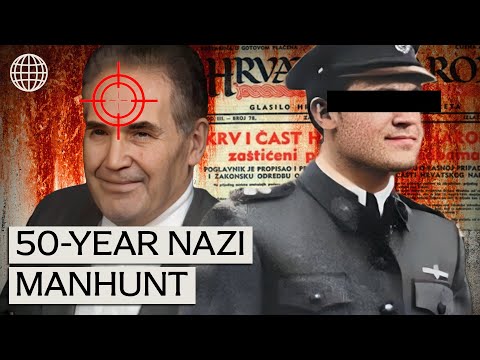
In the early 1990s, as Croatia declared independence and war erupted in the Balkans, the ghosts of World War II resurfaced. The name Dinko Šakić, once whispered in hushed tones, became a symbol of the unresolved horrors of the Ustaše regime. Journalists, Nazi hunters, and survivors began to ask: where was the man who had been the commandant of Jasenovac, the camp known as the “Auschwitz of the Balkans”?
Šakić had fled Croatia at the end of the war, along with thousands of other Ustaše, aided by the so-called “ratlines” that helped fascists escape Europe. He found refuge in Argentina under the protection of President Juan Perón, who welcomed former Nazi and fascist leaders with open arms. There, he lived under the name Ljubomir Šakić Banić, ran a textile factory, and raised a family, all while remaining active in Ustaše émigré politics.
But in 1998, his luck ran out. A reporter from the Argentine TV program Telenoche knocked on his door, and Šakić, perhaps craving attention or believing his past was safely buried, agreed to an interview. “I was at Jasenovac,” he admitted on camera, a confession that would prove to be his undoing. The interview caused a sensation, and Nazi hunter Efraim Zuroff of the Simon Wiesenthal Center immediately began proceedings to extradite him.
Croatia, now led by President Franjo Tuđman, found itself in a dilemma. Tuđman had publicly downplayed the atrocities at Jasenovac and had sympathies for the Ustaše legacy. But under international pressure, especially from the United States, Croatia had to demonstrate its commitment to justice. Within weeks, Šakić was arrested in Argentina, and by June 1998, he was on a plane back to Croatia, his wife Nada—herself a former guard at Jasenovac—by his side.
The trial that followed was a watershed moment for Croatia. It was a chance for the country to confront its fascist past, but it also exposed deep divisions. As Šakić entered the courtroom, survivors of Jasenovac watched, their faces etched with pain and determination. The prosecution charged him with the deaths of thousands of prisoners, presenting witnesses who recounted the horrors they had endured.
Šakić, however, remained defiant. He laughed during testimony, showed no remorse, and insisted he was a patriot. “I am proud of what I did,” he declared at one point, a statement that shocked the courtroom. The judge repeatedly warned him to control his behavior, but Šakić continued to sneer at the proceedings.
The evidence against him was overwhelming. Witnesses described how he personally selected prisoners for execution, how he ordered the killing of the sick and elderly during the “Autumn liquidation” of 1944, and how he oversaw the destruction of evidence as the partisans advanced. The court heard how Jasenovac was not just a camp but a killing factory where inmates were murdered with hammers, knives, and even specialized blades called “Serb cutters.”
After a trial that lasted months, Dinko Šakić was found guilty and sentenced to 20 years in prison—the maximum penalty under Croatian law. The verdict was hailed by many as a victory for justice, but for others, it was too little, too late. Šakić had lived freely for 50 years, and the families of his victims had waited decades for this moment.
Yet the story does not end with the verdict. Even as Šakić was led away to prison, the debate over his legacy continued. In Croatia, some still viewed him as a hero, a defender of the nation against communism and Serbian domination. The Catholic Church, which had blessed the Ustaše regime, remained silent on the matter, its own role in the atrocities still a subject of controversy.
As Šakić served his sentence, he remained unrepentant, a symbol of the unhealed wounds of the Balkans. His death in 2008 did little to close the chapter on Jasenovac; if anything, it reopened old questions about collective guilt, historical memory, and the price of freedom. The capture of Dinko Šakić was a victory for justice, but it was also a reminder that the past is never truly buried—it waits, sometimes for decades, to resurface and demand reckoning.
The courtroom in Zagreb fell silent as the verdict was read. Dinko Šakić stood motionless, his face a mask of defiance. The judge’s words echoed off the walls: guilty of crimes against humanity, sentenced to twenty years. For the survivors in the gallery, it was a moment they had waited half a century to see. Yet for Šakić, it was merely another stage in a life lived without remorse.
As he was led from the court, he turned to the cameras and smirked. “I would do it all again,” he muttered, a statement that sent shockwaves through the nation. The remark was broadcast across Croatia, sparking outrage and disbelief. How could a man who had overseen such atrocities show no contrition?
But the trial had exposed more than just Šakić’s crimes. It had laid bare the fault lines in Croatian society. President Franjo Tuđman, who had once downplayed the horrors of Jasenovac, was forced to issue a statement condemning Šakić’s actions. Yet his words rang hollow to many, who remembered his past glorification of the Ustaše regime.
The Catholic Church, too, found itself under scrutiny. Archbishop Josip Bozanić, the current head of the Church in Croatia, issued a cautious statement expressing regret for the suffering at Jasenovac. But he stopped short of acknowledging the Church’s complicity, a omission that angered survivors and their families. “They blessed the killers and now they offer empty words,” said one elderly woman, a survivor of the camp. “Where was their compassion then?”
In the years that followed, Šakić’s imprisonment became a symbol of Croatia’s struggle to reconcile with its past. The country was eager to join the European Union, and Brussels demanded accountability. Yet for many Croats, the trial was a painful reminder of a history they preferred to forget. Some still saw Šakić as a patriot, a man who had fought for Croatian independence against Serbian domination.
In 2008, at the age of eighty-six, Dinko Šakić died in a prison hospital. His funeral in Zagreb drew a small crowd of supporters, some wearing Ustaše insignia. A Catholic priest, defying the Church’s official stance, declared that Šakić was a hero. “He defended our nation and our faith,” the priest said. “We should be proud of him.”
The funeral was met with protests from anti-fascist groups, who held signs reading “Never Again.” The clash outside the cemetery reflected the deep divisions that still haunted Croatia. For the survivors, Šakić’s death brought no closure. “He never apologized,” said Pavao Molnar, a former inmate. “He never showed remorse. That is the greatest insult to those who suffered.”
Yet the story of Dinko Šakić is not just about one man. It is about the countless individuals who enabled him—the politicians, the priests, the ordinary citizens who looked the other way. It is about the silence that allowed him to live in peace for fifty years, and the courage of those who finally broke that silence.
As Croatia continues to grapple with its history, the trial of Dinko Šakić remains a turning point. It was a moment when the country was forced to confront the darkest chapter of its past. But it was also a moment that revealed how much work remains. The scars of Jasenovac are far from healed, and the debates over guilt, memory, and responsibility continue to this day.
In the quiet town of Santa Teresita, Argentina, the house where Šakić lived still stands. Neighbors remember him as a polite man who kept to himself. “We had no idea,” said one. “He seemed so normal.” But behind that normalcy was a man capable of unspeakable cruelty—a reminder that evil often wears an ordinary face.
The verdict in Zagreb was not the end, but a beginning. The trial had cracked open a door to the past that many in Croatia wished to keep sealed. For the survivors, it was a moment of validation, but also a painful reminder that justice had been delayed by half a century. “We waited fifty years to hear the word ‘guilty’,” said one survivor. “Fifty years of silence, of denial, of watching him live freely while our loved ones were forgotten.”
Yet the trial also sparked a reckoning. Historians and educators began to re-examine the Ustaše regime, and the Jasenovac memorial site received increased attention. The Croatian government, under pressure from the international community, launched educational programs to combat Holocaust denial and promote tolerance. But the deep divisions remained. In some circles, Šakić was still celebrated as a hero, a martyr for Croatian independence.
The Catholic Church, too, faced a moment of truth. While Archbishop Bozanić’s statement was cautious, it marked a shift from the Church’s long silence. Some priests and theologians began to speak openly about the Church’s complicity, calling for repentance and reconciliation. “We cannot preach forgiveness without confessing our own sins,” said one prominent theologian. But the path to healing was fraught with resistance, as traditionalists accused reformers of betraying Croatian identity.
In Argentina, the exposure of Šakić led to a broader reckoning with the country’s Nazi past. The government opened files and investigated other war criminals who had found refuge there. The Jewish community and human rights groups demanded accountability, and the case of Dinko Šakić became a symbol of the fight against impunity. “His capture showed that time does not erase guilt,” said Efraim Zuroff. “It sent a message to all fugitives: you are never safe.”
As the years passed, Šakić’s health declined. He remained in prison, a forgotten figure to many, but a haunting presence to those who had suffered. His wife Nada, who had been interrogated but never tried, faded into obscurity. The house in Santa Teresita was sold, and new owners painted over the past. But the story refused to die.
In 2008, when Šakić died, the reactions were as divided as ever. Some celebrated, others mourned, and many simply shrugged. For the survivors, his death brought no closure. “He took his secrets to the grave,” said Pavao Molnar. “He never told us why. He never showed remorse. That is the hardest part.”
The funeral, with its Ustaše insignia and priestly praise, was a stark reminder that the ideology that had fueled Jasenovac was not dead. It had merely gone underground, waiting for another opportunity to surface. The protests outside the cemetery showed that there were still those willing to fight it.
Today, Dinko Šakić is a name that few young Croats recognize. But for those who lived through the war, and for the families of the victims, he remains a symbol of the evil that ordinary people can commit when driven by hatred and nationalism. His story is a warning from history, a reminder that justice, however delayed, must never be abandoned.
As Croatia moves forward, the ghosts of Jasenovac still linger. The debate over the past is not just about Šakić, but about the soul of a nation. Will Croatia confront its history honestly, or will it continue to glorify those who committed atrocities? The answer lies not in the verdict of a court, but in the hearts of its people.
What do you think? Can a nation truly heal without confronting its darkest chapters? Share your thoughts in the comments below.
Report this article
Select a reason for reporting:






