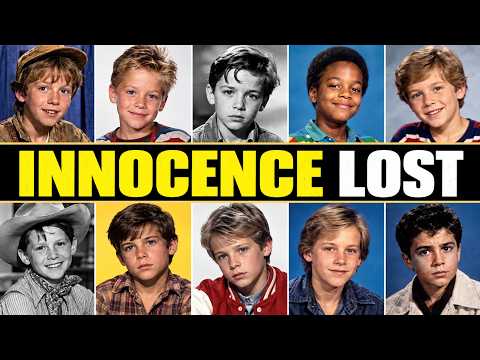
They were the faces that lit up our screens, the child stars we invited into our living rooms every week. We watched them grow up, laughed at their jokes, and cheered their triumphs. But behind the cameras, a darker story was unfolding—one that would lead some of them to murder, addiction, and utter ruin. These are the child TV stars who became monsters.
One was acquitted of murdering his wife, then ordered by a civil jury to pay her family $30 million. Another killed a man with his fists and did two years in San Quentin. Both started out as kids America adored.
If you like real Hollywood stories told straight, subscribing helps us make more. These are 12 child TV stars who became monsters.
Number 10: Robert Blake. Before anyone knew him as Robert Blake, he was Mickey Gubitosi, the little dark-haired kid who turned up in 40 Our Gang shorts between 1939 and 1944, and who ended up as the last lead boy the series ever had. Those shorts later went out on television as The Little Rascals, and generations of kids who were never alive in 1940 grew up watching him in reruns on Saturday mornings.
From 1944 to 1947, he played Little Beaver, the sidekick to the cowboy Red Ryder, in 23 westerns for Republic Pictures. And in 1948, he was the Mexican boy who sells Humphrey Bogart the winning lottery ticket in The Treasure of the Sierra Madre.
As an adult, he kept going, which almost nobody from Our Gang managed to do. In 1967, he played the real killer Perry Smith in In Cold Blood. And from 1975 to 1978, he was Detective Tony Baretta on the ABC series Baretta, a role that won him an Emmy and made him one of the most recognizable faces on American television.
Blake talked openly over the years about how rough his own childhood had been, and he wrote about it in a memoir called Tales of a Rascal in 2011. He was one of the very few people who went from Our Gang to real adult stardom, and for a long time, that was the whole story people told about him.
On the night of May 4th, 2001, Blake took his second wife, Bonnie Lee Bakley, to dinner at Vitello’s, an Italian restaurant in Studio City. They’d been married for about 6 months, and they had a baby daughter together. When they walked back to his car, which was parked around the corner, Blake said he’d left a pistol inside the restaurant and went back to get it. When he came back, Bakley, who was 44, had been shot in the head while sitting in the passenger seat. She died that night.
Police later found an old handgun in a dumpster near where the car had been parked. The marriage itself had been strange from the start. Bakley had a long history of chasing famous men and running mail order schemes and when she got pregnant, it wasn’t even clear at first who the father was. DNA testing eventually showed the baby girl was Blake’s and he married Bakley in November 2000, largely by most accounts, because of the child.
Blake always denied having anything to do with the shooting and he kept saying it right up until the end of his life. Nearly a year after the shooting, on April 18th, 2002, Los Angeles police arrested him and charged him with murder with special circumstances, a charge that could have carried the death penalty. His bodyguard, Earl Caldwell, was arrested, too, though the charges against him were later dropped.
Blake sat in jail for close to a year before a judge finally let him out on bail. For people who’d grown up watching Baretta, it was hard to process because the theme song of that show had a line almost everyone over 50 can still sing, “Don’t do the crime if you can’t do the time.”
The part of the case that people still bring up is the testimony of two retired Hollywood stunt men, Ronald Hambleton and Gary McLarty, who both told the court that Blake had approached them about killing his wife. The defense went after their credibility hard and it worked. On March 16th, 2005, the jury acquitted Blake of the murder. On the two counts of trying to get someone to kill her, he was cleared on one and the jury deadlocked on the other, which prosecutors then dropped.
The Los Angeles District Attorney was so frustrated that he publicly called the jurors incredibly stupid. But the story didn’t stop at the criminal court. Bakley’s children sued him for wrongful death, and in a civil trial where the standard of proof is lower, a jury decided on November 18th, 2005 that Blake was responsible for her death and ordered him to pay $30 million. An appeals court upheld that verdict in 2008, but cut the damages to $15 million. And Blake had already filed for bankruptcy in February 2006. So one jury said the state hadn’t proved he killed her, and another jury said he did, and both of those findings stand on the record to this day.
Robert Blake died on March 9th, 2023 at 89. Little Mickey still grins at the camera in Little Rascals reruns, while the man he grew into spent his last 20 years as the only person in that cast a court ever held responsible for a killing.
Number nine: Lance Kerwin. If you watched television in the late 1970s, you probably remember Lance Kerwin, even if the name doesn’t come right away. He starred in the NBC drama James at 15, which ran from 1977 to 1978. And he was the teenage lead in the 1979 mini-series Salem’s Lot, the Stephen King vampire story directed by Tobe Hooper that scared a whole generation of kids who weren’t supposed to be watching it.
Before that, he’d made The Loneliest Runner in 1976. And afterward, he did The Boy Who Drank Too Much and Children of Divorce, both in 1980. He’d also been all over the ABC Afterschool Specials between 1974 and 1976, the kind of issue-of-the-week TV movies schools used to roll into classrooms on a cart.
James at 15 got a lot of attention because it took on things network TV usually avoided with teenagers, and when the character turned 16 during the season, NBC even changed the title to James at 16. One critic at the time called him probably America’s leading boy actor of the late ’70s, and for a few years that wasn’t much of an exaggeration. The parts he played were usually the sensitive, troubled kid who learns a hard lesson by the end of the hour.
By the 2000s, he’d moved to Hawaii and become a pastor at Calvary Chapel in Kapaa on the island of Kauai. He also ran programs for an organization called U-Turn for Christ, which helps people coming out of addiction. So, he was the man a lot of struggling people went to when they needed someone honest to tell them how to put their lives back together. He’d married his wife Yvonne in 1998, and he was raising a big family, five children in all.
In July 2010, Kerwin and his wife Yvonne pleaded guilty in Hawaii to falsifying documents so they could collect state medical assistance, the health coverage meant for people who have almost nothing. According to the case, they’d left off the paperwork that they owned three properties on the mainland. Kerwin was sentenced to 5 years of probation and 300 hours of community service.
The published record doesn’t put a dollar figure on it, and we won’t guess one. What’s on the record is the plea, the three properties, and the sentence. This is the lightest case on the list in terms of harm to a single person, and it’s worth being fair about that. Nobody was hurt physically, but he was taking public health money set aside for the poorest families in the state while standing in a pulpit and telling other people how to live straight, and that’s hard to square.
Kerwin died on January 24th, 2023 in San Clemente, California at 62. James Hunter is still 15 forever in old episodes, while the man who played him ended up with a fraud conviction on his record.
Number eight: Paul Kelly. Paul Kelly started acting in 1906 when he was a small boy and he grew up in front of silent film cameras. He was a real child star of that early era working for the Vitagraph studio in Brooklyn when movies were still a novelty and in 1919 he played Gilbert Blythe opposite Mary Miles Minter in the first film version of Anne of Green Gables.
His co-star in that film, Minter, would soon be pulled into the unsolved 1922 murder of the director William Desmond Taylor, one of the big scandals of that decade and a few years later Kelly would give Hollywood another one. He also worked on the Broadway stage and by the mid-1920s he was a handsome working actor with a long career in front of him.
On April 16th, 1927, Kelly, who’d been drinking, confronted a fellow actor named Ray Raymond. Kelly had been having an affair with Raymond’s wife, the stage actress Dorothy Mackay, and the two men got into a fight. Kelly hit Raymond several times and left him on the floor. Raymond died from his injuries.
Kelly was arrested and convicted of manslaughter and sentenced to up to 10 years in prison. Dorothy Mackay was charged, too, with felony conspiracy for her part in trying to hide what had actually happened and she was sentenced to one to three years though she served just under 10 months. Kelly ended up serving 25 months in San Quentin.
At the time it was one of the biggest scandals in show business, a former child actor and a Broadway actress tied up in a love triangle that ended with a man dead. Today a conviction like that would end an acting career overnight and nobody would expect to see the man on a movie poster again.
What makes Kelly’s case so strange to look back on is what happened next. When he got out his parole rules said he couldn’t marry for 18 months and had to work as a clerk for $30 a week but he talked his parole supervisors into letting him go back to the stage. He married Mackay in 1931, the woman he’d fought over, and they stayed together until 1940, when she died after her car swerved and rolled into a ditch. Kelly married again a year later.
He made his first talking picture in 1933, and through the 1930s and 1940s, he became one of the busiest supporting actors in Hollywood, playing tough guys, cops and officers. He was in Flying Tigers with John Wayne in 1942, and in the film noir Crossfire in 1947. In 1948, he won the Tony Award for Best Actor for the Broadway play Command Decision, sharing the honor that year with Henry Fonda and Basil Rathbone.
He died of a heart attack on November 6th, 1956 in Beverly Hills at 57. He’s probably the only Tony winner in history who did 2 years in San Quentin for killing a man with his fists, and the studios that hired him through the Depression and the war years knew it the entire time. Hollywood in that era was very good at forgetting things when a man was useful, and Kelly worked constantly for more than 20 years after he walked out of prison.
Gilbert Blythe still carries Anne’s books in that old silent film, while the boy who played him grew up to kill a man over another man’s wife.
Number seven: Stanley Fafara. He played Whitey Whitney on Leave It to Beaver, the blond kid always running around with the Beaver in 57 episodes. After the show ended in 1963, he drifted into drinking, then heroin, and started breaking into pharmacies to keep the habit going. He was arrested seven times for pharmacy break-ins and did a year in jail after an eighth burglary conviction in the 1980s.
In fairness, Fafara got sober in 1995 and stayed that way for the last eight years of his life, living quietly on social security in Portland. He died on September 20th, 2003, his 53rd birthday. Whitey still tags along after the Beaver in reruns, while the man who played him spent years breaking into the same kind of drugstore the show’s families used to walk to.
Number six: Scotty Beckett. He was Spanky’s best friend in Our Gang, then the young Al Jolson in The Jolson Story, a working adult actor with an MGM contract. But the parts shrank, and his life came apart in court records: drunk driving, bad checks, a Mexican jail, a border arrest with 250 stimulant pills.
In late 1963, during a domestic argument, Beckett hit his teenage stepdaughter on the head with one of his aluminum crutches. A court put him on probation and ordered him to stop drinking. On May 10th, 1968, he was found dead in a Hollywood nursing home at 38. The boy in the cap still grins next to Spanky, while the man he became hit a teenage girl with a crutch.
Number five: Joey Cramer. He starred in Disney’s Flight of the Navigator in 1986, on screen for almost every scene. Thirty years later, in April 2016, a man in a bandana, sunglasses, and a messy wig walked into a Scotiabank in Sechelt, British Columbia, and demanded money. It was Cramer. He pleaded guilty to bank robbery, wearing a disguise, fleeing police, and dangerous driving, and was sentenced to two years less a day plus treatment for narcotics abuse.
Number four: Todd Bridges. He played Willis Jackson on Diff’rent Strokes, then spent his 20s addicted to crack. In 1989, a drug dealer was shot inside a crack house and Bridges was charged with attempted murder. Johnny Cochran got him acquitted. Two months after a 1992 meth and weapons arrest, Bridges says he stopped using, and he’s spent decades since talking openly about addiction.
Number three: Bobby Driscoll. Disney’s first live-action contract star, the voice of Peter Pan, an Academy Juvenile Award winner before he was a teenager. Disney dropped him when he stopped looking like a little boy, and by the early 1960s he was addicted to heroin. In March 1968, two boys found a man’s body in an abandoned East Village building. He was buried in an unmarked grave on Hart Island, and it took more than a year before fingerprints confirmed it was Driscoll. He was 31.
Number two: Brian Bonsall. He played Andy Keaton on Family Ties and Alexander Rozhenko on Star Trek: The Next Generation. He walked away from acting as a teenager, and by his 20s the police reports started: a 2007 arrest for assaulting his girlfriend, more arrests in 2009 and 2010. He got sober by 2016 and joined The Ataris, but his record includes a conviction for assaulting a partner, and that’s the kind of harm a comeback story doesn’t soften.
Number one: Harold Switzer. He and his brother Carl, later famous as Alfalfa, were signed to Our Gang together in 1934 after singing in the Hal Roach commissary. Carl became a star; Harold drifted to the background and left acting for good in 1940. As an adult, he ran a Speed Queen franchise, installing washing machines.
In April 1967, after a dispute with a customer, Harold Switzer killed the customer. He then drove himself to a remote area and took his own life. He was 42. Of everyone on this list, Harold is the one who took another person’s life and never had to face a courtroom for it. He’s buried at Hollywood Forever Cemetery next to his father, with Carl on the other side. Slim still sits quietly in the back row of those old shorts strumming his mandolin, while the man he grew into ended one of the saddest family stories in Hollywood history with a killing of his own.
Which of these stories hit you the hardest—and do you think Hollywood owes these kids more than a footnote in a rerun?
Report this article
Select a reason for reporting:






