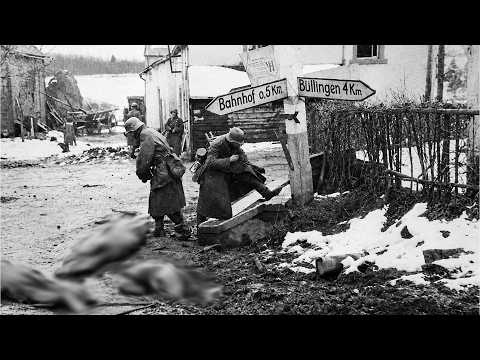
Late December 1944. In the small Belgian village of La Gleize, the remnants of one of Nazi Germany’s most powerful armored formations sat abandoned—Panthers, Panzer IVs, and the enormous new King Tigers, silent monuments to a shattered offensive. Just days earlier, these machines had spearheaded Hitler’s last great gamble in the West, leaving a trail of destruction and murder in their wake. How did this armored spearhead break through the American lines? And how close did it come to success?
To answer that, we must turn the clock back to December 16, 1944. By that winter, Nazi Germany was approaching catastrophe. In the East, the Red Army was poised for another massive offensive. In Italy, Allied forces continued pushing north. And in Western Europe, the armies that had landed in Normandy just six months earlier had crossed France and Belgium and were now fighting along Germany’s own frontier.
But Hitler believed there was still an opportunity to reverse the situation. His plan was to attack in the Ardennes. Three German armies would smash through the thin American lines along an 80-mile front, cross the River Meuse at top speed, drive towards Antwerp, and split British and Canadian forces from their American allies. The plan was enormously ambitious—and frankly, pretty ridiculous. Antwerp lay more than 100 miles beyond the German front line, across extremely difficult terrain. The Germans had limited fuel supplies, were massively outnumbered in artillery, armor, and infantry, and would be operating on a battlefield dominated by Allied air power. And they didn’t just have to reach Antwerp; they had to get there before the Allies could react and hold it once they did. That meant the entire offensive depended upon one thing above all others: speed.
On the northern shoulder of the attack, much of that responsibility fell on the 6th SS Panzer Army. Its most powerful formations included two Waffen-SS armored divisions: the 12th SS Panzer Division Hitler Youth and the 1st SS Panzer Division Leibstandarte Adolf Hitler. Leading the Leibstandarte’s main thrust was Kampfgruppe Peiper.
Its commander, 29-year-old SS-Obersturmbannführer Joachim Peiper, was already a veteran of fighting on both the Eastern and Western fronts. A former adjutant to Heinrich Himmler, he had developed a reputation as an aggressive armored commander, but his career was also closely associated with the brutality of the Waffen-SS and allegations of atrocities in the East and Italy.
For the Ardennes Offensive, Peiper was given command of one of the most powerful battle groups available to the Germans. The idea of a Kampfgruppe was relatively straightforward: rather than fight with every component of a division separated according to its normal organization, German commands could combine tanks, infantry, artillery, engineers, and other troops into a temporary battle group designed for a particular mission.
Peiper’s was a formidable formation. At its heart were tanks of the 1st SS Panzer Regiment, including Panthers and Panzer IVs. There were armored panzergrenadiers, engineers, self-propelled artillery, anti-aircraft guns, support vehicles, and attached to the force were a number of the new 70-ton King Tiger heavy tanks. With thick frontal armor and a powerful 88-mm gun, it was more than a match for any Allied tank it was likely to encounter.
But there was another side to the equation. Peiper’s force was enormous—more than 800 vehicles all told—and had to advance along narrow country roads, small bridges, and through heavily wooded terrain. All this meant that mechanical breakdowns, destroyed bridges, impassable roads, a lack of fuel, or determined American resistance could prove catastrophic.
Let’s take a look at Peiper’s proposed route and the obstacles presented by the terrain. Here was the German frontier, and around 100 miles to the west lies Antwerp. But Peiper’s immediate objective was much closer: the River Meuse. Specifically, his Kampfgruppe was expected to break through the American front, race across the Ardennes, and seize river crossings around Huy and Amay. If those bridges could be captured intact, the rest of the 6th SS Panzer Army could pour across the river and continue the advance towards Brussels and ultimately Antwerp. And Peiper was expected to reach the Meuse in just a matter of days.
On a map, the basic concept looks simple enough: drive west. But German planners had already identified a major obstacle. There were relatively few roads capable of carrying an armored formation of that size through the Ardennes. So, rather than simply being given a destination, German armored formations were allocated specific routes of advance known as Rollbahnen. Think of them as predetermined corridors through which each formation was expected to move. Five principal routes, designated Rollbahn A to E, were allocated to the northern armored attack. The Leibstandarte was principally assigned the southern routes, D and E.
Following an infantry assault to breach the front lines, Peiper’s advance would initially be channeled along Rollbahn D through an area of relatively open, low-lying ground called the Losheim Gap. But breaking the front lines was only the start of the story. Once through, the route westwards ran through deep valleys, clusters of small villages in American hands, and a succession of rivers and streams, many of which formed natural choke points.
Let’s take a closer look at the rivers lying between Peiper and his objective. Here is the Amblève. In this location ran the Liège, here the Sauer, and further west eventually the Meuse itself. Every one of these waterways potentially funnels the Germans towards a limited number of crossings, and every bridge therefore was enormously important. Capture one intact, and the advance could continue. Lose it, and an entire armored column would have to turn around, wasting more time and fuel, and find another route.
There’s one other key factor to consider: the defenders. Holding this stretch of line directly in front of Kampfgruppe Peiper’s route were the men of the 99th Infantry Division, a highly motivated but inexperienced unit holding a larger than usual stretch of front. Could they, or the various other units in the area, impose enough delays on the German timetable for the skies to clear and Allied air power and reinforcements to blunt the attack?
The start of the answer to that question came shortly before dawn on December 16, when a wave of Volksgrenadier and Fallschirmjäger infantry slammed into the lightly held American lines on the edge of the Ardennes, tasked with clearing the path ahead through which the armored spearheads would drive. Almost immediately, the timetable began to slip.
One of the most famous delays occurred around Lanzerath. A small American reconnaissance platoon commanded by Lieutenant Lyle Bouck occupied positions in a tree line overlooking the village and the vital road running through it. For much of the day, the tiny force of just 22 men resisted repeated attacks by more than 500 German paratroopers, until finally, after some 8 hours of fighting, the position was overwhelmed.
That delay had serious consequences for Kampfgruppe Peiper. Forced to divert via Lanzerath, where the Losheim-Hellenthal crossroads couldn’t be cleared, Peiper’s new route took him right through the village. Not only that, but even getting there had been a nightmare. His 15-mile-long column had started the offensive well behind the German lines in these woods and had been hampered early on by a blown bridge which hadn’t been repaired. Then, it ran into unmarked German mines which immobilized several Panthers and imposed further delays. A deeply frustrating day.
When Peiper finally arrived at the Café Scholzen in Lanzerath after dark on the first day, he flew into a rage upon learning that the leading infantry screen still hadn’t pushed beyond the village, unaware that the way to their front was clear. Finally, by 3:30 a.m. on December 17, the head of Peiper’s column was through Lanzerath and on the move.
His next obstacle was Honsfeld, a rest area for one of the front-line American infantry regiments and known to be occupied. Expecting a tough fight, Peiper’s vanguard made a cautious approach and were met with silence. Despite the presence of 150 infantry plus two entire tank destroyer companies in the village, not a shot was fired and the vanguard passed silently through. The defenders had been caught, quite literally, napping. Seeking warm billets in houses or vehicles, it was not until after dawn that anyone realized something was amiss, and by then, it was too late. A short but bloody fight broke out in the town streets which resulted in more than 300 prisoners taken in just a handful of minutes.
It was also here that a sinister pattern of brutality emerged. As Rottenführer Siegfried Yackel recalled: “The first prisoners I saw during the offensive were at the outskirts of Honsfeld. As we were leaving the town towards Bullingen between 8:00 and 9:00 a.m., just before turning right towards Bullingen, I remember passing an American truck which had a machine gun mounted above the cab. As we approached the intersection, I heard machine pistol fire coming from the right and later saw 15 American dead alongside the road.” They would not be the last prisoners to meet that fate.
With only minor delays on his planned route to Moderscheid that morning, Peiper decided to make a detour to the nearby town of Bullingen, where a crucial fuel depot had been identified. At the head of his column were Panther tanks, not the much slower King Tigers, which were actually proving more of a burden than an asset.
Barring his advance was a scratch defense made up of men from the 254th Engineer Combat Battalion’s Company B and a handful of other details. Amongst those in the south of the town was a bazooka-armed Sergeant Grant Yeager, who recalled the scene around 7:30 a.m.: “I looked up and saw a tank with a cross on the front. It was German. The tank was buttoned up and the machine gun firing and the turret turning, looking for targets. I made ready the bazooka and had Roommaker load and arm it. As the first tank passed in front of us, I was ready to fire but found the sight broken and the tank went on by. Then I made up my mind I could fire without the sights by looking alongside the barrel. This I did and fired and hit the second tank as it was directly in front of us.” Apparently, his shot hit the tank in the track as it turned partway round and stopped.
Although only a pinprick to the overall strength of Kampfgruppe Peiper, actions like this nevertheless imposed serious delays, often requiring specialist equipment to be called up to clear vehicles blocking the narrow roads. Yeager and his comrades were captured a short time later and watched on as the nearby fuel dump was captured. Forced to refuel German tanks and vehicles at gunpoint, they soon began an eastwards march back towards Germany, during which some 50 prisoners were shot at random at different times and by different groups of passing SS.
Peiper’s westward drive in the meantime was picking up pace, and by using the local back roads his vanguard made rapid progress, first reaching Moderscheid, then Schöborn and Ondenval. By midday on the 17th, the leading German units had reached Thirimont where a slight left-hand turn led to the next objective of Ligneuville. Here though, problems arose again. The planned route running between these points was found to be a very minor road, more like a dirt track which descended into a valley, crossed a small stream, and then had steep dirt banks making it impossible for heavy tanks.
Knowing that time was of the essence, particularly as Ligneuville was the site of a bridge over the Amblève River, Peiper detached the heaviest elements of his column on a northward diversion along a better road by nearby Bouny. They would rejoin the column on the Ligneuville Road. That decision and this very location would go down in infamy in the history of the Second World War.
Let’s just consider the bigger picture for a moment. By the afternoon of December 17, Allied commanders knew that a major offensive was underway but did not yet know the exact strength or the extent of the assault or where it had actually reached. The Allied response was to rush troops to concentrate on the most important locations in the area. They were in the north, the road hub of St. Vith, and in the south, Bastogne. Throughout the morning, units had been flooding into the area and using the fast Ligneuville road to join up with their respective commands.
Amongst them was Battery B of the 285th Field Artillery Observer Battalion. Traveling in unarmed vehicles with nothing heavier than a .50 caliber machine gun for defense, they were no match for an armored battle group. Unfortunately, that’s exactly what they met. By overlaying this wartime aerial image onto the modern satellite map, we can see exactly what the Bouny crossroads looked like on that December day. So, whilst trucks of the 285th raced southwards down this road, just 600 yards away, traveling in the opposite direction along this parallel road, were the leading tanks of Kampfgruppe Peiper.
Moments later, the Germans spotted the American column, and turning westwards, began to engage. Obersturmführer Werner Sterenbeck described what happened next: “The lead panzer opened fire. Several vehicles immediately caught fire. The column became confused, and vehicles began running off the road and into each other. The crews dismounted and sought cover. That was the moment to attack. Before reaching the intersection, we were hit by machine gun and rifle fire from the dismounted crew. We returned fire with our on-board machine guns and hastened our attack into the standing column. When my lead panzer had approached within 60 to 70 m, the Americans stood up from the roadside ditch and raised their hands in surrender.”
The precise details of what occurred in this snow-covered field at around 2:15 p.m. on the day remain unclear, but at some point gunfire erupted, and dozens of unarmed prisoners were hit in the space of just a few minutes. But the killing wasn’t over yet, as a wounded Mario Butera recalled: “I was conscious. As I lay there, I could hear the German voices and laughing. Then I heard pistol shots, and one of my companions, who was lying beside me moaning and spitting blood, was approached by a German who four shots from a pistol into his body.”
At least 84 American prisoners were murdered in cold blood. Many killed with a rifle butt or shot to the head in an incident that quickly drew international infamy as the Malmedy Massacre.
Several miles further ahead, and not present at the site of the massacre, Joachim Peiper and his leading elements were already on the outskirts of Ligneuville, and quickly overpowered the makeshift defense of the bridge over the Amblève, taking it intact. Here lies one of the great what-ifs of Kampfgruppe Peiper’s advance. Had they pushed on immediately to the next town, Stavelot, with its bridge over the Amblève, it’s quite possible that things would have turned out very differently. Instead, Peiper halted, perhaps to wait for his King Tigers, which were still making their way along yet another costly diversion. Had he known that Stavelot at that very moment was garrisoned by only a single company of engineers who had been forgotten in the general chaos, he may well have made a dash for it.
Even several hours later, only a single squad had reinforced that defense, but it was a crucial pause. Ordered to set up a roadblock on a single-lane road to the south of Stavelot, Sergeant Hansel and his 12 men were in place by about 6:30 p.m., an hour after Peiper had left Ligneuville. But forced to traverse these winding roads, contact wasn’t made until 7:30 p.m. In a short but ferocious fight, the American squad at the roadblock were driven off, and rather than fall back on the company in town, they drove straight through and out the other side to Trois-Ponts. Lieutenant Chandland and his engineers, assuming a retreat had been ordered, followed suit, and at 8:30 p.m., Stavelot was left completely undefended.
But again, the fog of war had descended, and Peiper, expecting a tough fight for the town, did not act, deciding to wait until dawn to launch his assault. That pause was long enough for Lieutenant Chandland and his engineers to reach Trois-Ponts, receive some blunt orders to return immediately along with several anti-tank guns, and reoccupy the position they had left a few hours earlier. By 3:30 a.m., Stavelot, with its bridge mined but not rigged for demolition, was again under American control.
In a somewhat confused situation at 5:30 a.m., another order was received for two platoons at the bridge to move out and reoccupy the roadblock they’d been driven out of the night before. It was terrible timing. As the small convoy climbed this hill, they ran squarely into the German assault coming the other way and were thrown back in total chaos. Within a few minutes, Panzergrenadier infantry were across the bridge and a savage fight broke out for control of the bridge around these houses on the northern side. Eventually, a fresh influx of GIs forced the Germans to withdraw, but not before learning that the bridge was not wired for demolition.
The result was a renewed German assault, this time with armor, which despite fierce anti-tank fire, proved unstoppable. The exhausted Americans manning the bridge were forced back and eventually out of town as Kampfgruppe Peiper’s massive armored column continued to drive toward Trois Ponts. Unbeknownst to them, in doing so, Kampfgruppe Peiper, which had consumed roughly double the planned amount of fuel, passed within just 1 mile of a large fuel dump, the existence of which was never discovered.
Around 11:00 a.m. outside Trois Ponts, literally three bridges, another makeshift defense was in place. This time, a small roadblock with a 57-mm gun here and a chain of anti-tank mines across the approach road about here. The crew manning the anti-tank gun waited anxiously as the clatter of tank tracks grew louder. Before long, the first Panther came into view. Spotting the chain of mines at the last second, its commander brought the tank to a halt. Kicking them clear, he remounted and began to move. Seconds later, the first shot struck the tank’s frontal armor before careering into the air. Despite being massively outgunned, the gunners manning the 57-mm fired for all they were worth, sending round after round screaming along the road until, under a deluge of shells, the gun was silenced with the loss of the entire crew.
This sacrifice, though, was not in vain. Those few minutes meant that engineers around the bridge could do their work, and as the first Panzers approached this bridge, a massive explosion brought it down in a cloud of dust and debris. Kampfgruppe Peiper’s route westwards via Trois Ponts was closed.
Infuriated, ever lower on fuel and in a constant nightmare of traffic jams, Peiper was forced to turn his entire column round and take a winding road northwards in search of another route. That crossing of the Liènne River was located right here, and was, according to Colonel Anderson, commanding the engineers in the area, completely undefended. Guessing that Peiper was heading that way, he detached a small group of men in a headlong race to get there and blow it before the Germans could reach it. They were just in time, and when at 4:45 p.m. the first German tanks came into view with machine guns firing, the order was given and the handle on the attached blasting machine cranked. Nothing. Realizing something had malfunctioned, Corporal Cheppin rushed forward under a hail of fire and manually lit the secondary fuse before running for his life. Several seconds later, for the second time that day, Kampfgruppe Peiper’s route westwards had been blocked.
Increasingly frustrated and now under worryingly clear skies, the Kampfgruppe was forced back to Leglise to consolidate for the night. But Peiper had not yet given up on the advance, and throwing out his reconnaissance force in search of alternative routes, a way forward was identified right here, through the village of Stoumont, which still offered a slim hope of advancing westwards.
Blocking that route was a single battalion of the 30th Infantry Division, which, together with a handful of anti-tank guns, had centered its defense around the village church. The engagement that followed, caught on film in this German newsreel footage and identifiable today as being taken in this spot, with the house in the background still largely unchanged, was close quarters and predictably brutal. Despite considerable bravery, the weight of numbers of armor began to tell, and by 10:00 a.m. the Kampfgruppe had again forced open a route through the village, taking some 280 Americans prisoner in the process.
But as with everything in the Ardennes, time was key, and every minute of delay favored the defenders, buying valuable time for reinforcements to arrive. And now they were right here. Pre-warned by the gunfire in the distance, the Americans had time to establish a strong blocking position on the road beyond Stoumont station, and crucially, along the river on the far bank of the Amblève. Here they resolved to stop Kampfgruppe Peiper once and for all.
As the massive King Tigers, now leading the column, rumbled down this picturesque road on that winter morning, a fusillade of fire rent the air. Assailed from front and flank, several of the King Tigers were knocked out in quick succession, with the rest pulling back in search of cover. Kampfgruppe Peiper’s advance on the Meuse was over. The fight now was one for survival.
For the men trapped around Stoumont and La Gleize, the battle was far from over. Sensing the tide had turned, American tanks and infantry drove the Germans back up the road, while Peiper’s vehicles ran dry and his exhausted troops faced aircraft attacking at will. He had little choice but to switch to the defensive.
To make matters worse, on December 18, reinforced Americans at Stavelot retook the bridge over the Amblève, cutting Kampfgruppe Peiper in two. Assaults to reestablish the link failed, and shortly before midnight, engineers manhandled 1,400 lbs of TNT beneath the span and blew a 25-foot gap in its northern side, making it useless for tanks.
Key to the defense was the Stoumont Preventorium, attacked three times before the GIs finally held it on the evening of December 21. With pressure mounting from the 82nd Airborne at Cheneux, Peiper abandoned his lines and pulled back to La Gleize for a last-ditch stand, hoping for a relief force that would never come.
Hammered by artillery, air attack, and armor for 48 hours, La Gleize was reduced to rubble. Finally, on the afternoon of December 23, permission came to withdraw. After nightfall, all heavy equipment was abandoned and 800 men slipped south through American lines. Hopping from forest to forest over two days, some 770 exhausted men, including Peiper himself, made it back to German territory.
The men might have escaped, but their tanks, guns, and vehicles had not. Kampfgruppe Peiper had ceased to exist. So how close did Peiper actually come? In reality, not close at all. He never reached the Meuse, let alone Antwerp, and achieved little beyond the destruction of his own force.
The plan had always been wildly overambitious, relying on speed, limited fuel, and an impossible timetable. But what ultimately ensured its failure were the defenders: the 22 men at Lanzerath, the engineers at Trois-Ponts, the corporals in foxholes armed with bazookas, and the rear echelon men fighting stubbornly in the front line. Thousands played their part, many giving their lives in the process.
What do you think—was Peiper’s failure inevitable from the start, or could one bold decision have changed the course of the Ardennes? Share your thoughts below.
Report this article
Select a reason for reporting:






