Staff Sergeant Joe Toye was one of Easy Company’s toughest soldiers—a man whose name became synonymous with grit and resilience. But the story of what happened after the war is one that Band of Brothers never told. It’s a story of survival against impossible odds, of love and loss, and of a father’s unwavering devotion to his severely disabled son.
Joe Toye’s journey began in the coal mines of Pennsylvania, where he dropped out of school at thirteen to support his family. He enlisted after Pearl Harbor, volunteered for the paratroopers, and became a legend among the men of Easy Company. Dick Winters called him the best soldier in the company, second only to Floyd Talbert. But it was after the war that Joe faced his greatest challenges.
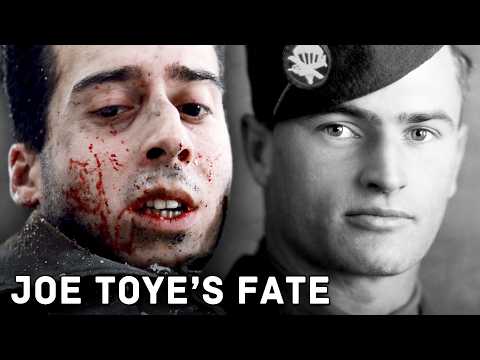
On January 3, 1945, during the Battle of the Bulge, a German shell nearly ended Joe’s life. He lost his right leg below the knee, then above the knee after gangrene set in. Shrapnel tore through his stomach, chest, arms, and his other leg. He returned home weighing just 110 pounds, a shadow of the 180-pound boxer he once was.
But Joe Toye was not a man to be defined by his wounds. He learned to walk on a wooden leg, married the love of his life, and found work at Bethlehem Steel. Yet his toughest battle was still to come.
Joe’s youngest son, Jonathan, was born with severe cerebral palsy—unable to walk, talk, or care for himself. Doctors expected Jonathan to die young, but Joe refused to accept that fate. He visited his son nearly every day at the Hamburg Center, an hour away, feeding him and looking after him. Even after a divorce and remarriage, Joe remained a constant presence in Jonathan’s life.
His stepson George recalled, “He never considered anything in his life a handicap. He always just did it.” Joe’s humility was profound—he never spoke of his four Purple Hearts, and he refused disability benefits, always paying his own way.
Joe Toye died in 1995, but not before teaching us all what true heroism looks like—not just on the battlefield, but in the quiet, daily acts of love for a child who needed him most.
But the story of Joe Toye doesn’t end with his death. It lives on in the lives he touched, in the family he raised, and in the legacy of a man who gave everything for his country and his loved ones. His son Steve, who was only a teenager when his father passed, remembers him as a quiet hero who never sought recognition. “He didn’t feel like he had done much with his life,” Steve recalled. “I told him that what he did in one year, most people don’t do in a lifetime.”
Joe’s humility was legendary. Even after the publication of Band of Brothers and the subsequent miniseries, he remained uncomfortable with the attention. His stepson George discovered Joe’s four Purple Hearts buried in the back of a dresser drawer. “He didn’t want any special recognition,” George said. “He always paid his own way, never accepted handicap plates or free licenses. He said, ‘If I’m going to do it, I’m going to do it.'”
That fierce independence defined Joe Toye long after the war. He walked a mile a day on his wooden leg, worked out with weights, and even took community college classes in his retirement, exploring painting and cooking. His children remember him as a great cook, a devoted father, and a man who never let his disabilities define him.
But perhaps the most poignant chapter of Joe’s life was his relationship with his son Jonathan. After Joe’s second wife, Mary, died in 1987, he told Steve, “I just want to live long enough to bury Jonathan and then I’ll be happy.” It was a statement that revealed the depth of his love—and the quiet fear that had haunted him for decades.
Jonathan, against all odds, lived to age 32. Doctors had predicted he wouldn’t survive childhood, but Joe’s unwavering care gave him three times the life expectancy. Every day, Joe made the hour-long drive to the Hamburg Center, feeding Jonathan, talking to him, and ensuring he knew he was loved. Even when Joe himself was in severe pain from a knee replacement in his good leg, he never missed a visit.
Richard Winters, Joe’s former commander and lifelong friend, witnessed this devotion firsthand. In a letter to Joe after Jonathan’s passing, Winters wrote: “No son ever had a father more dedicated and faithful. All of the above demonstrate true character, true love. As a soldier in training or in combat, you always did your best. I never heard you complain. I never heard you talk about yourself or brag. My respect for you over all these years has never mellowed. It has only grown stronger.”
Those words from Winters—a man who rarely spoke with such emotion—speak volumes about the kind of man Joe Toye was. He was tough as nails on the battlefield, but his true strength lay in his capacity for love and sacrifice.
After Jonathan’s death in 1993, Joe’s health began to decline. He was diagnosed with pancreatic cancer and died on September 3, 1995, at age 76. Richard Winters delivered the eulogy and served as a pallbearer. Joe was buried at Gethsemane Cemetery in Laureldale, Pennsylvania, near Reading—the same town where he had once lived with his brother before shipping off to war.
Today, Joe Toye’s story serves as a reminder that heroism isn’t just about what happens on the battlefield. It’s about the quiet, daily acts of love and duty that define a person’s character. Joe never thought he had done much with his life, but those who knew him—and those who have since learned his story—know better.
His son Steve put it best: “The sacrifices and accomplishments he made for his country in the matter of a year, 99% of the population doesn’t make in a lifetime.” But it was his role as a father—driving an hour each day to care for a son who couldn’t care for himself—that truly exemplified the man Joe Toye was.
In the end, Joe Toye’s legacy is not just one of courage under fire, but of unwavering devotion. He was a soldier, a husband, a father, and a friend. And in the hearts of those who loved him, he will always be a hero—not just for what he did in the war, but for who he was every day after.
Yet for all the admiration his story inspires, there is a quieter, more painful side to Joe Toye’s postwar years that the series never touched—and that even his own children only came to understand as adults. The war did not leave Joe when he left the Army. It followed him home and sat with him in the dark.
His son Steve remembered his father falling asleep in an armchair in front of the television, only to begin moaning in his sleep, trapped in nightmares he would never describe. Joe never admitted to the dreams, never spoke of Bastogne, never named the friends who died beside him. Like so many men of his generation, he bottled it up and tried to numb it—often with alcohol.
That silence had a cost. Joe and his wife Eleanor divorced in 1963, and Steve believed the drinking, born of the war, was a large part of why. In those days there was no word for what Joe carried. PTSD wouldn’t enter the vocabulary until the 1970s, when Vietnam veterans came home and forced the country to look. Before that there was only “shell shock” and “combat neurosis”—labels that offered no treatment and even less comfort.
And yet, what makes Joe Toye’s story remarkable is not the darkness he carried but what he did in spite of it. He never let his own pain excuse him from the pain of others. Even after the divorce, even after the children moved to Philadelphia with their mother, Joe made the monthly trips and carved out two weeks every summer for them.
His second marriage to Mary Vogel in the late 1960s gave him a second chance at family, and he embraced it fully. He umpired his stepson George’s baseball games, attended every one of the kids’ games, and still found time to drive down to Philadelphia to watch Pete and Steve play—and then spend Sunday at the Hamburg Center with Jonathan. Three families, three cities, one leg, and somehow Joe was present for all of them.
George never forgot the summers Joe took them to Canada to camp and fish. He remembered watching his stepfather walk down to the lake on his peg leg, holding a rope attached to it so it wouldn’t sink in the mud, then removing it once he was in the water. “You see people looking at him, giving him these strange looks,” George recalled. “But he just did it. He never considered anything in his life a handicap.”
What strangers couldn’t see was the map of scars across Joe’s back—shrapnel wounds so numerous that George described them as “incredible to see.” Some of that metal stayed in Joe’s body until the day he died. He carried the war in his flesh as surely as he carried it in his dreams.
And yet the war never fully released him. Some of that shrapnel stayed in Joe’s body until the day he died, a physical echo of Bastogne that no doctor could remove. He carried it silently, the way he carried everything else.
What his family remembers most is not the medals buried in a drawer, but the man who showed up. “He managed to do stuff up here for myself and then still get down to Philly to see Pete and Steve play and then still spend Sunday up at the Hamburg school with Jonathan,” George recalled. Three families, three cities, one leg—and Joe was present for all of them.
Richard Winters understood what that cost. At the funeral, standing as a pallbearer for the soldier he once called the best in Easy Company, Winters grieved a man whose courage had simply changed uniforms. The war had tested Joe Toye in a foxhole; peace tested him in a car, driving an hour each way to feed a son who could not feed himself.
Joe never believed he had done much with his life. He was wrong—and the proof was not in the four Purple Hearts hidden in a dresser, but in the smiles of a boy everyone said would not survive, who lived to thirty-two because his father refused to let go.
So here is the question worth asking ourselves: if heroism is measured not by the battles we fight but by the love we show when no one is watching, how many quiet heroes are sitting unnoticed in our own families right now?
Report this article
Select a reason for reporting:






