The night was October 24, 1942, and the jungle south of Henderson Field was about to become a slaughterhouse. Seven hundred Marines of the 1st Battalion, 7th Marines, stood between the Japanese 2nd Sendai Division and the only airfield that mattered in the Pacific War. They were outnumbered, outflanked, and fighting in pitch darkness against a professional army that had marched 15 miles through volcanic jungle to reach them. By dawn, the barrels of Sergeant John Basilone’s machine guns were burned out. They had fired 26,000 rounds. In front of his line lay 1,462 Japanese dead. Nineteen Marines had been killed. The math should not have worked.
But it did. And the reason was water—seven pints of it, wrapped around a steel barrel, boiling and condensing and pouring back in, keeping the gun alive when every other weapon on the line would have failed. This is the story of how a century-old design, a sergeant’s bare hands, and a desperate all-night stand turned the tide of the Pacific War.
Henderson Field had a name only because the Marines had taken it from the Japanese in August. Before that, it was an unfinished airstrip on a malarial island in the Solomons. After that, it was the strategic prize of the Southern Pacific. Whoever held it controlled the air across thousands of miles of ocean. By mid-October, the Japanese 17th Army under Lieutenant General Harukichi Hyakutake had nearly 20,000 men on the island. The plan called for a diversion along the Matanikau coast to pull the Marines west. The main blow would fall on the southern face of the perimeter, where Lieutenant Colonel Lewis “Chesty” Puller’s 1st Battalion of the 7th Marines was dug into the jungle.
To reach Puller, Lieutenant General Masao Maruyama marched the 2nd Sendai Division—7,000 men in three regiments—15 miles through broken volcanic ridges along a track his engineers cut through the dark. They abandoned their mountain guns. They went on half rations. The attack was postponed twice. On the night of October 24th, when the Marines shifted Lieutenant Colonel Herman Hanneken’s 2nd Battalion west to meet the diversion, Puller was left alone on 2,500 yards of jungle front. Seven hundred men, roughly one rifleman every 11 feet.
At 9:30 that night, Sergeant Ralph Briggs, lying in a 46-man listening patrol 3,000 yards beyond the wire, picked up a field telephone and spoke quietly into it. “Colonel, there’s about 3,000 Japs between you and me.”
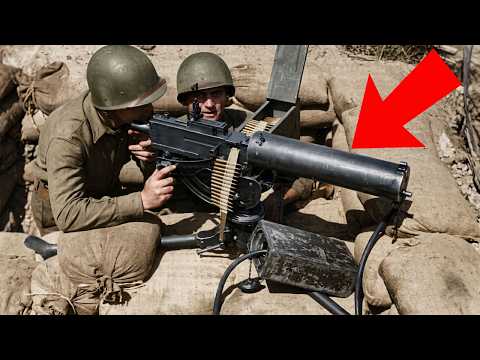
The weapon that would meet them was older than the war. John Moses Browning had patented the design in 1901. In the official Springfield Armory endurance trial of 1917, one prototype fired over 20,000 rounds without a serious malfunction. A second ran continuously for 48 minutes and 12 seconds, putting more than 21,000 rounds through the gun. The United States Army adopted it that year and called it the machine gun, Browning caliber .30, model of 1917. By 1942, modernized as the M1917A1, it was the heavy machine gun of every Marine rifle company in the Pacific.
It fired the same .30-06 cartridge as the Marines’ Springfields and Browning automatic rifles. Five hundred to six hundred rounds per minute. A 250-round belt fed from a metal can. With its tripod, water, and ammunition load, the whole system weighed about 93 pounds and took three to five men to move and place. What set it apart from every other gun on the line was the steel jacket around the barrel. The jacket held seven pints of water. As a crew fired, the water boiled. Steam vented through a hose into a condensing can on the ground, where it cooled back into water and could be poured back into the jacket. The barrel did not warp. The gun kept firing as long as there was water in the jacket and ammunition in the belts.
By comparison, the air-cooled M1919—same caliber, same cartridge, same belt feed—began to warp its barrel after a few hundred rounds of sustained fire. Rounds cooked off in the chamber. The gun went down.
Basilone’s section had four M1917A1s on the right side of Puller’s line. As night fell, the crews filled the jackets, ranged the final protective line, and laid out belts in the mud. At 12:30 in the morning, the first wave came out of the jungle into the wire. Basilone’s first gun opened up. The water in the jacket began to heat. The belt ran. The men in front of the muzzle stopped moving.
Maruyama’s first echelon was the 29th Infantry Regiment under Colonel Masagero Furumiya. Japanese engineers crawled forward in the rain and cut the Marine wire. The infantry came through it in waves, screaming, bayonets fixed in the standing doctrine of the Imperial Army. Mortars and grenades fell on the Marine positions before the men reached them. The right flank section of Basilone’s company took the heaviest weight. One section of two M1917A1s, gun crews and all, was knocked out by Japanese grenades and mortar fire. Of the seven men on those guns, two were still able to fight.
Basilone moved an extra gun into position on the line. Then he found another gun jammed, the crew dead around it, and he stripped it and repaired it under fire. He personally manned it. The Medal of Honor citation later described this moment in the bureaucratic prose of the naval service. The reality was a sergeant kneeling in the mud in the dark working the action of a heavy machine gun while the men of an enemy regiment ran at him through the wire.
When the right flank guns went silent again, Basilone picked up an M1917A1 off its tripod, carried it across about 200 yards of open ground swept by Japanese fire, and emplaced it in the breach. He told a Marine public relations officer about it in a recorded interview the following year in flat language. The gun he carried over, he said, did not have water in its jacket. He was now firing a gun with no coolant. He lost his asbestos gloves. He cleared jams on hot barrels with his bare hands and burned the skin off his palms and his forearms.
The ammunition supply line behind the position was cut by Japanese troops who had filtered through the perimeter. Basilone ran the 200 yards back to the resupply point twice through hostile lines barefoot with a .45 caliber pistol stuck in the waistband of his trousers and came back each time carrying belts. When the water in the jackets ran out, the crews urinated into them and kept firing.
In front of the muzzles, the Japanese dead piled up. Two bodies high, three, four. The gunners could no longer fire at the men still coming because the bodies of the men already killed were blocking the lanes. Basilone sent Marines out beyond the wire to drag the dead clear so the guns could fire low again. The crews of those guns went deaf in the close cover from the sustained fire. They could not hear orders. They could not hear the men they killed. They could only feel the gun pulse against their shoulders and watch the tracers walk into the dark.
This continued for roughly six hours. The 29th Infantry Regiment broke against the line and was effectively destroyed. Colonel Furumiya himself, with the seventh company guarding his regimental colors, briefly penetrated the Marine breach behind the Marine line and was sealed off when the Marines closed it.
On the second night, Maruyama threw in his reserve, the 16th Infantry Regiment under Colonel Toshinari Hiroyasu. Hiroyasu was killed in the assault. Major General Yumio Nasu, commanding the left wing, was killed. The 16th broke against the same wire as the 29th.
By dawn on October 26th, the burial detail of the 1st Marine Division walked the killing ground in front of Puller’s frontage with their faces wrapped in rags against the smell. They counted 1,462 Japanese dead. They cut trenches with bulldozers and rolled the bodies in. Basilone’s section had fired roughly 26,000 rounds. The barrels were burnt out. Puller had lost 19 Marines killed.
What the Japanese could not understand was how any number of men could produce that volume of fire. After the war, American intelligence officers translated captured Japanese documents from the Guadalcanal campaign. One of them, an analysis of American combat methods, included an assessment written by Colonel Furumiya himself before his death. Furumiya could not reconcile what he had seen on the southern face of the Lunga perimeter with the standard infantry doctrine of any army in the world. He suggested in writing that the Americans must be using machine guns operated by remote control, thus eliminating the need for a crew to man the gun. A professional infantry colonel watching M1917A1s in sustained fire had concluded the guns had no human operators. No human crew, in his understanding of warfare, could produce that volume of fire.
Furumiya, trapped behind the Marine line with the regimental colors and unable to break out, burned the colors to prevent their capture—an act of profound disgrace in the customs of the Imperial Army. Then he wrote in his diary, “I am going to return my borrowed life today with short interest.” Then he shot himself.
The gun had real limitations. Ninety-three pounds was a tremendous burden to move. A bullet through the water jacket meant the coolant draining out and the barrel heating uncontrolled. The crews who fired it through the night went deaf for days afterward. By 1944, the lighter M1919A6 was the preferred weapon for mobile operations. But for the all-night defensive battle of a Marine line against a regiment in the dark, nothing else in the American arsenal could have done what the water around the barrel did.
In the morning, Private First Class Nash Phillips of Fayetteville, North Carolina, lying wounded in a field hospital with a hand he had lost the night before, saw Basilone walk through the tent. “He was barefooted,” Phillips said. “His eyes were red as fire. His face was dirty black from gunfire and lack of sleep. His shirt sleeves were rolled up to his shoulders. He had a .45 tucked into the waistband of his trousers.”
Basilone received the Medal of Honor at a ceremony in Australia in May of 1943. He was the first enlisted Marine to receive it in the war. He refused a commission. He refused an instructor billet. He requested combat duty. On the morning of February 19th, 1945, a Japanese mortar shell killed him two hours after he landed on Iwo Jima. He was 28 years old.
The same Browning recoil mechanism he had fired through the night on Guadalcanal lives today inside the M2 .50-caliber, the heavy machine gun mounted on every American war machine, almost a century after the design was sketched. But on a 2,500-yard front south of Henderson Field on the night of October 24th, 1942, the water around the barrel was the war.
Basilone’s stand was not a story of superior numbers or superior technology—it was a story of men who refused to break. The water-cooled M1917A1 bought them time, but it was the Marines themselves who held the line. They fought through deafening fire, burned hands, and the stench of death, and they did not yield.
The math should not have worked, yet it did—because of grit, improvisation, and a machine gun that could keep firing when all others failed. Today, the same Browning recoil mechanism lives on in the M2 .50-caliber, a testament to a design that outlasted its creators. But the true legacy belongs to the men who fired those guns until the barrels glowed and the water boiled away.
What would you have done in that darkness, with the enemy closing in and nothing but a water jacket between you and the wire? Share your thoughts below.
Report this article
Select a reason for reporting:






