September 1939, London. The air raid sirens wailed across the city, a mournful prelude to the horrors of war. Prime Minister Neville Chamberlain’s voice crackled through radio sets across the British Empire: “This country is at war with Germany.” With those seven words, the Royal Air Force faced a crisis that could lose the war before a single bomb fell.
The numbers were terrifying. Britain had exactly 1,456 trained pilots. The Luftwaffe had over 4,000. Churchill’s analysts did the math: Britain needed at least 3,000 pilots within months, or German bombers would own the skies. Training schools worked around the clock, but it took 200 hours of flight training to make a pilot combat-ready. There was not enough time, not enough planes, not enough instructors. Young men were crashing during training because they were rushed through too fast.
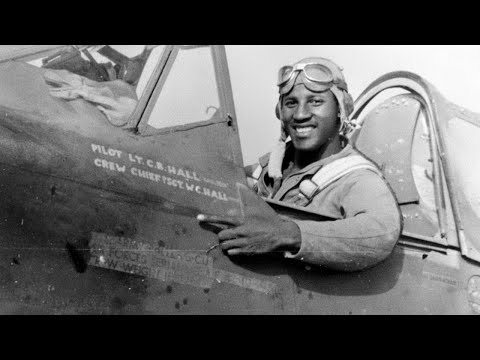
Across the Atlantic, in the warm islands of the Caribbean, young men heard Chamberlain’s announcement and made a decision that would change everything. Billy Strachan, 22, sat in his home in Kingston, Jamaica, listening to the same broadcast. He had dreamed of flying since boyhood, watching seaplanes land in Kingston Harbor. When Britain called for pilots, Billy did not hesitate. He had grown up singing “God Save the King” in school, taught that he was a subject of the British Empire, that when the empire needed him, it was his duty to answer.
Within a week, Billy had sold almost everything he owned to buy a ticket on a steamship to England. The passage cost him £58, more money than most Jamaican families earned in half a year. He was not alone. In Trinidad, Ulric Cross was making the same choice. In British Guiana, Cy Grant was packing his bags. All across the West Indies, hundreds of young men from Jamaica, Trinidad, Barbados, and a dozen other islands were booking passage to England. They were educated men, many from middle-class families. They all shared one thing: They wanted to fly. They wanted to fight. They wanted to prove themselves.
But there was one enormous problem that none of them fully understood until they arrived in cold, gray England. The British military did not want them. Not because they were unqualified, not because they could not learn, but because their skin was the wrong color. The Air Ministry had a policy that was never written down in any official law but was known by every commanding officer in every RAF station across Britain. The policy was simple and absolute: Empire Air Forces are for Europeans only. Black men could serve, yes, but only on the ground. They could load bombs, fix engines, cook food, and clean latrines. But they could not fly combat aircraft. Not as pilots, not as navigators, not as gunners. The idea was considered impossible by the men who ran the RAF.
When Billy Strachan arrived at the RAF recruitment office in London in October 1939, the officer behind the desk looked at him like he had made a terrible mistake. “You understand,” the officer said carefully, “that there are many ways to serve. Ground crew is essential work.” Billy understood exactly what the man was saying. He was being told that his £58, his voyage across an ocean, his willingness to risk his life, all of it meant nothing because of the color of his skin.
Other Caribbean volunteers had the same experience. They were turned away politely. They were offered ground positions. They were told that flying was not suitable for them. The message was clear: The sky was for white men only.
But Britain was losing the war. By December 1939, two months after war began, the pilot shortage was even worse than predicted. Training schools could not produce pilots fast enough. The Luftwaffe was growing stronger. And still qualified volunteers from the Caribbean kept arriving in England, kept showing up at recruitment offices, kept insisting they wanted to fly. Some commanding officers began to ask a dangerous question: If we are desperate for pilots, and these men are educated and willing, why exactly are we turning them away? There was no law against it, no written rule, just tradition, just the assumption that it had always been this way and would always be this way.
Then something unexpected happened. Billy Strachan received a letter in January 1940. It was from an RAF training school in the north of England. The letter said he had been accepted for pilot training. He read it three times to make sure it was real. Somewhere in the massive bureaucracy of the Royal Air Force, someone had decided that the rules could bend, that the color of a man’s skin mattered less than his ability to fly a plane. Billy packed his single suitcase and took the train north, barely believing his luck. He did not know that he was about to become part of a quiet revolution, one that would challenge everything the British Empire believed about who deserved to fight for it.
The loophole that saved Billy Strachan and hundreds of other Caribbean volunteers came down to a simple fact: There was no written law that said a black man could not fly for the Royal Air Force. The policy existed only in the minds of old officers and in unspoken tradition. When a few progressive commanding officers decided to ignore that tradition, there was nothing anyone could do to stop them legally. These officers looked at the situation with clear eyes. Britain needed pilots more than it needed to protect old prejudices. If a man from Jamaica or Trinidad could pass the same tests as a man from London or Manchester, then that man would fly. It was that simple and that revolutionary.
Billy Strachan arrived at his training school in February 1940 and immediately understood that he would have to be twice as good as everyone else just to be treated as equal. The training was brutal for everyone, but Billy knew that any mistake he made would be seen as proof that men like him should never have been allowed in the cockpit. The RAF pilot training program required exactly 28 hours of flight time before a man could be certified. Every hour mattered. Students learned to fly in all weather conditions, day and night. They practiced navigation using only a compass and landmarks below. They learned gunnery, how to lead a target, how to calculate deflection angles while flying at 200 mph. They learned formation flying, staying wingtip-to-wingtip with other aircraft, while every instinct screamed at them to give more space.
The failure rate was high. Out of every 10 men who started training, only six finished. Some washed out because they could not handle the stress. Some crashed and died during training exercises. The RAF was in such a hurry to produce pilots that safety took second place to speed. But Billy survived. He passed every test. He flew his required hours. And in April 1940, he received his wings, the small silver badge that every RAF pilot wore with fierce pride. He was officially a pilot in His Majesty’s Royal Air Force.
But even as he pinned those wings to his uniform, senior officers at other bases were trying to make sure that what happened to Billy would never happen again. Letters flew between RAF commands throughout the spring of 1940. Conservative officers argued that allowing colonial subjects of color to become pilots would destroy morale among white air crews. They claimed it was a distraction Britain could not afford during wartime. They pushed for official regulations that would make the unwritten rule into actual law. But they faced a problem. The man in charge of RAF recruiting was Air Commodore Chamier, and he had made up his mind. Chamier believed that merit mattered more than skin color. He quietly instructed training schools that qualified candidates should be accepted regardless of where they came from or what they looked like. He never made a public announcement. He never challenged the old guard directly. He simply made sure that Caribbean volunteers who met the standards got their chance.
The breakthrough came in October 1940. Two more West Indian pilots earned their wings on the same day: John Blair from Trinidad and Errol Barrow from Barbados walked out of their training school as certified RAF pilots. Word spread quickly through the Caribbean communities in London. If three men could do it, others could too. By the end of 1940, 20 Caribbean men were in RAF pilot training. By mid-1941, that number had grown to over 100. The floodgates had opened just slightly, but it was enough. In total, more than 450 West Indian volunteers were serving in various RAF roles by the summer of 1941, with over 100 of them training or serving as air crew—pilots, navigators, or gunners.
But getting into the RAF was only the first battle. These men had to reach England first, and that meant paying their own way across the Atlantic Ocean. A steamship ticket from Kingston to Liverpool cost between £50 and £80, depending on the season. That was a fortune for most Caribbean families. Many of the volunteers sold everything they owned. Some borrowed money from relatives. Others worked extra jobs for months to save enough. The voyage itself took two weeks, crossing an ocean that was now prowled by German submarines hunting Allied ships. Every Caribbean volunteer who made that journey knew they might die before ever seeing an RAF plane. They came anyway.
The men who made it to England faced a country that did not quite know what to make of them. Britain in 1941 was cold, gray, and exhausted from nearly two years of war. Food was rationed. Cities were bombed nightly. And suddenly, black men in RAF uniforms were walking the streets, eating in the same cafeterias, sleeping in the same barracks as white British airmen. Some Britons welcomed them. Others did not. But inside the training schools and on the air bases, a strange thing happened. When men flew together, trained together, and faced death together, old prejudices started to matter less. Not for everyone, not all at once, but enough to make a difference.
The training was relentless. Navigation classes taught pilots to find their way across Europe using only stars and dead reckoning. Gunnery practice required hitting a target towed behind another plane while both aircraft flew at full speed. Radio operation meant learning Morse code and proper communication procedures under stress. Physical fitness training pushed men to their limits because pilots needed to stay conscious during high-speed turns that could make blood drain from the brain. Every single day was a test. Every flight could be deadly. Accidents happened constantly. Planes crashed during training. Engines failed. Students made mistakes and paid for them with their lives.
But the men who survived became some of the finest pilots in the RAF. They had to be. They knew they represented more than just themselves. Every Caribbean pilot carried the weight of proving that they belonged in the sky. If they failed, it would be used as evidence that the old policies were right. If they succeeded, it would open doors for others. That pressure was enormous, but it also created a kind of excellence born from necessity. By late 1941, Caribbean pilots were being assigned to operational squadrons. They were about to face their real test, and it would come not in training, but in the deadly skies over Nazi-occupied Europe. The Luftwaffe had no idea what was coming for them.
By the end of 1945, over 5,500 West Indian volunteers had served in the RAF, with more than 400 as air crew. Cy Grant flew 60 missions as a Lancaster navigator before being shot down over Holland and spending the rest of the war as a prisoner. Ulric Cross flew 80 missions, earned the Distinguished Flying Cross, and was promoted to squadron navigator leader. They had proved that courage and skill have nothing to do with the color of a man’s skin.
Yet the cost was real. Sixteen West Indian pilots were killed in action, their names scattered through squadron logs that rarely noted where they came from. And when the war ended, the men who had bombed Germany returned to colonies where they still could not vote. Cy Grant became the first black person to appear regularly on British television. Ulric Cross became a High Court judge in Trinidad. Billy Strachan stayed in England, helping the Windrush generation find their footing. They fought two wars at once—and won both, though one took far longer.
For seventy years, Britain largely forgot them. Not until 2015 did the RAF publicly honor Caribbean air crew; a London memorial followed in 2020, long after most had died. Their story teaches us that real change rarely comes from the top—it comes from those who refuse to accept the limits others place on them. The sky belongs to anyone brave enough to reach for it.
So ask yourself: how many talented people are we overlooking right now—not for lack of ability, but because we cannot see past our own assumptions? What will you do to make sure their wings are not forgotten?
Report this article
Select a reason for reporting:






