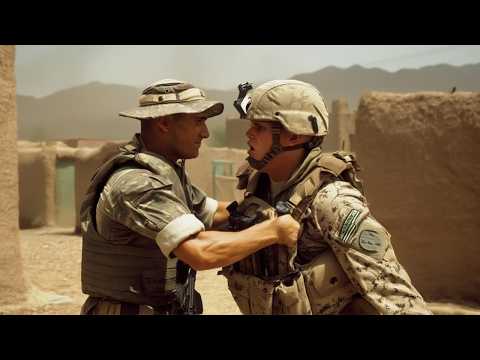
Kandahar, 2002. The joint briefing tent smelled of dust and diesel. A Navy SEAL team leader, Captain Jason Reynolds, scanned the four Australians who had just walked in from a 12-day patrol. Unshaved. No body armor. Boots held together with tape. He leaned toward his sergeant and said it loud enough for the room to hear: “Worse than local militia.”
The Australian patrol commander didn’t look up. He was cleaning his scope. He had been awake for 31 hours. He didn’t have the energy to respond, and he didn’t need to. 72 hours later, that same SEAL team leader was sitting in a classified debrief reading what those four men had done in the Baluchi Valley. He requested a private meeting with the Australian commander that evening. What he said in that meeting never made it into any official record.
His name was Captain Jason Reynolds, 29 years old, six years in the teams, BUD/S class 222. Three deployments before Afghanistan—two to the Persian Gulf, one to the Philippines. He had run direct action raids in three countries. He knew what a professional soldier looked like. That was the problem.
Reynolds had been raised inside a specific theory of what special operations meant. His team carried $500 worth of communications equipment per man. They wore body armor rated to stop rifle rounds. Every patrol had a quick reaction force on standby, a casualty evacuation plan, and a 24-hour radio schedule. When something went wrong, the machine responded in minutes. This was not bureaucratic excess. This was the doctrine that had kept his men alive across six years of deployments.
When the four Australians walked into the briefing tent at Kandahar airfield in November 2002, Reynolds saw none of that. What he saw were four men who looked like they had crawled out of a drainage ditch. They carried stripped non-standard gear, packs with no recognizable load configuration. Their rifles were two different models. One man’s compass was attached to his wrist with a rubber band. They carried no body armor. Their boots, in Reynolds’ own written account filed years later, looked as though they had been repaired with electrical tape and what he described as “two”—he did not finish the sentence.
He did not know where they had been. He did not know what they had done. He saw the appearance and made the only calculation available to a man looking at that evidence. The comment was not arrogance. It was the logical output of a specific framework. A framework in which appearance, equipment standardization, and force protection indicators were the visible markers of professional competence. By every marker of that framework, the four men in front of him should not have survived whatever they had been doing.
Reynolds had never operated alongside the Australian SAS before. Very few Americans had. That was about to change. The intelligence report they were carrying was sealed in a classification envelope stamped with a code Reynolds did not recognize. Nobody at Kandahar airfield had been told it existed.
It is worth stopping here and being precise about something. Reynolds was not wrong. Inside his own doctrine, every single criticism he made was valid. The American approach to force protection in 2002 had been built on hard experience. From Mogadishu, from Beirut, from decades of watching small units disintegrate because they moved too lean in environments that had changed around them. The soldiers who died in Mogadishu died partly because their force was too small and too lightly supported to survive the collapse of a mission that had seemed straightforward. The doctrine Reynolds operated under was a direct answer to those deaths. It had been paid for specifically. He did not follow it out of habit. He followed it because he understood what it had cost to write. He was operating inside a different theory of war. That was all.
The Australian approach traced back not to American special operations doctrine, but to David Stirling’s original concept from North Africa in 1941. Small patrols operating deep behind enemy lines, surviving through concealment rather than firepower. The Australian Special Air Service Regiment had refined this over decades of exercises in conditions that American training rarely replicated. Long periods of isolation, extreme terrain, no resupply, no radio contact, no safety net. Their selection course filtered for a specific kind of man. Not the strongest, not the fastest. The man who could remain motionless, alone, cold, hungry, uncertain, and still make a correct decision at the precise moment when a correct decision was required.
The body armor Reynolds noticed they weren’t wearing was not an oversight. Body armor weighs between 8 and 14 kg depending on configuration. It produces noise when a man moves. The shift of ceramic plates, the creak of strapping. In terrain where survival depends on never being detected, anything that makes movement slower or louder is a liability that must be weighed against the protection it provides. The Australians had done that calculation. They reached a different answer than Reynolds would have. Their answer was not recklessness. It was a doctrine calibrated to a different set of risks.
Reynolds did not know any of this. The Australian SAS had been operating in Afghanistan since October 2001. They had been running deep penetration patrols into terrain that US forces had not entered. They had been watching compounds, mapping routes, building intelligence pictures that no satellite could produce. For more than a year, they had done this almost entirely without recognition. Because the intelligence they gathered fed into US planning processes with their source obscured. The chain of custody stripped out the origin. US commanders used the product without seeing who had made it.
Reynolds had read none of those reports at the level of detail that would have told him where they came from. The classification architecture meant that most specifics never reached operators at his level of the structure. He knew the outputs in the form of operational planning maps. He did not know the inputs were four men in the dirt with cracked optics and rubber-banded comms. So when he made his comment in the briefing tent, he was making the only judgment available to a professional soldier looking at an incomplete picture. He was wrong about the conclusion. He was right about every piece of evidence he had.
Here is what nobody has explained. Task Force K-Bar had been running joint operations since November 2001—12 months of coordination between US and coalition special operations forces—and a veteran SEAL captain with six years of deployments still looked at a returning SASR patrol and saw something that should not have been there. That invisibility was not an accident. Someone made a deliberate decision to keep the Australian contribution out of the visible record at the operator level. The question is why. And the answer to that tells you something about Afghanistan in 2002 that the official histories have been careful to omit.
That answer is in a room at Bagram Air Base. Two weeks after the Kandahar briefing tent, a room with six officers, a sealed document, and one decision that was made quietly and has never appeared in any public account of the period. The room matters. And because what was decided there explains why Reynolds was still in the dark 12 months into the war.
Rear Admiral Robert Harward commanded Task Force K-Bar from November 2001 to April 2002. He was one of the first senior American officers to understand with precision what he was looking at when he observed the Australian SAS at work. He would later describe them in a formal assessment as among the most professional and capable special operations forces he had encountered in a career spanning three decades. But Harward’s understanding required proximity. It required sitting at the end of a chain of intelligence products, watching the detail accumulate over months, and eventually tracing that detail back to its source. Most officers in the coalition structure never made that connection.
The deliberate decision that was made, not once but continuously throughout the first two years of the war, was to keep the Australian contribution at a classification level that protected the operational methodology. If the Taliban understood how the intelligence was being gathered, they would change their behavior. The Australians’ survival depended on the enemy not knowing that four men had been lying motionless 300 meters away for nine days. If that method became visible in reporting chains at lower classification levels, it would eventually leak. The method would be lost. So the source was kept dark. And the men who had used the method remained invisible to the operators who benefited from their work.
Reynolds was one of those operators. When Harward later made his public statements about Australian capability, Reynolds read them. He said he had assumed it was diplomatic language, coalition diplomacy. Every allied unit got praised. He did not yet understand that Harward was being specific.
The mission that changed this began on November 14, 2002. The target was a logistics network operating out of the Baluchi Valley, approximately 60 km southwest of Kandahar. Coalition intelligence had tracked weapons movement through this corridor for eight months. Aerial surveillance had produced limited results because the network operated primarily at night and used livestock convoys as concealment for vehicle movement. Ground-level confirmation of the route, the timing, and the command structure required a patrol that could insert without detection, hold a position for an extended period, and gather pattern-of-life intelligence without triggering a response from the network.
The mission was offered to three units before it reached the Australians. Two declined on the basis of force protection constraints. The patrol would operate beyond reliable quick reaction force range for periods that their command authority assessed as unacceptable. The third unit accepted and then withdrew when the insertion window was pushed back 72 hours, stretching the timeline beyond what their planning parameters permitted. The Australians were given the brief on November 12th. They accepted in under 15 minutes.
The patrol was four men. Sergeant Dave Kellerman, 31, from a sheep station outside Longreach in Central Queensland. He had done two previous deployments, one to East Timor in 1999, one to the first rotation in Afghanistan in 2001. He had the habit under sustained stress of chewing the inside of his left cheek. By the end of this deployment, the tissue there had developed calluses. He was the patrol commander. He had been asked once in a training debrief what he thought about when he was in the field for extended periods. He had said, “Lists.” He would not elaborate on what the lists contained.
Corporal Ben Mitchell, 27. He had been an electrician in Rockhampton before selection. He had failed the SASR selection course twice before passing on his third attempt. He had never spoken about this to anyone except Kellerman, who had heard it secondhand and had never raised it directly. Mitchell was the patrol’s communication specialist, which meant he was responsible for a radio schedule that they had already been told they would not be following strictly.
Corporal Aaron Webb, 29. West Australian. Former amateur boxer, 16 bouts, 11 wins, seven by decision, four by technical knockout. He had been in a relationship for six years that had ended three months before this deployment. He had not discussed this with any member of the patrol. He carried a photograph in his left breast pocket. He was asked about it once on a previous deployment by a junior trooper. He said it was a photograph of a dog. The patrol did not pursue this.
Trooper James Chin, 24, the youngest man in the patrol by three years. He had completed one previous deployment to Timor where he had not been in contact. Afghanistan was different from Timor in ways that training had partially prepared him for and in ways that it had not. He had not slept longer than four consecutive hours since arriving in country. He did not report this.
These four men were told they would be operating for a minimum of 14 days. They were told there was no guaranteed extraction window. The timeline would extend based on the intelligence value of continued observation. They were told that air support could not be guaranteed in the first 72 hours due to competing strike package priorities over Kandahar city. They were told the mission priority was intelligence collection, not direct action. Kellerman asked one question: did the patrol have authority to call in a strike if a high-value target presented itself under the right conditions? He was told yes, under specific authorization protocols. He nodded and began planning the insertion route.
While Kellerman was plotting a foot insertion through a valley that had no friendly forces within 40 km, the Pentagon was completing a contract review for a new generation of wide-area aerial surveillance drone. The program was budgeted at $2.3 billion. It would be canceled in 2006 without having produced reliable intelligence on the Baluchi corridor. The network operating there had adapted its movement patterns to satellite overpass schedules within three months of the program becoming active. The four men with binoculars and a cracked scope cost the coalition $3,400 a day to keep in the field. The figure included rations.
The goat was not on the insertion plan. Nothing about the goat was on any plan. They inserted at 02:43 on November 15th on foot through a ridgeline that required a six-hour approach in darkness to reach the observation post. They carried no equipment beyond what the mission required. Kellerman’s pack weighed 61 kg. The ration allocation was calculated to the gram, not the meal. They carried enough water for 48 hours. After that, they would source water from the terrain. Two potential water points had been identified from satellite imagery. Both existed on the ground. This was not a given. They had checked twice and were prepared for both to be dry.
The observation post was a shallow depression in limestone screened on three sides by thorn scrub on a ridge approximately 300 meters above the valley floor. From that position, they had a direct line of sight to three compounds, a road junction, and a dry riverbed the intelligence assessment had identified as a probable weapons transit route. The field of coverage from the position was approximately four square kilometers of operational ground. They had no sandbags, no permanent overhead cover, a layer of hessian, and their own bodies. The limestone was cold enough at night that Chin’s hands would not function normally for the first 40 minutes after first light. He adjusted. He had to.
They did not move for 31 hours. At 08:15 on day two, a child walked within 20 meters of the observation post—a girl, perhaps nine or ten years old, carrying a bundle of cut grass on her back. She walked along the ridgeline from the north, stopped at a point that gave her a view of the valley below, stood looking at it for perhaps 30 seconds, and then walked back the way she came. She did not look at the thorn scrub where four men were lying flat in the dirt. She did not slow her pace. Nobody breathed for the duration of her presence. She disappeared over the ridge to the north. Kellerman counted to 600 before authorizing any movement.
This was day two. Twelve days remained at minimum. Nobody said anything for a long time after that. Not because there was nothing to say. Because there was nothing to say that anyone wanted to hear.
By day four, the valley’s rhythm became readable. A three-vehicle convoy crossed the junction each evening between 18:30 and 19:15. Livestock moved through the dry riverbed, not randomly—the animals provided ambient noise cover for the engines. The eastern compound, reinforced gate and newer roof, held 12 to 15 military-age males rotating in shifts. Someone inside was running a schedule.
Kellerman recorded everything. Vehicle times to the minute. Personnel counts and descriptions. Weapons identified through the scope at 300 meters. Who entered, who left, who smoked, who ate alone. This was pattern-of-life intelligence. It required only patience, a notebook, and the willingness to stay still longer than the mind found comfortable.
Day seven, 14:12. The convoy pattern broke—one vehicle, three hours early. Four men climbed out and went directly into the eastern compound. They did not emerge. Kellerman used a 60-second radio window to report the anomaly. “Continue observation,” came the reply.
Day eight, 03:27. A goat appeared at the hide. Gray, one ear torn, trailing a broken rope. It did not run. Then came footsteps in loose scree—a herder, retrieving the animal. He passed 12 meters from the hide, took the rope, and turned south. He had gone eight meters when he stopped. Stood still. Kellerman counted eleven seconds. Then the man walked on, and the sounds faded.
They could not abort. Sixty meters of open ground in daylight, under observation from the compounds below. They were committed. Four hours passed with no movement toward the ridge. The compromise was partial or imagined. No movement came.
That evening a satellite dish appeared on the eastern compound’s roof. It had not been there the previous day. Kellerman reported it and requested strike authorization. The stand-by lasted 19 hours. At 04:15 on day nine, a second vehicle arrived—different model, two men, met at the gate and taken inside. Eighty-two minutes later they left, turning west at the junction, away from the main corridor. Kellerman tracked them until they passed out of range. He recorded the license plate, the time, the direction, the descriptions.
At 08:30 the authorization came. The patrol had to maintain eyes on target until 30 seconds before impact—four men on a limestone ridge in daylight, waiting for two precision bombs. Mitchell checked the coordinates three times, then again. Kellerman made the call.
The first strike hit at 14 seconds past the window. The second at 41. The pressure wave pushed dust through the hessian. Webb’s left ear bled for 22 minutes; he did not mention it until extraction four days later. Two vehicles fled toward the ridge, then stopped when a second air asset made a low pass. The men inside ran. Kellerman recorded which direction.
The patrol had a guaranteed extraction window on day ten. The task was complete. They did not call for extraction. They stayed 72 more hours—because the vehicle that went west meant the picture was structurally incomplete. A second node existed upstream. Kellerman stayed on the basis that intelligence collection was the priority, and it was not finished.
Day eleven, 11:07. A man arrived at the rubble on foot from the west. Alone. He stood at the edge for ten minutes—not searching, looking. Then he turned and walked back. Kellerman photographed him through the scope. That photograph became the basis of a six-month assessment identifying two additional command nodes.
The debrief was at Kandahar airfield, November 26th, room three, building seven. Reynolds read the 67-page report in one sitting. He did not eat that day. The tactical result was not exceptional—he had called in comparable strikes. What stopped him was the eight days of observation data that preceded it. He had never produced a document like this. Not because he lacked the capability, but because his force protection requirements made it structurally impossible to place men in that position for that duration without detection.
He found Kellerman in the mess hall, eating reconstituted rice from a metal tray. Reynolds got two sentences into his prepared framework about intelligence methodology before stopping. He asked three questions about decision protocols for remaining in a compromised position. Kellerman answered precisely, without instructing. Reynolds asked about the goat. Kellerman described it without visible amusement. Reynolds said that by his own protocols, he would have aborted at that point.
Kellerman looked at him for a beat. “Different risks. Different answers.” He finished his rice, stood, and shook Reynolds’s hand. “What you do works, too. Just in different places.” Then he left.
Reynolds sat there for another few minutes, trying to recategorize something. His model of what elite soldiers looked like was not wrong. It was just smaller than he had understood it to be.
The Baluchi intelligence product remained operationally active for six years. Four operations between 2003 and 2008 drew from the network map Kellerman’s patrol produced; three confirmed targets no other source had identified. The fourth, in 2008, dismantled the secondary node he had suspected on day 11.
Reynolds retired in 2011. In a 2018 podcast, unprompted, he mentioned the Australian team—said he’d said something stupid when he first saw them, and had no idea what he was talking about. At 1:53 he stopped. The interviewer moved on. Six minutes later he went quiet mid-sentence. Asked if he was all right, he said “Yes,” then took 23 seconds before continuing.
Kellerman left the regiment in 2014 and runs a four-wheel-drive touring company in Outback Queensland. Asked once if he was proud of what he had done, he said, “I’m proud of the men I served with.” He did not answer the question that was asked.
That silence is the story’s true ending—the gap between what these men carried and what language can hold. So here is the question worth sitting with: when we praise a capability without reckoning with its cost, are we honoring the men who paid it—or simply making it easier to ask the next four to do the same?
Report this article
Select a reason for reporting:






