The sky over Germany was a graveyard, and the American bombers were dying by the dozens. In the summer of 1943, daylight raids into the heart of the Reich were bleeding the Allies dry—sixty B-17s lost in a single day, 1,500 airmen gone in a week. The Luftwaffe’s fighters, waiting just beyond the range of American escorts, tore through the unprotected formations like wolves among sheep. Something had to change, and fast.
Enter the P-51 Mustang—a plane that almost never was. Born from a British request and built in a blistering 117 days, the Mustang was fast, sleek, and long-legged. But it had a fatal flaw: at high altitude, its Allison engine gasped for air, making it a sitting duck in the deadly skies over Europe. For a while, it was relegated to low-level ground attack, a role it performed well but without glory.
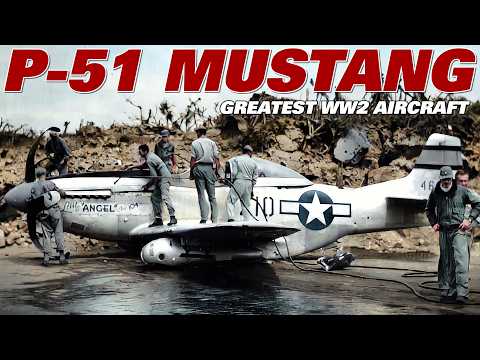
Then came the gamble that changed everything. In 1942, a team of Rolls-Royce engineers swapped the Mustang’s weak Allison for the legendary Merlin engine—the same powerplant that gave the Spitfire its bite. The result was instantaneous and staggering: the Merlin gave more power at 25,000 feet than the Allison had at takeoff. The Mustang suddenly had the range, the speed, and the high-altitude punch to go toe-to-toe with anything the Luftwaffe could throw at it.
But the Americans weren’t convinced. They had their own darling—the P-47 Thunderbolt, a heavyweight bruiser that could take a beating and dish one out. Yet the Thunderbolt guzzled fuel like a drunk, limiting its escort range to just over 300 miles. Berlin was 550 miles away. The math was brutal: without a long-range escort, the bombing campaign would collapse.
Meanwhile, the men flying those bombers were paying the price. “I watched them go down and couldn’t do a damn thing,” one fighter pilot recalled, his voice still heavy with guilt. “You’d come back practically crying. Ten men weren’t coming home that night, and it was your fault for not being there.” The P-51, with its bubble canopy and six .50-caliber guns, was the answer to their prayers—if only the brass would listen.
As 1944 dawned, the Mustang finally got its chance. With drop tanks extending its range to over 2,000 miles, it could fly all the way to Berlin and back, hunting German fighters wherever they dared to appear. “When I saw the fighters over Berlin, I knew the jig was up,” Hermann Göring later admitted. The tide was turning, and the P-51 was leading the charge.
But the war was far from over. The Luftwaffe still had aces of its own, and the skies over Europe were about to become a swirling cauldron of fire and death. For the young pilots climbing into their Mustangs, every mission could be their last—and they knew it.
The men who flew the Mustang were a different breed. “You had to be aggressive. If you thought defensively in a fighter plane, you were lost,” one ace explained. They were told to be the tip of the spear, to hunt rather than wait. And hunt they did, sweeping ahead of the bomber streams, scanning the vast, cold sky for the telltale specks that meant German fighters.
The Luftwaffe pilots learned to respect the Mustang, but they also learned to exploit its old weakness—the moment the escorts turned for home, they struck. “You could see them circling, waiting. They knew exactly when we had to leave,” a Mustang pilot remembered. But now, with drop tanks and the Merlin’s fuel efficiency, the Mustang could stay longer, push deeper. The hunters were becoming the hunted.
On the ground, the relationship between pilot and crew chief was sacred. “The airplane belonged to the crew chief, not the pilot,” one man joked. “He took care of it like a baby. Then you’d climb in, strap it on, and it became yours.” That bond—between young men and their machines—was the unseen armor of the Eighth Air Force.
By the spring of 1944, the Mustang was everywhere. It flew top cover over Berlin, strafed airfields in France, and tangled with Focke-Wulfs and Messerschmitts in brutal, twisting dogfights. “We were always attacking, no matter the odds,” a pilot said. And the odds were shifting. German pilots were increasingly young, inexperienced, easy prey. “It was like shooting fish in a barrel. And if it’s the enemy, I don’t mind shooting fish in a barrel.”
But the cost was real. Ground attack missions were deadly, with five Mustangs lost to flak for every enemy plane downed. Pilots flew through walls of tracer fire, skimming treetops, hearts pounding. “I thought, this won’t hurt long,” one recalled, “same as sitting in the dentist’s chair.” They pressed on because the war demanded it.
By late 1944, the Luftwaffe was crumbling. On a single day in April 1945, Mustangs destroyed over 700 German aircraft, most on the ground. Göring’s once-mighty air force was a shell of itself. The Allies owned the sky.
And yet, for all the Mustang’s dominance, the men who flew it never forgot what they were fighting for. “I didn’t hate the Germans. I hated that son of a bitch,” one pilot said, meaning Hitler. “That solved a lot of my problems. If I could have gotten my hands on him, I would have.” The war had become personal, not against a people, but against a regime that had brought the world to its knees.
As the Allies pushed into Germany, the Mustang’s role shifted. It became a roving hunter-killer, roaming far ahead of the advancing armies, destroying anything that moved—trains, trucks, convoys. “Anything that moved, we shot up,” a pilot recalled with a grin. The German countryside became a shooting gallery, and the Mustang was the perfect weapon for it.
But the war in Europe was winding down, and a new challenge loomed in the Pacific. The Mustang was already there, flying long-range missions from Iwo Jima, escorting B-29s over Japan. It was a different kind of war—vast, lonely, and brutal in its own way. Yet the Mustang proved just as deadly, its range and speed making it a natural fit for the endless expanses of the Pacific.
For the pilots, the end of the war brought a strange mix of relief and emptiness. “I still dream about the missions,” one veteran admitted. “I dream about what I could have done, what I should have done, where I made mistakes.” The war had shaped them, defined them, and left scars that never fully healed.
But they also remembered the good days—the thrill of flight, the camaraderie of the squadron, the sheer joy of piloting the finest fighter of its generation. “I was twenty years old and they gave me this big, beautiful airplane,” one man said, his eyes still bright with memory. “I had the time of my life.”
And so the Mustang passed into legend. It was more than a machine; it was a symbol of what America could achieve when it put its mind to it—a marriage of British ingenuity and American muscle, a fighter that turned the tide of the air war and helped crush the Nazi war machine.
But the story wasn’t over. The Mustang would fly on, in Korea and beyond, its sleek silhouette a reminder of a time when young men climbed into the sky to save the world. And for those who flew it, the Mustang would always be more than a plane. It was a friend, a partner, a piece of their soul.
Now, as the sun sets on the airfields of England, the Mustangs sit silent, their engines cold. But in the hearts of the men who flew them, they still roar to life, still climb into the blue, still chase the enemy into the sun. The war is over, but the legend lives on.
Decades later, the men who flew the Mustang still gather at reunions, their hair white, their hands gnarled, but their eyes still sharp when they talk about the sky. “You never forget the sound of that Merlin,” one says. “It’s in your bones.” They swap stories about close calls, about friends who never came back, about the sheer terror and exhilaration of aerial combat.
And they wonder, quietly, whether future generations will understand what they did. “We weren’t heroes,” one insists. “We were just doing our job.” But the world knows better. The P-51 Mustang, with its sleek lines and deadly purpose, remains a symbol of a moment when the fate of the free world hung in the balance—and young men in silver machines tipped the scales.
Today, a few Mustangs still fly at air shows, their engines thundering across the skies, drawing crowds who marvel at their beauty. Children point, veterans wipe their eyes, and for a moment, the past is alive again. “She’s a time machine,” a pilot says. “When I fly her, I’m twenty again, and the war is waiting.”
The Mustang’s legacy isn’t just in museums or history books. It’s in the freedom we take for granted, in the quiet skies over Europe, in the simple fact that we can gather here today and remember. The plane that once brought death now brings tears of gratitude.
As the last Mustang lands and the crowd disperses, one question lingers in the air, as it always does: What would have happened if the Mustang had never been built—would we still be free to ask? What do you think? Share your thoughts below.
Report this article
Select a reason for reporting:






