In the heart of the Third Reich, while the wives of Hitler’s inner circle were paraded as paragons of Aryan virtue—fanatical, fertile, and photogenic—one woman stood in stark, silent defiance of everything they represented. Eva Braun never joined the Nazi Party. She never bore a child. She was photographed with Hitler in public exactly once. For sixteen years, she shared his bed, his private moments, and his mountain retreat, yet she remained a ghost in the propaganda machine, a contradiction that exposes the deepest hypocrisy of the Nazi regime.
While Magda Goebbels, the first woman awarded the Mother’s Cross of Honor, posed like a Madonna with her six children, and Gerda Bormann bore ten children as living proof of the Aryan birthrate, Eva Braun shopped for Ferragamo shoes in Florence and watched Hollywood films banned for ordinary Germans. She chain-smoked, drank champagne, and sunbathed nude—all while the regime preached austerity and modesty to millions of German women. How could the woman who shared Hitler’s life embody every vice the Nazis condemned? And why did the Führer, who demanded total visibility from his followers, keep her hidden for sixteen years?
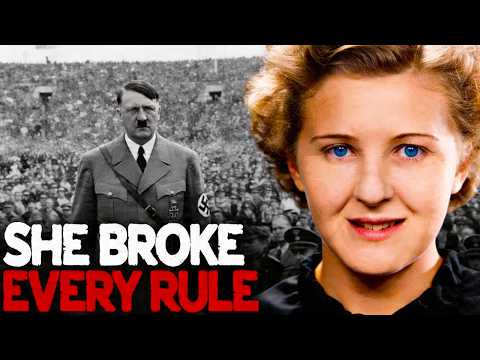
The answer lies in the stark contrast between the public and private faces of the Third Reich. The wives of Hitler’s paladins were not merely decorative; they were load-bearing pillars of propaganda. Their faces on magazine covers, their pregnancies celebrated, their dinner parties covered in newsreels—all of it was engineered to tell German women what their lives should look like. They were fanatical, fertile, and loud, while Eva was apolitical, childless, and silent. Yet it was Eva, not they, who occupied the most intimate space in Hitler’s world.
Consider the party card. Lina Heydrich joined the Nazi Party two years before her husband, Reinhard, the architect of the Holocaust. Annelies Ribbentrop signed hers in December 1932, months before Hitler took power. Every top Nazi wife had her membership documented, visible, permanent. Eva Braun never signed a single party membership book—not in 1932 when she became Hitler’s lover, not in 1935 when she moved into his household, not even when war broke out. Hitler never asked her to. She wasn’t being groomed for a public role; she was being kept for a private one.
That private role was one of near-total invisibility. While Magda Goebbels graced newsstands and Emmy Göring’s weddings were national events, Eva Braun appeared in exactly one published newspaper photograph near Hitler—at the 1936 Winter Olympics—and even then, most Germans didn’t know who she was. The Reich’s press corps had standing orders not to name her, not to caption her, not to draw attention to her. Albert Speer, who saw her constantly at the Berghof, described her as being banished from the table the moment any high-ranking official arrived. She was, in his words, the loneliest woman he had ever known.
But behind the scenes, Eva lived a life no other Nazi wife was permitted. Her wardrobe ran to Ferragamo shoes ordered from Florence, her lingerie monogrammed with her initials, and she changed outfits up to seven times a day. She chain-smoked behind Hitler’s back, drank champagne, and watched Gone with the Wind in the Berghof’s private cinema—a film ordinary Germans were legally barred from seeing. At the same moment she was sunbathing in silk and smoking imported cigarettes, the NS-Frauenschaft was preaching that cosmetics were decadent and jazz was degenerate. The Führer’s own woman embodied every single vice the regime publicly condemned, and he didn’t just tolerate it—he provided it.
The biggest inversion, however, was her childlessness. The Nazi cult of motherhood was institutional, measured, and rewarded. The Mother’s Cross was awarded to roughly three million women: bronze for four children, silver for six, gold for eight. Magda Goebbels was the first recipient. Gerda Bormann had ten children; Magda had six; even Lina Heydrich had four. Eva Braun had zero. Instead, she had two Scottish terriers named Negus and Stasi—a quiet act of rebellion against Hitler’s much-photographed Alsatian, Blondie. Hitler was godfather to Edda Göring, to Wolf Rüdiger Hess, to Adolf Martin Bormann. He attended their christenings, weddings, and anniversaries. He never attended anything for Eva—not a birthday, not an anniversary, nothing until the last forty hours of both their lives.
And when the end came, the contrast was seared into history. In the bunker beneath the Reich Chancellery, Magda Goebbels dressed her six children in white nightgowns and crushed cyanide capsules into their mouths one by one. She, the first recipient of the Mother’s Cross, killed the children the regime had demanded she produce. One floor below, Eva Braun was already dead—33 years old, no children, a cyanide capsule bitten the previous afternoon, her feet curled up on a small sofa beside the body of the man she had waited sixteen years to marry. They had been husband and wife for about forty hours.
Two women, forty feet apart, one concrete floor between them, embodying the two opposite poles of Nazi womanhood. The propaganda mother killed her children; the apolitical mistress died without producing any. And death wasn’t the last thing that separated them. While the surviving Nazi wives faced denazification, loss of property, and lives spent defending or denying their husbands’ crimes, Eva faced nothing. No trial, no memoir, no children to carry her legacy. She became a silence, a vacuum in the historical record—the one woman at the top of the regime who never had to answer for any of it because she chose not to survive it.
As her cousin Gertraud Weisker, who visited her at the Berghof in 1944, said: Eva was the unhappiest woman she had ever met. Her last recorded words were to Hitler’s secretary, Traudl Junge, minutes before she bit into the cyanide capsule. She told Junge to try to get out, to make her way through the Soviet lines, and asked her to give Bavaria her love. In Hannah Arendt’s sense of the word, Eva Braun was the banal opposite of every other Nazi wife—not the fanatic, not the mother, not the propagandist, just the quiet woman in the mountain house who watched American films and waited sixteen years for a man who was never going to love her the way she wanted.
That banality, that ordinariness sitting at the center of the most extraordinary evil of the twentieth century, is exactly what makes her case the most morally uncomfortable of them all. But to fully understand how Eva Braun became the private truth behind the regime’s public lie, we must first unravel the machinery of Nazi propaganda that shaped the ideal wife—and the woman who defied it at every turn.
To understand how Eva Braun became that private truth, you have to go back to the machinery that manufactured the public one. From 1933 onward, the regime didn’t simply encourage Aryan motherhood—it industrialized it. The NS-Frauenschaft drilled millions of German women through speeches, pamphlets, and newsreels into a single mold: fanatical, fertile, visible, obedient. The ideal woman carried children, not opinions. She wore simple wool, not silk stockings. She did not dance to jazz, did not sunbathe, did not shop abroad.
At the apex of this pyramid stood the wives of Hitler’s inner circle, and their roles were carefully cast. Magda Goebbels posed on the cover of NS-Frauen-Warte like a Madonna with her six children in matching white. Emmy Göring hosted state receptions at Carinhall, the looted palace her husband had stuffed with stolen art. Henriette von Schirach operated as the consort of Vienna’s Gauleiter. Annelies Ribbentrop ran the foreign minister’s household with such ferocity that Hitler himself half-joked she was the one who really ran the foreign ministry.
These women were not passive background. They were propaganda infrastructure—their faces, pregnancies, and dinner parties engineered to tell ordinary German women what their own lives should look like. And they pushed the ideology further than the men sometimes dared. In January 1944, as Germany was losing the war, Gerda Bormann wrote her husband Martin a letter proposing a Volksnot-Ehe, an emergency marriage of the people, in which worthy Aryan men would be permitted multiple wives who would alternate pregnancies. In her own chilling phrasing, Martin would always have a wife who was serviceable. He wrote back that the Führer thought exactly the same thing.
Henriette von Schirach confronted Hitler directly in June 1943 over the deportation of Jewish women from Amsterdam she had witnessed firsthand. Hitler snapped that she was sentimental, that she had to learn to hate, and banished her from the Berghof. But she had pushed. Lina Heydrich wrote glowingly in her memoir about the looted Czechoslovak estate her husband was granted—an estate where she oversaw forced labor and, by multiple accounts, personally abused the prisoners working there. She described the whole arrangement as a fairy tale.
Now set that against Eva Braun’s one documented political statement. It comes in a letter she wrote to Hitler after the July 20th, 1944 assassination attempt. The entire political content of it is a single sentence: she lived only for his love, and that was all. No ideology, no policy, no pushing. The other wives were active engineers of Nazi thought inside their own homes. Eva was defined by a silence so complete that historians for decades assumed she simply didn’t know.
Recent scholarship has dismantled that assumption. She knew. She wasn’t ignorant—just silent. And that silence was precisely what made her useful to Hitler in a way none of the fanatics ever could be. The fanatics demanded things of him: laws, privileges, ideological victories. Eva demanded nothing but his time.
Which raises the question the regime could never answer out loud. If the Nazi ideal of womanhood was so absolute, so sacred, so central to the thousand-year Reich—why did the Führer himself choose its exact negation to share his bed? The answer sits in the bunker, in the final hours, in the wedding that came sixteen years too late and forty hours too short.
Because when Hitler finally married Eva Braun, he did it with two shell-shocked witnesses and a civil registrar dragged in from a nearby Volkssturm unit. No aircraft flew over Berlin. No newsreels covered it. No party card was ever signed. He staged elaborate propaganda weddings for his paladins, stood godfather to their children, signed their marriage registers—and gave his own bride a ceremony in a concrete hole as Soviet shells landed above.
The historian Heike Görtemaker, whose 2010 biography reshaped how scholars read Eva, put it most sharply: Eva wasn’t an embarrassing deviation from the Nazi ideal of womanhood. She was the private truth the regime spent twelve years telling ordinary German women was forbidden. The silk, the films, the champagne, the childlessness, the silence, the invisibility—that was what the Führer actually wanted for himself. Everything he demanded from his Volk was the exact opposite.
And that is where the story turns from hypocrisy into something darker still. Because the women who obeyed the propaganda most completely did not survive it intact. The women who were paraded as the regime’s mothers, its iron consorts, its fertile flagships—they were the ones who had to live inside the wreckage afterward, defending, denying, and teaching their children to defend and deny. Eva never had to. She chose the cyanide instead.
So the final question isn’t whether Eva Braun was a victim or a collaborator—it’s why the regime’s loudest symbols of womanhood ended up its most broken survivors, while its quietest ghost escaped judgment entirely. Magda Goebbels killed her six children in the name of a dying ideology; Eva Braun simply died beside the man she’d waited for. One became a monument to fanaticism, the other a footnote to silence.
Perhaps that’s the most unsettling truth of all: the Third Reich’s propaganda machine built its ideal woman so rigidly that even its own Führer couldn’t live with her. He chose the opposite—and hid her for sixteen years. What does it say about a movement that its most celebrated wives were performative fictions, while its leader’s real partner was the very thing he told Germany to despise? Did Eva Braun’s invisibility make her complicit, or was she simply the regime’s most honest mirror—reflecting back everything it refused to admit?
Report this article
Select a reason for reporting:






