In February 1995, a team of archaeologists was working its way into a tomb that almost everyone had given up on. For years, the place had been choked with debris, left by floods and by earlier excavators.
Then, in the back wall of one of the first rooms, they found a doorway. Behind it ran a corridor more than 100 feet long, lined with door after door after door.
The man leading the team was Kent Weeks, an American Egyptologist who had grown up in Everett, Washington, and taught at the American University in Cairo. And the people this tomb had been built for were not one king, but the sons of a king.
Their father was Ramesses II, the most famous pharaoh of ancient Egypt. A viral video by the page Timetrax sums him up in a single line: the pharaoh who fathered more than 100 children.
It sounds like an exaggeration. In some ways it is. But the real story is stranger than the number.
Because the most remarkable thing about Ramesses II was not how many children he had. It was how many of them he had to bury.
A family that large needed a king who lived long enough to build it. Ramesses II did.
Ramesses II came to the throne at about 25 years old, after the death of his father, Seti I. He would rule Egypt for roughly 66 years, from about 1279 to 1213 BC.
That is not a typo. Sixty-six years. Most of his subjects were born, grew up, grew old and died while he was still on the throne.
Early in his reign he marched north against the Hittites, a powerful kingdom based in what is now Turkey. The great clash came at a place called Kadesh, in modern Syria.
Ramesses carved his victory into temple walls all over Egypt. Modern historians are less impressed. Most believe the battle was a stalemate.
At home, he built on a scale no one had seen. In the eastern Nile Delta he raised a new capital, Pi-Ramesses, decorated with at least 50 colossal statues of himself. He celebrated an unprecedented 13 or 14 Sed festivals, the great royal jubilees, the first in his 30th year as king.
He was worshipped in his own lifetime as a living god.
Years later, the two empires made peace, and Ramesses sealed it the way kings often did. He married a Hittite princess.
She took the Egyptian name Maathorneferure and became one of his great royal wives. She gave him at least one more child, a daughter named Neferure.
She was far from his only wife. Like other pharaohs, Ramesses II had many wives and concubines.
Two women stood above the rest in the early years: Nefertari and Isetnofret. Between them, they gave birth to the sons who would line up, one by one, to inherit the throne.
Nefertari bore his firstborn, a boy named Amun-her-khepeshef. Isetnofret bore another son, also named Ramesses, then Khaemwaset, then a boy called Merneptah.
Nefertari’s second son, Pareherwenemef, was the king’s third son. In the early years, these few boys were the ones everyone watched.
And then there were the others. Dozens of them.
So how do we know how many children he had? Not from a birth register. We know because Ramesses had them carved in stone.
In his temples at the Ramesseum, at Luxor, at Wadi es-Sebua and at Abydos, long processions of princes and princesses march along the walls. Each one is shown in turn, many of them with names.
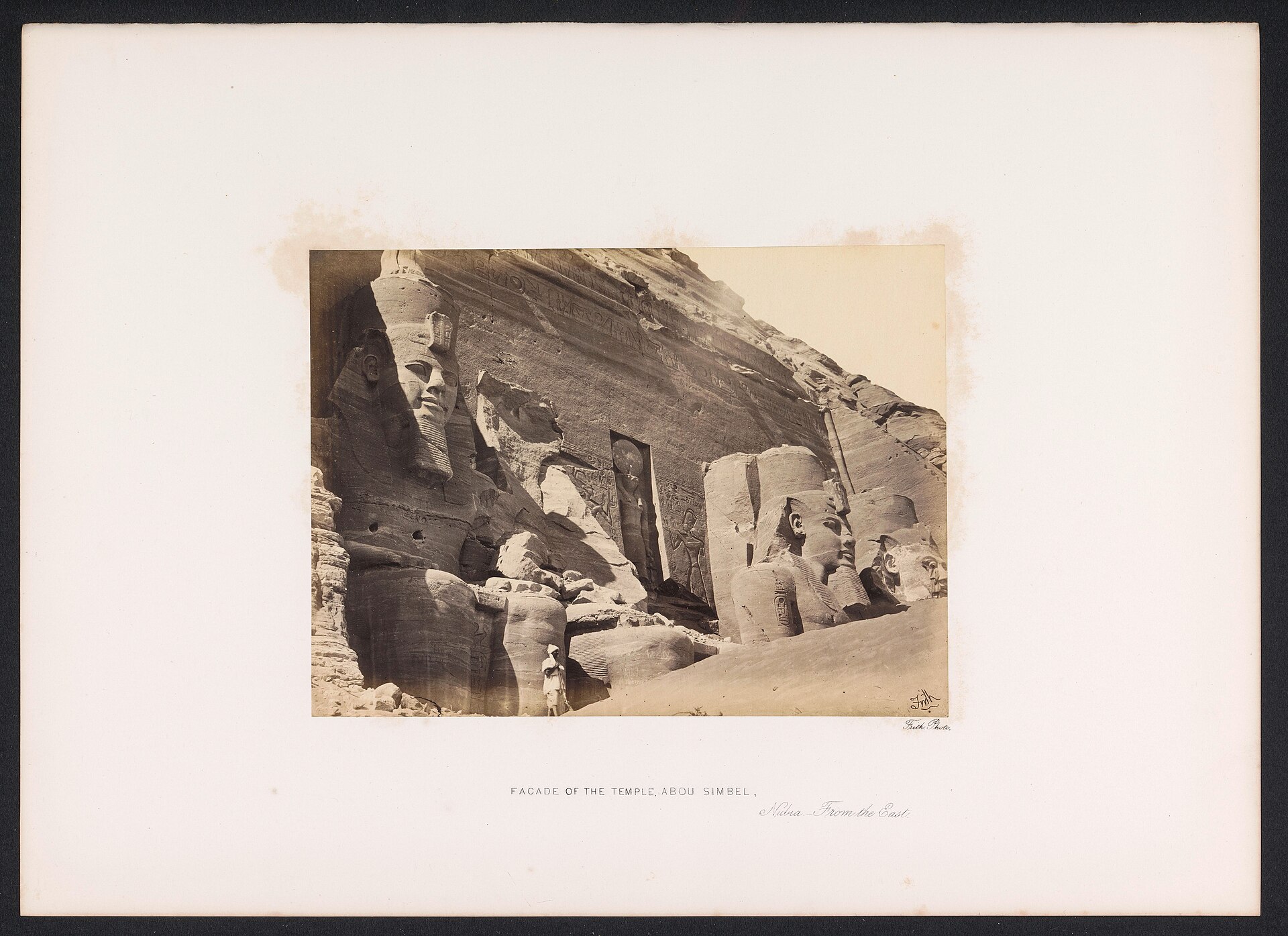
At Abu Simbel, his great temple in the far south, statues of some of his eldest children stand alongside the colossal figures of their father.
He and Nefertari travelled south to inaugurate it in 1255 BC. Centuries later, the explorer Johann Ludwig Burckhardt rediscovered it, in 1813.
These lists were not a family album. They were propaganda. A king with a crowd of heirs was a king blessed by the gods, and Ramesses wanted the whole country to see it.
So, is the number in the viral video right?
Egyptologists Aidan Dodson and Dyan Hilton, in their standard reference work on Egypt’s royal families, count between 48 and 50 sons and between 40 and 53 daughters.
Add those up and you get somewhere between about 88 and 103 children.
The Cambridge Egyptologist Toby Wilkinson, in his 2023 biography of the king, puts the figure at around 100.
In 1995, Biblical Archaeology Review put it more carefully: Ramesses II “claimed to have fathered more than 100 children.”
That word, claimed, matters. Some of the children on those temple walls may have stood more for royal status than for real, individual people. And the order of the daughters is much harder to work out than the order of the sons.
So “more than 100” is possible, but it sits at the very top of the range. “Around 100” is the safer answer.
You may also see numbers like 150, 170 or even 200 online. None of the sources checked for this story supports them.
Either way, the scale is staggering. And it came with a price no one could have planned for.
Ramesses II lived to around 90 years old. In his world, that was almost unthinkable.
“Most people died well before their 40th birthday and he was on the throne for two or three generations,” says Egyptologist Susanna Thomas, who works at the Grand Egyptian Museum.
That long life had a dark side. A father who lives to 90 can outlive his children. Ramesses outlived a great many of his.
His firstborn, Amun-her-khepeshef, was the crown prince. He died around the 25th year of his father’s reign.
The title passed to the next son, Isetnofret’s boy Ramesses. He held it for about 25 years, and then he was gone too.
Next came Khaemwaset, his younger brother. He was crown prince from about the 50th year of the reign to the 55th.
Then he also disappeared from the line.
One after another, the young men who were supposed to rule Egypt grew old, and died, while their father was still on the throne.
In the end, the crown passed to the 13th son: Merneptah.
“Twelve of his elder brothers had died before him and frankly he was just next in line,” Thomas says.
By the time Merneptah finally became pharaoh, he was probably already in his sixties.
The royal daughters’ lives took a turn that looks very strange to modern eyes. At least four of them, Bintanath, Meritamen, Nebettawy and Henuttawy, later held the title of Great Royal Wife, the rank of principal queen, as wives of their own father.
For the sons who died, there was one more question. Where do you bury so many princes?
The answer, archaeologists now believe, was a tomb of their own in the Valley of the Kings, not far from the one being prepared for the king himself.
Over the next three thousand years, that tomb was forgotten, robbed, flooded and half-buried.
Today it is known as KV5. And it waited a very long time for someone to take it seriously.
In 1825, an explorer named James Burton poked into its first rooms. In 1902, Howard Carter examined it too. Twenty years later, Carter would become world-famous for finding the tomb of Tutankhamun.
Carter could not get past the first few chambers. He used the entrance as a dumping ground for rubble from other digs.
Then, in the late 1980s, a team from the Theban Mapping Project, based at the American University in Cairo, came looking for it.
They had a practical reason. There were plans to widen a road nearby, and Kent Weeks was afraid the work could damage the tomb.
His team found it using the maps of 19th-century travelers. On those maps, Weeks later said, the entrance was little more than “a little black dot.”
They dug through layers of debris until they hit a smooth stone surface, cut by human hands. It was the top of a doorway.
For years, the work was slow. Then came February 1995 and that doorway in the back wall.
Beyond it lay a great hall held up by 16 pillars.
From there, a passage led toward a statue of Osiris, the god of the dead. Corridors branched out to chamber after chamber.
By the summer of 1995, the team had counted 67 rooms. Weeks would later speak of “over 100 chambers and hallways.”
By 2006, the count had passed 130. And only about 7 percent of the tomb had been cleared.
KV5 turned out to be the largest tomb in the entire Valley of the Kings.
The American University in Cairo announced the discovery on May 15, 1995. The next day it was in The New York Times, and the story quickly spread around the world.
The names of the princes were still there. On the walls and on fragments of objects, the team found the names of Ramesses II’s sons, including the firstborn, Amun-her-khepeshef.
Weeks spoke of “four names on the objects,” and of more than 25 images of sons on the walls. That could mean as many as 25 sons were buried there.
And there were bodies. In a pit in a small room near the entrance, the team found the remains of four adult men, jumbled together.
Weeks believed tomb robbers had dragged them out from deeper inside. They were probably four of the king’s sons.
Fragments of a skull linked to Amun-her-khepeshef were also found and pieced back together. The firstborn son, the boy who was supposed to be king, had come back as a handful of broken bone.
By Weeks’s count, Ramesses had 52 sons. Either way, a single father had filled a tomb with his children.
And what about the father?
Ramesses II spent his final years as a very old man. Scans of his mummy suggest those years were not easy.
“Ramesses II was likely crippled by arthritis and walked with a hunched back for several years in later life,” says Sahar Saleem, a professor of radiology at Cairo University who has studied the mummy.
He also suffered from severe dental disease. But “no definitive cause of death was identified on CT (computed tomography) scans.” In all likelihood, he died of natural causes.
When he finally died, around 1213 BC, Merneptah took the throne. There is no evidence of any fight over the crown.
The trouble came later. Ramesses’ grandson, Seti II, had to deal with a rival named Amenmesse, who seems to have ruled Upper Egypt for a couple of years.
With so many descendants, there were, as the archaeologist Henning Franzmeier puts it, “hundreds of members of the royal family who might have felt inclined to seek for power.”
The huge family that had once been proof of the king’s power had become a problem for the kings who came after him.
Even the pharaoh’s body did not rest in peace. He was buried in his own tomb, KV7, but after it was plundered, priests moved his mummy several times.
In 1881 it was found in a hidden cache of royal mummies at Deir el-Bahari, lying in a plain wooden coffin that had been used before.
In 1976 the mummy was flown to Paris for treatment and greeted with full military honors. (The popular story that it was issued a passport is not true.)
Today Ramesses II lies in the National Museum of Egyptian Civilization in Cairo.
So is the viral claim true? Mostly. Ramesses II really did have an enormous family, probably around 100 children, and perhaps a few more.
But the number is only the beginning. He lived so long that a dozen of his sons died waiting for a throne that never came, and the 13th finally inherited it as an old man.
Thousands of years later, an archaeologist following a little black dot on an old map found the tomb where some of those sons were laid to rest.
Which surprises you more: that twelve of his sons died waiting for the throne, or that their tomb lay half-forgotten under rubble until 1995?
Report this article
Select a reason for reporting:






