They dazzled us on screen, charmed us in interviews, and signed autographs with smiles that made fans swoon. But behind the carefully crafted public images of some of entertainment’s biggest names lurked shocking truths: some of them actually took human lives.
Hollywood’s Golden Age wasn’t just about glamour and fame. It hid darker secrets that studio fixers and powerful lawyers worked overtime to bury. Some celebrities didn’t just play killers in movies. They actually killed. These weren’t on-screen deaths fixed with editing or special effects. They were real people who died at the hands of stars we celebrated and invited into our living rooms.
Some cases made headlines before being strategically erased from public memory. Others were covered up so completely that the truth only emerged decades later. “Studio publicity departments didn’t just hide affairs and drinking problems,” explains former entertainment journalist Margaret Collins. “They buried homicides. They made witnesses disappear. They paid off police.” When a valuable star was involved in a death, the studio machinery mobilized with military precision to protect their investment, regardless of who had to be silenced.
Today, we’re pulling back the curtain on entertainment’s darkest chapter: 10 celebrated figures from Hollywood’s Golden Age who actually ended human lives. Some killed in drunken rages, others in jealous fury. A few claimed accident or self-defense, but in every case someone died while the entertainment industry worked to ensure the show went on.
These aren’t just scandalous stories. They’re a window into a system that valued profit over justice and image over truth, where being famous enough could sometimes mean getting away with murder.
Consider William S. Burroughs, the literary icon and cult film actor. In 1951, he shot his wife, Joan Vollmer, in the face while playing William Tell at a party in Mexico City. He spent just 13 days in jail. His wealthy family sent a connected attorney, and Burroughs fled the country, never serving serious time. The killing became part of his literary mystique, and he later chillingly stated that Joan’s death “activated the ugly spirit” within him and set him on the path to becoming a writer. He transformed a woman’s violent death into part of his personal creation myth.
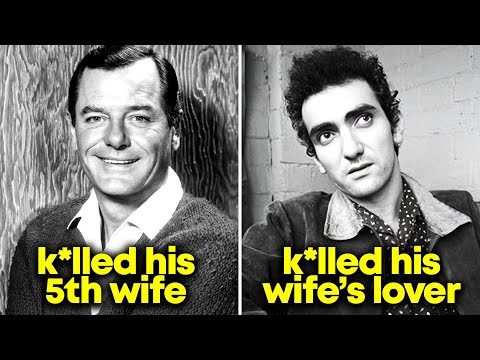
Then there’s Gig Young, the Oscar-winning actor who embodied Hollywood charm. On September 27, 1978, just three weeks after marrying his fifth wife, 31-year-old German actress Kim Schmidt, Young shot her in the head and then turned the gun on himself. The wedding champagne hadn’t even gone flat yet. Friends reported Young had seemed relatively happy about the marriage, though some noted concerns about his mental state. The murder-suicide left Hollywood stunned, with no death note and no clear motive.
Paul Kelly achieved what few could imagine: he killed a man with his bare hands, went to prison, and then returned to Hollywood for a successful second act. In 1927, Kelly beat actor Ray Raymond to death in a brawl over Raymond’s wife, Dorothy Mackaill. He served just 25 months in San Quentin and came back to Hollywood like nothing happened, eventually marrying Mackaill and enjoying a flourishing career in films like The Flying Tigers and Crossfire. By the time of his death in 1956, many in the audience had no knowledge of the killing that had temporarily derailed his career.
These stories reveal how completely Hollywood could separate public image from private history when sufficient financial incentive existed. But the question remains: how many more dark secrets are buried beneath the glamour?
Roscoe “Fatty” Arbuckle’s case stands as one of Hollywood’s most notorious scandals: a career destroyed by a death he was legally absolved of causing. In 1921, at a Labor Day party in San Francisco’s Saint Francis Hotel, actress Virginia Rappe became seriously ill and died days later from peritonitis caused by a ruptured bladder. Arbuckle was tried three times and finally acquitted—the jury deliberated for just six minutes and issued an unusual statement expressing regret for his ordeal.
Despite this legal vindication, the damage was irreversible. The newly formed MPPDA, headed by Will Hays, banned Arbuckle from the screen even after his acquittal. Theaters refused to show his films, contracts were canceled, and the jovial persona that had made him one of silent comedy’s biggest stars was permanently tainted. Legally innocent, but nobody ever forgot the headlines. He eventually returned as a director under the pseudonym William Goodrich, but died in 1933 at age 46, having never recaptured his former stature.
Robert Blake’s career spanned Hollywood eras, from child star in the Our Gang series to Emmy-winning actor on Baretta. That long career ended in 2001 when his second wife, Bonnie Lee Bakley, was shot to death outside a Studio City restaurant. Blake claimed he had left her in the car while retrieving a gun he’d accidentally left behind, returning to find her shot in the head.
The prosecution alleged Blake had either killed Bakley himself or hired someone, presenting testimony from stuntmen who claimed he had approached them about killing his wife. Blake was acquitted in criminal court, found liable in civil court—a split verdict that mirrored other high-profile cases like O.J. Simpson’s. The civil judgment of $30 million, later reduced to $15 million, effectively bankrupted him.
He swore he didn’t pull the trigger, the jury wasn’t so sure. Blake died in March 2023 at age 89, having spent his final two decades in the shadow of Bakley’s murder, never escaping public association with the crime.
Rex Bell represented the perfect Hollywood-to-politics pipeline: a handsome Western star who married sex symbol Clara Bow before transitioning to a successful career in Nevada politics. As lieutenant governor and a prominent businessman, Bell embodied the respectable public figure with impeccable connections. Behind this carefully maintained image lurked allegations of a covered-up killing that never made the newspapers.
Clara Bow’s husband allegedly beat a man to death in a Vegas hotel in 1937, explains Nevada historian Dr. Sarah Jenkins. While never proven in court—because it never reached a courtroom—the incident has persisted in accounts from multiple sources. According to these accounts, Bell was involved in an altercation with a man who had made remarks about his wife. The confrontation reportedly escalated from verbal exchange to physical violence that allegedly ended with the unidentified man’s death.
Studio lawyers made it disappear. Witnesses were allegedly paid for silence, local authorities persuaded to look the other way, and any potential evidence quietly handled by fixers with connections to both Hollywood and the developing Las Vegas power structure. Bell’s subsequent political career, including his service as lieutenant governor from 1955 until his death in 1962, proceeded without public controversy.
She kept smiling, he kept secrets. This level of containment demonstrates the extraordinary reach of studio power during Hollywood’s golden age, particularly when combined with the developing influence structures of early Las Vegas—creating circumstances where even alleged homicide could potentially vanish from public record when the right connections were activated.
Spade Cooley was known as the king of Western swing, a bandleader and television host whose weekly variety show made him one of Southern California’s most popular entertainers during the 1950s. Behind this family-friendly facade lurked a monster capable of violence so extreme it shocked even hardened homicide detectives.
Cooley tortured and murdered his wife in 1961 in front of their 14-year-old daughter. Convinced his wife Ella Mae was having an affair—a belief investigators later found no evidence to support—Cooley subjected her to escalating violence over a period of hours, including repeated beatings, stomping, and cigarette burns. Their daughter Melody was forced to watch much of this violence, with Cooley telling her, “This is what happens to people who cheat on Spade Cooley.”
The medical examiner later testified that Ella Mae had suffered more than 40 separate injuries. Cooley initially claimed his wife had fallen in the shower, but his daughter’s testimony and overwhelming physical evidence quickly disproved this. Unlike many celebrity killings that benefited from powerful intervention, Cooley’s crime was too public and too extreme for even Hollywood connections to mitigate. He was convicted of first-degree murder and sentenced to life imprisonment.
Cooley died of a heart attack in 1969, backstage after a standing ovation at a police benefit concert—his first performance in eight years—just days before he was scheduled for a parole hearing. He played violins, then snapped her neck. The hands that drew music from violin strings were the same hands that tortured and killed the mother of his children.
Johnny Lewis represented Hollywood royalty through bloodline rather than achievement. The grandson of Golden Age star Loretta Young, he was connected to entertainment industry power from birth. While his own acting career included roles in television series like Sons of Anarchy, his connection to Hollywood history through his grandmother’s legacy created expectations he struggled to fulfill before his shocking violent end.
His downward spiral became increasingly apparent in the years before his death, with multiple arrests, strange behavior, and concerns about mental health issues that weren’t adequately addressed despite his family’s resources. In 2012, Lewis killed his elderly landlady and her cat in a psychotic episode. The 81-year-old woman, Catherine Davis, was found beaten to death inside her home where Lewis had been renting a room.
The extreme violence of the attack—including manual strangulation and blunt force trauma—suggested a profound disconnection from reality rather than conventional criminal motivation. After attacking two neighbors who heard Davis’s screams and attempted to intervene, Lewis climbed onto the roof of the property and fell or jumped to his death in the driveway below. Toxicology reports showed no drugs in his system, supporting the theory that his violence stemmed from untreated mental illness.
He didn’t just fall from grace, he fell off a roof after killing someone. The contrast between Loretta Young’s carefully managed image of Hollywood glamour and her grandson’s violent end represents a stark reminder that dynasty and bloodline provide no immunity from tragedy.
Cheryl Crane’s case stands apart from others on this list: a killing widely viewed as justified defense of her mother, screen legend Lana Turner, from an abusive gangster boyfriend. On April 4, 1958, at Turner’s Beverly Hills home, Johnny Stompanato—a bodyguard and enforcer connected to notorious gangster Mickey Cohen—had been dating Turner for over a year in a relationship marked by increasing control, threats, and physical violence.
According to accounts from both Crane and Turner, Stompanato had been threatening Turner during an argument, promising to disfigure her face and end her career. Crane, overhearing these threats from another room, retrieved a kitchen knife and stabbed Stompanato once in the abdomen when she believed he was about to harm her mother. The stabbing proved fatal.
The killing was ruled justifiable homicide after investigation and inquest. Authorities determined that Crane had acted to protect her mother from imminent harm, basing this conclusion on both physical evidence and testimony about Stompanato’s history of violence. This ruling prevented criminal charges against Crane despite her direct acknowledgement of having inflicted the fatal wound.
While the legal outcome provided technical exoneration, the incident created lasting trauma. Sensationalist media coverage, including suggestions of inappropriate relationships and alternative theories about who actually wielded the knife, created a cloud of innuendo that persisted despite the official findings. The studio called it heroic, but someone still died in that bedroom.
For Crane, the aftermath proved more difficult to manage. She experienced years of personal struggles including suicide attempts, substance abuse issues, and multiple stays in psychiatric facilities and reform schools. She eventually achieved greater stability in adulthood, becoming a real estate broker and author while maintaining a close relationship with her mother. In her 1988 autobiography, Detour: A Hollywood Story, she provided her own account of the killing and its aftermath, confirming the self-defense narrative while detailing the lasting trauma the incident created.
Charles Chaplin Jr. carried one of entertainment’s most illustrious names—the eldest son of Charlie Chaplin, burdened with expectations that proved impossible to fulfill. While never achieving the towering success of his legendary father, his connection to Hollywood royalty ensured privileges and protections that became particularly significant when his actions resulted in another person’s death.
Chaplin Jr. was involved in a fatal drunk driving accident in the 1960s. According to available accounts, he was driving under the influence when his vehicle struck another, resulting in at least one fatality. The exact date, location, and victim’s identity have been inconsistently reported in the limited sources addressing the incident.
Despite the fatal outcome, Chaplin Jr. faced reduced legal consequences compared to typical defendants in similar cases during that period. This preferential treatment reflected both his famous name and the continuing influence of Hollywood legal fixers who maintained practices established during the studio system era, even as that system itself was fading.
He wasn’t his father, but he inherited the protection. Chaplin Jr.’s troubled life extended beyond this incident, including struggles with alcohol that contributed to his relatively early death in 1968 at age 42. His inability to emerge from his father’s overwhelming shadow created a lifetime of challenges, with his involvement in a fatal accident representing perhaps the darkest chapter in a biography defined largely by the contrast between his famous name and his failure to establish comparable individual significance.
The limited documentation of this incident compared to other celebrity-involved deaths speaks to the effectiveness of influence in controlling narrative even after the studio system’s decline. While the accident apparently occurred during the 1960s, when Hollywood’s centralized power had diminished from its peak, the Chaplin name still commanded sufficient respect and fear to maintain significant control over how the story was reported and recorded.
Chaplin Jr.’s case represents a particularly pure example of inherited privilege—protection flowing not from personal achievement or current commercial value, but purely from familial connection to established entertainment royalty. His story demonstrates how Hollywood’s power to minimize consequences for the connected extended to the next generation, regardless of whether that generation had earned such protection through their own accomplishments.
These ten stories reveal a chilling pattern: fame didn’t just shield killers—it often rewrote their crimes into footnotes. Studios buried evidence, lawyers silenced witnesses, and audiences happily forgot. But the victims never got a second act.
From Burroughs’ literary mystique to Chaplin Jr.’s inherited immunity, the message was clear: if you were valuable enough, even homicide could be managed. The show always went on.
Yet the question lingers: how many more dark secrets remain buried beneath the glamour? And would we even recognize the truth if it surfaced today?
Which of these cases shocks you the most—and why? Share your thoughts in the comments below.
Report this article
Select a reason for reporting:






