In the darkest days of World War II, as the world teetered on the brink, a force of over two and a half million men emerged from the Indian subcontinent—not conscripts, but volunteers—to fight on fronts from the burning deserts of Libya to the dense jungles of Burma. This was the British Indian Army, the largest volunteer army in history, yet its monumental role has often been overshadowed. How did this colonial force transform into one of the most battle-hardened fighting machines of the war? And what made it such a crucial pillar of the Allied victory?
At the outbreak of war in 1939, the British Indian Army was a modest colonial force of around 200,000 men, designed for internal security and frontier warfare, not for global conflict. But when Britain declared war on Germany, India was automatically committed, and the army underwent one of the fastest expansions in military history. By 1945, it had grown to over 2.5 million volunteers, forming 14 infantry divisions, four armored divisions, and dozens of independent brigades and regiments. This was a completely volunteer force—every soldier who joined did so by choice, for loyalty, adventure, pay, or the chance to escape poverty. Together, they transformed a small imperial army into one of the most battle-hardened fighting forces of the war.
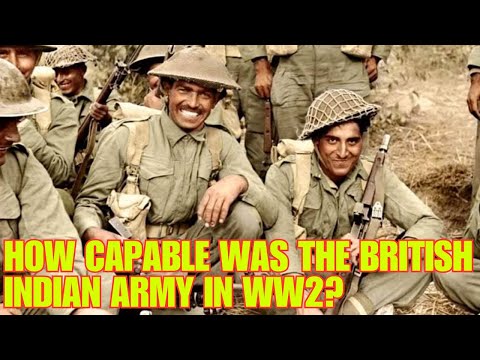
The men who filled its ranks came from every corner of the subcontinent. Recruitment followed the long-standing British martial race theory, which favored certain groups thought to possess natural fighting qualities. The army drew heavily from the Punjab, the northwest frontier, Rajasthan, and Nepal, with ranks filled with Sikhs, Gurkhas, Punjabi Muslims, Dogras, Rajputs, Marathas, and Pathans—men from communities with deep military traditions. But as the war expanded, recruitment widened dramatically. Soon soldiers came from Bengal, the United Provinces, Madras, and Assam, turning the Indian army into a truly pan-Indian force. By 1944, almost every region, religion, and language of British India was represented in uniform.
To join, recruits had to meet strict physical standards. The ideal soldier was between 18 and 25 years old, fit enough to march long distances in tropical heat or mountain cold. Medical and endurance tests were rigorous, focusing on stamina, eyesight, and strength. By 1943, Indian officers were being commissioned from the Indian Military Academy at Dehradun, marking the steady Indianization of command ranks. For the first time, Indian officers began leading platoons, companies, and even battalions into battle.
The strength of the Indian Army lay in its flexible and balanced organization. A standard Indian infantry division consisted of three brigades, each with roughly three infantry battalions, supported by divisional artillery, engineers, transport, and medical units—totaling around 15,000 to 17,000 men. In the early and middle years of the war, most brigades followed a deliberate pattern: one British battalion, one Indian battalion, and one Gurkha battalion. This design gave each brigade a mix of experience, training, and fighting styles. The British battalion brought long-service professional soldiers and experienced officers. The Indian battalion added manpower and local knowledge. The Gurkha battalion, fierce and tenacious, contributed shock power and jungle endurance. For example, the 7th Indian Infantry Brigade of the 4th Indian Division included the 1st Royal Sussex Regiment, the 1st Rajputana Rifles, and the 4th Battalion, 11th Sikh Regiment. As the war progressed and more Indian units became experienced, this structure evolved. By 1944, many brigades, especially in the Burma campaign, were composed entirely of Indian and Gurkha battalions, reflecting both growing Indianization and the declining number of available British troops.
The army’s first major test came in East Africa and North Africa. In East Africa, the 4th and 5th Indian Divisions fought Italian forces in Eritrea and Ethiopia, capturing the fortress of Keren after weeks of brutal mountain combat. Soon after, Indian divisions moved to North Africa, where they fought under the British Eighth Army against Rommel’s Afrika Korps. The 4th Indian Division became one of the most respected units in the desert, fighting at Sidi Barrani and El Alamein. Field Marshal Wavell described it as one of the finest fighting formations in the desert. Indian artillery, engineers, and transport drivers kept the Allied armies moving across the harsh terrain, often under fire.
But the army’s worst disaster came in the Far East. In December 1941, Japan entered the war, and Indian divisions defending Malaya and Singapore faced a devastating defeat. The 9th and 11th Indian Divisions, poorly equipped and unsupported, were outmaneuvered by Japanese forces who advanced rapidly through the jungles. Despite brave stands by units like the 30th Punjabis and 16th Dogras, the campaign ended in disaster. When Singapore fell in February 1942, over 40,000 Indian soldiers were taken prisoner. Many later joined the Indian National Army under Subhas Chandra Bose, hoping to fight for India’s independence alongside Japan. It was one of the most complex and controversial chapters in Indian military history, showing both loyalty and rebellion in equal measure.
After this disaster, the Indian Army reorganized and returned to the fight. Under General Bill Slim, the 14th Army, composed largely of Indian divisions, fought one of the toughest campaigns of the war in Burma. At Imphal and Kohima in 1944, Indian and British soldiers held out for months against repeated Japanese assaults. The fighting was so close that at Kohima, the two sides fought across a tennis court. When the siege was lifted, the Japanese suffered one of their worst defeats of the war. From then on, the Indian Army went on the offensive, retaking Mandalay, Meiktila, and finally Rangoon in 1945. By the war’s end, Slim’s Indian divisions had become some of the most skilled jungle fighters in the world.
While the bulk of the Indian Army fought in Asia, several divisions also served in Europe. The 8th Indian Division fought in Italy from 1943 onward, crossing the Rapido and Garigliano rivers and enduring the brutal assault on Monte Cassino. The 10th Indian Division joined the Italian campaign later, while Indian engineers, mule companies, and medical units supported the Allied advance through the mountains. Leadership played a crucial role in this transformation. General Sir Claude Auchinleck, Commander-in-Chief in India, pushed hard for modernization and greater Indianization. Under his guidance, Indian officers began to rise in both competence and confidence. Figures like Kodandera Cariappa, K. S. Thimayya, and S. M. Shrinagesh distinguished themselves in combat and would later lead the armies of independent India.
The Indian Army also produced numerous heroes whose courage was recognized at the highest level. Naik Yeshwant Ghadge of the Maratha Light Infantry received the Victoria Cross for single-handedly destroying several German positions in Italy before being killed. Rifleman Ganju Lama of the 7th Gurkha Rifles won the Victoria Cross in Burma after knocking out Japanese tanks while wounded. Sepoy Kamal Ram of the 8th Punjab Regiment received his Victoria Cross at just 19 for storming enemy bunkers at Monte Cassino. By the end of the war, Indian soldiers had earned 31 Victoria Crosses, more than 200 Distinguished Service Orders, and thousands of other decorations for gallantry.
So, how capable was the British Indian Army? In 1939, it was a small colonial force. By 1945, it had become one of the largest, most experienced, and most professional armies in the world. It fought successfully in deserts, mountains, and jungles. It learned modern combined-arms warfare, developed strong logistics networks, and produced officers and soldiers of the highest caliber. Its logistical achievements alone were staggering—building roads and airfields through jungles and mountains, supplying entire armies in some of the most inhospitable terrain on Earth. By every measure—manpower, training, endurance, and versatility—the British Indian Army proved itself to be one of the most capable forces of the Second World War.
Yet behind these statistics of valor and transformation lay a more complicated reality. The Indian Army that marched into 1945 was not the same institution that had marched out of 1939, and the men who wore its uniform carried with them questions that no medal could answer. What, exactly, had they been fighting for?
For many sepoys and Indian officers, the war was a strange paradox. They fought for the King-Emperor against fascism, yet they returned home to a colony where their own freedom was denied. The same government that praised their courage at Monte Cassino and Kohima jailed Indian nationalist leaders and refused to grant self-rule. This tension was never far from the surface, and it would explode into politics the moment the guns fell silent.
The Indian National Army episode haunted the postwar years. When the war ended, the British put captured INA officers on trial at the Red Fort in Delhi, charging them with treason. But the trials backfired spectacularly. Instead of discrediting Bose’s followers, the prosecutions turned them into nationalist heroes and provoked mass protests across India. The very soldiers who had remained loyal now watched their former comrades being cheered as patriots, and many began to wonder where their own allegiance truly lay.
This political awakening spread through the ranks with remarkable speed. Indian officers who had commanded battalions in Burma and Italy now demanded the same dignity at home. The army that Britain had built to defend its empire was becoming, in subtle and irreversible ways, an instrument of Indian national consciousness. The British understood this, and it shaped their calculations in the desperate years that followed.
Meanwhile, the human cost of the war was staggering. The Indian Army suffered over 87,000 battle casualties, including more than 24,000 dead, with tens of thousands more wounded, missing, or taken prisoner. Beyond the battlefield, the war triggered the Bengal Famine of 1943, which killed an estimated two to three million civilians—a catastrophe made worse by the prioritization of military shipping and the diversion of resources to the war effort. Soldiers returned from distant fronts to find their villages starving, a grim reminder that the war’s burdens had fallen unevenly across the subcontinent.
And yet, the army’s achievements could not be erased. Its logistics corps had built roads and airfields across some of the most forbidding terrain on earth. Its engineers had bridged rivers under fire and cleared minefields in Italy. Its mule companies—often forgotten—had carried supplies up mountains where no vehicle could go. The Indian Army had become, by 1945, a modern, mechanized, and confident force, and its men knew it.
When independence finally came in 1947, the army was partitioned along with the country itself. Regiments that had fought side by side at El Alamein and Imphal were split between India and Pakistan, their battle honors divided like family heirlooms. Officers who had shared trenches now found themselves on opposite sides of a new and bitter border. The institution that had been the pride of British India became the foundation of two rival national armies.
But the story was not over. The officers who had learned their trade in the deserts of North Africa and the jungles of Burma would go on to lead their new nations through crises and conflicts of their own. Cariappa became the first Indian Commander-in-Chief. Thimayya commanded Indian forces in Korea. The Gurkhas, meanwhile, continued to serve in the British Army, their reputation as some of the world’s finest soldiers undiminished.
For the men who had worn the King-Emperor’s uniform, the transition was bittersweet. They had fought for a freedom that, for a time, denied them their own. Yet in the decades that followed, the Indian Army’s wartime legacy would echo through the institutions of both new nations—their professionalism, their discipline, and their hard-won experience shaping the armed forces of a free India and Pakistan.
The British Indian Army’s story is one of paradox: a colonial force that became a crucible of national awakening, a volunteer army that fought for an empire while sowing the seeds of its dissolution. Its soldiers earned their place among the great fighting forces of the Second World War, and in doing so, they helped to forge the modern history of South Asia.
So, when we remember the war, should we see the Indian Army as a loyal instrument of empire, or as the unwitting architects of a freer world? What do you think—did their sacrifice serve the Crown, or the cause of independence itself? Share your thoughts below.
Report this article
Select a reason for reporting:






