On May 8th, 1945, inside a crumbling schoolhouse in Reims, France, a German general named Alfred Jodl picked up a pen and signed the unconditional surrender of the Third Reich. Just six years earlier, that same Germany had been considered the most dangerous military machine on the planet. Its tanks had cut through Poland in weeks. Its soldiers had crushed France—supposedly the strongest army in Europe—in just 46 days. It controlled territory stretching from the icy coast of Norway to the burning deserts of North Africa. For a brief moment, it looked like Nazi Germany might actually succeed in reshaping the entire world.
And yet, by the spring of 1945, Berlin was a smoking crater. Hitler was dead in a bunker. German cities had been pounded into dust. Millions of German soldiers lay in mass graves scattered across Russia, France, Italy, and North Africa. The question historians have fought over ever since is deceptively simple: How did a country that looked unstoppable in 1940 end up as the most comprehensively defeated nation in modern history by 1945?
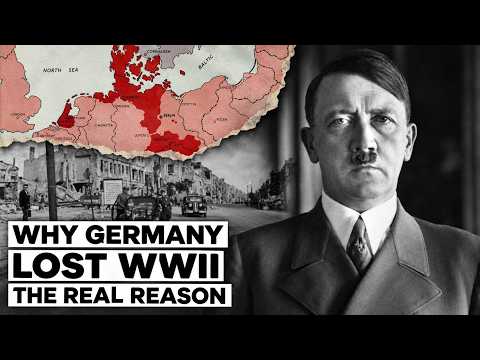
The answer isn’t just the Russian winter, as the Germans themselves like to claim. It isn’t just Hitler’s madness, though that certainly played a role. It isn’t just American industrial power, though that mattered enormously. The real reason Germany lost World War II is a brutal mathematical story—one that was already being written years before the first shot was fired. It’s a story about oil, steel, numbers, geography, and a dictator who gambled an entire continent on a timeline that was never going to work.
To understand why Germany lost, you first have to understand just how ridiculously outmatched they actually were. On paper, when the war broke out in September 1939, Germany looked terrifying. Hitler had spent six years rebuilding the Wehrmacht into the most mechanized, best-trained, and most ideologically motivated army in Europe. The Luftwaffe was arguably the most advanced air force in the world. The German military industry had been churning out tanks, planes, and submarines at a frantic pace. Combined with their Axis allies, Italy and later Japan, they seemed poised to challenge anyone.
But here’s the uncomfortable truth that German generals understood even as they were planning their blitzkrieg across Poland: Germany had almost none of the raw materials needed to fight a long war. Hitler’s economic planners knew it. The military high command knew it. Even Hitler himself knew it—which is precisely why his entire strategy depended on winning fast, winning cheap, and winning before the enemy could get organized.
Germany at the beginning of the war had basically no domestic oil reserves. It had limited iron ore. It had limited rubber. It had limited access to key industrial metals like tungsten, chromium, and manganese. Even its food supply depended on imports from Eastern Europe to feed its population at anything approaching peacetime levels.
Now compare that with what Germany was up against. The British Empire at its 1939 peak controlled roughly a quarter of the world’s land surface and population, with access to oil from Persia and the Middle East, rubber from Malaya, metals from Africa and Australia, and food from Canada and Argentina. The Soviet Union, which Hitler eventually invaded in 1941, had the largest reserves of oil, iron ore, coal, and manpower in continental Eurasia—with the ability to simply absorb losses that would have broken any other country. And then there was the United States, which in 1939 was already producing roughly 63% of the world’s crude oil, more than half of its steel, and had an industrial capacity larger than Germany, Italy, and Japan combined.
When you add up the gross domestic product of the eventual Allied powers against the Axis in 1939, the Allies had an economic edge that only widened year after year. By 1942, the United States alone was outproducing the entire Axis in nearly every category of raw material and finished weapon. By 1943, the Allies held a 3:1 munitions advantage. This wasn’t a close fight on paper. The only way Germany could possibly win was through speed, shock, and the collapse of enemy morale before enemy production could catch up. And that strategy, which worked brilliantly in Poland and France, started falling apart the moment Germany ran into countries that refused to collapse.
If there’s one single resource that explains why Germany lost the war, it’s oil. Every tank, every plane, every truck, every U-boat, every piece of mechanized equipment that made the German war machine so terrifying ran on petroleum. And Germany, for all its industrial sophistication, simply didn’t have enough of it. At the outbreak of the war, Germany had stockpiled roughly 15 million barrels of fuel—which sounds like a lot until you realize that peacetime consumption was already around 110,000 barrels per day. Once the war started and the military ramped up, consumption roughly doubled to over 200,000 barrels per day. The math was brutal. Without a steady source of oil from somewhere, the German war machine would literally grind to a halt within months.
Germany had three main ways of dealing with this problem, and all three were ticking time bombs. First, they invested heavily in synthetic oil—a process that used coal to produce liquid fuel. By 1944, synthetic plants were providing roughly half of Germany’s total fuel supply. But these facilities were huge, expensive, and sitting ducks for Allied bombers. Second, they relied on their alliance with Romania, whose oil fields at Ploiești became the single most important external supplier of petroleum to the Reich. At its peak, Ploiești was providing anywhere from 60 to 75% of Germany’s natural crude oil needs. Hitler knew that if those fields were ever lost or destroyed, the war was over. Third, they looked east toward the Caucasus, where the Soviet Union held massive oil reserves at Maikop, Grozny, and especially Baku. In 1942, Hitler himself was recorded as saying, “If we don’t take Baku, we will lose the war.” That quote wasn’t drama—it was arithmetic.
The problem is that none of these strategies worked out. The German advance into the Caucasus in 1942 captured Maikop, but found the oil fields systematically destroyed by retreating Soviet forces. German engineers extracted almost no useful oil before they had to withdraw in January 1943 because of the collapse at Stalingrad. The Ploiești oil fields, meanwhile, were pounded relentlessly by American and British bombers. The famous low-level raid on August 1st, 1943—Operation Tidal Wave—didn’t quite deliver the knockout blow planners hoped for, but subsequent raids throughout 1943 and 1944 crippled Romanian refinery capacity. When the Soviets finally overran Romania in August 1944, Hitler lost his most important external oil source entirely.
From that point onward, the German military was literally running on fumes. Luftwaffe pilots were being sent into combat with just enough fuel to take off, fight briefly, and land. Panzer divisions were being towed by horses because there was no gasoline for the tanks they’d been issued. The Battle of the Bulge in December 1944—Hitler’s last major offensive in the West—had to count on capturing American fuel dumps to continue advancing. When they couldn’t capture enough fuel, the offensive collapsed. Oil didn’t just handicap Germany. Oil defeated Germany. And this was all baked into the equation from the very beginning.
Now with that economic context in mind, let’s get into the specific decisions that turned Germany’s structural disadvantages into actual defeats. And no decision was more fateful than Operation Barbarossa—Hitler’s invasion of the Soviet Union, launched on June 22nd, 1941. On paper, this made a certain twisted sense from Hitler’s perspective. He had always considered the ultimate goal of Nazi ideology to be the destruction of the Soviet Union and the acquisition of what he called living space in the east. He also believed the Soviet Union was a rotten structure that would collapse at the first hard kick. And by invading in the summer of 1941, he calculated he could knock the USSR out of the war before the United States ever got involved.
The scale of Operation Barbarossa was staggering. On the day of the invasion, Germany launched over 3 million German and Axis troops along an 1,800-mile front stretching from the Baltic to the Black Sea. It was the largest military invasion in human history. And in its opening weeks, it seemed to validate Hitler’s expectations. Entire Soviet armies were encircled and destroyed. At Białystok-Minsk in late June, the Germans captured over 300,000 Soviet troops. At Smolensk, another 300,000. At Kiev in September 1941—perhaps the largest encirclement in military history—roughly 600,000 Soviet soldiers were captured in a single operation. By October, German forces were within 200 miles of Moscow. By November, lead panzer divisions were less than 20 miles from the Kremlin.
And yet, the Soviet Union didn’t collapse. Instead, something astonishing happened. The Soviets kept throwing new armies into the fight. For every army Germany destroyed, Stalin seemed to have another one ready. The reason was partly geographic, partly demographic, and partly because of one of the most incredible industrial relocations in history. Starting in July 1941, the Soviet government began physically dismantling over 2,500 factories in western Russia and Ukraine, loading them onto railroad cars and shipping them hundreds or thousands of miles east beyond the Urals, out of German reach. More than 17 million Soviet workers were relocated along with the factories. The city of Chelyabinsk in the Urals was transformed into what Soviet workers nicknamed Tankograd—a sprawling industrial complex that eventually produced tens of thousands of T-34 tanks.
By the end of 1941, despite losing roughly 40% of their pre-war population and 60% of their coal and steel production to German occupation, the Soviets still managed to produce around 6,590 tanks that year compared to Germany’s 5,200. Think about that for a second. The Soviets were being driven out of their heartland, their factories literally rolling east on railroad cars, and they still outproduced Germany in tanks for 1941.
Meanwhile, the German attack was running out of steam, both literally and figuratively. By October, autumn rains had turned Russian roads into rivers of mud—the Rasputitsa, or the time of bad roads. German trucks, horses, and tanks got bogged down. Then, when the mud finally froze solid in November, the German advance resumed. But by then, temperatures were plunging to minus 30°C and lower. German soldiers were still wearing their summer uniforms. German tank engines required special winter oil they didn’t have. Weapons jammed. Frostbite casualties mounted into the hundreds of thousands.
On December 5th, 1941, as the final German push toward Moscow fizzled out just miles from the city, the Soviets launched a massive counteroffensive led by fresh Siberian divisions, pushing the exhausted Wehrmacht back more than 150 miles. Operation Barbarossa had failed in its core objective. The Soviet Union had not collapsed. Hitler had bet everything on a quick knockout blow, and it hadn’t landed. And now Germany was committed to a brutal attritional war against an opponent that had more men, more land, more resources, and more time than they did. From that December onward, the clock was ticking against Germany, not for them.
But if Barbarossa was Hitler’s first fatal gamble, what happened just two days after the Soviet counterattack began might actually have been even worse. On December 7th, 1941, Imperial Japan launched a surprise attack on the American naval base at Pearl Harbor, Hawaii, dragging the United States into World War II. Germany had no formal obligation under the Tripartite Pact to join Japan in a war against the United States, since the pact was defensive and Japan had been the aggressor. Franklin Roosevelt had been inching the US toward intervention for months, but there was still significant isolationist sentiment in America. The war Roosevelt could get Congress to declare on December 8th was a war against Japan in the Pacific.
And then on December 11th, 1941, from the stage of the Kroll Opera House in Berlin, Adolf Hitler voluntarily declared war on the United States. To this day, historians argue about why he did it. Some believe he thought war with America was inevitable anyway and wanted to be the one to declare it on his own terms. Some believe he genuinely underestimated American industrial capacity, believing American goods were low-quality and American soldiers soft. Some believe he hoped it would motivate Japan to attack the Soviet Union from the east—which never happened. Whatever the reason, it was arguably the single most catastrophic decision of the entire war.
In one speech, Hitler had united the three largest industrial powers on Earth against him. He had effectively guaranteed what Roosevelt and Churchill soon formalized as the Germany First strategy—which meant that even though it was Japan who attacked America, the destruction of Nazi Germany would take priority over the defeat of Japan. What this meant in practical terms was that the full weight of American industrial production—the greatest manufacturing powerhouse the world had ever seen—was going to be directed primarily at destroying Nazi Germany.
And the sheer scale of American output is almost impossible to overstate. Between 1941 and 1945, the United States produced more than 300,000 military aircraft, over 100,000 tanks and self-propelled guns, more than 2 million military trucks, 8 million rifles, and 86,000 warships. American shipyards launched Liberty ships at an average rate of about three per day—meaning they could replace Allied shipping losses faster than German U-boats could sink them. By late 1943, American production alone had surpassed the entire output of all the Axis powers combined. There was no longer any realistic scenario in which Germany could win a long war. The only question was how long it would take and how many people would die before the mathematical inevitability caught up with Hitler’s ambitions.
Now, here’s where we need to talk about something often overlooked in Western histories: the Lend-Lease program. Starting in October 1941, the United States shipped over $11 billion in material to the Soviets—roughly $250 billion today. This included 400,000 trucks, 15 million pairs of boots, 4.5 million tons of food, and nearly a million miles of telephone cable. Without Lend-Lease, the Soviet war effort would have collapsed or been dramatically weakened.
By the summer of 1942, Hitler made one more desperate roll of the dice. Facing a growing fuel crisis, he launched Fall Blau—a massive offensive aimed at seizing the Caucasus oil fields. He split his southern army group in two, sending one toward Baku and the other toward a city on the Volga: Stalingrad. What resulted was the single bloodiest battle in human history. From August 1942 to February 1943, nearly 4 million combatants fought in the ruins of a single city, with combined casualties exceeding 1.8 million. More Soviet soldiers died at Stalingrad in five months than American soldiers died in the entire war across all theaters.
On November 19th, 1942, the Soviets launched Operation Uranus, a massive pincer movement that encircled the entire German Sixth Army. Hitler refused to allow a breakout, insisting on an impossible airlift. On January 31st, 1943, Field Marshal Friedrich Paulus surrendered. Stalingrad was a disaster from which Germany would never recover. It destroyed the strategic initiative on the Eastern Front, shattered the myth of German invincibility, and opened a hole the Wehrmacht simply couldn’t close.
While all this was happening in the east, Germany was also being systematically destroyed from above. The combined Allied bombing campaign poured millions of tons of bombs onto German cities, factories, and oil refineries. By 1944, Germany had roughly 2 million people assigned to anti-aircraft defense—guns that could have been used as anti-tank weapons at the front were instead pointed at the sky. The bombing destroyed Germany’s synthetic fuel production in a sustained campaign starting in May 1944. Within months, aviation fuel production had collapsed, and the Luftwaffe simply couldn’t put trained pilots in the air because there was no gasoline to fly them.
Then came June 6th, 1944—D-Day—when the Western Allies finally opened the long-promised Second Front. Over 150,000 troops landed on the beaches of Normandy, supported by over 11,000 aircraft and 7,000 ships. By the end of August, Allied forces had liberated Paris and were racing toward the German border. Hitler was now facing exactly what German military planners had warned against for generations: a full-scale two-front war against enemies with vastly superior resources—exactly like the one Germany had already lost in World War I just 26 years earlier.
Here’s where we need to talk about the Hitler factor. While structural economic realities doomed Germany to lose a long war, Hitler’s personal decisions turned a slow defeat into a catastrophic one. Early in the war, his intuition had worked, and he started believing he was a military genius. By 1942, after firing or sidelining experienced commanders, Hitler had essentially taken personal command of the entire German war effort—and his style was absolutely disastrous. He refused tactical withdrawals even when necessary, costing Germany entire armies in encirclements like Stalingrad and later in Belarus during Operation Bagration in the summer of 1944—Germany’s single worst military defeat, with over 300,000 casualties in just weeks.
Hitler obsessed over wonder weapons like the V-1, V-2, and Me 262 jet fighter, pouring vast resources into tiny production runs of complex technology instead of producing massive quantities of simpler, more reliable weapons like the Soviets did. He personally ordered the Ardennes offensive in December 1944—the Battle of the Bulge—draining Germany’s last mobile reserves and precious fuel stocks for an attack that had virtually no chance of succeeding. He insisted on holding every inch of ground to the last man, which repeatedly let the Soviets destroy German formations that could have been saved by timely retreats.
And beyond the military decisions, Hitler’s ideology actively worked against German war aims. The Nazi occupation policy in the east was so brutally murderous that it turned potential allies into enemies. When German forces first invaded Ukraine in 1941, many Ukrainians actually welcomed them as liberators from Stalin’s regime. But within months, Nazi policies of extermination, slave labor, and racial terror had turned these same populations into partisans who would spend the rest of the war ambushing German supply lines. Historians estimate that Soviet partisans tied down hundreds of thousands of German troops—troops who could otherwise have been fighting on the main battle lines. The Holocaust itself consumed enormous German resources throughout the war, prioritizing trains, soldiers, and administrators even when those same resources were desperately needed at the front.
Even German science, which had been world-leading in the 1930s, was damaged by Nazi ideology. The purging of Jewish scientists from German universities sent an incredible brain drain toward the United States and Britain. Figures like Albert Einstein, John von Neumann, Hans Bethe, and Edward Teller fled Nazi persecution and ended up contributing to the Allied war effort—most notably through the Manhattan Project. The nuclear bomb that was ultimately developed by the Allies was in many ways built by scientists Hitler had personally driven out of Europe.
By the autumn of 1944, Germany was essentially out of options. The Soviets had reached East Prussia and the gates of Warsaw. The Western Allies had crossed into Germany itself and were preparing to cross the Rhine. The Ploiești oil fields had been lost. Synthetic fuel production had been bombed to pieces. The Luftwaffe no longer meaningfully contested the skies over the Reich. German armies were being destroyed faster than they could be replaced. In the east alone, Germany lost roughly 1.5 million soldiers in 1944. New recruits being thrown into the Volkssturm—Germany’s last-ditch militia—included boys as young as 12 and men well into their 60s, armed with whatever weapons could be scraped up.
The final collapse came in the spring of 1945. The Soviet Vistula-Oder offensive in January brought the Red Army to within 40 miles of Berlin by February. The Western Allies crossed the Rhine at Remagen in March. Then came the Battle of Berlin itself, where roughly 2.5 million Soviet soldiers assaulted the city defended by around 750,000 German troops, many of them Hitler Youth and Volkssturm. On April 30th, 1945, with Soviet troops just blocks from the Reichstag, Hitler shot himself in his underground bunker. On May 7th and 8th, Germany signed its unconditional surrender. The Third Reich, which Hitler had claimed would last a thousand years, had survived for 12.
So, when we look back at the whole picture, what’s the real reason Germany lost World War II? The honest answer is that it wasn’t any single thing. It was a cascade of overlapping disasters, all flowing out of a fundamental mismatch between German ambitions and German resources. Hitler wanted to conquer a continent, but he didn’t have the oil, the steel, the manpower, or the industrial capacity to actually hold what he conquered against determined opposition from larger, richer enemies. He bet the entire future of Germany on quick victories and the collapse of enemy morale. And when those victories didn’t come fast enough—when the Soviets refused to collapse, when the Americans mobilized faster than anyone expected, when his own hubris led him to make decision after decision that compounded Germany’s problems—the structural math simply caught up with him.
Economists have run the numbers in dozens of different ways, and almost every serious analysis reaches the same conclusion. Once Hitler committed to a long war against both the Soviet Union and the United States, Germany had essentially no realistic path to victory. The outcome was decided by resources, population, geography, and industrial capacity. The battlefield heroics on both sides, while enormous in their human cost, were in a sense fighting over how fast and how brutally that outcome would be delivered.
There are also broader lessons here that still shape our world today. The war fundamentally reshaped the global balance of power, elevating the United States and the Soviet Union to superpower status and setting the stage for the Cold War that would dominate the next 45 years. The economic infrastructure that American industry built during the war effort transitioned into the post-war consumer boom, laying the groundwork for American economic dominance in the second half of the 20th century. European empires that had seemed permanent in 1939—from the British Raj in India to French Indochina to the Dutch East Indies—were fatally weakened by the war and would collapse within two decades. The lessons about the importance of oil security, strategic depth, and industrial capacity in modern warfare would shape military doctrine and foreign policy ever since.
Perhaps most importantly, the German defeat demonstrated something that still matters today: military prowess, no matter how impressive, cannot overcome long-term economic and demographic disadvantages against determined opponents. The German army of World War II was, man for man, probably the most tactically effective military force of the entire conflict. German soldiers inflicted more casualties than they suffered in most engagements, including against American and British troops. German tactical innovation was continuous and often brilliant. And none of it mattered in the end because the gap in resources, population, and industrial capacity was simply too large to overcome through tactical skill alone.
The real reason Germany lost World War II is that Germany was trying to do something impossible. And when you try to do something impossible with an aggressive, racist, totalitarian regime run by a dictator who increasingly refused to listen to his own generals, the result is one of the most catastrophic national defeats in human history. The ruins of Nazi Germany in May 1945 weren’t just the result of one bad gamble or one hard winter in Russia. They were the inevitable mathematical consequence of a war that Germany, from a purely resource standpoint, was never going to win. Hitler just made sure that when the loss finally came, it would be as total, as devastating, and as world-shattering as possible.
Now, if you made it all the way to the end of this video, I’d love it if you could leave a tank emoji in the comments so I know who the real history fans are. And if you haven’t already, please do subscribe to the channel—it would genuinely mean the world to me. If you enjoyed this one, you’ll probably also love the video I made about how the Dutch East India Company reshaped global capitalism or the deep dive on the Rockefeller Empire. Thanks so much for watching, and I’ll see you in the next one.
But before you go, I have one question for you: If Germany had somehow avoided war with the United States, could they have won against the Soviet Union alone? Or was their defeat inevitable from the very first day? Let me know your thoughts in the comments below.
Report this article
Select a reason for reporting:






