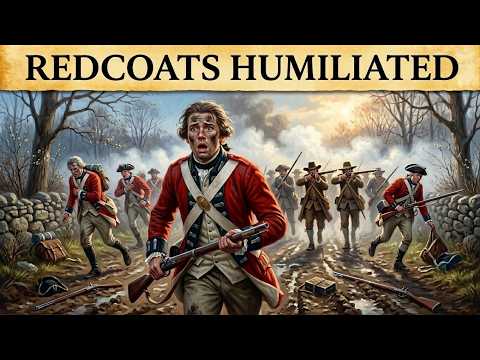
On the afternoon of April 19, 1775, the finest soldiers of the British Army were running for their lives. Not a tactical withdrawal, not a disciplined retreat—just raw, desperate flight down a dusty country road. Lieutenant Henry de Berniere of the 10th Foot watched it happen. Their ammunition was running low, the light infantry companies were exhausted, and the wounded could barely keep up. “The officers advanced and presented their bayonets, telling their men that if they advanced any further, they would die.” British officers threatening to kill their own men to stop them from charging into the next ambush.
These weren’t ragged garrison troops. They were grenadiers and light infantry—the hand-picked elite from eleven regiments, the best Britain had in North America. And by 2 p.m., they had become a terrified mob on a dirt road, cut down by farmers who knew every stone wall and apple orchard for miles. How did it come to this?
The answer begins the night before, with a secret mission that was never secret at all. General Thomas Gage, royal governor of Massachusetts, was trapped between impossible orders from London and a countryside in open rebellion. He decided to send a strike force to seize and destroy colonial military supplies stockpiled in Concord, about 18 miles northwest of Boston. Speed and secrecy were everything.
Lieutenant Colonel Francis Smith would lead roughly 700 men out of Boston under cover of darkness. They would cross the Charles River by boat, march through the night, reach Concord by dawn, destroy the supplies, and return before the countryside knew they were gone. But the boats went into the water late. The troops landed in a swamp near Cambridge, standing in knee-deep cold water for hours waiting for supply boats. By the time the column finally moved, it was well past midnight. Every man was cold, wet, and exhausted before they had marched a mile—and the mission had already been compromised.
The colonists knew they were coming. Riders raced through the countryside spreading the alarm. Paul Revere crossed the Charles by rowboat and rode north through Charlestown and Medford to Lexington, reaching the house where Samuel Adams and John Hancock were staying around midnight. William Dawes took a different route south through Roxbury then west. A third rider, Dr. Samuel Prescott, was the only one who actually reached Concord. Revere was captured by a British patrol near Lincoln, but the damage was done. Signal guns were firing across the countryside. Church bells were ringing. In dozens of towns, men were taking muskets down from the walls and heading for the road.
Smith’s column reached Lexington around 5 a.m. The sun was just rising over the village green. Waiting in two loose ranks were about 70 militiamen under Captain John Parker, a 46-year-old farmer and veteran of the French and Indian War. Parker knew he was outnumbered nearly 10 to 1. He told his men to stand their ground but not to fire unless fired upon. The British advance guard came around a bend in the road and saw the militia blocking their way. Major John Pitcairn rode forward and shouted for the colonists to lay down their arms and disperse.
What happened next is still debated 250 years later. Parker ordered his men to break ranks and leave after seeing the size of the force coming at them. They began to move—but then a single shot rang out. No one knows who fired it. Nervous British soldiers interpreted that lone shot as an attack and unleashed an uncoordinated volley into the scattering militia. When the smoke cleared, eight of Parker’s men were dead on the village green. Ten more were wounded. One British soldier was slightly injured. The column reformed and continued west toward Concord, leaving the colonial dead and wounded behind.
The British reached Concord around 8 a.m. Smith divided his forces. He sent roughly 220 soldiers under Captain Lawrence Parsons to secure the North Bridge over the Concord River and then continue to Barrett’s farm where the main supply cache was supposedly hidden. But the colonists had been warned days earlier. Most of the weapons had already been moved or buried in freshly plowed fields. British search parties found some cannon carriages and wooden supply chests, which they burned in the town center. That fire changed the entire day.
From a hill above the town, the growing force of colonial militia—now nearly 400 men from several neighboring towns—saw the smoke rising from Concord. They thought the British were burning their homes. Colonel James Barrett gave the order to advance toward the bridge. On the far side, three British light infantry companies under Captain Walter Laurie watched the colonists coming down the hill. Laurie was outnumbered and he knew it. His men fell back across the bridge and took up a defensive formation on the east bank. The Americans kept coming. The British fired warning shots, then a full volley. Two Americans were killed, one of them Prince Estabrook of Lexington, one of the first Black men to fight in the Revolution, who had already been wounded that morning on the green. The order came from Major John Buttrick, standing right at the bridge: “Fire, for God’s sake, fire!”
The militia fired into the British ranks. Three redcoats were killed. Four of the eight officers were wounded. The rest of the British broke and fled back toward Concord center. It was the first time in the conflict that colonists deliberately and intentionally fired on the King’s troops. The war had truly begun.
By late morning, Smith realized the mission was over. He had found almost nothing of value. He had dead and wounded, and with every hour, more colonial militia were arriving from surrounding towns. Companies from Reading, Billerica, Chelmsford, Sudbury, Framingham, and Bedford were already on the march. The countryside for 20 miles in every direction was pouring out armed men. Smith had no other choice. He gave the order to withdraw to Boston.
Around noon, the British column began moving east on the Bay Road out of Concord. Smith was a professional soldier, and he organized his troops properly. He put a strong advance guard at the front, a rear guard at the back, and light infantry companies on the flanks to sweep the fields on either side of the road. This was traditional military doctrine, the kind of formation described in Colonel Humphrey Bland’s treatise on military discipline, a book nearly every British officer owned. The flankers were supposed to find the ambushers behind walls and in the woods and drive them off before they could fire on the main force.
The first mile passed quietly. Then the column reached a road junction called Meriam’s Corner, still within Concord’s bounds. A narrow bridge forced the flankers to close in toward the road. Militia companies from Reading, Chelmsford, and Billerica were waiting behind farmhouses and stone walls. Reverend Edmund Foster, a soldier in the Reading militia, described an eerie silence as the British came down the hill. He said the redcoats marched with slow but steady steps, with no music, and not a word spoken that could be heard. Then the light infantry company stepped onto the narrow bridge. Lieutenant Jeremy Lister of the 10th Foot wrote that the moment they came down the hill onto the road, the rebels began firing heavily from every side, from behind fences and walls. The 18-mile running battle had begun, and it would not stop until dark.
What made this fight so devastating for the British was the terrain itself. Lieutenant John Barker of the 4th Foot later described the countryside as “a very advantageous country for them, full of hills, woods, stone walls,” and wrote that the rebels never missed an opportunity to use every one of them. The landscape was a patchwork of open pastures and meadows broken by stone walls and rail fences, dotted with small woods and apple orchards. Every wall was cover. Every hill was a firing position. And the colonists knew every inch of this ground because it was literally their ground—they had farmed it, walked it, and hunted across it their entire lives.
The British flanking parties fought back savagely. Captain William Soutar of the Marines wrote that they were “sometimes in possession of one hill, sometimes of another.” They weren’t just walking alongside the column; they were fighting furiously to control the high ground, clearing the slopes and orchards, trying to keep the column safe. A tactical study conducted on the site in 2015 confirmed that the broken nature of the ground made it impossible to keep the flankers permanently spread out. The moment the flankers pulled back to cross a stream or climb a fence, militia men would dart out from behind the nearest wall and fire into the packed column at point-blank range.
At a spot called the Bloody Angle, two miles east of Concord, the road bent sharply between two hills. Colonial militia occupied both sides. Major Loammi Baldwin ordered his men to spread out and use the trees and walls. According to Edmund Foster, the British were caught in a crossfire. The redcoats took heavy casualties in a short, vicious exchange before they could break through.
But the worst part of the retreat before Percy arrived was the approach to Lexington. Captain John Parker was waiting there—the same Parker whose men had been shot down on the green that morning. He had gathered the remnants of his militia on a rocky hill overlooking the road. These men had spent the entire morning thinking about what had happened to them at dawn. When the British column came within range, Parker’s men opened fire from the high ground at close range. The British could not stop to return fire effectively. They could only keep moving through the kill zone, taking casualties with every step.
This is where the column truly began to fall apart. The light infantry had been running flanking operations for hours—up and down hills, crashing through orchards, fighting at every stone wall between Concord and Lexington. They were utterly spent. Ammunition was dangerously low. Smith was wounded and barely able to stay on his horse. Panic spread through the ranks. Men stopped retreating in organized formations and simply started to run.
And then, on a hill east of Lexington’s town green near the Monroe Tavern, they found salvation. Brigadier General Hugh Percy had arrived from Boston with roughly 1,000 reinforcements from the 1st Brigade and two six-pounder field guns. Percy’s men formed up in battle order on the hill and the artillery fired into the surrounding woods, scattering the pursuing militia with a sound most of these colonists had never heard on a battlefield before. Smith’s shattered troops staggered behind Percy’s line and collapsed on the grass. Percy had saved them—but it never should have been necessary.
Gage had ordered the reinforcements to march at 4 a.m. Due to a series of staff errors, Percy’s brigade did not actually leave Boston until after 9 a.m. Five hours lost to paperwork and poor communication. Percy also made a hard decision. He left his supply wagons behind with a small guard to move faster, which meant the combined force now had limited ammunition and no extra provisions.
It was about 2:30 p.m. when Percy reached Lexington. He later wrote to his father that he had the satisfaction of saving Smith’s force from inevitable destruction. Percy gave the men about half an hour of rest while the cannon kept the militia at a distance. Wounds were bandaged, ranks reformed. Percy studied the situation and made his decisions quickly. He was an aristocrat with close ties to King George III, a Member of Parliament, and heir to the Earl of Northumberland. He was also a competent field officer, and he could see that the men from the morning’s march were in no condition for anything but orders and forward movement.
He placed the grenadiers and light infantry from Smith’s original column at the front of the new formation—the safest position. Percy’s own regiment, the King’s Own 23rd Regiment of Foot, took on the dangerous rear guard. Lieutenant Frederick Mackenzie of that regiment described how they lined the walls and fences with elite marksmen, then withdrew rank by rank to high ground, forming a disciplined rear shield that kept the militia from overrunning them.
Around 3:45 p.m., the entire force—now about 1,700 soldiers—began moving east again. The militia had pulled back briefly when they saw Percy’s cannon, but they reorganized quickly. General William Heath and Dr. Joseph Warren, head of the Committee of Safety, arrived to coordinate the colonial forces. Within minutes, the firing resumed.
As the column entered the densely settled village of Menotomy—modern-day Arlington—the fighting became feral. “They were fired upon from every side, but particularly from the houses on the roadside,” Lieutenant Mackenzie wrote. Enraged by an invisible enemy, redcoats stormed houses and killed everyone inside. At the home of farmer Jason Russell, 12 Americans died in room-to-room fighting; bullet holes remain in the stairwell today.
Nearly 6,000 men fought around Menotomy that evening—25 colonists and 40 British dead, the day’s bloodiest clash. Percy pushed through Cambridge and made a crucial choice: avoiding the destroyed bridge at Roxbury, he turned northeast toward Charlestown, confusing his pursuers and buying precious time.
By 7 p.m., the exhausted, bloodied survivors reached Charlestown and dug in on Bunker Hill under the guns of the Royal Navy. The militia wisely stopped. The final tally: 273 British casualties—one in six. The colonists lost 49 dead and 95 wounded.
Within weeks, 20,000 militia from across New England swarmed Boston and besieged the city. Percy, who had dismissed the Americans as cowards, wrote to his father that “whoever looks upon them as an irregular mob will find himself much mistaken.” Ordinary farmers had stood against professional soldiers—and survived.
What do you think was the true turning point of that long day—Lexington Green, the North Bridge, or the bloody road through Menotomy? Tell us in the comments below.
Report this article
Select a reason for reporting:






