She was known as the wife of a legend, but her own story was a masterclass in reinvention and survival. Josephine Sarah Marcus, born in 1861 to Jewish immigrants in New York City, would one day become the enigmatic Mrs. Wyatt Earp—a woman whose life was as wild and untamed as the frontier she called home. But before the legends, before the gunfights, there was a rebellious girl who kissed her mother goodbye and vanished into the chaos of the American West.
At just thirteen, Josephine left her family’s San Francisco home and never returned. “There was too much excitement in the air for one to remain a child,” she later wrote, a cryptic hint at the adventures that awaited. She drifted through California and Arizona, possibly working as a prostitute under the name “Sadie Mansfield,” and by the late 1870s, she was a dancer in burlesque shows—a life she would later try desperately to erase.
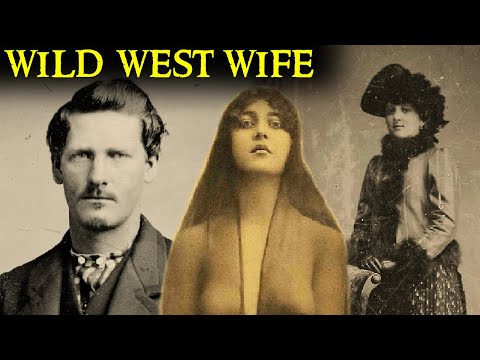
It was in Tombstone, Arizona—a silver boomtown nicknamed “The Town Too Tough to Die”—that Josephine’s path crossed with Wyatt Earp. She arrived with her lover, Johnny Behan, in 1880, just as tensions between the Earp brothers and the Clanton-McLaury gang were reaching a boiling point. When she returned from a trip to San Francisco, she found Johnny in bed with another woman—and promptly threw him out. Within weeks, she had fallen into the arms of Wyatt Earp, a man already married but whose reputation as a lawman was legendary.
Their affair was a scandal waiting to explode. Wyatt’s wife, Mattie, was in Tombstone, and Josephine’s past as a dance-hall girl made her a target for gossip. But Josephine was no stranger to scandal. She had already reinvented herself once, and she would do it again and again. When the gunfight at the O.K. Corral erupted on October 26, 1881, Josephine was there—not as a bystander, but as a woman deeply entangled in the feud that would define the West. The battle left three dead and Wyatt’s brothers wounded, and it set off a chain of revenge that would test every ounce of Josephine’s resilience.
As the violence escalated, Josephine and Wyatt’s bond deepened. She stood by him through the infamous “Earp Vendetta Ride,” a bloody campaign of retribution that cemented Wyatt’s legend. But their life together was far from a fairy tale. They drifted from town to town—Colorado, Idaho, California—chasing fortune and often finding only trouble. They married in 1892 on a yacht off the California coast, though no official record exists—a fitting mystery for a woman who kept her secrets close.
Their relationship was turbulent. Josephine often berated Wyatt for his financial failures, while he called her “Sadie,” a name she loathed because it reminded her of her past. They both had affairs, and Josephine’s inability to carry a pregnancy to term—she suffered at least two miscarriages—added to the strain. Yet they stayed together, bound by something deeper than convenience.
In the late 1890s, they chased the Klondike Gold Rush in Alaska, but like so many of their ventures, it ended in disappointment. They returned to California, eventually settling in a modest cabin in the Sonoran Desert—the closest thing to a home they had in thirty years. By the 1920s, they were in Los Angeles, where Wyatt befriended early Hollywood filmmakers and served as a consultant on Westerns. But as Wyatt’s health declined, Josephine’s gambling spiraled out of control, and the money she received from her family was often lost at the tables.
When Wyatt died in 1929, Josephine was left alone with a legacy she couldn’t control. She sued Twentieth Century Fox in 1939 over the film “Frontier Marshal,” claiming it invaded her privacy—a lawsuit she lost. Her final years were spent in Los Angeles, her life as mysterious as the woman herself. She died in 1944 at the age of 83, leaving behind a trail of questions and a legend that refuses to die.
But the story of Josephine Earp is more than just the story of Wyatt Earp’s wife. It is the story of a woman who survived on her own terms, who lied to protect herself, and who ultimately became a legend in her own right. And as we delve deeper into her life, we will uncover the truths she tried so hard to hide—and the lies that made her immortal.
But to understand why Josephine lied so compulsively, we must return to the years she fought hardest to bury. The 1870s were a crucible for a girl with no money, no protection, and no name worth defending. In her later accounts, she painted those years as a brief, unfortunate detour—a “distasteful nightmare” she simply woke from. Yet the records tell a messier story: a teenager moving between boarding houses, dance halls, and mining camps, learning early that survival often meant becoming whoever the moment required.
It was a skill she never lost. When she met Wyatt Earp in Tombstone, she was still technically Johnny Behan’s common-law wife. Wyatt, meanwhile, had Mattie by his side. Their attraction was immediate and reckless, and it unfolded in a town where everyone watched everyone else.
Behan, humiliated and furious, did not take the betrayal quietly. He was the sheriff of Cochise County, and Wyatt was a deputy U.S. marshal—two men on opposite sides of the law, now also on opposite sides of a woman. The personal and the political became impossible to separate. Every arrest, every warrant, every saloon brawl carried an undercurrent of jealousy and wounded pride.
Josephine, for her part, seemed to thrive in the tension. She was sharp-tongued, quick-witted, and utterly unwilling to play the demure frontier wife. She drank, she gambled, and she spoke her mind—traits that made her both magnetic and controversial.
What few people knew was how much of her bravado was armor. She had already survived things that would have broken most women of her era—abandonment, poverty, and the relentless judgment of a society that never let a woman forget her past. Every time she called herself “Mrs. Earp” before any ceremony had taken place, she was doing more than lying. She was building a wall between herself and the girl named Sadie Mansfield.
The wall held through the vendetta ride, through the years of wandering, through the failed mines and empty bank accounts. It held when Wyatt’s fame grew and reporters came asking questions. It held even when Josephine’s own memories began to blur the line between what had happened and what she needed to have happened.
By the time she sat down with Glenn Boyer’s sources decades later, she had been rehearsing her story for so long that even she may have believed it. The memoirs attributed to her were less a record of facts than a performance—a final, defiant act of reinvention.
And yet, buried beneath the embellishments, a real woman remained. One who loved a difficult man for thirty years, who buried two pregnancies in silence, who gambled away her dignity and then demanded it back. One who outlived her legend and died still guarding her secrets.
The truth about Josephine Earp may never be fully known. But perhaps that is the point. She understood something that Wyatt, for all his fame, never quite grasped: in the American West, the story you tell about yourself matters more than the facts. And Josephine told hers until the very end—loudly, stubbornly, and with a gambler’s nerve.
But the wall had cracks, and some of them ran deeper than she ever admitted. Consider the matter of her name—not just “Sadie,” but the dozens of variations she left scattered across the record like footprints in a dust storm. Josephine Sarah Marcus. Josephine Behan. Mrs. J. Earp. Sadie Mansfield. Josephine Earp. Each one a door she could open or slam shut depending on who was knocking.
Researchers who combed through census records, city directories, and hotel ledgers found a woman who seemed to exist in five places at once. In one San Francisco directory from the early 1880s, a “Mrs. J. Earp” appears at an address where no Earp was known to have lived. In another, she vanishes entirely for a year—a gap she never explained.
These inconsistencies frustrated historians, but they also revealed something essential about Josephine. She was not merely a liar in the ordinary sense. She was a strategist. Every false detail served a purpose: to protect her from the past, to elevate her in the present, or to secure her place in the future.
That instinct for self-preservation had been forged in the hardest years of her youth. When she left San Francisco at thirteen, she entered a world where a girl alone had two choices—find a protector or become prey. She chose protectors, one after another, until she found the one who could not be scared off.
Wyatt Earp was many things—a gambler, a lawman, a wanderer, a man who buried his own reputation under layers of myth—but he was not a quitter. When Josephine threw Johnny Behan out of their tent in Tombstone, Wyatt was there. When the bullets flew at the O.K. Corral, he stood his ground. When his brothers fell and his enemies hunted him, he rode into the desert and did not stop until the score was settled.
And when Josephine grew difficult—when she berated him, when she gambled away their money, when she called him a failure—he stayed. Not out of weakness, but out of something harder to name. Perhaps he recognized in her the same stubborn refusal to be defined by circumstance. Perhaps he simply loved her.
Their marriage, if it was a marriage, was never conventional. They lived in hotels and rented rooms, moved every few years, and kept few possessions. When they finally bought the cabin in the Sonoran Desert, it was the first property they had ever owned together—and they were already in their sixties.
It was there, in that dry, quiet place, that Josephine began to shape the story that would outlive them both. She wrote letters. She gave interviews. She cultivated relationships with anyone who might preserve Wyatt’s legacy—and, by extension, her own.
She understood that history is not written by the people who live it. It is written by the people who tell it. And she was determined to be one of the tellers.
But history, as Josephine learned, is a fickle partner. The very myths she helped create eventually eclipsed her. Wyatt became the marble lawman of dime novels and Hollywood Westerns, while she was reduced to a footnote—or worse, a rumor. When she sued Twentieth Century Fox in 1939, she wasn’t just fighting for privacy; she was fighting to be seen as something other than the woman who threw a man out of a tent and then followed a legend into the desert.
She lost, of course. The court saw no privacy in a life already so public. But the lawsuit itself was a final act of defiance—a refusal to let others write the last chapter of her story without her consent.
Josephine Earp died in 1944, alone in Los Angeles, her fortune gone, her legend intact but tangled. She had outlived Wyatt by fifteen years, and in that time she had become a kind of ghost—haunting the archives with half-truths and contradictions, daring anyone to pin her down.
What remains of her is not a clear portrait but a collage: the runaway daughter, the dance-hall girl, the common-law wife, the gambler, the litigant, the keeper of a legend she could never fully control. And perhaps that is her most honest legacy—a woman who understood that survival sometimes means becoming a story, and that stories are never as simple as the people who tell them.
So what do you think: was Josephine Earp a victim of her time, a master of reinvention, or simply a woman who loved a difficult man and paid the price for his legend? Let us know in the comments below.
Report this article
Select a reason for reporting:






