In the winter of 1914, as the world convulsed in the first months of the Great War, a decision was made that would cost tens of thousands of lives—not through enemy fire, but through the simple, brutal act of leaving coats behind. The Ottoman Empire, desperate to reclaim lost glory, entrusted its fate to a man who idolized Napoleon and believed speed could conquer mountains. But the mountains had other plans.
This is the story of the Caucasus Campaign, a theater of war so forgotten that even its victors were erased from memory. It is a tale of two commanders: one who dreamed of empire and sent 30,000 men into a blizzard without winter clothing, and another who methodically destroyed him and then vanished into history. Their collision at Sarikamish would become one of the most catastrophic military disasters of the 20th century.
Ismail Enver Pasha was 33 years old, the undisputed master of the Ottoman government, and a man who saw himself as a strategic genius. He had watched the German victory at Tannenberg with envy, convinced he could replicate it. His plan was audacious: a double envelopment to encircle the Russian Caucasus Army. But unlike Tannenberg, his flanking force would have to cross the Allahuekber Mountains—at 2,700 meters, in December, without overcoats.
“The terrain, the season, the supply situation—it could not be done,” warned General Hasan Izzet Pasha, the Ottoman commander who understood the mountains. Enver’s response was swift: he relieved him of command and replaced him with someone who would say yes.
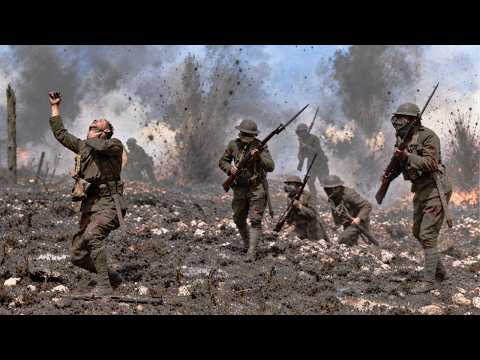
The 10th Corps marched into the mountains on December 20th. They had food for two days. The march would take longer. Temperatures plunged to -20°C, and blizzards reduced visibility to zero. Men began to fall—not from bullets, but from the cold. Hypothermia kills slowly: first the extremities freeze, then the body pulls blood inward, then confusion sets in, and finally, a paradoxical warmth just before death. Soldiers sat down to rest and never stood up again.
One Ottoman captain recorded the horror: “I understood that night that some of my men were already dying and that the ones who were still walking did not entirely know it yet.” By morning, 17 of his company were missing; six were found frozen against rocks, the others never found.
Of the 30,000 men who began the flanking march, 27,000 were dead or incapacitated before they engaged the enemy. The 9th and 11th Corps attacked frontally on December 29th, expecting the 10th to cut off the Russian retreat. But the 10th was no longer a fighting force—it was a scattered remnant in the snow.
On the other side, General Nikolai Yudenich, the Russian commander, refused to panic. He had studied the terrain for years and understood that the flanking force would arrive too weak to be decisive. He stripped his threatened sectors of reserves and built a hidden strike force. When the Ottoman frontal attack came, he let it grind against his defenses, then unleashed his reserve on the Ottoman flank.
By January 4th, 1915, the Ottoman Third Army was finished. Of 118,000 men, only 42,000 remained effective. Between 60,000 and 90,000 were dead, the majority from cold. Hafi Hakki Pasha, who had seen the truth and written it in his diary, died of typhus weeks later. Enver returned to Constantinople and went to a concert the same evening.
The disaster at Sarikamish was only the beginning. Enver, unwilling to accept failure, blamed the Armenians—a lie that would fuel the genocide to come. Meanwhile, Yudenich would go on to capture Erzurum and Trebizond, achieving the most sustained Russian victories of the war. But his triumph, too, would be erased by revolution and treaty.
This is the story of how mountains killed more men than battles, and how the ambitions of one man froze an army—and a people—in the snow.
But the story of the Caucasus Campaign does not end with Sarikamish, and it does not end with Yudenich’s victories. It continues into the spring of 1915, when the Ottoman Third Army was being rebuilt from the fragments that had survived the mountains, and when a new front was opening in the west that would drain the empire’s resources and attention away from the Caucasus entirely.
That front was Gallipoli. When the British and French fleets began their bombardment of the Dardanelles in February 1915, and when the Allied landings followed in April, the Ottoman high command faced a strategic crisis that made the Caucasus look secondary. The forces that had been earmarked for the reconstruction of the Third Army were diverted to the Dardanelles. The German advisers in Constantinople who had watched Sarikamish with growing alarm now watched the empire’s best divisions being pulled west to defend the capital itself.
Yudenich understood what this meant. He understood that the Ottoman forces facing him in the Caucasus were not being reinforced—they were being stripped. The window was open, and he intended to use it.
Through the summer and autumn of 1915, Yudenich conducted a series of limited operations designed to keep the Ottoman Third Army off balance, to push the Russian line forward where the terrain permitted, and to gather the intelligence he would need for the offensive he was already planning. He sent cavalry raids deep into Ottoman territory. He used his Armenian intelligence sources to map the fortress system at Erzurum in detail that the Ottoman defenders themselves did not possess. He stockpiled supplies at forward depots with a methodical patience that his subordinates found almost maddening.
And he waited. He waited through the autumn, through the first snows, through the winter of 1915-1916, while the Ottoman command in Constantinople convinced itself that no Russian offensive was possible in the Caucasus in winter. They had learned this lesson from Sarikamish—but they had learned it wrong. They believed the mountains made winter offensives impossible. They did not understand that the mountains only made unprepared winter offensives impossible, and that Yudenich was preparing with a thoroughness that Enver had never imagined.
On January 29th, 1916, the Russian Caucasus Army attacked Erzurum. The Ottoman commander, Mahmud Kamil Pasha, had positioned his defenses on the assumption that the terrain would do the work his depleted forces could not. The northern sector, where Yudenich struck, was considered secondary—the terrain there was too difficult, the passes too high, the snow too deep. It was precisely for those reasons that Yudenich attacked there.
The battle of Köprüköy, fought in the frozen passes north of Erzurum, was decided by men who had grown up in conditions not unlike those they were fighting in. The Siberian riflemen who led the assault climbed through waist-deep snow while Ottoman defenders fired down from prepared positions. They took casualties. They kept climbing. When they reached the Ottoman lines, the fighting was at close quarters—bayonets, entrenching tools, bare hands—between men who were all cold and exhausted and who had no warm place to go regardless of which way the fighting went.
The northern defensive line broke. The Russian advance rolled toward the outer ring of Erzurum’s forts. On February 11th, the attack on the Deve Boyun ridge—the heart of the defensive system, the position that Ottoman planners had considered impregnable—began. It fell. Fort Taft fell. Fort Cobandede fell. The outer ring collapsed.
On February 16th, 1916, Erzurum fell. Ottoman losses: 66,000 men, including 13,000 prisoners and 315 artillery pieces. Russian losses: 2,339 killed and 14,796 wounded. It was the most lopsided major fortress capture of the entire war.
The news reached Constantinople like a physical blow. The Ottoman general staff had told Enver that Erzurum was impregnable. The German advisers had concurred. The fortress had stood for centuries, modernized with German expertise, defended by terrain that was supposed to make it untakeable. And Yudenich had taken it in two weeks, in winter, with forces that by any conventional reckoning should have been insufficient.
Enver’s response was predictable. He ordered the Third Army to retake Erzurum. The Third Army was not in a condition to retake Erzurum. It never did.
The Russian advance continued. Trebizond fell on April 18th, 1916, captured in a combined land and sea operation that gave Yudenich a supply port on the Black Sea and transformed the logistics of his entire campaign. The overland supply routes from Tiflis—difficult in summer, nearly impossible in winter—were replaced by ships delivering directly to the front. The Russian Caucasus Army could now sustain operations at a scale it had never before achieved.
For the Ottoman Empire, the fall of Trebizond was a humiliation of a different order than Sarikamish. Sarikamish had been a disaster in the mountains, far from the centers of power. Trebizond was a city, a port, a symbol of Ottoman presence on the Black Sea coast. Its fall was reported throughout the empire and the reaction was one of shock that a city so apparently secure could fall so rapidly.
And still Yudenich was not finished. In July 1916, at Erzincan, he completed the destruction of the Ottoman Third Army for the second time in two years. The Ottoman commander, Vehip Pasha—a more capable officer than many of his predecessors—had been ordered to retake Trebizond. He attacked in June. The attack failed, not because Vehip was incompetent, but because Yudenich had anticipated it and had prepared the defense with the same methodical thoroughness he brought to every operation.
When the Ottoman attack stalled, Yudenich counterattacked. He drove toward Erzincan, the communication center of the Ottoman position in the region, forcing Vehip to abandon the offensive and respond to the new threat. The Russian counterattack hit the Ottoman forces in the transition between offense and defense—the ideal moment to strike an enemy. The Erzincan battle produced 34,000 Ottoman losses, half of them prisoners, against 12,000 Russian casualties.
By July 1916, the Ottoman military position in the Caucasus was not just weakened. It was structurally compromised. The army that fell back from Erzincan had lost the infrastructure that connected it to its rear areas, that brought its supplies and reinforcements, that allowed it to function as an army rather than a collection of armed men in the mountains.
And then, as Yudenich stood at the height of his achievement—having destroyed the Ottoman Third Army twice, having advanced 150 miles into enemy territory, having taken the fortresses and cities that the Ottoman command had believed impregnable—the thread that had held everything together began to fray. Not on the battlefield, but in Petrograd.
The February Revolution of 1917 reached the Caucasus front as rumor, then as orders, then as the slow dissolution of everything Yudenich had built. Soldiers’ committees sprouted in the regiments. Orders were debated rather than obeyed. The army that had taken Erzurum began to come apart from within, not from enemy fire but from the collapse of the state that had sent it there.
Yudenich was appointed commander of the entire Caucasus front in March 1917, then relieved in July for insisting on continued offensive operations when the Provisional Government wanted negotiation. He watched the Bolshevik coup from Petrograd, left for Finland in November, and eventually made his way to France.
The end, when it came, was almost absurd in its completeness. The Treaty of Brest-Litovsk, signed March 3rd, 1918, surrendered everything Yudenich had won—Erzurum, Trebizond, Erzincan, and the pre-war territories of Kars and Ardahan. Three years of campaigning, the destruction of the Ottoman Third Army twice, the most sustained Russian military achievement of the war—all of it handed back at a negotiating table by a government that had not fought for it.
Enver Pasha fled to Central Asia after the Ottoman defeat, chased the Pan-Turkic dream into the mountains of Tajikistan, and died in a cavalry charge against the Red Army in August 1922, aged forty. The man who sent 60,000 men to freeze without coats died exactly the death he would have wanted.
Yudenich died in Nice in 1933, celebrated by Russian émigrés as the only undefeated Russian general of the war. He knew that Erzurum was back in Turkish hands, that everything he had taken was back where it had been before he took it. He did not consider it a personal failure. He understood the difference between losing a campaign and having your campaign’s gains surrendered by people who had not fought it.
The mountains of northeastern Anatolia still hold the bones of the men who froze in the Allahuekber passes in December 1914. The snow still falls on the Deve Boyun ridge where the Siberian riflemen climbed. The fountain in Erzurum’s main square, where a Russian officer drank in February 1916, still runs.
What do you think history owes to the forgotten victors—the generals who won and were erased, and the men who froze and were never counted?
Report this article
Select a reason for reporting:






