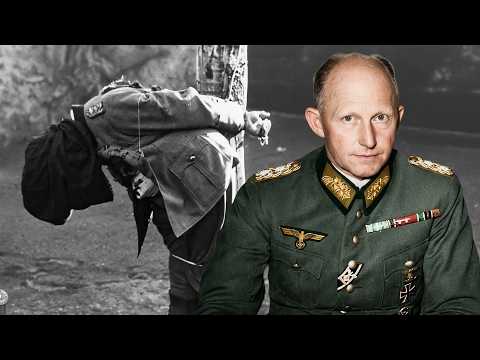
At 2:41 a.m. on May 7, 1945, in a red-brick schoolhouse in Reims, Colonel General Alfred Jodl signed the unconditional surrender of the German armed forces. Seventeen months later, the Allies hanged him at Nuremberg as a war criminal. Yet in February 1953, a Munich court looked at the same man and accepted that he had been “completely unpolitical and only a pure soldier.”
How did a German court end up trying to clear the man Nuremberg had sent to the gallows? The answer lies in a bitter clash over guilt, obedience, and the true nature of Jodl’s role in Hitler’s war.
The Nuremberg judges had already rejected Jodl’s defense in writing. He claimed he was a soldier sworn to obedience, bound to carry out orders. The tribunal dismissed that entirely. Under the charter, superior orders were no defense. “Participation in such crimes as these has never been required of any soldier,” they wrote. “He cannot now shield himself behind a mythical requirement of soldierly obedience at all costs.”
The judgment went further: “In the strict military sense, Jodl had been the actual planner of the war and responsible in large measure for the strategy and conduct of its operations.” He reported directly to Hitler on operational matters. The judges traced his hand back to before the war began. When Hitler moved against Austria in March 1938, Jodl brought the army’s existing staff plan to the conference and initialed Hitler’s order for the invasion. After the Munich Agreement later that year, he wrote that Czechoslovakia as a power was out.
The tribunal found nothing in mitigation and convicted him on all four counts: conspiracy, crimes against peace, war crimes, and crimes against humanity.
Six years later, a court in Munich would see the same defense very differently. Which of them was right comes down to one question: What had actually crossed Jodl’s desk?
Born on May 10, 1890, in Würzburg, Bavaria, Alfred Josef Baumgärtler—he later took the name Jodl—came from a family that produced more than soldiers. His uncle was the philosopher Friedrich Jodl; his younger brother Ferdinand would also become a general. In World War I, Alfred served with a field artillery regiment on the Western Front. In November 1914, he won the Iron Cross, second class, for gallantry, and was wounded in action. He served briefly in the East in 1917, returned to the West as a staff officer, and won the Iron Cross, first class, in 1918. In 1913, he had married Irma, Countess von Bullion.
Then, on August 23, 1939—nine days before Germany invaded Poland—Hitler chose him to run the operations staff of the Armed Forces High Command, the OKW. Jodl held that job from the first day of the war almost to the last. He spent most of those years at Hitler’s headquarters, much of the time at the Wolf’s Lair in East Prussia. In the summer of 1940, after the fall of France, he wrote in a memorandum that the final German victory over England was now only a question of time.
His relationship with Hitler was not always smooth. On September 7, 1942, at Hitler’s forward headquarters near Vinnytsia in Ukraine, Jodl returned from a visit to Field Marshal Wilhelm List, whose offensive in the Caucasus had stalled. At dinner, Jodl remarked that List had only followed Hitler’s own orders. According to historian Antony Beevor, Hitler shouted that it was a lie and stormed out. He then had stenographers sent from Germany to take down every word of his daily military conferences, and he considered getting rid of Jodl altogether. Within weeks, List and army chief of staff Franz Halder were gone. Jodl kept his post.
On July 20, 1944, he was in the room at the Wolf’s Lair when the bomb meant for Hitler went off. He was only slightly injured. That same year, his wife, Irma, died. For six years, the man the Munich court would later call a pure soldier worked at the center of Hitler’s war, reporting to him directly.
The case against him at Nuremberg rested on documents. In June 1941, just before the invasion of the Soviet Union, came the Commissar Order: Soviet political commissars captured by the German army were to be killed, and the decision whether they should be killed without trial was to be made by an officer. The tribunal noted that a draft existed with Jodl’s handwriting on it, suggesting the order should be presented as retaliation. Questioned at the trial about Soviet prisoners of war shot on the march, Jodl claimed the ones shot were not those that could not, but those that did not want to walk.
On October 7, 1941, Jodl signed an order stating that Hitler would not accept the surrender of Leningrad or Moscow, and that both cities were to be completely destroyed. On October 18, 1942, came the Commando Order: Allied commandos caught behind German lines were no longer to be taken but killed. At Nuremberg, Jodl testified that he had been strongly opposed to it on moral and legal grounds, but that he could not refuse to pass it on. He passed it on.
Five days after the order was issued, on October 23, 1942, seven British commandos captured in Norway after a raid on a power station were shot at the Sachsenhausen concentration camp. They were the first victims of the order. In March 1944, fifteen American soldiers captured on the Italian coast were shot under it as well. And in June 1944, his initials appeared on another High Command memorandum dealing with it. His signature was also on an order transferring Danish citizens, among them Jews, to concentration camps. In a speech on November 7, 1943, he called for action in occupied Denmark, France, and the Low Countries to be taken with remorseless vigor and resolution. And on October 28, 1944, Jodl sent a teletype ordering the evacuation of everyone in northern Norway and the burning of their houses. According to a Norwegian government document cited by the tribunal, 30,000 houses were damaged.
Those were the signatures Nuremberg weighed against the claim that he had only been a soldier.
Here’s a question for you: If you put your name to an order you believe is wrong because your superior demands it, are you still responsible for what that order does? Let me know in the comments below.
Because in the spring of 1945, Jodl’s war was about to end with two signatures of a very different kind.
The first came in April. On April 7, 1945, a month before the end, Jodl married for the second time. His new wife was Luise von Benda, born in 1905, a former secretary in the Army High Command and a close friend of his first wife. The marriage, which was childless, would last eighteen months.
The second came in May. With Hitler dead, Jodl went to the headquarters of the Western Allies at Reims in northeastern France as the representative of Hitler’s successor, Grand Admiral Karl Dönitz. According to the German Historical Museum, he tried to delay the surrender to the Red Army and negotiated with the Americans in vain. At 2:41 in the morning on May 7, 1945, in a red-brick school building that served as Allied headquarters, he signed the unconditional surrender.
General Walter Bedell Smith signed for the Western Allies, General Ivan Susloparov for the Soviet Union, and the French General François Sevez signed as a witness. According to wire reports at the time, Jodl then stood and said a few words. “With this signature,” he said, “the German people and the German armed forces were delivered into the victors’ hands, for better or worse,” and he hoped the victors would treat them generously. Nobody answered him.
Within hours, the Soviet High Command rejected the Reims document. Susloparov had not been empowered to sign, and the Soviets wanted the surrender to take place in Berlin, the seat of the government that had started the war. So the next day, May 8, the surrender was signed again in Berlin. The school building in Reims is now a museum to the surrender.
After the surrender, Jodl became a prisoner of the Allies. At Nuremberg, he sat in the dock with Göring, Ribbentrop, Keitel, and the rest of the surviving leadership. Asked how he pleaded, he answered that he was not guilty—“before God, before history, and my people.”
Luise joined his defense team. Years later, in interviews with the writer Gitta Sereny, she alleged that the prosecution had based charges on documents it refused to share with the defense. The trial did not go against him on every point. He managed to show that some of the accusations were untrue, such as the claim that he had helped Hitler take power in 1933.
Jodl also had a defender on the bench. The French judge, Henri Donnedieu de Vabres, strongly protested against his conviction. In his view, it was a miscarriage of justice to convict a professional soldier who had held no allegiance to Nazism. He was outvoted.
On October 1, 1946, Jodl was found guilty on every count and sentenced to death. The night before the executions, Hermann Göring killed himself in his cell with cyanide after his request to be shot instead of hanged had been refused. The next day, October 16, 1946, ten men were hanged at Nuremberg prison, Jodl among them, by the American hangman John Woods and his assistant Joseph Malta. Twelve days later, Time magazine reported that the hangings had been cruelly bungled. The army denied it.
Jodl’s reported last words were, “I salute you, my eternal Germany.” His body was cremated in Munich, and his ashes were scattered into a small stream that runs into the River Isar, so that no grave could ever become a place of pilgrimage.
That should have been the end of it. But in post-war Bavaria, there was one more way to judge a dead man. Under the Denazification Law, the state could confiscate the estate of someone who would have been classed as a major offender. The rule was in Article 37 of the law.
In early 1953, a case over Jodl’s estate came before the main Denazification Chamber in Munich, chaired by a lawyer from Berlin. On February 27, 1953, the chamber gave its ruling. It accepted that, on paper, Jodl fell into the categories of major offender and incriminated person. But it decided that everything he had done as a military commander lay outside the Denazification Law. It accepted evidence that he had been “completely unpolitical and only a pure soldier.”
The case was discontinued, and the costs were placed on the state treasury. Neither the prosecution nor the defense appealed. On March 2, 1953, the ruling became final. The German Historical Museum describes the result plainly: a German Denazification Court had acquitted Jodl, after his death, of all the crimes for which he had been convicted at Nuremberg, on the grounds that he had confined himself to purely operational questions.
The Americans saw it as a direct challenge to Nuremberg. The United States High Commissioner objected that the Munich ruling disregarded the factual findings of the Nuremberg judgment. On April 27, 1953, the American official Frederick Schwartz raised the case with Bavarian Minister-President Hans Ehard. A letter followed three days later: the United States could not accept a judgment that was legally wrong and that violated the occupation statute.
On May 11, 1953, a Bavarian official, Hans Knauer, annulled the Munich ruling. The case even reached the Bavarian Parliament, and on May 26 the cabinet discussed how to answer a deputy’s question about the annulment. Then came a quiet compromise. On September 3, 1953, the annulment was confirmed—but no new trial was held. After negotiations, Jodl’s estate was released to Luise, who was able to receive a pension. The ruling was gone, but the money stayed with his widow.
Luise went on defending her husband in interviews and in a book called Beyond the End. She died on January 26, 1998. On the Fraueninsel in Bavaria’s Chiemsee lake, the family grave held a cenotaph bearing Jodl’s name, rank, and dates, standing between the graves of his two wives.
In 2015 and 2016 the Munich artist Wolfram Kastner staged protests there, and on September 2, 2016, he covered the lower part of the cross in red paint. In December 2018 a Munich court ordered him to pay for the cleaning; in March 2021 the Federal Constitutional Court declined to hear his complaint. The local council wanted the grave dissolved when the family’s right ran out in January 2018, but on March 26, 2019, a court extended that right for another twenty years. The family agreed to remove Jodl’s name and dates. They are now covered by a slab that reads simply: “Family Jodl.”
Nuremberg called him the actual planner of the war. A court in Munich called him a pure soldier. Today, the stone on the island does not call him anything at all.
So when a court and a tribunal look at the same man and see opposite things, which verdict should history keep—and who gets to decide?
Report this article
Select a reason for reporting:






