The laughter started at the back of the room and rolled forward like a slow wave. That particular kind of laughter men allow themselves when they are certain — absolutely certain — they are right. General Frederick Weyand sat at the head of the operations table and let it wash over him, watching his staff officers exchange glances and shake their heads with the comfortable amusement of professionals who had just heard something professionally absurd.
On the table in front of him lay a single typed sheet. A proposal from the Australian Task Force in Nui Dat: 60 men. Four weeks of “complete operational independence.” No request for American artillery support. No airstrikes. No quick-reaction force on standby. Just 60 soldiers, their weapons, and four weeks in a jungle that had already swallowed three American division-level operations whole and spat out the bones.
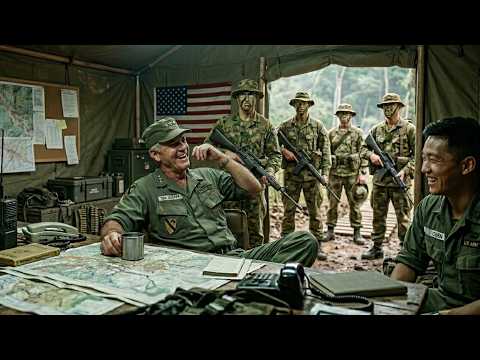
Weyand raised his hand and the laughter stopped. He had commanded at every level the United States Army offered, from rifle platoon to corps. He had learned long ago that the moment before a decision is the most important moment, because it is the last moment before you own it. He looked at the paper again. He thought about Cedar Falls. Junction City. Manhattan. Thirty thousand men, then twenty-five thousand, then ten thousand. Body counts that looked right in the reports sent to Saigon. Tonnage figures that looked impressive in the Pentagon briefings. Temporary disruption every time. And then within weeks, the enemy returned to the same ground, the same trails, the same bunkers, operating with the same confidence they had shown before the Americans arrived.
He thought about all of it, then looked at the proposal on the table and said three words. “Let them try.”
What the staff officers heard in those three words was diplomatic tolerance. But what Weyand meant was something closer to exhaustion than contempt. He did not believe 60 Australians would succeed where 60,000 Americans had achieved only temporary results. But he had run out of certainty about what success in War Zone D actually required. And uncertainty, in his experience, was at least honest.
His operations officer suggested assigning the Australians to preliminary reconnaissance while American infantry brigades prepared the main effort. Weyand nodded, the meeting moved on, and the Australian proposal was filed as a minor administrative note in a much larger document. No one in that room believed the filing would matter. They were wrong in a way that would take years to fully understand. And when that understanding came, it would not come gently.
To know why the laughter happened, you have to know what had already been tried. Operation Cedar Falls was the embodiment of everything American military doctrine prescribed. Thirty thousand troops drawn from multiple divisions. Coordinated helicopter assaults, artillery batteries firing around the clock. Arc Light strikes by B-52 bombers that turned wide swaths of jungle into cratered moonscape. The operation lasted three weeks in January 1967. By the time it ended, American commanders were writing reports describing it as a success. Estimates of 750 Viet Cong killed. Hundreds of bunkers and tunnel complexes destroyed. The elimination of major enemy infrastructure in the Iron Triangle and surrounding areas.
The reports were accurate. And within six weeks, intelligence observed enemy forces returning to the same ground, using the same trails, rebuilding what had been destroyed. The infrastructure returned. The logistics network returned. The command structure returned. Cedar Falls happened, and then essentially nothing happened, except that 72 Americans did not come home from it.
Junction City was larger. Twenty-five thousand troops, better coordination, an attempt to isolate the area of operations and prevent enemy withdrawal before the main assault. Two hundred eighty-two Americans were killed in that operation. Thousands more were wounded. The enemy took significant losses, and within two months they were back. Same areas, same supply routes, same levels of activity. They had absorbed the blow and returned to baseline, exactly as a body of water absorbs a thrown stone and closes over it.
Operation Manhattan in April was smaller and more focused. Ten thousand men with better intelligence and more precise targeting, and the results were marginally better but structurally identical. Temporary disruption, enemy reorganization, return to previous capability. The pattern was clear to anyone willing to see it clearly, which meant it was invisible to almost everyone, because seeing it clearly required admitting that the basic assumptions of American operational doctrine were not producing strategic results in this particular war.
The Viet Cong and the North Vietnamese Army were not fighting the war American doctrine was designed to win. They were fighting an infrastructure and patience war, where losing a battle meant nothing as long as the system that supported operations remained intact. American forces could seize ground and hold it temporarily. They could destroy individual positions with devastating precision. They could kill enemy soldiers at a rate that seemed mathematically unsustainable. But the enemy absorbed all of it, pulled back slightly, waited, and returned because the soldiers and the bunkers and even the individual commanders were not the target.
The system was the target. The network of supply routes and ammunition caches and communication nodes and medical facilities and training areas that made organized military activity possible in the jungle. American operations repeatedly destroyed individual nodes in that network and reported success. The network recovered, and the reports became lies without anyone having told one.
This was the legacy Major Peter Daw carried with him when he walked into that long briefing hall three days after we agreed to the Australian proposal. He was not the man the assembled American staff had expected. Short, quiet, with a methodical way of moving that suggested a man who had learned long ago that energy spent performing is energy wasted. He wore standard Australian uniform without modification, carried a map case and a notebook, and looked — as one American officer later described him in a personal letter home — like the sort of man you would not notice sitting next to you on a train.
What the American officers could not see was that Daw had spent three years in Malaya hunting communist insurgents through jungle terrain that closely matched what awaited them in War Zone D. That he had led more successful long-range patrols than any man in that room, and possibly more than all of them combined. That he had developed a fighting philosophy through accumulated operational experience rather than institutional doctrine. A philosophy of war so different from the American model that the two approaches barely shared a common vocabulary.
He thanked the Americans for the opportunity briefly and without ceremony, then explained what his 60 men intended to do. Twelve five-man patrols would enter a 40-kilometer area of operations on a single dark night, dispersed across an area twice the size of what American intelligence had designated as the enemy’s main base. Phase one was seven days of deep reconnaissance. The patrols would not seek contact. They would not call for strikes on targets of opportunity. They would move slowly through the jungle, covering perhaps two kilometers a day, spending far more time observing than moving, and they would build a complete picture of the enemy network from the bottom to the top.
Phase two was three days of preparation. The patrols would reposition to attack points, pre-position demolition charges, and establish ambush sites along the routes the enemy would predictably use when responding to the coming strikes. Phase three was four days of systematic destruction. Every designated target would be struck in a coordinated sequence designed to blind, isolate, and collapse the network as a functioning system rather than merely reducing its individual components.
The American staff’s questions came fast and confident. Each one was formulated from what the questioner already believed. How would 60 men attack multiple sites simultaneously? How would they sustain operations for two weeks without resupply? How would they avoid detection by an enemy force estimated in the thousands? Daw answered each question in the same quiet tone without visible impatience, which was itself a kind of answer.
The patrols would be self-sufficient. They carried enough and knew how to find enough. Detection avoidance worked because Australian training treated stealth as a core tactical skill rather than an afterthought. Coordination without radio worked because detailed planning made communication during execution unnecessary.
Then Daw’s operations officer, Captain Roy Harker, spread a map on the table and began explaining the patrol insertion plan, and the room went quiet with a different kind of silence than polite professional attention. Harker was a lean man from Broken Hill, accustomed to describing complex things with the plain clarity of a man describing weather. He pointed to 12 insertion points distributed across an area the Americans had treated as a single target, and explained that each patrol had its own sector, its own specific observation priorities, communication windows measured in seconds rather than minutes, and a target set for phase three selected on operational logic rather than available firepower.
The American operations officer leaned over the map and studied it, then looked at Daw and asked the question that summarized the entire staff’s assessment. “You’re planning all of this without artillery support, without airstrikes, without a quick-reaction force. How do you expect to survive, let alone succeed?”
Daw looked at him for a moment before answering. “We don’t need support. We just need to be left to work.”
The room absorbed that in silence. It was not arrogance in the American sense, not manufactured confidence from men trying to convince others of their capabilities. It was a statement of operational philosophy so foreign to American military culture that the officers could not find a category to place it in. American doctrine was built on combined arms. The integration of infantry, artillery, armor, and air power into a single coordinated system that overwhelmed enemy capability with mass and weight. The idea that soldiers would deliberately request isolation from that system, that they would treat the absence of support as an advantage rather than a vulnerability, was outside the familiar framework every man in that room had trained within for his entire career.
Daw made one final request. No American operations in the sector during the four-week window. No patrols, no airstrikes, no artillery fire, nothing that would disturb the jungle and alert the enemy that something unusual was approaching. Weyand agreed without hesitation, considering it the final rope the Australians needed to hang themselves.
The briefing ended with the formal courtesies military men exchange across national boundaries regardless of what they actually believe. Daw walked out of Long Binh knowing exactly what they thought of him. He had known before he walked in. He did not need their faith. He needed their absence.
The insertions began at 2100 on a night so dark Corporal Danny Murchison could not see the man two meters in front of him at the helicopter door. He was twenty-three, a sheep farmer’s son from outside Dubbo, four years in the SAS, and he felt that cold weight in his stomach that precedes every insertion — not quite fear, but an awareness of the gap between what was planned and what would actually happen.
Three seconds on the ground, then the helicopter was gone and his five-man patrol, callsign November 4, lay flat at the edge of the clearing, listening. Sergeant Frank Akafia moved first with a hand signal invisible to anyone but the man beside him, and November 4 dissolved into the jungle.
By the third afternoon Murchison lay two meters from a trail, watching a lone teenage soldier pass so close he could see the wear pattern on the boy’s sandal. He did not move. The soldier was not the target. The trail was the target. That discipline — intelligence over impulse — was the whole difference, and it was invisible to the Americans, who logged the silence as lost communications and kept the rescue force on standby.
At 0400 on the eleventh day, the network’s nervous system was cut before it could send a single warning. By 0600, War Zone D had stopped being an organized military force and become men in a jungle. Zero Australians killed. Three wounded, all walking.
Weyand sat with the after-action report for a long time. Sixty men had done what sixty thousand could not, because they had aimed at the system instead of the soldiers.
So here is the question the report never answered: if you had been in that briefing hall, laughing along with the staff — would you have seen it, or would you have needed the jungle to teach you?
Report this article
Select a reason for reporting:






