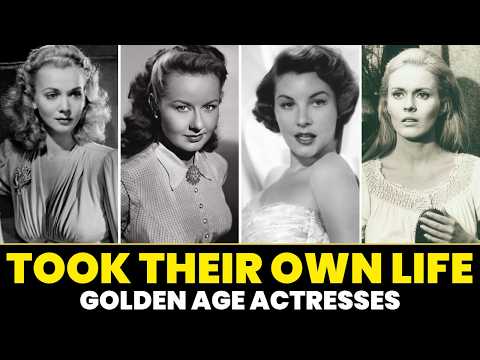
Hollywood’s Golden Age was a time of dazzling premieres, adoring fans, and stars who seemed to have it all. But behind the glittering façade, a darker reality lurked. The powerful studio system controlled every aspect of an actor’s life—from their public image to their private relationships—demanding perfection at all costs. For many actresses, the pressure was unbearable, and the lack of mental health support left them feeling utterly alone. This is the story of seventeen women who shone brightly on screen but battled devastating inner demons off it, ultimately making the tragic choice to end their own lives.
Carol Landis, the radiant star of 1 Million BC, seemed to have the world at her feet. Yet, behind her vivacious smile, she struggled with severe depression and financial instability. Her marriage to actor John Shelton ended in divorce, deepening her emotional distress. On July 5, 1948, at just 29, Carol took her own life in Los Angeles.
Barbara Bates, known for Mildred Pierce, faced a different kind of battle. Chronic pain and diabetes plagued her, making it difficult to maintain her career. The physical ailments exacerbated her depression, and on March 27, 1969, at 59, she died by suicide in Corona, California.
Bella Darvey, a French-Polish actress who lit up the screen in the early 1950s, found her personal life in turmoil. Her marriage to director Victorio De Sica was tumultuous, and financial difficulties added to her despair. On March 7, 1971, at 36, she ended her life in Paris.
Faith Bacon, a child star of the 1930s, struggled with the transition to adulthood. The pressures of maintaining her public image and finding meaningful roles left her isolated. On December 4, 1956, at just 18, she took her own life in Los Angeles.
Mary Nolan, a versatile actress of the silent and early sound eras, battled substance abuse and depression. Her career declined as the industry evolved, and financial instability followed. On April 24, 1965, at 59, she died by suicide in Palm Springs.
Lupe Velez, the fiery “Mexican Spitfire,” captivated audiences with her spirited performances. But her marriage to Johnny Weissmuller was marked by conflict, and financial problems mounted. On December 14, 1944, at 36, she took her own life in Glendale.
Ona Munson, unforgettable as Belle Watling in Gone with the Wind, faced depression and financial issues later in life. On March 29, 1955, at 64, she died by suicide in New York City.
Joan Dowling, a British-American actress, struggled with depression and the pressures of World War II on the film industry. On January 9, 1945, at 29, she ended her life in Los Angeles.
Florence Lawrence, often called the first movie star, pioneered early cinema but faced financial ruin and health issues later in life. On December 28, 1938, at 52, she died by suicide in Ottawa.
Marilyn Monroe, the ultimate Hollywood icon, battled anxiety, depression, and substance abuse. The relentless pressure of fame and media scrutiny left her feeling isolated. On August 5, 1962, her tragic death shocked the world.
Helen TwelveTrees, known for complex emotional roles, fought depression and chronic health issues, including cancer. On September 7, 1958, at 49, she took her own life in Santa Monica.
Dorothy Abbott, a actress of the 1930s and 40s, saw her career decline, leading to financial difficulties and despair. On September 7, 1980, at 64, she died by suicide in Los Angeles.
Clara Blandick, beloved as Auntie Em in The Wizard of Oz, struggled with depression and the emotional toll of aging. On March 14, 1962, at 81, she ended her life in Philadelphia.
Dorothy Hale, a silent film star, couldn’t adapt to sound films, and her career plummeted. On May 14, 1938, at 37, she took her own life in Los Angeles.
Maggie McNamara, acclaimed for Cat on a Hot Tin Roof, battled severe depression and personal losses. On July 22, 1978, at 49, she died by suicide in her Los Angeles home.
These stories are a stark reminder of the human cost of fame and the urgent need for compassion and mental health support in the entertainment industry. As we remember these women, we must ask ourselves: how many more tragedies will it take before the spotlight shines on the well-being of those who bring us magic?
But the list of names does not end there. Some stories are less remembered, whispered only in the margins of film history books—yet they carry the same weight of sorrow and silence.
Take Joyce Jameson, a familiar face in 1960s television and film, often cast as the bubbly blonde or the wisecracking sidekick. She appeared in Valley of the Dolls and Where the Boys Are, bringing warmth and humor to every scene. Yet her career, like so many others, was defined by the roles she didn’t get—the dramatic parts that never came, the leading lady status that always seemed just out of reach.
As the 1970s wore on, the phone rang less often. The industry she had given her youth to began to forget her. Friends described a woman who felt discarded, invisible, and increasingly alone.
On a quiet morning in Los Angeles, Joyce was found dead in her home. The official report cited an overdose, and though the circumstances were never fully clarified, those close to her believed the weight of rejection and lost purpose had finally become too much to bear. She was only forty-nine years old.
Her story echoes a painful truth: Hollywood has always been a town that celebrates youth and beauty, then turns its back when the spotlight moves on. For actresses of the Golden Age and beyond, that abandonment often proved fatal.
What makes these tragedies even harder to accept is how preventable many of them might have been. In an era before mental health awareness, before therapy was destigmatized, before studios offered any real support, these women had nowhere to turn. They were told to smile, to be grateful, to keep up appearances—no matter what it cost them inside.
The pattern repeats with heartbreaking consistency: a brilliant career, a personal life in shambles, a slow fade from public view, and then—silence. The same silence that once hid their pain now hides their memory.
Yet their stories deserve to be told, not as cautionary tales, but as reminders. Reminders that behind every glamorous photograph, every dazzling premiere, there is a human being who may be fighting a battle no one else can see.
As we look back on these seventeen women—their triumphs and their tragedies—we are left with an uncomfortable question: has Hollywood truly changed, or has it simply found new ways to hide the same old wounds?
The answer, perhaps, lies in the stories that never made the headlines—the ones that unfolded quietly, far from the klieg lights, in small apartments and forgotten corners of the industry.
Consider Vivian Marlowe, a contract player at RKO in the late 1930s whose name rarely appeared above the title. She was the girl in the background of the nightclub scene, the secretary who handed the boss a memo, the face you’d seen a hundred times but could never quite place. Studio records described her as “reliable” and “cooperative”—code words, her friends later said, for a woman who had learned to swallow her disappointment.
Vivian had come to Hollywood from a small town in Ohio with a suitcase full of dreams and a photograph of her mother tucked into her mirror. For a few years, the work was steady. Then the war came, the studio reorganized, and her contract was quietly dropped. No farewell party, no gold watch—just a letter thanking her for her years of service.
What happened next was never documented in any trade paper. Vivian took a job as a telephone operator, then as a clerk at a department store. She stopped attending screenings. She stopped answering letters from the friends she’d made on set. One by one, the threads that connected her to the life she’d loved simply frayed and snapped.
On a cold February morning in 1951, her landlady found her in her room, a bottle of sleeping pills on the nightstand and a note that read, in a careful, steady hand: “I am sorry to be such a bother. I only wanted to be remembered.” She was forty-three years old.
Her name does not appear in most histories of the era. There is no star on the Walk of Fame, no retrospective at the Egyptian Theatre. But her story is not unique—it is, in fact, the rule rather than the exception. For every Marilyn or Lupe whose death made front-page news, there were dozens of Vivians whose passing merited only a few lines in the back of the newspaper.
This is the part of Hollywood’s Golden Age that the documentaries rarely mention: the vast, invisible army of working actresses who gave everything to an industry that regarded them as interchangeable, disposable, and ultimately forgettable. The studio system was built on their hopes, and when those hopes were exhausted, it simply moved on.
Yet even as we reckon with this history, the present offers its own troubling echoes. The pressures that drove these women to despair—the obsession with youth, the fear of being replaced, the relentless scrutiny of appearance and behavior—have not disappeared. They have merely migrated to new platforms, new formats, new generations of performers who smile for the camera while privately wondering how long the smile will be enough.
The question is not whether Hollywood has changed. The question is whether we, the audience, are willing to see the human beings behind the images—and to demand that the industry do the same.
But perhaps the most haunting chapter is the one written not in headlines, but in the quiet margins of Tinseltown’s history. These forgotten women—the contract players, the bit-part actresses, the ones whose names never topped a marquee—carried the same dreams and suffered the same crushing disappointments as their famous counterparts. Their stories remind us that the spotlight’s warmth is not the only measure of a life’s worth.
The Golden Age’s glittering surface concealed a brutal truth: for every star who burned out, there were countless others who simply faded away, their struggles unseen and their deaths unremarked. The studio system that manufactured dreams also manufactured despair, and it did so with ruthless efficiency.
Today, as we look back with clearer eyes, we can honor these women not just by remembering their names, but by understanding the forces that broke them. Mental health support, fair treatment, and basic human compassion are not luxuries—they are necessities for any industry that asks so much of its artists.
The question that remains is simple yet profound: will we continue to romanticize the tragedy of the tortured star, or will we finally demand a Hollywood where talent can thrive without sacrificing the soul? What will it take for us to see the person behind the performance—and to care for them before it’s too late? Share your thoughts below.
Report this article
Select a reason for reporting:






