March 2nd, 1943. Marseilles, France. A coded telegram crackles through to a cramped apartment in Toulouse, 400 kilometers away. Three words that change everything: “Pat has fallen.” Albert Guérisse, the Belgian doctor known as Pat O’Leary, sits in a Gestapo interrogation room, his face already swollen from the first round of questioning. In the basement cells below, 47 more resistance workers await the same fate. The largest escape network in occupied France has just collapsed. Over 600 Allied airmen saved—all of it gone in 72 hours.
What the Gestapo doesn’t know is that the elderly woman reading that telegram in Toulouse, smoking a cigarette through her long ivory holder with a cat purring at her feet, is about to do something they believe impossible. At this exact moment, 127 Allied airmen are hiding in attics, barns, and cellars across southern France. Without the O’Leary line, they’re stranded behind enemy lines. The Nazis are closing in. Every hour that passes, the noose tightens.
Here’s what was at stake. Training a single B-17 bomber crew cost $243,700—three months and $15,000 per man in 1943. When a bomber went down over France, the Allies didn’t just lose a $238,320 aircraft. They lost 10 men who represented over $150,000 in training investment and three years of irreplaceable combat experience. In 1943, the death rate for Allied bomber crews exceeded 44%. Less than one in four crews completed their 25-mission tour. The strategic bombing campaign was bleeding the Allies dry.
The woman in Toulouse knows these numbers intimately. She also knows that by sunrise the Gestapo will have every address, every safe house, every name from Pat’s broken body. She has perhaps 48 hours before they come for her.
Marie-Louise Dissard is 61 years old. She runs a small dress shop. She has no military training, no weapons, no security team. The French police consider her mentally unbalanced. In her handbag: fake identity cards, 50,000 francs in British intelligence money, and the addresses of 18 men wanted by every German soldier in France.
What she didn’t know, what no one knew, was that this seamstress smoking nervously in her apartment would personally save more Allied lives than most infantry battalions, pioneer a network that would rescue over 700 airmen, and help establish the template for the 7,000 total aircrew who would escape occupied Europe. But first, she had to do something certifiably insane.
Let’s rewind six months to understand the crisis facing the Allies in late 1942. The strategic bombing campaign over Nazi-occupied Europe is hemorrhaging trained personnel. Every week, dozens of American and British bombers fall from the sky over France, Belgium, and the Netherlands. The crews parachute into hostile territory, wearing flight suits that scream “Allied Airman.” They speak no French. They have no idea where to hide. Within hours, most are captured.
The statistics are brutal. Of the airmen shot down over occupied France in 1942, fewer than 5% successfully evaded capture. The rest spent the war in Nazi POW camps, or worse. For the aircrews flying missions, it was a death sentence with extra steps.
The expert consensus from Allied high command was clear: We cannot afford to lose these men, but there’s nothing we can do once they go down over occupied territory. MI9, the British intelligence unit responsible for escape and evasion, tried everything. They printed silk maps hidden in playing cards. They distributed compasses concealed in uniform buttons. They sent coded messages through BBC broadcasts. None of it worked. Downed airmen still needed something intelligence officers couldn’t provide from London: people on the ground willing to risk their lives.
Enter the Pat O’Leary line. Named after Guérisse’s alias, this network stretched from Brussels to the Spanish border. Over 1,000 kilometers of occupied territory, safe houses, guides, forgers, train conductors, farmers. At its height, the O’Leary line was moving 30 to 40 Allied evaders per month through a sophisticated underground railroad. But there was a fatal flaw that British intelligence recognized but couldn’t solve: The entire network depended on one man. If Pat O’Leary fell, everything collapsed.
In London, MI9 officer Airey Neave paced his office, chain-smoking. “We’re building our entire southern escape route around a single point of failure,” he told his colleagues. “It’s brilliant, but it’s not sustainable.” And then catastrophically, the nightmare scenario happened. Not through German intelligence work, but through betrayal from within. Harold Cole, a British sergeant the MI9 officer James Langley would later call “an utter shit who betrayed his country to the highest bidder,” sold the entire O’Leary network to the Gestapo for money. In a 48-hour period starting March 2nd, 1943, the Germans rolled up the entire organization. Guérisse, the safe houses, the guides, the train conductors—all arrested.
The strategic impact was immediate. Between March and April 1943, the evasion rate for Allied airmen dropped to nearly zero. Dozens of downed pilots and bombardiers sat in French farmhouses with no way out, waiting for a network that no longer existed. Back in London, Neave received the devastating reports. The Pat O’Leary line had helped over 600 men escape to Britain. Now there was nothing. “We’re back to square one,” he wrote in his diary. “Every airman going down over France now is going straight to a POW camp.”
The problem seemed insurmountable. You couldn’t run an escape network remotely from London. You needed someone with deep local knowledge, extensive contacts, and the operational security to avoid German infiltration. Someone the Gestapo didn’t know about. Someone they would never suspect.
In Toulouse, Marie-Louise Dissard read the telegram about Pat’s arrest one more time. Then she threw it in the fireplace, picked up her ivory cigarette holder, and grabbed her shopping basket. She had 127 Allied airmen to save. And the Gestapo thought she was just an eccentric old woman who talked too much.
Marie-Louise Dissard was everything a spy was not supposed to be. Born November 6th, 1881, in Cahors, she was 61 years old in 1943—an age when most women focused on grandchildren, not guerrilla warfare. She had zero military experience, no intelligence training, no combat background. Her only qualifications were running a small dressmaking boutique on Rue de la Pomme in Toulouse and working as a secretary for the city government.
She was small, barely five feet tall, loud, opinionated. She talked constantly, chain-smoked cigarettes through a dramatic ivory holder, and carried a cat named Mémé everywhere. The French police had a file on her that concluded she was mentally unbalanced—an assessment she encouraged because it made her seem harmless.
But what the police file didn’t capture was this: Marie-Louise Dissard understood something fundamental about occupied France that military strategists in London didn’t. The insight came in July 1942, when a man named Paul Ulmann knocked on her door. Ulmann worked for the O’Leary line and was hiding English airmen shot down during bombing raids.
“Mademoiselle Dissard,” he said quietly, “I need your help.” She looked at this man asking her to commit treason against the German occupiers—punishable by torture and execution. Then she looked at her dress shop, her modest apartment, her quiet life. “How many airmen need shelter?” she asked. “Right now, six. But there will be more.”
That night, Marie-Louise Dissard made a decision that would save hundreds of lives. Not because she was brave, though she was. Not because she had skills, though she’d prove surprisingly adept. But because she had a realization that eluded both Allied intelligence and the Gestapo: Nobody suspects the elderly woman with a shopping basket.
She started small—renting a villa in Toulouse to house evaders, cooking meals for resistance members in prison, building relationships with train conductors, café owners, farmers along escape routes. By December 1942, she was running the entire Toulouse section of the O’Leary line, arranging safe houses, forging documents, escorting airmen on trains under the noses of German soldiers.
Her code name was Françoise. Her cover was perfect: an eccentric shopkeeper making her daily rounds, gossiping with neighbors, buying black-market food, visiting friends. The shopping basket she carried could contain anything—francs for bribing train conductors, fake identity papers, coded messages, clothing for airmen, food rations.
“She seemed never to sleep,” one resistance member recalled. “She survived on black coffee and cigarettes. She would appear at 3:00 a.m. to move an airman, then be at her dress shop by 9:00 a.m. as if nothing had happened.”
The moment of full realization came that March night in 1943 when the telegram arrived about Pat’s arrest. Most people would have fled, gone into hiding, saved themselves. Marie-Louise Dissard did the opposite. She grabbed her shopping basket, put on her most ridiculous hat, and walked straight toward Gestapo headquarters—to rent a new safe house in the building next door.
The crazy old lady was about to create the most audacious escape network in World War II history. Marie-Louise Dissard’s workshop was a cramped apartment at 40 Rue de la Pomme, literally in the shadow of Gestapo headquarters in Toulouse. This wasn’t bravery. It was calculated genius. “They’ll never look for me where they sleep,” she explained to her deputy, Jeanne. “I’m hiding in plain sight.”
Her crude prototype was brilliantly simple. She would become what the Germans expected and then weaponize their own assumptions against them. The system worked like this: downed airmen would be collected by local farmers and resistance contacts in the countryside. They’d send word through coded messages to Françoise in Toulouse. She would arrange train tickets, provide false documents identifying the airmen as French workers, and personally escort them on the train from northern cities to Toulouse.
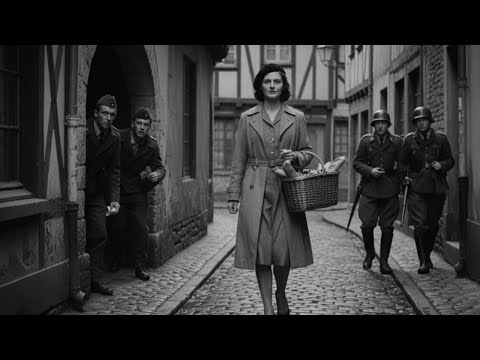
Picture this: a 61-year-old woman in an absurd feathered hat, chattering loudly in French, fussing with her shopping basket, accompanied by a ‘nephew’ who speaks no French and is clearly terrified. German soldiers see this scene daily on trains throughout occupied France. An elderly aunt escorting a shy young relative. They wave them through checkpoints without a second glance.
The first test came in April 1943, just weeks after Pat’s arrest. Eight American airmen were hiding in a farmhouse near Béziers, 120 kilometers from Toulouse. The Gestapo was conducting door-to-door searches. Time was running out. Marie-Louise made three train trips in four days. Each time, she escorted two to three ‘nephews’ past German checkpoints, chattering non-stop about fabric patterns and complaining about food rationing. The Germans were so annoyed by her constant talking, they rushed her through inspections just to make her leave.
All eight airmen reached Toulouse safely. From there she arranged their passage to Perpignan and across the Pyrenees into Spain. The reaction from other resistance members was immediate and brutal. “That is suicide. You’re going to get everyone killed,” a veteran O’Leary operative told her. “You’re too visible, too loud, too memorable.”
“Exactly,” she replied, blowing cigarette smoke through her ivory holder. “They remember the annoying old woman with the cat. They don’t remember the faces of the men I’m moving.”
Another resistance leader was more direct. “This is illegal. MI9 has strict protocols. You can’t just create your own network without authorization from London.” Marie-Louise looked at him coldly. “Then 127 Allied airmen will die while we wait for permission from bureaucrats who aren’t being hunted by the Gestapo.”
She sent one message to London through Swiss intermediaries: Pat has fallen. Françoise has risen. Send money. The British vice-consul in Switzerland, Victor Farrell, read her message and immediately understood what was happening. An elderly French shopkeeper was about to do what the entire British intelligence establishment said was impossible: rebuild a collapsed escape network from scratch, under active Gestapo surveillance, with zero military support. Farrell approved emergency funding—20,000 francs per airman delivered to Spain. The Françoise line was operational.
And the Gestapo still thought she was just a harmless old woman who talked too much.
May 1943. Airey Neave reads the Swiss report with disbelief: an unauthorized network run by a 61-year-old seamstress, moving airmen past checkpoints on shopping trips. “She’ll be caught within weeks,” he says. His colleague slides another paper across the desk. “The Swiss say she’s already moved 34 men since Pat fell.” Silence fills the room.
Then Neave makes the decision that saves hundreds of lives. He approves full funding and grants her complete operational independence. “For God’s sake, don’t tell her how to do her job. She clearly knows better than we do.”
By September 1943, over a hundred helpers answer to Françoise—conductors, farmers, nuns, even sympathetic policemen. The Gestapo files note only a “harmless, mentally unstable” dressmaker. “No action required.” That harmless woman moved 43 airmen through their checkpoints in three months.
When Toulouse is liberated in August 1944, she quietly returns to her shop. “I just did what needed doing.” France gave her the Legion of Honor; Britain the George Medal. She accepted, then vanished from the spotlight.
Marie-Louise Dissard died in 1957, never married, never famous, never captured. Over 700 airmen owed her their lives.
So here’s the question: if the Gestapo had read her file more carefully, would any of those 700 men have come home—and how many quiet heroes walk among us today, dismissed as harmless?
Report this article
Select a reason for reporting:






