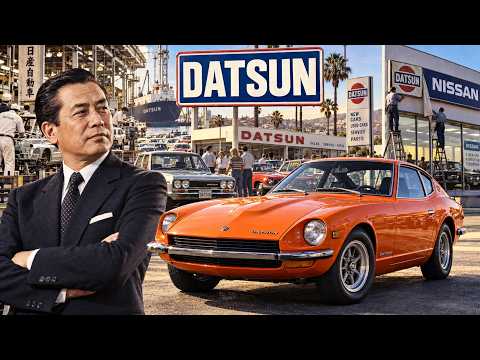
In July 1981, a Datsun sales manager in Orange, California, heard the news from Tokyo and asked the only question that mattered: “Who knows Nissan?” Almost nobody. Nissan’s own studies showed that just 13% of American consumers knew what the name stood for. Datsun, they knew. For 23 years, Datsun meant the boxy little sedan people called the poor man’s BMW. It meant the long-nose sports car that made America rethink what $3,500 and 2,600 pounds could buy. And Tokyo had just ordered it erased.
By 1986, the name was gone from every new car in America. By 2020, one surviving 240Z sold for $310,000. The name was born to escape loss. It won so much that its own maker could not afford to keep it.
In 1911, Japan had almost no cars and nobody who knew how to build one. Masujiro Hashimoto wanted to change that. He was an engineer from Okazaki in Aichi Prefecture, and he had already done something few Japanese engineers of his generation had done: he had gone to the United States and learned how engines worked there. He came home believing Japan could build its own automobiles. Most people around him thought that was a fantasy.
Hashimoto opened a small workshop in Tokyo anyway and called it Kaishinsha Motor Car Works. He had the skill. He did not have the money. So he found three backers: Kenjiro Den, a politician who would later serve as Governor-General of Taiwan; Rokuro Aoyama, a businessman; and Meitaro Takeuchi, an industrialist who, a decade later, would found the heavy equipment company that became Komatsu. Hashimoto honored all three in the simplest way he could. He took the first letter of each surname. D for Den, A for Aoyama, T for Takeuchi, and in 1914, he put those three letters on his first finished car. DAT.
The name carried a second meaning, and Hashimoto liked it. Read a certain way in Japanese, the sound echoed datto, a word for a hare bolting from danger. Fast, hard to catch. Remember those three letters because they would outlive Hashimoto’s workshop, his partners, his company, and nearly everyone who ever knew what they meant.
The early years were brutal. Kaishinsha built cars by hand in tiny numbers, and Japan had no real market to sell them into. The company survived on military contracts for trucks because the Imperial Army was one of the few buyers in the country who needed motor vehicles and could pay for them. It changed names and merged with an Osaka truckmaker in the mid-1920s, and the new firm became DAT Automobile Manufacturing. It was still small. It was still fragile.
And then the government handed it an opening. In 1930, Japan changed its rules so that people could drive small cars with engines under 500 cubic centimeters without a full license. Overnight, a market appeared for a light, cheap car that an ordinary shopkeeper or doctor could afford and operate. DAT’s engineers built one. It had a 495 cc four-cylinder engine and looked remarkably like the Austin 7, the little British economy car that had already put working families on four wheels across Europe. Historians still argue over how closely it borrowed from the Austin. What nobody argues about is that it worked.
Because it was the small offspring of the bigger DAT cars, the company gave it a playful name: Datsun, the son of DAT. It went on sale in 1931, and almost immediately someone noticed a problem. In Japanese, son can carry the sound of a word that means loss, damage, money gone and not coming back. For a struggling car company with no margin for error, that was not a joke anyone wanted printed on the hood.
The company was changing hands at the time. Control of DAT was moving to Tobata Casting, an industrial firm run by an ambitious businessman named Yoshisuke Ayukawa. And under the new ownership in 1932, the name was quietly fixed. They swapped one letter. Datsun became Dotsun. Sun for the rising sun on the Japanese flag. A word for light and beginnings instead of loss. It was a small decision made in a small company about a small car, and it took about as long as it takes to repaint a badge.
It would become one of the most valuable names in the history of the automobile. 50 years later, on another continent, a different set of executives would decide that name had to go, and the switch would take years and cost a fortune. The letter that was supposed to keep loss away would end up attached to the most expensive loss the company ever chose. But in 1932, nobody could see that far ahead.
What Ayukawa could see was bigger than one little car. He was not building a car company; he was building an empire. Yoshisuke Ayukawa understood American industry from the factory floor up. As a young engineering graduate in the early 1900s, he had gone to the United States and worked as an ordinary laborer in iron foundries, learning how Americans cast metal at scale. He came home, founded Tobata Casting in 1910, and spent the next two decades assembling one of the largest business groups in Japan. His holding company was called Nihon Sangyo, Japan Industries. On the Tokyo Stock Exchange, it was shortened to two syllables: Nissan.
In December 1933, Ayukawa formed a new automobile company to take over the Datsun operation. The following year, he renamed it Nissan Motor Company. And now the story has two names running side by side. Nissan was the corporation. Datsun was the car. That split would matter more than anyone realized.
Ayukawa did what he had seen in America. He built for volume. In 1935, Nissan opened a modern plant in Yokohama, laid out like an American assembly line and equipped with machinery bought from the United States. That spring, the first Datsun rolled off the line. Within a few years, Japan’s light car market had a clear leader. And its name was Datsun.
Then history closed in. Japan’s war in China widened through the late 1930s, and the military took control of what the country’s factories would build. Ayukawa moved much of his business group into Japanese-occupied Manchuria, where it became part of the government’s plan to industrialize the region. Passenger cars became a luxury the nation no longer allowed. Nissan’s lines turned to trucks for the army, and the company produced engines and parts for the war effort. The little Datsun disappeared. Not because it failed. Because the country stopped needing it.
By August 1945, Japan’s industrial cities lay in ruins. American occupation authorities detained Ayukawa as a suspected war criminal, and he spent roughly two years in Sugamo prison before being released without trial. He never returned to run Nissan. The company he left behind was broken, short of steel, short of money, and making whatever the occupation would allow. Small-scale car production resumed in 1947. The cars were crude, and Nissan’s engineers knew it. So, in 1952, Nissan signed a deal with Britain’s Austin to build the Austin A40 under license in Japan. Nissan would assemble a foreign design, study every part, and learn how a modern post-war car was made. It was humbling. It was also exactly how the company relearned its trade.
And there was one more lesson from the war years that shaped everything that followed. When Nissan began looking at markets overseas, many people around the world still associated the Nissan name with Japan’s wartime industry. Datsun carried no such weight. It was the name of a small, friendly car. So when Nissan began exporting, Datsun became the badge that went abroad. It was a practical choice, a cautious one. And for the next three decades, it meant that the world would fall in love with a name the company never fully considered its own.
Inside Nissan in the early 1950s, the bigger fight was not over export markets. It was over labor. In 1953, a bitter strike paralyzed the company, and the management that won that fight had a long memory for who had stood where. One of the people they remembered was a restless, car-crazy employee in the advertising department. He was not an engineer. He was not a director. He was the man who would take Datsun to America. His name was Yutaka Katayama.
Yutaka Katayama was born Yutaka Aso on September 15, 1909, in what is now Hamamatsu in Shizuoka Prefecture. He grew up loving machines that moved—cars, motorcycles, anything with an engine and a road ahead of it. But when he graduated from Keio University and joined Nissan in 1935, the company did not put him anywhere near the engineering department. It put him in administration, first in publicity and then in advertising. Katayama did not complain. He turned the advertising desk into a pulpit. He believed a car company had to make people want to drive, not just sell them a way to get from one place to another. Inside a conservative industrial firm, still run by men who thought in terms of production quotas and government contracts, that idea made him unusual. It also made him a little dangerous.
He kept pushing anyway. In 1954, Japan’s car makers had almost no way to show the public what they built. Katayama was one of the people who promoted the very first all-Japan Motor Show in Tokyo, the event that grew into today’s Tokyo Motor Show. Hundreds of thousands of people came. For a man in the advertising department, it was proof that Japanese drivers were hungry for cars.
Four years later, he went further. In 1958, Australia hosted one of the toughest endurance events in the world: the Mobilgas Trial, a punishing run around the continent over dirt roads, river crossings, and Outback tracks that broke cars and drivers alike. Nissan entered two small Datsun 210 sedans, nicknamed Fuji and Sakura. Katayama led the team. Nobody expected much from two little Japanese economy cars. Both finished, and Fuji won its class. For Nissan, it was the first big international win in the company’s history. For Katayama, it was proof of something he had been saying for years: put a small, honest, well-built car in front of the toughest test in the world, and it would earn respect that no advertisement could buy.
He should have come home a hero. Instead, he came home to a company still bruised by its labor war. In the aftermath of the 1953 strike, Nissan’s management backed a new cooperative union and expected its people to fall in line behind it. Katayama did not. He opposed the company-backed union, and in a Japanese corporation of that era, crossing management on a question of loyalty was not forgotten. Nissan found a solution that looked like an assignment. In 1960, the company sent Katayama to the United States. On paper, it was a posting to help run Nissan’s young American operation. In practice, many who knew the story saw it as exile. The American market was where careers went to disappear. Nissan was selling barely a thousand vehicles a year there through independent distributors to a country that barely knew Japanese cars existed. The men in Tokyo did not expect America to become important. They certainly did not expect the man they had sent away to come back with the most important name in the company’s history.
Katayama arrived on the West Coast at the age of 50 with no fame, no factory, and no real support from headquarters. There had been talk of setting up the American operations base in New York. Katayama insisted on Los Angeles. He had studied the regional markets, and he believed Southern California—with its freeways, its car culture, and its taste for anything new and fun—was where an unknown import had a chance. He had no showroom of his own. He had no national dealer network. He had a handful of small, underpowered cars and a brand almost nobody could pronounce correctly.
That was the turning point. Not a factory opening, not a breakthrough engine, but a company getting rid of a man it found inconvenient and sending him to the one place where his stubbornness would turn out to be priceless. Nissan exiled Katayama to save itself a headache. Over the next 17 years, he would build Datsun into a name that millions of Americans trusted. And 21 years after he landed in California, the company that had sent him away would decide that name had to die.
But first, he had to sell a car that could barely keep up on an American freeway.
In January 1958, two years before Katayama arrived, Datsun had already made its American debut. It did not go well. The cars were small, cheap, and well-built for Japanese roads, but they made less than 40 horsepower. In Southern California, that meant struggling to merge onto freeways and laboring up mountain grades. Toyota’s Toyopet Crown hit the same wall so badly that Toyota pulled it from the market.
Katayama did not fight this with slogans. He went looking for customers one at a time, driving the West himself, visiting small-town dealers and repair shops that could not get a Ford or Chevrolet franchise. He treated them as partners, listened to their complaints, and passed every one back to Tokyo. And he found a foothold in an unexpected place: the pickup truck. Farmers and contractors discovered a little Datsun truck could haul a load all day, start every morning, and burn far less gas than a full-size American pickup.
The trucks did not need to win a drag race. They just needed to work. They worked. Slowly, a reputation formed: Datsuns were small, but they did not break. Every satisfied owner became a salesman.
Meanwhile, Katayama fought a second war with his own company. Headquarters in Japan designed cars for Japan, and he kept telling them America needed more power, better heaters, and engines that could hold 70 miles an hour all day. Some requests were heard. Many were not. The managers in Tokyo had never driven across Nevada in August, and they did not see why a distant sales office in California should dictate how Nissan built cars.
In 1965, Nissan made Katayama president of its American operation. Officially, the exile was over. In practice, he was further from Tokyo than ever, running a growing business with his own ideas about what Americans wanted. He wore casual clothes, walked the floors, and talked to mechanics as equals. American employees began calling him by a simple nickname because his name was hard to say and he did not care about titles: Mr. K.
By the middle of the decade, Datsun was no longer a joke in America, but it was still a small player selling small cars to people who mostly bought them because they were cheap. Katayama wanted more. He believed Americans did not just want economy—they wanted economy with personality. He had seen it in Germany: the BMW 1600, a compact two-door with a lively overhead-cam four and independent suspension. American magazines loved it. The problem was the price. Katayama asked a simple question: what if Datsun built that car and sold it for the price of an economy car?
In Tokyo, the answer was skepticism. Nissan’s engineers were developing a new Bluebird meant to be sensible, durable, and cheap to build. Katayama wanted it to be something more. He pushed, as he always did. This time enough people in Japan listened. The new car was styled in-house by a young designer named Teruo Uchino, who gave it a flat hood, a sharp belt line, and a light upright greenhouse with thin pillars. In Japan it was the Bluebird. In America it went on sale in the fall of 1968 under its model number: the Datsun 510.
Here is what made it special. Most cheap cars of that era used a solid rear axle—a single beam connecting both rear wheels. Hit a bump with one wheel, and the other felt it too. The 510 gave each rear wheel its own independent suspension, the kind of engineering buyers expected from a BMW or a Mercedes, not a car priced for students. Up front sat a 1.6-liter overhead-cam four rated at 96 horsepower that loved to rev. The car weighed only around a ton, and front disc brakes helped it stop with confidence. And the four-door sedan started at $1,996.
Now set it beside Detroit. In April 1969, Ford launched the Maverick at $1,995—one dollar less than the Datsun. The Maverick had a 170-cubic-inch six with 105 horsepower, a little more than the Datsun’s 96. But underneath, it used a solid rear axle on leaf springs and drum brakes at all four corners. It was roomier, heavier, and built on old-fashioned American hardware. The Datsun was smaller, lighter, and engineered like a European sports sedan.
At the showroom, the Maverick won. Ford sold hundreds of thousands in the first year, far more than Datsun could even ship. But on a twisting road, there was no contest. Magazine testers praised the 510’s handling and its eager engine. Young drivers bought it because it was cheap, then discovered it was genuinely fun. Owners started taking their 510s to autocross events, bolting on better carburetors and stiffer springs, and beating cars that cost twice as much. They gave it a nickname that stuck for the next half century: the poor man’s BMW. It was a compliment and a joke at the same time, and Katayama loved it.
For the first time, an American could buy a Japanese car not because it was the cheapest thing on the lot, but because it was the best car for the money. The 510 changed what the Datsun badge meant. Before it, Datsun stood for reliable and cheap. After it, Datsun stood for reliable, cheap, and quick. Katayama made sure Datsun supported the private racers who were already proving the point on weekends. That decision would deliver the company its greatest moment on an American racetrack.
But the 510 was only the opening act. Katayama had been asking Tokyo for something far more dangerous than a fast family sedan. He wanted a sports car. A real one. Built for America, priced for Americans, and good enough to make the Corvette crowd nervous.
Nissan had tried to build a serious sports car once before, and it had walked away. In the mid-1960s, the company worked with Yamaha on a sleek grand touring prototype. Then Nissan backed out. Yamaha took the project to Toyota instead, and it became the Toyota 2000GT, the gorgeous, hand-built supercar that proved Japan could match Europe for beauty. It was also expensive and rare. In the United States it cost close to twice what Datsun would eventually charge for its own sports car, and only a few hundred were ever built.
Katayama did not want a jewel. He wanted a weapon. He had watched Americans fall in love with British sports cars—MGs, Triumphs, Austin-Healeys. They were fun and beautiful. They were also cramped, temperamental, and famous for leaking oil and losing their electrics in the rain. Above them sat the Porsche 911 and the Jaguar E-Type, superb cars most people could only dream about. There was a gap in the middle, and Katayama could see it clearly: a closed coupe with a smooth six-cylinder engine, real performance, modern suspension, and Japanese reliability, priced like a British roadster and built to be driven every day.
He told Tokyo again and again that America would buy that car. In Tokyo, many were not convinced. A sports car was a risky, low-volume product, and a Japanese company had never sold one in large numbers in America. Some believed the US market would decide whether the project lived or died. Inside Nissan’s design department, a team led by Yoshihiko Matsuo went to work. Over the years people have argued about how much credit belongs to outside designers, including the German-American stylist Albrecht Goertz, who had worked with Nissan earlier in the decade. The historical consensus credits Matsuo’s in-house team with the final shape. What nobody argues about is the result.
A long hood, a short tail, a fastback roofline sweeping down to a hatch, headlights set back in deep scoops. It looked like a car that cost twice as much. It debuted at the Tokyo Motor Show in October 1969. In Japan it carried the name Fairlady Z, chosen by Nissan’s president after the Broadway musical. Katayama reportedly hated that name for America. He believed American men would not buy a sports car called Fairlady. So the US cars were a simple alphanumeric badge taken from the engine size: 240Z.
Here is what was under that long hood: a 2.4-liter overhead-cam inline six displacing 2,393 cubic centimeters, breathing through twin carburetors, rated at 151 horsepower. A four-speed manual gearbox. Independent suspension at all four corners. Front disc brakes. A curb weight of roughly 2,300 pounds. A top speed of about 125 miles an hour. And a starting price of $3,726.
Now line it up against America’s own sports car. The 1970 Chevrolet Corvette coupe started at $5,192. For that money you got a 350-cubic-inch V8 with 300 horsepower, far more raw muscle than the Datsun. In a straight line, the Corvette was faster. Nobody disputes that. But the Datsun cost $1,366 less. It was lighter, more nimble, and easier to live with. It came as a closed coupe with a hatchback that could carry luggage, and it started every morning. The Porsche 911T, the entry-level Porsche of 1970, listed at $6,730—nearly twice the price of a 240Z for a car with less power than the Datsun six.
Suddenly, a young American with a modest income could buy a car that looked exotic, handled like a European thoroughbred, and cost about the same as a nicely equipped family sedan. The reaction was immediate. Magazine testers raved. Buyers lined up. Dealers could not get enough cars, and some began charging well over sticker. The waiting list stretched for months. In its first US model year, Datsun sold 16,215 examples of the 240Z. Chevrolet built 7,316 Corvettes for 1970, in a year cut short by an extended 1969 run. Think about that. A Japanese sports car from a brand that a decade earlier could barely survive on an American freeway sold almost as many cars as America’s own sports car icon in their first head-to-head season.
Nobody in Tokyo had predicted it. Katayama had. The 240Z did something no advertising campaign could have done. It changed what Americans believed a Japanese car could be. It was not just reliable anymore. It was desirable. People bought it because they wanted it, not because they had to settle for it. Over four model years, Nissan would build more than 148,000 of these first-generation Z cars. It became the best-selling sports car of its era and the most important car Datsun ever sold in America. The Z gave Datsun something it had never had before: glamour. And glamour is exactly what Nissan’s headquarters would later want for itself.
But first, Katayama wanted proof. Not in showrooms—on a racetrack. He wanted to beat the Europeans at the game they had invented, and he found the perfect man to do it: a former Shelby designer with a small shop in California and a big idea painted red, white, and blue.
Peter Brock was not a typical race team owner. He had trained as a car designer and worked at General Motors Styling while still a teenager. Then he joined Carroll Shelby’s operation in California, where he designed the body of the Shelby Cobra Daytona Coupe, the car that helped Shelby beat Ferrari for a world championship in 1965. He knew how to make cars fast, and he knew how to make them look like winners. In the late 1960s he started his own shop in Southern California: Brock Racing Enterprises, BRE.
His first Datsun deal came together almost by accident on a shoestring budget, with a pair of Datsun 2000 roadsters that arrived before anyone in Datsun’s head office had fully approved the arrangement. BRE won its first race with them. Word reached Katayama fast. Mr. K did not scold anyone. He called Brock and asked what else he could do. That was the beginning of a partnership. Katayama gave BRE the factory support that Tokyo would never have approved on its own, quietly arranging parts the team could not get anywhere else, including special high-performance cylinder heads from Japan. Brock gave Datsun a racing program with American flair. He painted the cars red, white, and blue—Japanese cars wearing the colors of the American flag. Brock understood exactly what that meant. Datsun was not a foreign invader. It was an American team with American drivers and American mechanics, building American dreams on Japanese engines.
The BRE 240Z won first. Its racers took back-to-back SCCA national championships in 1970 and 1971, beating Porsches and Triumphs in production class racing. But the real fight was the one Katayama cared about most. In 1971, the SCCA’s Trans-Am series created a new category for small sedans with engines up to 2.5 liters. It was called the 2.5 Challenge. The big V8 Camaros, Mustangs, and Javelins ran in their own class. The small cars got their own war, and that war had a reigning champion: Alfa Romeo.
The Italians had won the small-car Trans-Am title before with lightweight coupes built by real racing specialists. Their lead driver, Horst Kwech, was fast, aggressive, and experienced, and his Illinois-based shop had prepared his Alfa for one goal: keep the title in Italian hands. BRE entered a single Datsun 510 coupe for 1971, Number 46. Behind the wheel was John Morton, a lanky, intense Californian who had once swept floors at Shelby’s shop and had been racing Brock’s Datsun since the beginning. He was quick, smooth, and stubborn. In BRE’s hands, the little 1.6-liter base Datsun engine was coaxed far beyond its showroom output, to roughly 170 horsepower.
The 510 was not supposed to beat an Alfa Romeo. The Alfa had pedigree. It came from a company that had been winning races since before Datsun built its first car. The season was a brawl. Through the spring and summer, Morton and Kwech traded blows across the country. BRE won race after race—six of the ten that season by one account. But Alfa kept piling up points. Almost to the very end, Datsun trailed the Italians in the championship. Everything came down to the final round. Laguna Seca, near Monterey, California. 54 laps, one race, one title.
Thousands of fans came to Laguna that day. Many came to see the little red, white, and blue Datsun take on the Italians in a straight fight. Katayama was there. From the start, Morton and Kwech went at each other wheel to wheel. They swapped the lead. They pushed each other into every braking zone. The rest of the field faded behind them. Then they reached the Corkscrew—the most famous corner at Laguna Seca, a blind, plunging left-right drop that falls several stories in a few hundred feet. It rewards bravery and punishes mistakes. Kwech, trailing, made contact with the rear of Morton’s Datsun. The 510 spun. Kwech’s Alfa shot into the lead.
Morton fought back. He gathered the car, chased the Alfa down, and drove like a man who knew a championship was slipping through his hands. Brock watched from the pits and saw that two cars were going to keep colliding until one of them was destroyed. He decided they needed to be separated, and there was another problem: fuel. Under the rules, every car in the 2.5 Challenge was limited to a 15-gallon tank. 54 laps of flat-out racing was supposed to require a fuel stop. Late in the race, Morton came into the pits and BRE poured in gas. Kwech never stopped. Lap after lap, the Alfa kept running. People in the pits looked at each other. How was that possible?
The checkered flag fell. The Alfa Romeo crossed the line first. Morton crossed second. Alfa had won the race. Alfa had won the championship—or so it seemed. But the questions would not go away. How had a small Alfa run 54 hard laps on a 15-gallon tank without stopping? BRE’s team suspected the answer. So did the officials. After the race, the chief technical inspector ordered a fuel check. They drained the Alfa’s tank and measured it. The tank held 18.1 gallons—more than three gallons over the limit.
The next morning, Sunday, the announcement came over the loudspeaker. The Alfa had been disqualified for an illegal fuel tank. The official winner of the race was John Morton in the BRE Datsun. And with that win, the 1971 Trans-Am 2.5 Challenge Championship belonged to Datsun.
It was not the clean, triumphant finish anyone would have scripted. Morton had not taken the checkered flag first. He would always carry a sense of frustration over watching another man cross the line ahead of him. But the rulebook was clear, and the result stood. A small Japanese family sedan, sold in America for under $2,000, had beaten Alfa Romeo for a national championship. Katayama celebrated with the crowd, waving to the fans who had come to watch his cars.
In 1972, BRE came back with 3s, 5s, and 10s, and Morton did it again. This time there was no controversy. He dominated the season and took the title a second time. It was the high point of Datsun in America. The 510 was the poor man’s BMW that beat the Europeans. The 240Z was the affordable sports car that sold almost as well as the Corvette. Datsun dealerships were spreading across the country, and the man who had been exiled from Tokyo was now the most beloved figure in Nissan’s American business.
Then, after the 1972 season, the SCCA dropped the 2.5 class entirely. Datsun’s factory support for BRE ended. Brock closed the team. The glory had lasted exactly two years. And far from any racetrack, in a boardroom on the other side of the Pacific, a very different future was already being planned.
In October 1973, the world changed overnight. Arab oil producers cut off shipments to the United States, and within weeks American drivers were waiting in gas lines that stretched around city blocks. Prices jumped. Stations ran dry. Some states rationed fuel by the last digit on your license plate. Detroit was caught flat-footed. Its showrooms were full of big, heavy cars with big, thirsty V8s. Datsun showrooms were full of exactly what America suddenly needed: small cars, light cars, cars that sipped gasoline instead of gulping it. The little Datsun B210 would later be rated at up to 50 miles per gallon on the highway in its most economical version, a remarkable figure for a carbureted car of that era.
Americans who had never considered a Japanese car walked into Datsun dealerships because they had no other good choice. And once they were inside, many discovered what earlier owners already knew. The cars were well-built. They started every morning. They did not leak, rattle, or break the way many people expected. The numbers exploded. Datsun had passed a quarter of a million sales a year in America for the first time back in 1971. In 1973, the company sold its one-millionth vehicle in the United States. By late 1975, Datsun had nearly a thousand dealerships across 49 states, and 1975 was the year Volkswagen fell. For more than 15 years, the Beetle’s maker had ruled the American import market. In 1975, Toyota took the top spot for passenger cars, and Datsun finished barely behind Volkswagen with 263,922 cars. Count Datsun’s popular pickup trucks, and Nissan was comfortably ahead of the Germans.
Fifteen years earlier, Nissan had sold about a thousand vehicles a year in America. Now Datsun was one of the two biggest import brands in the country. The exile had won. And that was exactly the problem.
In Tokyo, Katayama’s success did not look like a triumph. It looked like a man who had grown too big. He had become a celebrity in American car culture. Dealers adored him. Racers worshipped him. Journalists wanted to interview Mr. K, not the executives in Japan. One detailed history of the company describes how visiting Nissan leaders seemed cold and disapproving when they came to California, and how they bristled when Americans praised Katayama to their faces. He had broken an unwritten rule. He had taken credit—or at least allowed others to give it to him. He had not played the humble company man who owed everything to his superiors.
Nissan’s leadership was changing, too. Takashi Ishihara, a hard-driving executive with a global vision, was rising toward the top of the company. Ishihara believed Nissan’s future lay in becoming a true worldwide automaker, with factories abroad and a single unified corporate identity. He had little patience for a semi-independent American empire built around one charismatic man.
In 1975, Tokyo made its move. A new executive, Hiroshi Majima, arrived in California as president of the American company. He was a loyal company man, closely tied to Ishihara. Katayama was moved up to chairman. On paper, it was a promotion. In practice, it cut him off from the daily decisions that ran the business. His American employees could not understand why the company seemed to be treating the man who had built everything with such coldness. Katayama understood. He had seen this coming for years.
In early 1977, he received a cable from Tokyo summoning him home. No explanation. According to that same account, when he arrived in Japan, he was told he had already retired. He was 67 years old. That April, Japan’s trade ministry gave him an award for his service to Japanese exports in America. His own company barely acknowledged him. For years afterward, when American writers asked Nissan about the people who had built the business, his name was conspicuously missing from the list.
The decision looked reasonable from Tokyo. Bring the American operation under direct control. Replace a maverick with a manager. Align the biggest export market with the global plan. But Nissan had removed the one person who understood what the name Datsun meant to Americans. The man who had built that name from nothing, one dealer and one race at a time, was no longer in the room.
Meanwhile, the Z car was changing, too. The light, nimble 240Z grew into the 260Z and then the 280Z, heavier and more comfortable with each step, partly to meet American safety and emissions rules. In 1979, the 280ZX arrived, a softer, more luxurious grand tourer. It sold extremely well, but to many enthusiasts, something of the original spirit had been traded away. The cars were drifting toward Tokyo’s vision. The people were drifting toward Tokyo’s control. And in 1980, Nissan announced it would build its first American factory in Smyrna, Tennessee. It would not be a Datsun factory. It would be a Nissan factory.
The last piece of the plan was the name itself. The decision was made in Tokyo, and the reasoning was simple. Nissan made far more than cars. It built trucks, forklifts, marine engines, industrial machinery, even lawn equipment, and all of it carried the Nissan name. Only the cars sold overseas wore a different badge. To the men running the company, that was an inefficiency. Two names meant two advertising budgets, two identities, two stories to tell. If Nissan was going to become a true global automaker with factories on several continents, the world had to know one name, and that name was going to be Nissan.
In the summer of 1981, the American subsidiary confirmed it. On Friday, July 17th, the news went out across the country. The Datsun name would be phased out of the United States. Every car and truck Nissan exported would eventually carry the Nissan badge, starting with a new compact sedan for the 1982 model year: the Nissan Stanza. It was the replacement for the old Datsun 510 line. The president of the American company, Tetsuo Arakawa, explained that the switch would better identify the company’s worldwide lineup and begin to unify its international image. It was a careful corporate statement.
The dealers did not respond carefully. Many of them had spent 20 years building their businesses around a single word. It was on their signs, their letterhead, their service bays, their radio ads, their license plate frames. Some had named their entire dealership after it. In Orange, California, the sales manager of Quality Datsun asked the question that would follow the company for years: “Who knows Nissan?” He also asked why anyone would change something that had been so successful. Other dealers said they had been told there would be no name change. Now they felt blindsided.
Not everyone was angry. In Dearborn, Michigan—Ford’s own hometown—a Datsun fleet manager shrugged and said he doubted the name would make much difference to buyers. People bought the car, not the badge. But the numbers told a harder story. Nissan’s own studies showed that only 13% of American consumers knew what the name Nissan represented. 13%. After two decades of work, after the 510 and the 240Z, after Trans-Am titles and fuel-crisis triumphs, after a million vehicles sold, almost nine out of ten Americans knew the car but not the company. Nissan was about to throw away the name they knew and ask them to learn the one they did not.
Business analysts saw the size of the job immediately. One Wall Street analyst joked that the switch would be a bonanza for the advertising industry. Signs had to come down. New signs had to go up. Brochures, manuals, parts catalogs, dealer forms—every printed piece of the business had to be redone. The American subsidiary admitted the change would be costly, and the bill for physical changes alone was expected to run into the millions. And the hardest part could not be bought with signs at all. Nissan had to teach an entire country a new word.
The company tried to soften the blow. For a period in the early 1980s, many cars wore transitional badges, and ads talked about “Datsun by Nissan.” Then the Datsun part shrank. Then it disappeared. A national advertising campaign hammered one message into American living rooms: “The name is Nissan.”
Nobody has published a precise final cost. Estimates of the full changeover—from signs to advertising across several years—vary widely, but most run into the hundreds of millions of dollars. By 1986, it was over. The last Datsun badges were gone from new cars in America. Showrooms that had once glowed with the Datsun name now displayed a different word. The 280ZX had been replaced by the Nissan 300ZX. The pickup that had first won over California farmers was now a Nissan truck. The Smyrna factory in Tennessee was building Nissans for Americans on American soil. From Tokyo’s point of view, the mission was accomplished. From the point of view of the people who had built Datsun in America, something had been lost that could never be bought back.
You can read the death of Datsun two ways. You can read it as a hard but rational business decision. Nissan was becoming a global company with factories on several continents, and one strong corporate name was simpler, clearer, and cheaper to support for the long run than two. Toyota and Honda sold under their own company names, and Nissan wanted to stand beside them as an equal. Decades later, Nissan is a household name around the world. So, in its own terms, the strategy worked.
Or you can read it as an act of corporate pride. Leaders in Tokyo took a brand that Americans had chosen, trusted, and loved—a brand built by a man the company had exiled and then forced out—and threw it away. They spent a fortune and years of goodwill teaching customers a name those customers had never asked for, and they overruled the dealers who knew those customers best.
Honest history holds both readings at once. Nissan won the name it wanted, but it paid for that victory with the one thing money could not manufacture: 25 years of American trust attached to a single word. And somewhere in that trade-off sits the cruelest irony of all. Back in 1932, the company had changed one letter to keep the sound of loss away from its little car. Son became sun. A small fix to avoid bad luck. Fifty years later, the company itself chose the loss.
Across America, the signs came down one by one. Picture a dealership on the edge of a small town in the 1960s. A little businessman who could not get a Ford or Chevy franchise takes a chance on an unknown Japanese brand. He hangs a modest sign out front. He sells a few pickups to farmers, then a few sedans to young families, then a 510 to a college kid, then a 240Z to a man who never thought he could afford a sports car. Twenty years go by. The business grows. His sign becomes a landmark. Then one day in the early 1980s, a crew arrives with a ladder. They take down the sign that says Datsun. They put up one that says Nissan. Nothing inside the building changes. The same mechanics, the same customers, the same cars, more or less. But the word that held all those years together is gone.
In July 1981, a man in Orange, California, had asked a question. Who knows Nissan? By 1986, everyone did. And almost nobody under the age of 10 had ever heard of Datsun.
The story should have ended there. A great brand sacrificed for a global plan. A familiar corporate tragedy. But 26 years later, Nissan did something nobody expected. It dug the name back up.
In March 2012, Nissan announced that Datsun was coming back. Not to America, not to Europe, not to the showrooms where Z cars had once drawn crowds. The revived Datsun would be a budget brand for fast-growing emerging markets: India, Indonesia, Russia, later South Africa. The man behind the plan was Carlos Ghosn, the chief executive who had rescued Nissan from near collapse at the turn of the century. Ghosn saw a huge opportunity. Millions of families in developing countries were about to buy their first car. They needed something cheap, simple, and reliable. Nissan did not want to put its own name on a car that cheap. So it reached back into its past for a name that already stood for affordable, dependable transportation.
In July 2013 in New Delhi, Ghosn unveiled the first car of the new Datsun. It was a small hatchback called the Go. More models followed. The ambitions were enormous. Nissan hoped the Datsun brand would help push its share of the Indian car market from 1.2% to 10% within a few years. It never came close.
The problem was in the details. To hit a rock-bottom price, Nissan stripped the cars down hard. Early versions lacked equipment many buyers in those markets were starting to expect. And then came the crash test. In 2014, the independent safety group Global NCAP crash-tested the Datsun Go. It scored zero stars. The name that had once stood for quality at a fair price now made headlines for safety. Nissan added equipment over time and improved the cars, but the damage to the brand’s image was hard to undo. And as the cars grew safer and better equipped, they also grew more expensive, which removed the one advantage they had been built to deliver.
Buyers in India and elsewhere had other choices. Established local rivals already knew how to build cheap cars that people wanted. The new Datsun was neither the cheapest car on the market nor the most desirable.
Then the man who had brought it back was gone. In November 2018, Ghosn was arrested in Japan on allegations of financial misconduct. A year later, he fled the country and ended up in Lebanon. The project most closely associated with his grand vision lost its strongest defender. In 2020, Nissan announced a sweeping restructuring plan to cut costs and focus on its core models. Datsun production ended in Indonesia and Russia that year. India was the last stand. In April 2022, Nissan confirmed that production of the Datsun redi-GO had ended at the Chennai plant. It was the last factory in the world still building cars under the Datsun name.
The revival had lasted less than a decade. Over those years, the reborn brand sold roughly 470,000 vehicles. In 2021, its final full year, it sold just over 7,000. For comparison, the original Datsun had once sold nearly that many 240Z sports cars in America in a few months.
Think about how this story bent back on itself. In the 1960s and 1970s, Datsun won America by being cheap and good at the same time. The 510 was cheap, but it handled like a BMW. The 240Z was cheap, but it looked and felt like an exotic. Price got buyers in the door. Quality and personality made them stay. The second Datsun kept only the first half of that formula. It was cheap and very little else. It had the name, but none of the spirit that made the name matter.
So Datsun died twice. The first time it was killed because it was too successful under the wrong name. The second time it was killed because the name alone could not save it. And yet the name refuses to stay buried. Because while the badges vanished from new cars, they never vanished from the old ones.
On a winter day in January 2020, an online auction for a 50-year-old Japanese sports car came down to its final minutes. It was a 1971 Datsun 240Z, built in May 1970, painted in its original racing green. It had been sold new at Munson Datsun, a small dealership in Marion, Indiana. The dealer had given it to his son as a graduation gift from dental school. The son barely drove it. For most of the next half century, the car sat carefully stored, first back at the dealership and later at the family’s home. The same mechanic who had worked on it at the dealership kept servicing it for decades. When it came up for sale on Bring a Trailer, it showed about 21,030 miles. The original window sticker came with it. Base price plus a few options: $3,957.
Collectors expected a strong result. Nobody predicted what happened next. As the clock wound down, a bidding war broke out. Five bidders were still in the fight above $170,000, which almost never happens for this model. The price kept climbing. The hammer fell at $310,000. That was roughly five times the value of a perfect concours-condition 1971 240Z in the leading collector price guide at the time. One valuation analyst called it the most original 240Z in existence.
It was not the only sign that the world had changed its mind about the Z. Five years earlier at the Amelia Island auctions in Florida, a 1970 Nissan Fairlady Z432—the rare Japanese-market version powered by the same twin-cam engine as the first Skyline GT-R—had sold for $253,000. In 2023, Bring a Trailer marked its 100,000th auction by selling its own customized 1973 240Z for $124,240 and donating the money to train young automotive technicians. A car that once cost about as much as a family sedan had become a blue-chip collectible.
And on every one of those American 240Zs, on the badges and the sill plates and the owner’s manuals, there it was. The name Nissan had spent a fortune erasing. Datsun. It never really left. Owners kept it alive in garages and at track days, in parking lots and car shows across the country. Clubs like the Z Car Club Association connected thousands of enthusiasts who restored, raced, and simply drove their Datsuns. The 510 became a cult car among young tuners. Old Datsun pickups still haul firewood on farms in California and Oregon. The BRE 510 that won those Trans-Am titles sits today in Nissan’s own heritage collection.
Even Nissan eventually made peace with its past. The Z never died. It returned as the 350Z in the early 2000s, and in 2022, Nissan launched a new Z whose long hood and fastback tail openly echo the original 240Z. Nissan advertises its heritage proudly now. It just rarely says the old name out loud.
And what about the man who started it all? For years after his forced retirement, Yutaka Katayama was quietly pushed aside by the company he had served. But the people who drove his cars never forgot him. Z clubs invited him to their gatherings. Owners lined up to meet him. In America, he was a folk hero. Slowly, Nissan came back to him, too. In 1997, the company built an American ad campaign around a friendly character named Mr. K, played by an actor. In 1998, Katayama himself was inducted into the Automotive Hall of Fame in Dearborn, Michigan, honored for the 510 and the 240Z and for helping redefine the American car market. He joined Soichiro Honda and Eiji Toyoda among the small number of Japanese industry figures in that hall. Ten years later, Japan’s own Automotive Hall of Fame finally inducted him as well.
And then he did something nobody expected. He outlived almost everyone. He was still showing up at car events in his 90s. He was there when Nissan revealed a new Z concept at the start of the 2000s, waving to cameras with the same delight he had shown at Laguna Seca. He watched the Z name return. He watched the Datsun name come back in 2013 as a budget brand for emerging markets.
On February 19, 2015, in Tokyo, Yutaka Katayama died of heart failure. He was 105 years old. He did not live to see Datsun die a second time. But he lived long enough to know that the name he built had outlasted the corporate plan that tried to bury it.
That is the real legacy of Datsun. It was born from three investors and a letter swap. It was carried to America by a man the company wanted out of sight. It won with honest cars sold at honest prices to people who were told they could not have something exciting for that kind of money. And it built a level of trust so deep that its own parent company decided it had to be destroyed.
Datsun was named to escape loss. It won so much that Nissan chose to lose it, and then spent decades discovering that some things cannot be rebuilt by order from headquarters. You can change a badge in a factory. You cannot change what it meant to the people who drove it. Datsun outlived the dealership signs, the boardroom plan, the second revival, and very nearly the man who built it. And the most valuable thing it ever earned was never written on a balance sheet. It was trust.
If you have ever owned a Datsun, driven one, or wrenched on one, drop a comment below. Tell us the model, the year, and whether your car wore the Datsun badge—or one of those transitional Datsun by Nissan badges from the early ’80s. The people who drove these machines know more about what was lost than the people who sold them. Subscribe if you want to keep building this archive with us. We have the story of another Japanese empire coming next, and you will not want to miss how it ends.
Report this article
Select a reason for reporting:






