June 28, 1942. The southern Russian steppe trembles under the roar of engines. German panzers surge eastward, not toward Moscow, but toward the oil fields of the Caucasus—a prize that could fuel the Reich’s war machine or starve the Red Army. This is Case Blue, Hitler’s audacious gamble to win the war by capturing the Soviet Union’s petroleum lifeline.
But the seeds of disaster are already sown. Fuel shortages plague the Wehrmacht, railways can’t keep pace, and the vast distances of the steppe loom like a grave. As the offensive begins, both sides know the stakes: control the oil, control the war.
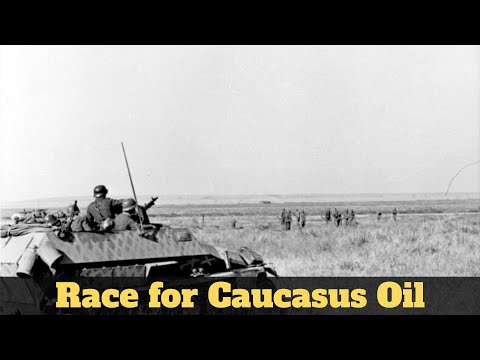
The plan is simple: destroy Soviet forces in the south, seize the Don River crossings, and drive into the Caucasus to capture Maikop and Grozny, with Baku as the ultimate prize. Army Group South, split into two powerful pincers, must execute a lightning advance across hundreds of kilometers of hostile terrain.
Yet from the first day, the logistics are a nightmare. Panzer divisions report hundreds of vehicles broken down, fuel reserves dwindling, and supply lines stretching thin. The Luftwaffe rations sorties to conserve aviation gasoline. Every drop of fuel must be hauled across converted rail lines and rickety bridges—often under fire.
On the Soviet side, Stalin’s commanders face their own crisis. The oil fields of the Caucasus are the lifeblood of the Red Army. After the disasters of 1941, they have rebuilt, but the southern front remains vulnerable. Stavka orders a layered defense, with anti-tank strong points at every river crossing and urban center. Evacuation teams prepare to dismantle and destroy refineries if necessary, denying the Germans the spoils.
As the first German spearheads reach the Don near Voronezh, Soviet reserves rush to block the crossings. The fighting is fierce, but the Germans push on, their eyes fixed on the distant oil derricks. The masking operation at Voronezh succeeds—Soviet reserves are drawn north, away from the main thrust.
But the real test awaits in the south. Army Group A, led by the First Panzer Army, races toward Rostov-on-Don, the gateway to the Caucasus. The city falls on July 23, and the German juggernaut spills into the Kuban steppe. Yet the victory is hollow: the oil fields of Maikop, when reached, are found wrecked, their wells and refineries destroyed by retreating Soviets.
The drive on Grozny falters. Mountain passes and fanatical resistance slow the advance. Fuel columns struggle forward over single-track railways and bombed bridges. The same fuel that drives the offensive becomes its Achilles’ heel. Every kilometer deeper into the Caucasus stretches the supply line further, and the autumn rains turn roads into quagmires.
Meanwhile, far to the north, a storm is gathering. The Red Army masses forces around Stalingrad, and the German flanks are held by under-equipped Romanian and Italian allies. The stage is set for a catastrophic counterstroke.
The campaign for oil, born of desperation, will end in a desperate retreat. But for now, the German war machine grinds on, its fate sealed by the very resource it sought to conquer.
The summer of 1942 wore on, and with each passing week the Caucasus campaign revealed itself as a contest not of armies but of tonnages. German staff officers at forward headquarters pored over fuel ledgers with the intensity once reserved for battle maps. Every panzer division’s daily draw was calculated against the distance to the nearest rail head, and every kilometer beyond that head was a gamble paid in petrol.
At Maikop, the technical teams worked feverishly. Engineers hauled replacement valves from Rostov, improvised distillation units from salvaged pipe, and pressed captured Soviet technicians into service. Yet the output was pitiful—a few hundred tons per month against a demand measured in thousands. The wells that had once fed the Soviet war machine now yielded barely enough to fuel the trucks that hauled the equipment to repair them.
In Berlin, the high command grew restless. Directive 45 had split the effort between Stalingrad and the Caucasus, and now neither axis received sufficient fuel to press home its advantage. Hitler’s headquarters issued a stream of orders that assumed a speed the logistics could not deliver. Fourth Panzer Army was shuffled between Army Groups A and B like a chess piece, its fuel columns burning precious petrol simply to reposition.
On the Terek line, the fighting settled into a brutal rhythm. German assault groups seized bridgeheads at Mozdok and Malgobek, only to find their armor immobilized for lack of fuel while Soviet counterattacks hammered the perimeters. Third Panzer Corps reported that on some days, fewer than half its tanks could move under their own power. The rest waited, engines cold, for tanker columns that might not arrive for days.
Soviet commanders recognized the pattern and exploited it ruthlessly. Counterattacks were timed not to the enemy’s strength but to his supply cycle—striking in the intervals when German fuel trucks were known to be in transit, when bridging equipment was committed elsewhere, when the Luftwaffe could not fly for lack of aviation gasoline.
The mountain passes became a graveyard of ambitions. At the Klukhor and Marukh passes, Jäger detachments climbed toward snowline with mules carrying ammunition and rations, while Soviet mountain troops contested every saddle. The Elbrus flag-raising on August 21 was a propaganda triumph that cost the mountain division precious fuel and manpower for no operational gain—a photograph, not a breakthrough.
By September, the autumn rains had begun. Roads that had been dust in August turned to rivers of mud. Vehicle breakdowns multiplied as engines ingested grit and suspensions shattered on frozen ruts. Supply columns that had required six hours for a run now needed twelve or eighteen, and the fuel consumed in delivery rose proportionally, shrinking the net tonnage that reached the front.
At Grozny, the refineries still stood. Soviet anti-aircraft belts thickened, smoke generators shrouded the tank farms, and fighter regiments contested every Luftwaffe raid. The city had become a fortress whose value lay less in its oil than in its refusal to fall. German reconnaissance flights returned with photographs of smoking, half-ruined facilities—and of new defensive works ringing the approaches.
The race for oil had become a siege, and the besiegers were running out of time.
October brought the first snow to the mountain passes, and with it the collapse of the last German hopes for a breakthrough to Grozny. First Panzer Army’s spearheads at Malgobek and Mozdok could advance no further—not because Soviet defenses were impenetrable, but because the fuel to move them simply did not exist. Divisional commanders reported petrol reserves measured in hours of combat, not days.
In the Kuban, Seventeenth Army’s drive on Tuapse had stalled along the ridges, its mountain divisions reduced to fighting for individual saddles while supply columns struggled through roads that autumn rains had turned to quagmires. The Black Sea coast remained in Soviet hands, and with it the lateral communications that kept the Caucasus Front supplied.
At Novorossiysk, the fighting had settled into a brutal stalemate among the cement works and harbor moles. German infantry cleared warehouse after warehouse, only to find each position reoccupied by Soviet marines who infiltrated back through the ruins at night. The port had become a symbol of the campaign’s larger failure—a prize within reach that could never quite be grasped.
Far to the north, the true decision was being made. Through October and into November, Stavka massed fresh armies on the Don flanks, opposite the Romanian Third and Fourth Armies. The Germans knew their allies were weak, but the fuel to reinforce those sectors did not exist. Every drop of petrol was committed to the Caucasus or to Stalingrad, and the flanks were left to hold with what they had.
On November 19, the storm broke. Soviet artillery and armor tore through the Romanian lines north and south of Stalingrad, and within four days the pincers had closed at Kalach. Nearly three hundred thousand Axis soldiers were trapped in the city that bore Stalin’s name.
The news reached the Caucasus headquarters like a death sentence. Army Group A’s staff officers understood immediately what it meant: their supply line through Rostov-on-Don was now threatened from the north, and every formation south of the Don risked encirclement. The same fuel that had driven them into the Caucasus now had to carry them out—or they would never leave.
Manstein’s relief attempt toward Stalingrad, Operation Winter Storm, stalled short of the pocket in mid-December. The failure sealed the fate of the Sixth Army—and reweighted every calculation in the south. Hitler’s initial orders demanded that Army Group A hold its positions, but the field commanders knew that obedience meant annihilation.
The withdrawal, when it came, was a masterpiece of improvisation under pressure. Bridge trains leapfrogged from river to river, one span in service while another was repaired and a third prepared. Rear guards held canal bends and levies until darkness, then blew their charges and slipped away. Fuel columns received absolute priority over everything—including the heavy equipment that had to be abandoned in place.
Soviet forces followed cautiously, repairing the same bridges and culverts the Germans had destroyed. The pursuit was measured not in kilometers gained but in spans restored. Each repaired crossing shortened the interval to the next German demolition and tightened the noose around the retreating columns.
By early February, the remnants of Army Group A were streaming through the Rostov corridor, their formations intact but their equipment shattered. The oil fields of Maikop and Grozny remained in Soviet hands, damaged but rebuildable, while the Reich’s fuel reserves had been spent in a gamble that had failed.
The campaign for oil was over. What remained was the reckoning—for the armies that had marched east in search of fuel, and for the coalition that had bet its future on the promise of Caucasian petroleum.
Rostov fell to the Red Army on February 14, 1943, and the gateway to the Caucasus slammed shut. The armies that had marched east in search of oil now trudged west through freezing rain, their columns skeletal, their fuel gauges empty. Behind them, the wrecked derricks of Maikop stood as silent monuments to a gamble that had consumed the Reich’s last reserves of strength.
For Germany, the reckoning was measured in tonnage that would never arrive. Romanian fields and synthetic plants could not fill the void left by the Caucasus. Through 1943 and 1944, fuel allocation tables grew leaner, panzer divisions trained on empty tanks, and the Luftwaffe watched its sortie rates collapse. The war machine that had invaded the Soviet Union in search of petroleum now sputtered on fumes.
For the Soviet Union, the victory was quieter but no less decisive. Grozny’s refineries resumed production under strengthened air defenses, and the rail lines of the North Caucasus carried fuel east to fronts from Kursk to the Black Sea. The oil that Hitler had sought to seize now powered the armies that drove him back.
Historians still debate whether Case Blue was a strategic necessity or a fatal delusion. What remains undeniable is the arithmetic: bridges, rail heads, fuel cycles, and distances measured in tons per day. The campaign proved that in modern war, geography and logistics are not merely background conditions—they are the terrain on which victory and defeat are truly decided.
The race for oil ended not with a single battle but with a ledger balanced in petrol and blood. The Caucasus remained Soviet, the Reich remained thirsty, and the war turned on a resource that neither side could ever fully control.
What do you think—was Case Blue doomed from the start by its own logistics, or could a different decision at a critical moment have changed the outcome? Share your thoughts in the comments below.
Report this article
Select a reason for reporting:






